From aero pockets made on a dining table to skinsuits worn by Mark Cavendish – How one rider took Nopinz from Devon to a world-leading 'everyday aero' brand
Cyclingnews visits Blake Pond at Nopinz HQ to find out how his brand went from very humble beginnings and a small idea to innovative clothing that helped Mark Cavendish on the way to 'Project 35'
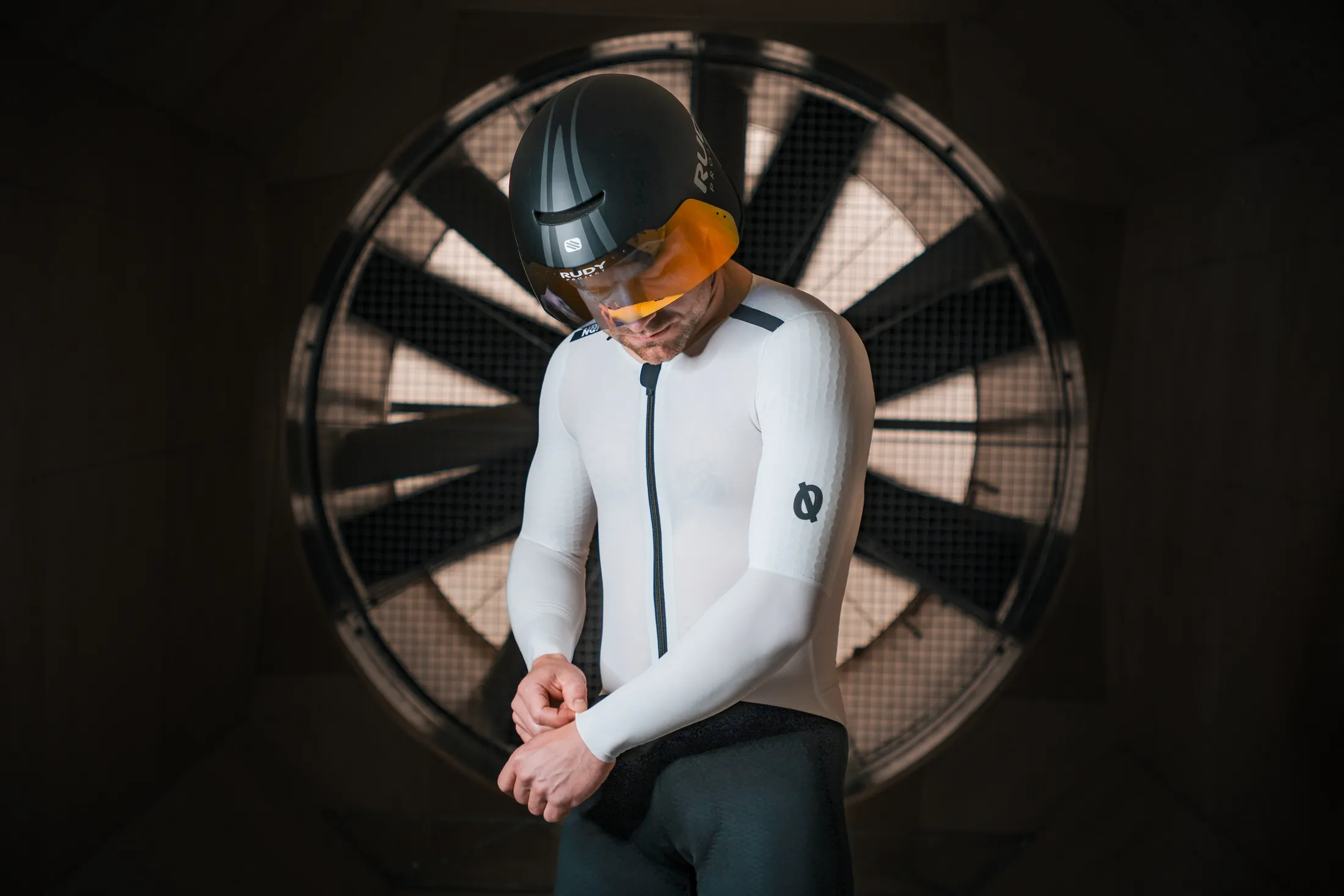
A couple of thousand years before bike racing even existed, Plato had it right: necessity is the mother of all invention.
An elite racer in the UK finishing at the sharp end of the country’s time trials on highways and byways, Blake Pond was getting into an unwanted routine. He would lovingly spend several minutes getting his race number pinned perfectly for every time trial. It was a need, driven by aesthetics, aerodynamics and fastidiousness.
When he jumped on the bike, rode off and heard a ripping noise, he knew what it meant: gigantic pinholes in a speed suit which had cost a week of his bike shop mechanic wages. The alternative fate was just as undesirable: he would pass riders with numbers flapping like parachutes. "On the drive back, I was thinking there’s got to be a better way of doing this," Pond tells Cyclingnews over coffee.
His solution: a stretchy pocket, as you’d find on a documents-enclosed envelope, stuck on a skinsuit with special adhesive. Initially, the idea went in his training kit drawer for a few years, doubting its mass appeal. But he was drawn back to it after hearing other racers airing their frustration or even yelps of pain from competitors accidentally getting stuck by a pin-wielding friend trying to give them perfectly flat race numbers.
In 2014, Nopinz was born with the SpeedPocket. At first, it was just Pond, his computer and a heat press. The next iteration involved using a seamstress to sew in this aero addition before posting the garment back.
In little more than a decade, his company has gone from the dining room table in the Devon town of Bideford in the south-west of the United Kingdom and a self-explanatory brand name to more than 50,000 orders and the WorldTour, with a range of apparel and aerodynamic accessories tailored for TT, road racing, triathlon, running and indoor cycling. The WorldTour teams and riders supported along the way include Mark Cavendish on his record-breaking 'Project 35' stage-win quest at the Tour de France.
Nopinz wouldn't be where it is today without the community’s explosion of interest in aero gains over the last decade. "How optimised everyone’s got in TT is crazy. When I was racing back in 2014, I had a lot of watts but not a lot of aero," Pond reflects. "And now it’s shifted the other way completely. I’m going the same sort of speed as I was back then, off 15 per cent less power."

An aero obsessive, Pond climbed a lamppost at the 2015 Tour de France prologue in Utrecht to take photographs of riders from above. This obsession feeds their comprehensiveness, testing products in the wind tunnel at Silverstone, prototyping in-house and doing fabric tests.
WorldTour recognition for 'everyday aero' kit
Their attention to detail pays off; Nopinz were among the winners of Cyclingnews’ own recent aero sock test with the Sonic, beating pricier rivals and bigger companies.

- ‘Who is influencing whom and why?’ – Some of cycling’s biggest backers are spinning a sponsorship spiderweb, but what are the risks?
- 'I'd say it’s costing people’s lives' – Safer technology is here, so why hasn’t the cycling industry implemented tougher helmet testing yet?
- 'Hot burning knife blades on our wheels' – The controversial story of disc brake adoption in the peloton, 10 years on
"We always test and market the averages. If we test at 40, 45 and 50 [km/h] and nought to seven degrees of yaw, we’ll average it out across the speeds we’re aiming that product at," he says, implying that they do not cherry-pick certain data for marketing. Alongside the weighted model designed to better reflect real-world riding conditions that he mentions, theirs is a competitive price point: their popular Sonic socks cost £24.99.
Pond has tried to keep their pricing reasonable, though he is aware of the perverse "reassuringly expensive" philosophy that can pervade in the sport. More expensive does not necessarily mean better. "We need to make the margin in the suit and obviously get profit out of it, but it comes to a stage where you’re making it up, really. Sometimes that does happen with other brands – I can’t understand why the suits are so pricey when we can do it [for cheaper] and do all the R&D," he says.
For the founder, Nopinz suits are for the person who can’t spend £20,000 in a wind tunnel. "Maybe we’re doing it more cost-effectively. There’s a ceiling price: we want to be that reliable sort of partner: you know you’re getting a really good product and it’s not stupidly expensive. That’s how I see it really: NoPinz – everyday aero."
As the framed and signed jerseys around their HQ in the Devon town of Barnstaple attest, the WorldTour wanted a piece of their watt savers too. Starting with support for LottoJumbo-NL in 2015, riders from the likes of FDJ, Israel-Premier Tech and AG2R have all benefited. Alex Dowsett bought his own skinsuits from the company and wore one to win a 2020 Giro d’Italia stage.
The company became an official TT partner to WorldTour team Intermarché the next season, giving it visible "additional credibility" after years of secretly supplying ingredients to the bunch, without recognition or under an NDA.
Pond says Nopinz was offered a full clothing partnership with the Belgian squad but couldn't accommodate the approximate £500,000 outlay, nor the quantity of kit. "That sort of commitment would be crushing," he says.

Still, teams or riders came calling with projects – and you might be surprised at how disorganised and last-minute pro cycling can be. One of the company’s latest nights on the job involved working with takeaway boxes after Israel-Premier Tech realised several days before the Tour de France start that they had sent the wrong designs for their special edition skinsuits. One of their coaching team drove from the south of France to Devon, got a few hours’ kip in Pond’s campervan while Nopinz put on a production run of 50 suits, turning it around in 24 hours in time for him to drive to the Grand Départ.
Cutting-edge materials and UCI pushback
There is a knick-knack sign in Pond’s home which says 'One bike ride away from a good mood'. He was inspired to get in the saddle by hearing tales of the sport: his grandfather, Lew Pond, was a rival of British track sprint icon Reg Harris and was selected for the 1948 Olympics in tandem racing.
After starting in triathlons, he moved to the family’s legacy sport and quickly noticed his bike leg was his strongest. Becoming an elite-licensed racer, he finished seventh in the British national TT championships, although being knocked off by a car led to a back injury which stopped competition between 2014 and 2024. Now back pinning on numbers using his own SpeedPocket – and winning time trials galore in the UK’s south-west – being in the racing environment helps him to understand his customer base and generate ideas.
Pond regards himself as a "fake CEO" and more a hands-on, jack of all trades, doing everything from business direction, budgeting, R&D, product design and social media to fixing machines, using his old bike mechanic nous. Reinvestment in his company has often been preferable to status symbols: when he had the money to consider buying himself a Porsche, a new laser cutter for Nopinz took priority.
Investing in the cutting-edge was worthwhile for their latest skinsuit, the Hypersonic Mk2, building on their original, double-layered (base layer and skinsuit) aero iteration. "We dared to be a bit different with it," he says.
Top speed-suits use a lot of the similar striped fabric on the sleeves, which he dubs 'Super Stripe'. Pond and Nopinz collectively spent four years looking for an aero, textured fabric that would be faster.

A year and a half ago, he found his Eureka material from a company on Italy’s Lake Como and christened it Speedcell. It wasn’t cheap, coming in at roughly £45 a metre at orders of 250 metres minimum, but worth every penny. From a rudimentary aero test, switching from the former material to the new one, the basic prototype showed measurable gains, and they made improvements to the fit. It looks different – sci-fi, even – it feels different, and their testing proved that it saved watts.
An ongoing challenge for Pond is keeping up with UCI regulations. In 2022, the sport’s governing body banned the SpeedPocket at mass events after a consultation with a working group of manufacturers. It was a bitter pill to swallow. "Brands started to cotton on to it and were doing their own versions, but the trouble was, you could hardly see the numbers," he says.
Economic challenges, sustainability, and 'Project 35'
Governing body caprices are just one blast in the face for a business that has faced "one headwind after another" in the last five years.
The vast majority of the cycling industry can relate.
He estimates raw fabric costs have risen "15 to 20" per cent, likely due to the increasing cost of oil and the raw materials used. War has a knock-on effect, with the Russia-Ukraine conflict causing a spike in prices.
Shipping costs have also risen considerably, and Brexit added complications. While Pond produces in the UK, fabrics are bought from European nations or ones outside the continent, bringing pressures associated with import and export.
"Because the industry has been so negative and there’s been so much discounting, you can’t pass it on or win it back," he adds.
From Nopinz’s side, wage inflation and increased National Insurance contributions have added approximately £90,000 to their wage bill across a team of 15, which has been streamlined in recent years.
It all means the customer feels the pinch. A European client will have to pay VAT and additional tariffs as well as possible fuel charges and surcharges from delivery operators, even though Nopinz do customs duties and taxes paid now (i.e. settled by the sender) to try to mitigate nasty surprises. With all the added costs, a would-be buyer might easily abandon their shopping basket and drop off. "That’s been quite hard to navigate," Pond says.
It has become harder to manufacture in the UK and make a profit. Nopinz has been flat in terms of growth in recent years, but making a profit, which he perceives to be rare. "We’d obviously love to see Nopinz go back on that growth trajectory, but we don’t want to do it at the expense of being a sustainable business," he says.
In a crowded market of apparel makers at similar price points, Pond expects they will focus more on the high-end side of the sport and the pinnacle. "I feel that’s where we can differentiate ourselves as a brand," he says.
"We want to have products that people go ‘I’m racing, this is super important, I’ve trained really hard, and I want to make sure I invest in the kit.’ We want them to think Nopinz when it comes to cycling products."
While its size might make them feel the hit more from, say, Donald Trump’s latest economic whims, it can also make them more nimble. Its custom cycling club platform has no minimum order or spend, a case of buying whatever whenever, Amazon-style.

"Being small is good. We’ve got the Speedcell now, and we’re already looking for the next thing – we’ve acknowledged we’ve done that, now someone else is going to do that, and the only way we can stay one step in front is being able to rapidly prototype and produce something," Pond says.
"In a company with a lot more management and structure, it might take two years for a product to be conceived and actually find its way to market. Whereas for us, it can be 10 days if we have to, like something to do with Cavendish."
Ah yes, collaborating with the greatest sprinter in the sport. As office dogs Rodney and Cassandra pad in and out of the HQ boardroom to the whirr of air compressors, Pond locates a pair of surprisingly small white shoes with a blue Nike tick which belonged to the sprinter extraordinaire.
Yes, Nopinz was part of 'Project 35'. Nopinz brand ambassador Alex Dowsett, a fellow aero geek, went to the wind tunnel with Cavendish in the middle of 2024 and called Pond, wanting to fine-tune every possible aero gain in his pursuit of the record.
Turning round prototypes and testing them at Silverstone rapidly, Nopinz worked up toe overshoes ('Hypersonic Tovershoes') and eye-catching textured, shoelace covers. "We tried to simulate the texture of the laces, while also tidying up the aero around the Boa [dial]," he says.
There was also what would become the Hypersonic Mk2 socks, initially called P35, with V-shaped aero chevrons. However, Pond was mindful that, due to UCI equipment rules, anything used for competition has to be on the market. "I said ‘put them on [the website] for £1,000 so nobody buys them’ – and somebody did," he says.
Nopinz also contributed a road race suit for lead-out man Michael Mørkøv and Cavendish. Optimised for hotter conditions using graphene, according to Pond, the Manxman rode it for the sweltering first day across Italy, where he was nearly eliminated in the time cut.
"Unfortunately for us, just not on the stage he won," Pond adds. "But it was super cool to be involved and asked at the eleventh hour, and have someone of Mark’s level and standing. He did ride most of that Tour in our stuff."
Whether it is for road racing’s greatest fast man or the rider looking to win the town sign sprint on the club ride, Pond is constantly thinking about how to get ahead of the competition with his 'everyday aero' apparel. So, what is the future of high-performance clothing in racing?
He imagines fabrics that adjust their own textures to different speeds in the real world. "There are already fabrics that can control how they react electronically, so you can imagine that with a speed suit or something where the texture changes as they go from 30km/h to 50km/h. Optimising itself as you’re riding."
He likens them to people in Tron-style suits, a bit like when Nike did Back to the Future auto-closing shoes. Good luck getting that one past the UCI.

Formerly the editor of Rouleur magazine, Andy McGrath is a freelance journalist and the author of God Is Dead: The Rise and Fall of Frank Vandenbroucke, Cycling’s Great Wasted Talent and Tadej Pogačar: Unstoppable.
You must confirm your public display name before commenting
Please logout and then login again, you will then be prompted to enter your display name.
