Wind tunnel tested: Who makes the fastest deep aero wide gravel wheels?
Enve, Zipp, Black Inc, Roval, Hunt, Cadex and more all go head-to-head in the latest CN Labs showdown

Cast your minds back a decade and you'll be met with a world in which gravel bikes were barely out of diapers/nappies (delete as appropriate).
Gravel racing was nothing more than a flannel-coated subsection of cyclo-cross with a side order of IPA, and the concept of 'optimisation' was derided by all involved, for it was "against the 'spirit of gravel'".
Returning to the present time, the only spirit is the ghost of that former sport, which has been killed off in favour of aero tubes, deep wheels, wide tyres, skinsuits and maximised carb intakes.
Money talks, so as prize money has grown, competition has become more intense, average speeds have rocketed, and the sport's laissez-faire approach has all but been replaced with a performance engineering mindset.
Nothing evidences modern gravel racing as clearly as the cohort of aero gravel wheels that have launched in the past few years.
It's well known that wider tyres roll more smoothly over rough terrain, but chunky tyres are naturally less aerodynamic; largely by dint of simply being bigger. So designers face the paradox of making gravel wheels that can house as wide a tyre as possible, while also trying to make them as aerodynamic as possible. Oh, and don't make them too heavy either! I don't envy their task.
The result is wheels like Zipp's 303 XPLR SW, Enve's G SES 6.7 and Black Inc's Sixty Four Gravel. All are as deep as their roadgoing counterparts, but designed to house what are essentially - and often literally - mountain bike tyres.
But which of those – and the others listed below – is winning the technical arms race? To find out, we headed to our second home: the wind tunnel.

Wheelsets tested
We tested eight of the most race-focussed wheelsets we could get our hands on, all of which centre around wide internal rim beds, optimisation for wider tyres, and deep profiles.
The list, and accompanying gallery, is as follows:


View Original

View Original

View Original

View Original

View Original

View Original

View Original

View Original

- Black Inc Sixty Four Gravel
- Cadex Max GXR
- Enve G SES Pro 6.7
- Gulo Composites GGA 44
- Hunt 5AM Gravel
- Roval Terra Aero CLX
- Scribe Gravel Ultra Berd
- Zipp 303 XPLR SW
Protocols and standardisations
As with our previous aero testing, we used the renowned cycling wind tunnel at Silverstone Sports Engineering Hub. Alongside aerodynamic drag calculations, we also weighed each wheelset, and measured the tyre widths to complement the aero data.
For the aero testing, every wheelset was mounted to the exact same gravel bike: the new, slightly wild-looking Factor Elara. We selected the Elara for two reasons: Firstly, the simple one is that we were already taking the bike with us on the day to test its own aero credentials. You can see how it did in our Factor Elara wind tunnel results write-up. Secondly, it made sense as it is the most unashamedly high-performance aero gravel race bike to launch this year. If any bike was a fitting mule for these hyper aero wheels, it was this. And no, Factor didn't pay me to say any of that.

To keep our data as precise as possible, we opted for a bike-only configuration rather than using a live rider. The variance in human body movement during a test sweep introduces a margin of error larger than the wattage differences expected between top-tier wheelsets. Removing the rider from the equation allows us to confidently attribute any performance deltas strictly to the wheels themselves.
To quantify our error margin on the day, which was also spent testing road and gravel bikes against our baseline Trek Emonda, we ran said baseline through a series of repeated runs, some at the start of the day, then more at the end.
In this case, the confidence margin we found was a CdA of 0.0004, or 0.2 watts at 35km/h.
To explain this with an example: If two tests of an identical setup measure differently, and said delta is 0.2 watts, then our confidence in the accuracy of any of the other tests cannot be any better than +/- 0.2 watts. And thus, if one wheelset measures at 99.8 watts, and another is 100.2 watts, they are statistically equal.
Testing was conducted at a wind speed of 35km/h, with the tunnel’s powered rollers spinning the wheels at the same speed. The crankset was fixed in a horizontal position with the driveside arm forward for all tests, with a small velcro strap holding the non-driveside crank arm in place on the nearby chainstay.
Every wheelset was fitted with the exact same pair of Vittoria Terreno Dry 55mm (2.2in) tyres, and we were careful to maintain the same front and rear orientation when swapping from wheelset to wheelset, to eliminate differences in manufacturing tolerances between individual tyres.
Brake rotors were removed and a SRAM Red cassette were transferred between wheelsets too, to avoid any potential unwanted interference on the results there.
All other things were kept identical, including the gear the bike was put into, the bottles on the bike, and even the pressure in the tyres (which was set to the recommendation provided by the SRAM Tyre Pressure calculator, which fluctuated slightly based on the internal width of the wheel).
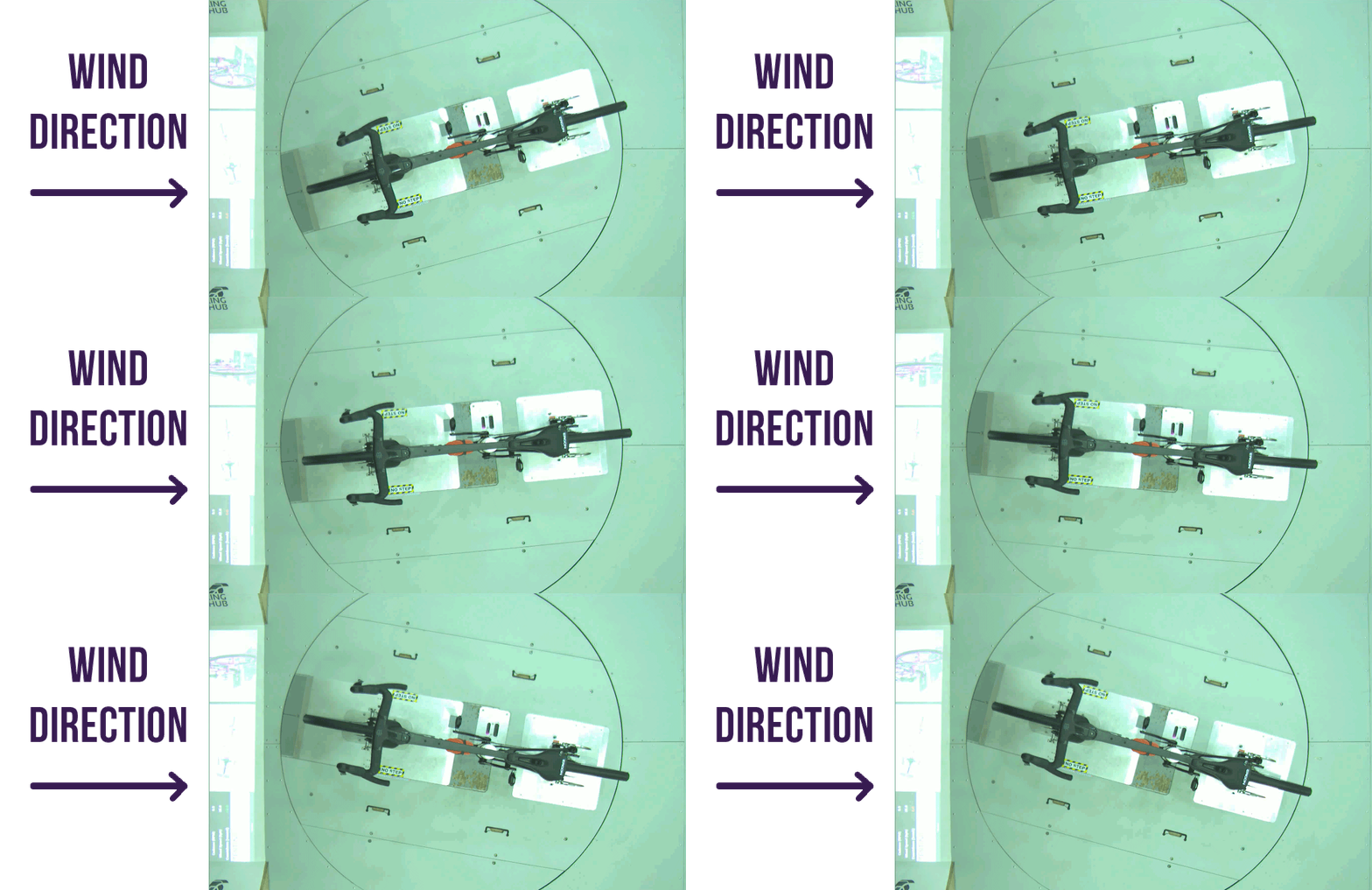
Yaw sweeps and data capture
We tested each wheelset across seven distinct yaw angles: -15°, -10°, -5°, 0°, +5°, +10°, and +15°. For an idea of what that looks like, check out my High School Art Project above, aka the GIF of a bike transitioning between each yaw point.
Data was measured using 15-second static captures at each yaw point, and the sweep was always done in the same direction (negative to positive yaw) to maintain maximum repeatability.
Caveats
There are a few caveats to throw into the mix before we get into the results.
Firstly, Black Inc. is owned by Factor, and so there's a possibility they were advantaged by our decision to test using the Factor Elara bike, as the two may have been designed in conjunction with each another. There's no knowing to what extent, if at all, this affected the results, and it is an issue we would have run into had we used a Crux (with Rovals) or a Revolt (with Cadex wheels).
Secondly, by testing without a rider on the bike, we aren't giving an accurate real-world representation of how the wheels will be challenged in their actual use. Both Specialized and Giant, for example, design and validate their with a pedalling-leg mannequin, and that when the turbulent air of a rider's legs is introduced, it's likely that their comparative performances will improve. The performance of the Tarmac SL8 in our road bike wind tunnel testing adds weight to this claim; without a rider it's mid-table, but with a rider aboard, it climbs to a much higher place in our rankings.
Thirdly, aero data should only be a small part of your buying decision when it comes to choosing the right wheels for you. Weight, price, build quality, customer service and many other factors are important too.
Results
To get the results below, for each bike I averaged out the datapoints from each of the seven yaw angles.
In calculating those averages, I applied weightings in line with the 2018 research paper by Nathan Barry - A New Method for Analysing the Effect of Environmental Wind on Real World Aerodynamic Performance in Cycling - which weights each yaw angles to better reflect how often you'll experience it in real-world riding scenarios.
That average is then used to calculate the power required to overcome the aerodynamic drag.
Given we're measuring a bike without a rider, the actual wattages shown will be lower than you'll be used to seeing on your head unit, but remember it's the differences between each wheelset that we're interested in here, not the absolute values.
Ahead of publishing this writeup, I shared the data with each brand and gave them the opportunity to comment on the results. I will stitch in their comments below as naturally as I can.
Getting straight into the results, the fastest wheels on test were the Black Inc. Sixty Four Gravel, which come in at $2,399.00 / £2,199.00. They boast a 30mm internal width, a 40.25mm external width, a hooked bead, and as the name suggests, a 64mm deep rim profile.

This is followed closely by the Enve G SES Pro 6.7, which boasts the widest internal diameter here at 35mm. They use a hookless bead, like the Zipp and Hunt wheels below, and claim an external width of 42.6mm. The rear wheel is the deepest on test at 67mm, although the front is a smidge shallower at 60mm. At $3,100.00 / £3,500.00 for a pair, they're among the spendiest here too.
In third place is a product that's yet to be released from British brand Hunt, but which we were given exclusive early access to test, and I've been given explicit pre-embargo permission to tell the Cyclingnews subscribers about. They're called the Hunt 5AM Gravel, or 5AMG for short. They are a 'reverse mullet' wheelset, with a 54mm front wheel and 49mm rear. They offer a 27mm internal width, with a hookless bead, and the front wheel boasts a chunky 45mm external width to help the airflow off the front tyre. I don't yet have prices on these.

Hunt's aero expert, Paddy Brown, who kindly loaned both their own wheels and the Zipp wheels to us for the test, said "we’re incredibly proud of how the 5AMG Ti_UD performed in this test. To come out near the top aerodynamically while also being one of the lightest wheelsets tested is a strong validation of the development work that has gone into this platform. The very wide front rim profile delivers real aerodynamic efficiency, while the Aero Mullet concept continues to prove its value beyond the road and into gravel."
Speaking of aero mullets, interestingly, Hunt and Roval – the Terra Aero CLX – landed the exact same result. They were separated by just one one-thousandth of a watt, but given our error margin is two-tenths, they're all but equal.

The Terra Aero CLX also offers a 27mm internal width with this reverse mullet concept, but Specialized introduces a 'chopped aero' design which squares off the trailing edge of the front rim, claiming equal aero performance to a deeper wheel, but with much less weight. The external width is also much smaller, at 38.5mm (38.4mm for the rear). Priced at $3,398.00 / £2,998.00, these are up there with the Enve and Cadex on price.
Below this comes Zipp, still only 1.9 watts behind the Black Inc wheels, with the the 303 XPLR SW – the wheelset that I think it's safe to say kicked off this whole aero wide gravel wheel game – with their 54mm depth, 32mm internal rim width (hookless), and 40mm external width. At $2,200.00 / £1,600.00, their price is relatively good in this company, and given they're a couple of years old now, it's not too difficult to find them on offer either.

Next up comes Cadex, with the Max GXR, which aren't quite as deep as the above counterparts, but still peddle the aero and wide marketing speak, despite a comparatively narrow 25mm internal width and 35mm external width. Their weight is impressive, as we'll get to below, but their $4,000.00 / £3,500.00 price tag is the spiciest here.
Bringing up the rear are a couple of wheels that have a different purpose. Their marketing isn't centred on being aero, but vibration absorbent.

First up, the Scribe Gravel Ultras are laced with Berd's polymer spokes, which are essentially string but possess an insane strength to weight ratio, while remaining flexy enough to swallow some of the bumps you feel on the road. Their 30mm internal width is among the widest even here, but the use of a hooked bead will perhaps swing the odds in their favour among some buyers. At $1,999.00 / £1,449.00, they're also the most affordable on test.
And finally, the Gulo GGA 44 also offers a hooked 30mm internal rim, but rather than using third-party Berd spokes, they come with a proprietary carbon spoke designed by Gulo itself. At $2,345.00 (approx £1,750.00, based on a currency conversion, but they're not sold in the UK), they're reasonably priced in this company, but neither their wind tunnel result nor their weight (seen below) will win them any custom.

Weight
Looking at the comparative weights of each wheelset, there's a fairly clear inversion of the results above. The more aero a wheelset is, the heavier it tends to be. Zipp and Gulo are slight outliers here, with their aero deficits not being made up on the scales.
Elsewhere, choosing between Roval and Hunt remains a difficult task, and Cadex shines as the potential hillclimber's wheelset.
Width
Despite our Terreno Dry tyres being labeled as 55mm, on all of the wheels here, they blew up to less than 55mm when measured on our calipers.
A slight admission to this section is that we didn't remember to measure all of them (no conspiracy here, just a busy day and things sometimes get missed). I almost didn't include it as a result, but I decided to just share what we had, so those we did get are listed below. The widest was the Enve wheel, at 54.9mm, whereas the narrowest was 51.0mm, courtesy of the Cadex wheels. Naturally, there's a bit of correlation between the rim width and the tyre width.
Conclusions and takeaways
My first takeaway here is that there are definitely aero savings to be had in gravel, as we found in our gravel bike aero test, even with chunky 55mm rubber. That big tyre isn't ruining all the aerodynamic intentions of the wheels, and there's a strong correlation between wheel depth and aero performance. It's always reassuring to know these brands know what they're doing!
I'm aware not all of us will be riding at average speeds of 35km/h (I know I won't be at my current fitness), but for the points in races that matter, such as chasing back onto a group after a crash (ask me how I know), or bridging up to a breakaway where speeds are likely above your all-day average, there are aero savings to be taken advantage of.
But weight is still important. The way Specialized marketed the Crux 5 was notable – and logical to my mind. It said that aero is important, but given rolling resistance matters significantly more in gravel than it does on the road, and that rolling resistance scales with mass, weight should factor more heavily in a consumer's buying decisions for gravel than it does on the road.
Also… I don't know about your local gravel races but all of the ones I've done have been really damn hilly!

As a result, although the big hitters from Black Inc and Enve sit at the top of the table as the most aero on test, don't discount the Roval and Hunt wheels. They sit in a nice sweetspot that trades a watt of aero drag for around 350g of mass. How that equates to speed depends on the course you're riding, and your power output (because more power = more speed = a higher relative importance of aerodynamics).
One of the biggest takeaways for me, though, is that the gap between the aero wheels and the two 'comfort' focussed wheels is only around five watts. If you're racing flat gravel time trials, go all-in on aero, but if your usual gravel routes or race courses are bumpier, slower, and/or you'll spend your time riding in the relative shelter of a group, the lack of a big aero deficit in this dataset could actually sway you away from the Enve or Black Inc wheels in favour of the bump-smoothing comfort of Gulo or Scribe.
The one datapoint we don't have, however, is rolling resistance. Would a Berd spoke actually save more than five watts over rough ground or not? Or would the wider measured width of the tyre on the Enve wheels offset this? These are all things a wind tunnel won't tell you.
Still, I hope the data the wind tunnel can tell you – i.e., all that's written above – is useful. Thanks as ever for reading.

Read more from Cyclingnews Labs
- Wind tunnel tested: The Enve Melee v2 ditches versatility in pursuit of race-day speed, but has it worked?
- Fastest frame, fastest wheels, and a potential 22-watt upgrade: The Factor Elara wind tunnel tested
- What are the fastest UCI-legal road wheels? Wind tunnel testing the big-name brands and Chinese contenders

Josh is Associate Editor of Cyclingnews – leading our content on the best bikes, kit and the latest breaking tech stories from the pro peloton. He has been with us since the summer of 2019 and throughout that time he's covered everything from buyer's guides and deals to the latest tech news and reviews.
On the bike, Josh has been riding and racing for over 15 years. He started out racing cross country in his teens back when 26-inch wheels and triple chainsets were still mainstream, but he found favour in road racing in his early 20s, racing at a local and national level for Somerset-based Team Tor 2000. These days he rides indoors for convenience and fitness, and outdoors for fun on road, gravel, 'cross and cross-country bikes, the latter usually with his two dogs in tow.
You must confirm your public display name before commenting
Please logout and then login again, you will then be prompted to enter your display name.
