Wind tunnel tested: The Enve Melee v2 ditches versatility in pursuit of race-day speed, but has it worked?
Less tyre clearance, aero bar tape and a sub 6.8kg claimed weight as Enve chases 'benchmark-setting' aero performance

When was the last time a new bike launched with less tyre clearance than its predecessor? That's one of today's headlines with the launch of the new Enve Melee.
Previously a race bike for the masses, with a focus on versatility, clearance for 35mm rubber and a reasonably relaxed geometry, the updated Melee v2 is a complete shift in mindset for the American brand, one that signals a clear intent to sponsor a WorldTour team.
Enve says it focused on improving "the two things that matter most in modern road racing – weight and aerodynamics."
So it's not all in on aero at the expense of other things like weight, and you'd still call it an aero all-rounder, but it's definitely spent more than a token few minutes in the wind tunnel during its development.
In fact, the shape of the tubes put me in mind of the last two Specialized Tarmacs, with deep sections up front for aero, and skinny tubes out back for weight.
That shrunken maximum tyre clearance is now 33 mm, so still in line with many of its go-faster competitors, and Enve's claim that a 56cm SRAM Red model will hit 6.8kg seems legit, since our test bike was exactly that model and size in the Ultralight Black colourway, and weighed just 6.73kg.
But what about Enve's other claims of 'benchmark-setting aerodynamics'? Well, this is Cyclingnews, so you can bet we've had it in the wind tunnel, so let's find out.

The protocol
To make the comparisons as fair and accurate as possible, we followed the same protocols used in all of our other road bike wind tunnel tests.
These are best explained in our aero bike shootout in 2025, for those who want to understand it in full. Here, though, I'll outline the topline points.
We test every bike in three ways:
- Bike only:
Firstly, we test the bike on its own, with its stock wheelset. We swap the front tyre so that every bike is tested with the same tyre, and we ensure bikes are set up in the same position, with the same saddle, no pedals, and the same two bottles.
This lets us compare each bike against the others with maximum accuracy, offering a really good comparison of how the bike interacts with the airflow before we introduce the movement of pedalling legs.

- With a rider:
Since no bike is ever ridden without a cyclist, we then put a cyclist (me) onto the bike.
This lets us see how aero the bike is under a more realistic set of conditions, with the movement of the pedalling legs and the interaction therein, as well as with the airflow moving past the handlebars and onto the rider's body.
This is more realistic, but less accurate. The error margin was 3.7 watts on the day of testing the Melee, which is greater than the difference between some bikes, so we always ensure to test in both ways to help our readers make fair comparisons.
- Bike only, control wheels
We then fit a 'control' wheelset to the bike and re-test it without a rider. This lets us compare the aero credentials of the frame, fork, cockpit and so on, rather than letting the results be skewed by the wheels that come with each of the bikes.
Some aerodynamic frames are sold with really 'slow' wheels, which many riders might then choose to upgrade. Whereas some slow frames are sold with 'fast' wheels. Understanding this helps our readers make better buying decisions, especially when coupled with our separate wind tunnel road bike wheel tests.
As a bonus, this test also allows us to understand how each bike's stock wheelset compares to the others by comparing their respective differences to the control wheelset.
Each of the above three tests is made up of seven different sub-tests, whereby we measure at seven different wind angles, technically known as 'Yaw Angles'. These are -15°, -10°, -5°, 0°, 5°, 10° and 15°. See my wonderfully curated gif below if you're confused.
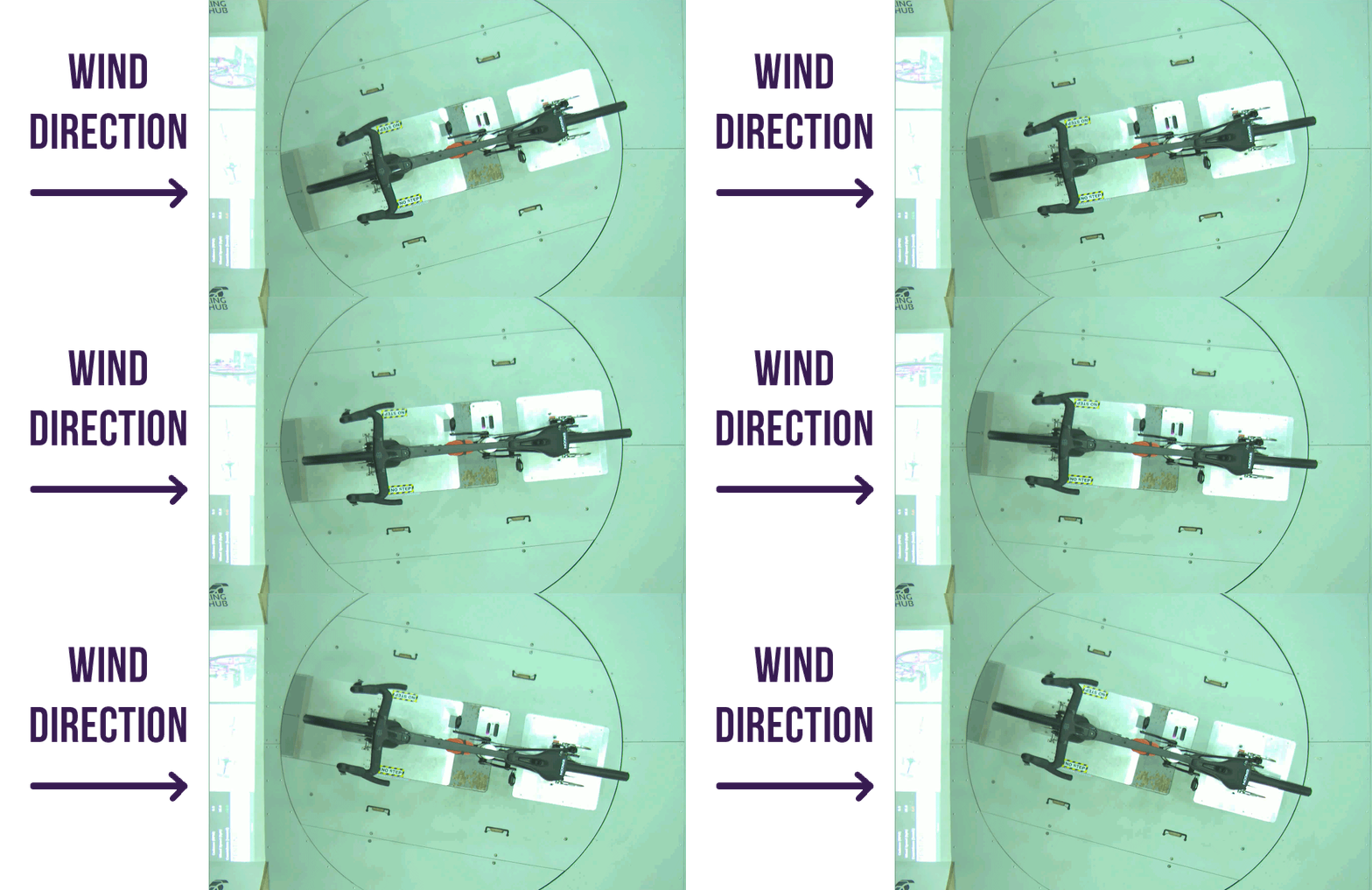
For every test, the wind is blown at 40km/h (a smidge shy of 25mph). We measure for 10 seconds for the bike-only tests, and 30 seconds for the rider-on-bike tests.
We normalise everything else as closely to the real-world application of each bike as possible, within sensible reason. That means the fit of each bike is set up the same, with the same front tyre, and we always put the bike in the same gear.
We also ensure that all bikes are tested with two bottle cages, and we use the same Elite Vico cages with Elite Fly bottles. However, if a bike comes with aero cages and/or aero bottles, we use them.
My reason for this is that if you buy a bike that comes with aero cages, you're unlikely to remove them in favour of less aero cages. We have done a separate test comparing standard round bottles and traditional cages versus aero bottles to understand the differences.
So if you are planning to swap to round bottles, that piece should help you understand how much there is to be gained or lost.
And most importantly, every time we go to the wind tunnel, we start and end the day by testing an old Trek Emonda ALR – my old winter training bike – as a 'baseline' to compare against. This bike remains completely unchanged between tests, and thus lets us make fair comparisons between the new bikes tested on different days, even if the ambient conditions change.
The results
Bike only
It's a pretty impressive start for Enve, with the 2026 Melee tracking pretty close to the fastest bike we've ever tested, the Factor One.
By the way the line is almost 'seagull'-shaped, rather than V-shaped, we can see how the bike utilises the sail effect to harness the wind as it comes from wider angles, rather than simply adding drag.
Once we've processed that raw data and then compared it to the drag of the baseline bike, we can see that the new Melee is 36.56 watts more aerodynamically efficient. That puts it in the ballpark of some dedicated aero bikes and ahead of a lot of its aero-all-rounder competition.
Given the Melee tipped our scales at 6.73kg (with no pedals, two empty cages), that's pretty impressive. However, when you add a rider into the mix, things get even more impressive.
With rider
This is a really impressive-looking performance for Enve. The way the graph tracks closely to the Factor One but then dips when it gets to the wider yaw angles of +/ -15°, shows a bike that is really able to harness the wind, even with a rider on the bike.
However, It's important to remember that we are comparing against the Trek Emonda on each given day of testing, and as we can see in the graph above, the testing conditions in 2026 were slightly faster than in 2025. This could be due to the air pressure or the temperature on each testing day, or simply due to fluctuations in my weight.
So even though the Enve's raw CdA figures are slightly lower than the Factor's, when we compare against the baseline bike on the respective testing days, the Factor still comes out marginally better, as we will see below.
A genuinely impressive performance here for Enve, coming in at 25.91W better than our baseline Trek Emonda. That's just 1.66 watts slower than the Cervélo S5, which edged ahead of the Factor to become the fastest of all time, after we apply the appropriate weightings and average out the seven yaw angles.
With our error margin taken into account, the Melee can even lay claim to victory, but given it weighs around a kilogram lighter than the two dedicated aero machines ahead of it, Enve will be calling this a win even without that technicality.
Control wheels
Given our 'control' wheels are a pair of Enve SES 4.5s, and the 2026 Melee comes with a pair of the newer Enve wheels (which haven't yet been released, but have been all over our TV screens all summer underneath Tadej Pogačar), it's no surprise to see the bike get slower when we swapped them over.
I've left the result of the newer stock wheel in the graph to make for easier comparisons, but the biggest takeaway is that they are both faster across all wind angles, and that they start to sail between 10 and 15°.
Comparing all of the bikes we've tested with the control wheel against the baseline bike, the top of the table is a who's who of dedicated aero machines, transitioning down to the aero-all-rounders.
The Factor One still wins out, followed closely by the Incolor SSR (a new bike to the list, which we'll be doing a deeper dive into in a few weeks).
The 2026 Melee sits mid-table, which might seem like an average result, but for a sub-6.8 kg bike to hold its own against some dedicated aero bikes like the Cube Litening Aero and Felt Nexar is a strong showing. And it's nigh-on seven watts better than its predecessor, just from the frame, fork and cockpit (remember, this is with the same wheelset).
To reiterate the point made earlier, it's hardly surprising that the new Enve wheels that come with the bike are faster than the older Enve wheels that we use as our 'control', but to put a number on 'how much faster', the graph above compares the two bike-only tests.
It shows a 2.68w deficit. Only beaten by the Vision Metron wheels on the Felt Nexar and the Scope Artech 6 wheels on the latest Look Blade 795 RS.

The conclusions
Enve says the Melee is "engineered for riders who demand the absolute best in lightweight performance and speed," and that it "builds on the foundation" of the original, versatile Melee, to "deliver a truly world-class, benchmark WorldTour-level race bike."
That's obviously marketing speak 101, but based on our data, it's not far-fetched to conclude – or at least believe – that Enve has achieved what it set out to achieve.
The Melee v2 not only sits third in our with-rider leaderboard, but it does so while also tipping the scales at under 6.8kg. The bike only tests push it a little further down the order, but still within the error margin of true go-fast bikes like the Y1Rs and the S5.
It's a very strong showing for the brand, especially for its second-ever road bike (ignoring the Fray all-road bike).
The only unanswered question that remains is which WorldTour team the brand is hoping to work with. Its deal with the not-actually-WorldTour Team TotalEnergies ended a couple of years ago, so Enve's foray into the pro peloton was a short-lived one, but this launch is a clear signal of its intent to return.
With both Merida and Factor missing from the WorldTour too, competition looks fierce for the few teams not locked into long-term partnerships.

Josh is Associate Editor of Cyclingnews – leading our content on the best bikes, kit and the latest breaking tech stories from the pro peloton. He has been with us since the summer of 2019 and throughout that time he's covered everything from buyer's guides and deals to the latest tech news and reviews.
On the bike, Josh has been riding and racing for over 15 years. He started out racing cross country in his teens back when 26-inch wheels and triple chainsets were still mainstream, but he found favour in road racing in his early 20s, racing at a local and national level for Somerset-based Team Tor 2000. These days he rides indoors for convenience and fitness, and outdoors for fun on road, gravel, 'cross and cross-country bikes, the latter usually with his two dogs in tow.
You must confirm your public display name before commenting
Please logout and then login again, you will then be prompted to enter your display name.
