You asked, we answered: Our Labs experts on wind tunnel testing, reverse mullet wheels, our ultimate Roubaix setups and more – AskCN
The team behind CN Labs answer all your wind tunnel and bike tech questions

Welcome to the first edition of Ask CN, a new AMA-style series on Cyclingnews where our readers get the chance to put their questions to us, our columnists, and more.
For the inaugural episode, we're shining a light on CN Labs, the longstanding series of wind tunnel tests, rolling resistance tests and other empirical inquisitions into bikes, gear and industry trends.
Over the course of the past week, subscribers, readers and followers have been submitting questions to Josh, Will and Tom - the CN tech team responsible for the aforementioned tests. Today, subscribers alone will get to read their answers.
So whether you're curious about the technical details of our wind tunnel protocol, want to know what future tests we have in mind, or even the bike we'd choose for Roubaix, you'll find it below.
And if you're not yet subscribed, then there's no better time to join our ever-growing community that gets unlimited access to all our industry-leading tests, expert tech insight, comprehensive race coverage, and plenty of subscriber-exclusive articles, like our AskCN Q&As! Click here to subscribe.
Do you have a standard setup or a standard bike on which you calibrate your equipment in order to make sure you can compare results from different campaigns? (Kleinkaro)
Start with an easy one… we do!
We have my old Trek Emonda ALR, a bike that I bought in around 2016 when I worked at a bike shop. It spent a couple of years untouched in my garage and was eventually donated to the CN Labs cause in 2024. Nowadays it lives in the office store and remains unchanged between tests so that we can use it as a 'baseline' to compare against every time we test other bikes.

I trusted this was a solid theory, but we verified it in 2025 when we did our 12 aero bikes test. We not only took along the Emonda, but also the Scott Foil we'd also tested in 2024 as a second 'baseline'.
Using the same protocols, both bikes were around six watts faster than the previous year. If we didn't take a baseline at all, we'd have just concluded that everything tested in 2025 was a similar amount (six watts) faster than the bikes we tested in 2024, even if they were actually equivalent.
The difference between the two baselines (the Foil was around 35 watts faster) changed by just 0.65w across the two tests.
Do we know how much difference modern aero clothing (aero fabrics, speed suits, aero socks etc..) makes to rider speed/power compared to the rather looser, less technical fabrics of clothing from (even the not-so-distant) past? (Bernard the Badger)
Sort of.. We didn't go back to fabrics from previous years, but we did check how the performance changed as you moved from cheaper to expensive clothing.
The big caveat is that clothing is massively rider dependent, so the actual savings are to be taken with a pinch of salt, but in 2025, we got hold of an outfit at each price point from Kalas, and tested how they varied.
We had the entry-level bibs and jersey, the next tier up, a road skinsuit, a time trial skinsuit, and a double-layered super-suit designed for Olympic athletes. We also threw in some extra aero accessories too.

We found 18 watts between the fastest and slowest options, but perhaps most interesting was that there was as much variance between the different high end options as there was between cheap and expensive. This, we believe, is because when you get into the high-end options, fabric choice is tailored to speed.
When will you test the new Orca Aero and SL9? Also, any plans to test TT bikes too? Or skinsuits? (flowerforalgernon)
Both of those bikes are conversations in progress. I have an SL9 here for review, but it's not in the correct size for fair wind tunnel testing.
As for TT bikes, it's not something we've got in the pipeline for now, but it's not off the table for next year.
Skinsuits, aside from testing the difference across price points mentioned above, we've not done a skinsuit head-to-head because the results are so rider-, position-, and speed-dependent. We'd either need to do it as a bit of fun, knowing the results aren't super helpful to our readers, or do it using multiple different riders, of different genders and sizes, across a load of different speeds. That's probably more than a single day in the tunnel, which isn't a dealbreaker, but I think there are higher-priority tests that we should do first.
I’d really like to know the aero impacts of a mullet setup, like the Factor Elara, 64 up front and 46 in the rear. Does that combo give the best aero and weight setup? I currently run a Zipp XPLR up front and a 650b in the rear on my Cannondale Topstone gravel setup for tyre clearance, but I don’t notice any aero penalty with the 650b in the rear. Does the wind tunnel have anything to say? (Nathan W Ramsey, via email)
You won't believe me, but we planned to do this before aero mullets were cool.
Back in 2024, when we ran our second (of three so far) aero road wheel group test, we took along some Zipp 808s and 404s. We planned to test them as sold, then run some mullet / reverse mullet tests. Sadly, we ran out of time that day and haven't come back to the idea since.
I'll definitely add this idea back onto the list, though.
For some added context, the closest we've come to your setup is running different tyre widths front and rear. Interestingly, a 38mm front with 2.0 rear is 1.1% slower than a 2.0 front and 38mm rear (on 700c Hunt CGR40 wheels, tested as a bike only using an Allied Able frame). This was done in connection with our gravel tyre width test.
Would love to see a tunnel review of the Cervélo Aspero-5, which is curiously missing from the stable of gravel bikes tested (toadpalmer)
We tried for our gravel bike shoot out back in May. Cervélo promised a bike, but then went quiet on us, and it never showed. I think our contact at PON was juggling a few Cannondale-related things at the time, but it's definitely on the radar for the future.
The Áspero-5 is a different beast from bikes like the Crux and the Elara though, which each offer 10mm+ more tyre clearance, so that should factor into buying decisions.

How about a handlebar showdown? As this is a leading edge, what about exposed cables versus internal routing for the same bars / one piece vs. aero bar and stem etc. It seems like this could be a good place to find some speed without changing one's whole bike (older frames unite LOL) (btlrck)
Can you test against a pre-aero bike from around 2016? E.g. Focus Izalco Max, then ridden by Team AG2R. Some of us are stuck with bikes from that era. I am doing some early research on a new race bike, so I'd like to know how much I am gaining with a new aero bike both on the flat and on climbs. And please always include the weight of the bikes, including the pedals. Thanks. (brookelazich)
I've combined these two questions because my answer to both leads down a similar path...
On the handlebar suggestion, I've steered clear so far because new bikes are invariably sold with proprietary one-piece cockpits, and so fewer and fewer new bikes are customisable in this way. However, I do appreciate that it ignores not only older frames, but the more budget end of the spectrum too.
As for the suggestion of testing a couple of older race bikes as a means to benchmark their performance in the wider standings, this is something I'm keen to try to make happen in 2027.
And to combine the answers into one thread, what could work well is taking a couple of old bikes. Focus Izalco Max, SuperSix Evo 3, Venge Vias(!?), and seeing how much we can close the gap to a modern bike. This probably won't happen very quickly, because we have a few other big projects in early 2027 to focus on (more on this soon), but it's on the list.
As for the pedals, we weigh without, as we don't know whether our readers are using Shimano, Look, Speedplay etc.

Would a 35mm tyre fitted to a rim optimised for 35mm tyres be as aero as a 28mm tyre on a rim optimised for 28mm tyres? (tc_fair_weather_rides)
Why are wider tyres more aerodynamic? (Cycle Tech Ireland)
Another duo of questions combined here, as they sort of ask the same thing.
To answer the first question: in our testing, they're not. They might be faster, but with everything else kept equal, they're slower.
To answer the second: it's a simple no when querying aero alone, but complicated when you try to solve for speed.
With all else equal, a narrower 28mm setup will be more aerodynamic when both are optimised for their respective tyre widths. A bigger tyre on a bigger rim has a larger frontal area – the A in the CdA equation.
To give some data to answer this, here's a graph.
As tyre width grows, so does aero drag. A 32mm tyre on the Zipp 303 XPLR wheel is faster than a 28mm tyre on the Hunt CGR 40, but this will mostly be because the Zipp wheel is 14mm deeper.
Remember, though, speed isn't only made up of aerodynamics. I implore you to read our test on 40mm tyres, as we tackled this question fairly head-on. On rougher surfaces, a 35mm tyre is 13 watts faster (per tyre) than a 28mm tyre. When we swapped to a different rim optimised for wider tyres, that saving grew to around 55w per tyre.
However, on smooth tarmac, the benefit of going wider was actually negative. Rolling resistance didn't change with any significance, and the aero got marginally worse.
So the real trade-off is aero versus rolling resistance on the surface you ride, plus a little bit of weight, cornering and acceleration peppered into the equation too. And you'll probably find that the lower tyre pressure of wider tyres means more comfort, better grip, and less chance of a puncture too.
In your wind tunnel tests, why do you take the seven different angles in such a narrow band? Why not 45 degrees, or at least 30 degrees, along with straight, 10, 20...? (Kelly Wilde)
This is down to what yaw angles you're actually likely to experience when riding. Since there isn't one predominant wind direction the world over (i.e., it blows in all directions, and we travel in all directions), we can agree that the most common wind you'll face when cycling is the air that you ride through, equivalent, therefore, to the speed you travel. And since you always travel forwards on a bike, if there were no ambient wind at all, you'd experience a 0° yaw (as is common in a velodrome).
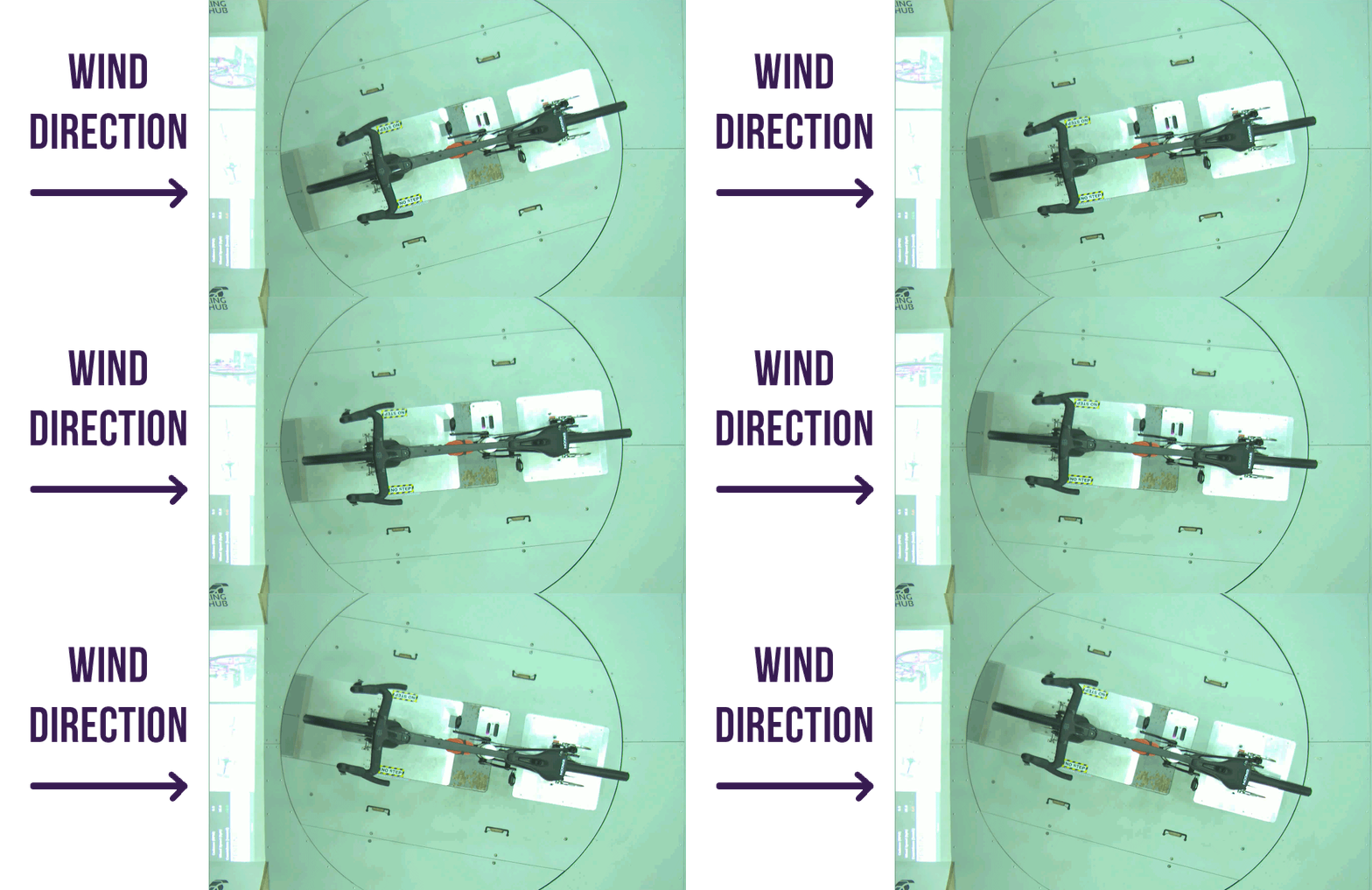

But even if the wind is coming at you from 90° to the right, the actual experienced yaw angle will be less than this, because you're creating your own headwind by moving through air.
There are a few mathematical models that have calculated - in extreme detail - the likelihood of experiencing any given wind angle at any given time, taking into account ambient wind conditions, average riding speeds and so on.
To solve for watts, we calculate a weighted average based on the weightings supplied by one of these mathematical models.
The models all create a bell curve that centres around 0°, and in all cases, the probability of experiencing anything beyond 15° on either side is so small that it doesn't make any difference to the results when we calculate that average, and thus it would be a waste of time to test it.
Now that you know all the data on rolling resistance and aero, what would you spec as the ultimate Roubaix bike for a normal rider? (itcanalwaysbelouder)
This one felt like a good question to pose to the whole team, so you'll find individualised responses below, starting with Tom Wieckowski, who rode the Roubaix Sportive in 2024.

"‘Ultimate’ will mean different things to different riders. In my opinion, the ultimate for a normal rider at Roubaix is to be fast on and off the cobbles whilst suffering zero mechanicals or flats.
Whilst there are road machines with bigger clearances, I’d take one of the fastest road bikes, with official tyre clearance that tops out at around 37/38mm right now.
There’s an element of luck, but a tougher tyre, with stronger sidewalls, will help minimise flats for an amateur; leave the race tyres at home. Perhaps take a GP5000 AS TR, tubeless, with plenty of sealant and perhaps even inserts.
You don’t need a wide gearing range; I’ve ridden the key sectors without issue on 2x mechanical, but a SRAM XPLR rear mech will offer the best chain retention, and 1x is a small aero gain and less to worry about.
If you want a specific answer, if I left for Roubaix tomorrow, I’d be very happy taking the Canyon Endurace CF SLX I’m riding, with the biggest tyres I could fit, and a full bolt check before I set off."
Next up is Will Jones, who has fronted the Cyclingnews Tech YouTube channel since its launch in Spring, during which time he's ridden and reviewed over two dozen flagship race bikes.

"Having ridden the cobbles briefly (though not nearly as much as my colleague Tom), I’d say the key for a normal rider is going to be based around your tyres and your overall comfort. Get something that can take at least a 35c tyre, then from that cohort pick something that fits you and is reasonably aero. My gut tells me a Cervélo Áspero-5 could be the move with 40mm Pirelli P Zero Race TLR, with the bonus of being a little more stable and predictable in the wet from the geometry."
And finally, me (Josh Croxton).

Can I have an aero bike that weighs sub-7 kg, with clearance for 40mm tyres (as a minimum), with a racy geometry? Does that even exist? If so, that'd be my bet.
Roubaix for me would be about finding a good group, rolling turns on the smooth roads, and not losing them on the cobbles when things inevitably break up. If I can make that part easier, I’d be able to hold on to a better group for a longer time, and if I find myself struggling, I could sit in the draft and skip a few turns on the smoother stuff.
Therefore, I'd definitely prioritise wider tyres over aero and weight. Don’t get me wrong, all three aspects are important, with the high speeds requiring something aero and the constant accelerations being affected by weight.
I’d probably go for a Crux 5 with as wide a road tyre as I could get my hands on. Or if I were stuck with 40mm tyres, I’d be happy with something like an Allied Echo or FiftyOne Sika.
What's more aero: Moustache or clean-shaven? (Will Strickson)
To wrap up with a silly one... this question comes from Will Strickson, the Web Editor over at our most hated mortal enemies at Cyclist Magazine.
We all know hair is the enemy of aero, so the initial theory is that clean-shaven wins out. However, trip strips have proven effective in clothing, so would they not apply here too? Alex Dowsett once shaved trip strips into his leg hair, so in 2027, we're going to make Will Jones grow just the vertical segments of a handlebar 'tache and see whether the aero savings outweigh the friends he loses along the way.

That's all for today, folks. With so many questions still to answer, I've convinced my colleagues to let me do a second part in the coming weeks. Feel free to drop any new questions into the comments of this article, and I'll endeavour to get to them.
And with that, thanks for reading!
Josh is Associate Editor of Cyclingnews – leading our content on the best bikes, kit and the latest breaking tech stories from the pro peloton. He has been with us since the summer of 2019 and throughout that time he's covered everything from buyer's guides and deals to the latest tech news and reviews.
On the bike, Josh has been riding and racing for over 15 years. He started out racing cross country in his teens back when 26-inch wheels and triple chainsets were still mainstream, but he found favour in road racing in his early 20s, racing at a local and national level for Somerset-based Team Tor 2000. These days he rides indoors for convenience and fitness, and outdoors for fun on road, gravel, 'cross and cross-country bikes, the latter usually with his two dogs in tow.
You must confirm your public display name before commenting
Please logout and then login again, you will then be prompted to enter your display name.
