Lighter, stiffer, but is it more aero? We wind tunnel tested the Giant Propel
The Propel looks very similar on the outside, but Giant claims some big system benefits that reduce drag by more than 14 watts. Has it worked?
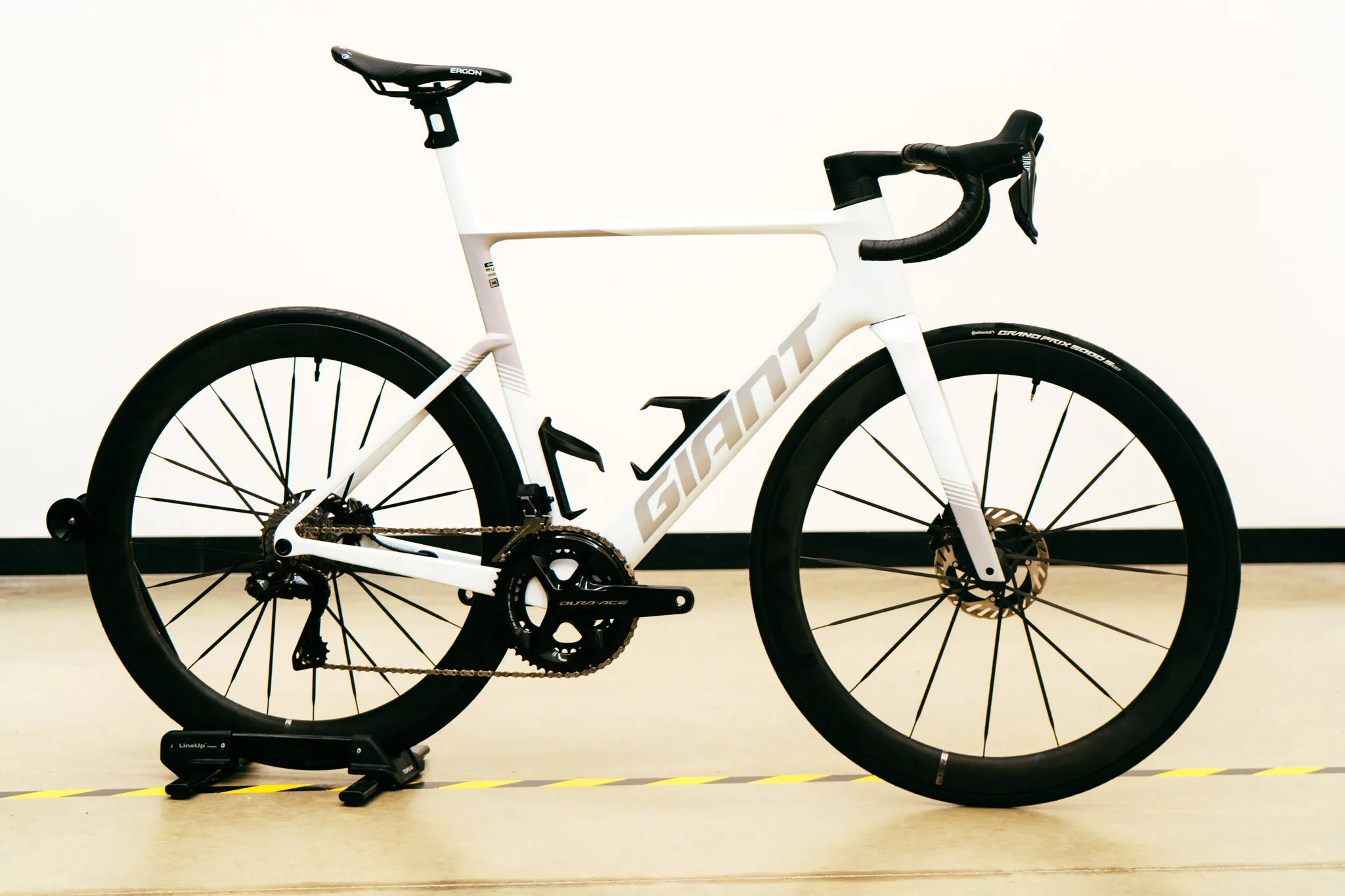
The Giant Propel was updated for 2026, although you'd be hard-pressed to tell it apart from the outgoing model, and in doing so, it achieved the bifecta of bike launch goals, cutting both weight and aero drag numbers; the latter by a significant claimed amount.
A full build comes in at a claimed 6.56kg in a size medium, meaning you'll need to bolt on some extra weight somewhere to meet the 6.8kg UCI limit. The biggest headline figures for this bike versus the previous one, though, were a full system aero approach which contributed to an overall 18.4 watt saving.
Not all of that came in aerodynamic terms, with some attributed to tyre rolling resistance too, but it saw aero gains from the frame, the new Cadex Max 50 wheels and the new aero tyres.
The biggest relative gain, though, is the new narrower handlebar. Given that a rider makes up most of the drag, the new bars with 40cm drops and 37cm hoods are designed to allow for a more aerodynamic rider position.

The protocol
Our protocol has remained consistent since our first wind tunnel test, so that we can reliably compare as many bikes as possible, even when testing across different days and years.
You can find in-depth details on how the testing was conducted in our 2025 aero bike shootout article, but to refresh memories, I'll outline what we did here.
- Bike only:
As with all our other tests, we start by testing the bike as it comes from the factory. The only caveat here is that we use the same front tyre, as that has a significant impact on total aerodynamic performance, especially when just testing the frame and wheels.
Wheels, groupset, and finishing kit remain the same, but we set the bikes up to have consistent saddle heights and handlebar positions.
This gives us an interesting insight into how the bike performs in isolation. Although not relevant to real-world riding, it allows us to compare the bikes with a smaller error margin.
- With a rider:
Of course, bikes don't ride themselves, so we always test with a rider present as well.
Our rider and position are kept consistent, while the wind tunnel takes 'edge' files so we can match the rider position for every run and across different days.
Rider-on testing always has a larger margin of error, and we test for 30 seconds per run rather than 10 seconds per run so we can smooth out the data and quieten down the data 'noise'.
A pedalling mannequin would be the gold standard way to combine those tests, and while it's on the roadmap for Cyclingnews Labs, it wasn't available in time for this test. Notably, Giant has its own pedalling mannequin, called Grischa. This is based on a scan of former pro Grischa Niermann, who nowadays works as Sports Director at Lidl-Trek.
Its latest version, Grischa 2.0, can adapt to different positions for gravel bike testing too (we have a test of the Giant Revolt coming soon), and this was used to develop and validate the Propel's claimed improvements.
- Bike only, control wheels
Given that some frames come with wheels specifically designed to work best with those frames - think Roval and Specialized, Reserve and Cervélo, Cadex with Giant - we also test with a control set of wheels.
We use a set of ENVE SES 4.5 wheels with 28mm Continental GP5000 S TR tyres. This also allows us to narrow down where performance comes from. A bike that comes with a 60mm front wheel might outperform a frame that comes with a 40mm wheel. Adding a control wheel test lets us see if those performance differences are down to just the frame, the wheels, or a combination of the two.
We have also done separate tests on wheels, so for the Look 795 Blade RS (2026) that came with the super-fast Scope Artech 6 wheels, we can see that adding the ENVEs dropped the relative performance. Likewise, the ENVE Melee V2 with ENVE 6.7 Pro wheels gave us an idea of where those wheels might sit in the overall table based on their comparative result against the 4.5 model.
We tested across yaw angles (the angle the wind hits the bike) of -15°, -10°, -5°, 0°, 5°, 10° and 15° to allow us to assess crosswind performance. For reference, Giant's in-house testing goes out to 20°, which its engineers believe offers a fairer reflection of real-world experience.


Testing itself is conducted at 40km/h, chosen as a speed that the majority of buyers may expect to go on their faster-paced group rides, group events, or giving a road bike time trial a go. Most bikes are advertised at 45-50kph, in part because of the speed of pro races, but also because larger differences in watt savings tend to appear the higher the speed. We set 40kph as a more realistic benchmark, and we appreciate everyone will go faster than this at points, but that'll mostly be with the support of a tailwind or a hill.
To try and standardise things, we ensure all testing is done in the same gear, so rear mech placement is similar, and with the same front tyres, as they are the first thing the wind impacts. Position on the bike is kept as close as possible, and kit, helmet, glasses, and shoes are consistent from test to test.
Two Elite Vico cages with Elite Fly bottles are fitted to each bike, save for when the bike comes with aero bottle cages as standard, such as the Colnago Y1RS or Factor ONE. This is because those are included parts of a bike, and people are unlikely to remove them (in favour of something nominally worse), so we feel it's fair to test them as part of the entire system.
We have done a piece about the impacts of round bottles versus aero bottles if you want some extra light reading.
To have a baseline, we have our Trek Emonda ALR control bike, which is now a full-time wind tunnel test bike. We test at the start and end of each day to ensure atmospheric conditions have remained consistent, while we also make sure that results correlate with prior test visits.
And as ever, the caveat applies that our tests aren't the be-all and end-all of a bike's performance. Aerodynamics is just one part of a bike's overall design, and Giant itself says that for the Propel, it "developed and tested the frame, cockpit, wheels and tyres together as one complete system, balancing aero performance with rolling resistance, weight, efficiency, compliance and handling."
What's more, other testers may get different results under different wind tunnel or aero-testing protocols. Our data is subject to an error margin, the size of which is outlined within the results.

The results
Bike only
In our data, the new Propel Advanced SL 0 is 3.45w faster than the previous model.
Interestingly, performance at higher yaw was where it struggled relatively more. Perhaps the shorter tube profiles impacted the performance here, as the sail effect is more limited than with deeper-profile tubes.
You can see here that the bike now sits at the top of the bottom third out of all the bikes we tested, 7.45w away from the Factor ONE.
However, to be fair to Giant, part of the improved performance versus the previous model is the aero tyres, which we removed from the front in order to avoid skewed results. Likewise, the narrower bars, which have minimal impact on performance when the rider is not present.
With rider
When we put a rider on the bike, it's a relatively similar picture. Again, I will caveat here, as with the Merida Reacto One 2026, we had set a testing protocol for the drops in a consistent position, rather than narrow or flared hoods.
Both the Giant and Merida rely on the narrower tops to allow for a narrower, classic breakaway style of riding.
We can see here that with a rider on, the gap actually broadens to the top of the field, now 8.21w slower than the Cervelo S5, and with the rider on producing generally smaller wattage gaps, the percentage difference between the Cervelo and the Giant is actually larger.
This also sends the Giant down the field further and only 0.47w faster than the previous model. Our margin of error, of course, means it could be up into the top 10, but it could also drop it to the slowest of the bunch.
Control wheels
When we add the control wheels, things do not get better for the Propel's overall picture, but it does at least show that the new Cadex Max 50 wheels are faster on this frame than the ENVE SES 4.5 wheels are, as switching wheels resulted in one of the larger swings in performance, with a 2.55w decrease in performance compared to the standard Cadex wheels.
Overall, then, a surprising set of results for the new Giant Propel Advanced SL 0, seeing it very close to the previous generation, and struggling to move up the table while others like the Look and ENVE have made great strides with the latest releases from those brands.


The conclusions

- Most aero socks are a waste of money: Here's the wind tunnel verified proof
- Wind tunnel tested: Who makes the fastest deep aero wide gravel wheels?
- Fastest frame, fastest wheels, and a potential 22-watt upgrade: The Factor Elara wind tunnel tested
- What are the fastest UCI-legal road wheels? Wind tunnel testing the big-name brands and Chinese contenders
- Behind the scenes in the wind tunnel: Watch our latest video to see how a testing day unfolds
It's a difficult one to unpack here. The Propel tested previously and the new 2026 model look nearly identical, save for a greater drop in the seatstays. Most of the specific frame differences are reductions in weight and also rideability improvements, which we will cover in a full review.
Our testing protocol admittedly does impact Giant negatively, given that several of the key aero improvements were elements that we had to switch out for the sake of test controls. The Cadex aero tyre was gone, although Giant's 0.42w saving is not massive, and we tested our rider-on tests in the drops, not the tops. This is a similar predicament to the Merida Reacto, which builds on most of the aero savings from getting the rider into a narrower position. But then really we're testing rider position, not the bike in some isolation.
Saying that, ENVE have a similar design with the SES Pro bars, as they have long used narrow tops and flared drops to balance aero and stability. But with the Melee V2, testing in the drops did not handicap the bike, even with the aero drop shape and bar tape designed to minimise the drag produced by the drops with a rider in the tops.
What we can say for the new Propel is that the Cadex Max 50 wheels are now faster, but given the minimal differences to the frame, aero performance is near unchanged. It is lighter, though, and with the 14.8% increase in ‘system handling efficiency’, we trust it will ride even better, although we will determine that in full testing.
Given the less-than-favourable results, I gave Giant the opportunity to comment on the data ahead of publication, and their retort was a fair one. To paraphrase: the Propel was designed with the use and validation of a pedalling mannequin, and designed as a system with the cockpit, wheels and tyres to not only be aerodynamic, but also be fast across all conditions. Its full procedure can be found here, and is worth a read. It's
To add my own analysis and largely echo Andy's conclusions, the removal of the front tyre, though well-intentioned as a means to make tests more comparable, stands against Giant here, in a similar way that it stands against the Merida Reacto One (and others that fit the Continental Aero 111 tyre).
Similarly, our rider position in the drops undid the aero benefit of the narrower bars, since they flare out to be wider at the drops. This controls the rider position more comparably and accurately, but isn't quite as representative of what you might experience when riding the Propel every day.
Also, as hinted above, Cyclingnews is now the proud owner of a pedalling mannequin, so we'll be starting from a clean slate with our protocol in the new year.

Freelance cycling journalist Andy Turner is a fully qualified sports scientist, cycling coach at ATP Performance, StemNotes, and Venturi Dynamics.
He spent 3 years racing as a UCI Continental professional and held a British Cycling Elite Race Licence for 7 years. He now enjoys writing fitness and tech related articles, and putting cycling products through their paces. Predominantly road focussed, he is slowly venturing into the world of gravel too, as many ‘retired’ UCI riders do.
When it comes to cycling equipment, he looks for functionality, a little bit of bling, and ideally aero gains. Style and tradition are secondary, performance is key.
- Josh Croxton Associate Editor (Tech)
You must confirm your public display name before commenting
Please logout and then login again, you will then be prompted to enter your display name.
