PHD chemistry and three types of sand – Inside the CeramicSpeed chain lubricant test labs
No standard testing exists for chain lubricants. We visit CeramicSpeed to see how they formulate their drivetrain products
Cyclists have been applying lubricants to their bicycle chains for well over a century. From the invention of 3-in-1 oil in 1894 to condition-specific wet and dry formulations, through to hot waxing and the performance-focused, watt-saving lubricants we have today.
There are now countless products promising an increase in speed, quietness and longevity. Currently, no industry-standard test procedures exist for chain lubricants and waxes, and what is the best thing to test? There are established big names, but how can you tell an effective product from one that might actually do your drivetrain harm?
CeramicSpeed is one brand that formulates and tests all of its own chain waxes and lubricants in-house. A fact which possibly draws less attention than the brand's more visible high-end ceramic bearings and OSPW pulley wheel systems.
I visited the CeramicSpeed headquarters in Holstebro, Denmark, where the brand has dedicated chain-lubricant formulation and test labs in an attempt to answer a few of the questions the chain lube nerd in me had, and to learn more about how you go about formulating an effective chain lubricant or wax, testing it and bringing it to market.

The origins of the modern-day chain waxing revolution lie with Jason Smith’s Friction Facts chain lubricant and testing business, which carried out some of the very first, if not the first, dedicated drivetrain friction testing over a decade ago.
CeramicSpeed acquired FrictionFacts in 2016, including at least one of its test machines, and then built on Smith’s original UFO product foundation. Smith joined the business as well, and later worked on the Driven chainless drivetrain project, but is no longer involved.
Product development and rigorous testing are a cornerstone of the CeramicSpeed product philosophy. The brand commits plenty of time to formulating and testing chain products.
Various brands carry out their own lubricant testing; some do none. It varies, and more than one brand markets its products as the fastest. ZeroFriction, an Australian independent testing company, is a reference point for many who are interested in lubricants and testing, but a lot happens behind closed doors.
The formulation lab

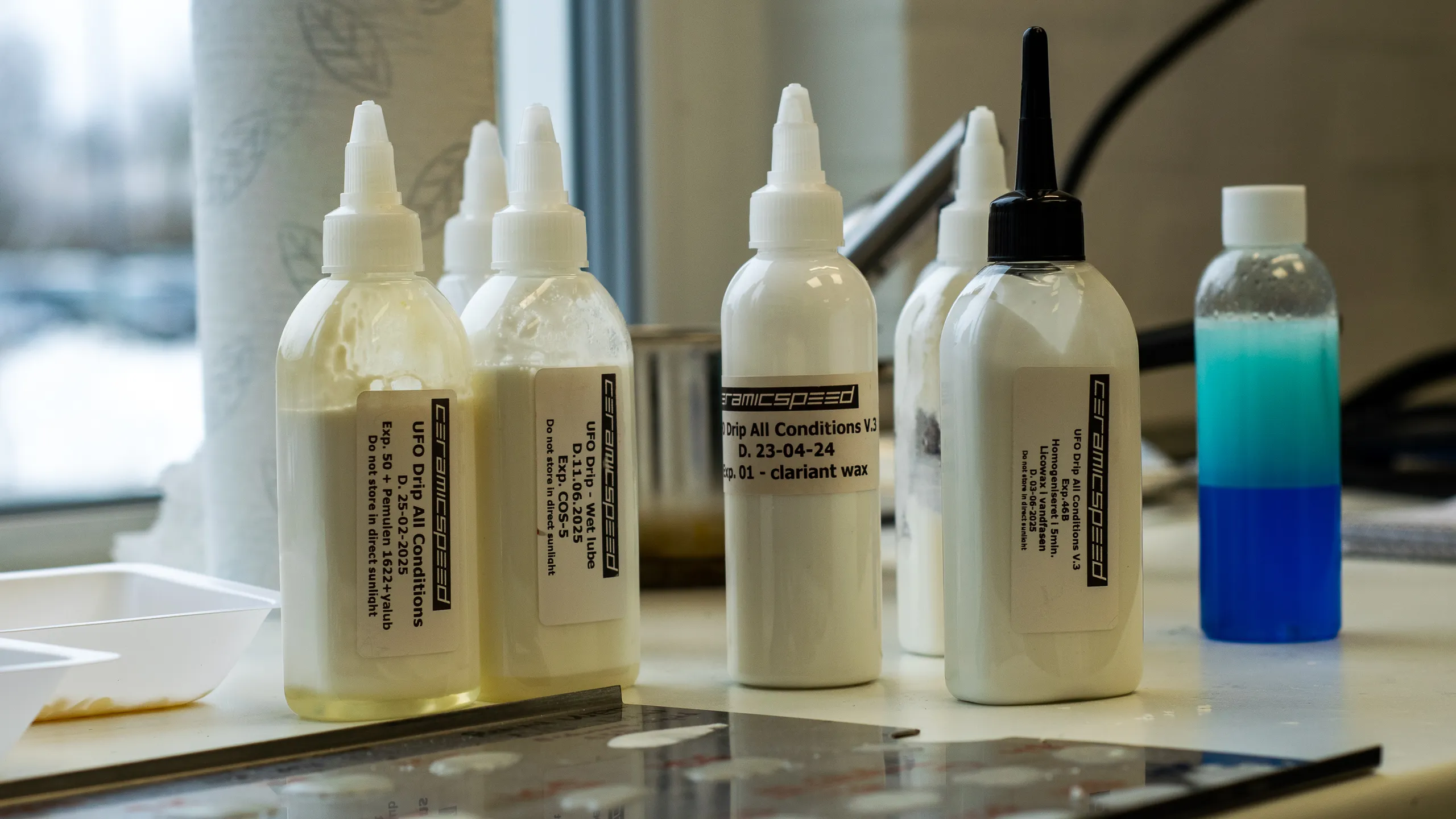
CeramicSpeed chain products begin life in the brand's lab. Glass flasks line a wall, and at the end of a workbench topped with several machines that look a bit like microscopes, there’s a cabinet full of the base ingredients used to produce chain lubes and wax. This being Denmark early in the year, the carpet of snow on the ground outside matches the colour of the product in some of the bottles today.
Lina Søbjerg Madsen, a PHD chemist, and Michael Pedersen, Development Engineer, have both been with CeramicSpeed for the best part of a decade and form the backbone of the brand's wax and lubricant development and testing programme. If you have used a CeramicSpeed lube or wax product in that time, they will have developed and tested it.
CeramicSpeed wax and lube products are both wax-based. Hot melt wax is a blend of pure waxes, including what Søbjerg Madsen tells me, with a grin, is her 'secret ingredient'.
When it comes to a drip chain lubricant in a bottle, Ceramicspeed uses wax, emulsifiers, a corrosion inhibitor to protect the chain, which it claims not every brand uses, and demineralised water as the carrier, which is what, as the name suggests, helps carry the wax lubricant itself deep into your chain links, where it can do its work and protect the chain.
Drip lubricants are mixed thoroughly using machines, heated, and then cooled. Today's formulations are water-based, but the original carrier fluid for the first UFO Drip was kerosene, which was known to melt bottle nozzles over time due to its aggressive nature.
The water-based carrier evaporates, leaving behind the wax. Oil-based drip lubricants tend to become dirtier in use because contamination is suspended within the oil, which remains on the chain.

Charged with developing CeramicSpeed’s chain lube offerings, Søbjerg Madsen begins by explaining that it’s not possible to have one product that’s the best at everything.
“What people need to understand is that there are over 1000 different waxes; there are synthetic and natural products, and each of them has different properties. She explains.
“So when sales suggests a new lubricant or a new product, my main goal is to ask, 'What kind of properties do you want?’, because you can't have everything.
“The first part is getting the wax composition with the properties that I would like, and once that's done, then I need to find a way to keep it in this water solution, and also get the shelf life correct, and that's a really difficult task.” Søbjerg Madsen explains.
A product's composition depends on the desired properties. Is longevity the priority, or is all-out efficiency the goal? Something that lasts for a thousand kilometres may very well not be the fastest option.
CeramicSpeed's approach is that a one-size-fits-all product isn't ideal for chain treatments. The first wet lube, for instance, went through 300 experiments to arrive at the desired composition.
Cyclists, or at least road cyclists with a focus on performance, often look for what's fastest, or what saves watts, but there's more to it than that. Making a quality product that performs for the most amount of riders, across different regions, climates and weather systems is a tricky ask.
CeramicSpeed offers three drip products: All Conditions, Wet, and Indoor and the range was overhauled this year and given a new look.
All Conditions and Speed Wax are the best bet for speed; Wet lasts longer and protects your chain in the rain, and Indoor doesn't shed like a regular wax, making it useful for the velodrome or home training. The new Ultra Endurance Wax doesn't focus on low friction, a first for the brand; its priority is high durability and consistent performance over hundreds of kilometres.
It is 'stickier'. It might not be the quickest option for a road race, but it will protect a chain for hundreds of kilometres off-road in a gravel race, for example. A super-fast chain wax or lube's benefits will be null and void if it's gone after 2 hours of hard use.

The brand's chain lubricants are developed in small batches in the lab and produced in volumes of up to two litres. These samples are used for the brand's testing and by test riders.
The brand now also has an in-house production facility where it can produce 50- 300 kg of drip product in a batch, allowing them to control the process.
Søbjerg Madsen explains that this close proximity means it can be easy to address issues that may arise from production at scale.
“Sometimes, because it's chemistry, and chemistry can be unpredictable when you scale up, we'll see some issues where I have to correct something, then when they say go, they are ready to produce and put it in bottles,” she explains.
Shelf life is another factor when it comes to our chain lubricant; top tip: don’t leave the cap off your water-based drip chain wax, as the water will evaporate over time.
CeramicSpeed aims for a two-year product shelf life, and needs to ensure a product doesn't solidify in the bottle. Søbjerg Madsen explains that a drip lube which separates in the bottle is a poor sign, something to look for when you are next in the bike shop buying chain lube.

"That's a very poor sign; it's a sign that it's unstable, and the product development didn't do a good enough job.
"Every time I make the sample, I put it in the incubator at 40 degrees. It stays there for three months, and if it doesn't solidify or separate, then we say we have a shelf life of two years," she says.
After nearly a decade, it's clear the pair have a strong feel for what's needed, but verification from the test lab's machines and Pedersen's experience and feel inform the direction Søbjerg Madsen needs to take at times.
"When I make the first wax compositions, and I think 'Okay, this might be interesting,' then I'll make a test chain for Michael and ask him to do an experiment to measure the watts, because then I have an idea. If it's really high, then I need to do something to make it lower," she explains.
The testing lab and three different kinds of sand

The lubricant and wax formulations are designed, and then the testing phase takes around six months on average, though the brand is always busy testing different things, including the competition, and running experiments.
Engineer Pedersen has tested a lot of products in general in the lab, including over 800 chains; the 11-speed Shimano Dura-Ace chain is held in particularly high regard. If you are running 11-speed Shimano, buy yourself a Dura-Ace chain.
CeramicSpeed uses a combination of internal and external test riders. This includes company founder and CEO Jacob Csizmadia himself; we pass a few of his stealth all-black bikes in the corridor on our way to the lab.
The test lab is a fairly small, brightly lit room that is lined with workbenches. Many of which are topped with testing machines, which in different ways all vaguely resemble a bicycle drivetrain.
There are five chain testing machines, which all serve a different purpose; There's the original Friction Facts testing machine, a clean conditions test machine, a wet conditions test machine, a machine to add water and sand contaminants together and the brand's latest baby, the Full Load Watt Tester machine (FLWT); a larger unit, which runs as a complete drivetrain, whilst adding sand and water and measuring friction. This machine has been designed to take the brand's testing to the next level.
CeramicSpeed measures friction in watts by using torque sensors. The durability of the chain treatment is also monitored, but chain wear specifically is not, though it can be as part of a specific extra-long extreme test.

The Friction Facts test machine was the original, weighting a single-speed arrangement at 250 watts of load in a clean environment. It's a style of machine being used by other brands to test as well, but it isn't a full drivetrain and can skew results because the chain is in tension pretty much the whole time due to there being no derailleur.
A Tribology test for friction rates called a Pin and Disc test also exists, and whilst it can be performed to an ISO standard, it isn't specific to bicycle drivetrains or modern wax formulas. CeramicSpeed don't consider it to be a worthwhile testing avenue to go down.
For years, only clean-conditions testing could be done, but as Søbjerg Madsen points out, unless you are riding in a velodrome environment, "we all know even on a hot summer day, it's not completely clean conditions," meaning dust and other contaminants are still present.
A machine that could add contamination was required to mimic real-world conditions. The wet conditions test machine was also developed, but adding only water could only tell so much.

"We could only add water, and a lot of water, and what does that really simulate in the real world?" Søbjerg Madsen says. Every cyclist knows a wet, rainy day comes with all sorts of grit, dirt, and mud that also interact with a chain.
CeramicSpeed has now developed a machine capable of adding contamination and water. The FLWT machine is run using four different protocols that simulate different conditions over five hours; to standardise things, because, as the pair point out, you could end up just testing forever.
These test protocols are as follows:
- Clean test without contamination.
- Tests with water added every five minutes.
- Dry test with sand added every five minutes.
- Extreme test with water and sand added every 15 minutes.
The brand also uses three different types of sand from around the world in testing because, naturally, it varies all over the world. Sand from Australia, Denmark and America is used. The sands all differ; the one from Colorado in the US is very fine and dusty, the sample from Australia has more clay, and the Danish sand has more 'fine particles'; using it consistently allows for repeatable testing.
The FLWT machine uses a motor to power a drivetrain at a load of 250 watts (though this can be altered) and advanced torque sensors on the input and output axles to measure the wattage difference; custom test software has also been written in-house to calculate the test results.
CeramicSpeed runs various tests, and the brand was careful not to give me everything; it's a competitive area, so we couldn't dive into all of the test data, graphs and findings. The brand has published some test results on its site for its chain lubricants.
Generally, though, tests last five hours, and multiple runs of each test are completed for validation. When test graphs are produced, they show a break in time, an optimal running period and a decline in performance due to wear and/or abrasion from the test contaminants.
The FLWT can also be remotely controlled and has a built-in horn to warn colleagues that a test is about to start when the engineers are working remotely.
There is even a microphone to monitor the changing sound of a chain's treatment as testing progresses and a lubricant 'wears in'. The sound a chain is making can tell the engineers a lot, and plenty of riders recognise a change in sound as a reminder to re-lube or re-wax their chains.
Apparatus in workshops to break in freshly waxed chains is also getting more complex; the brand's advice: re-install your freshly waxed chain, work it by hand a little if needed and go ride it; it will settle down and go quiet soon enough.

"We know from the industry that there are a lot of people who are looking into this (an FLWT-style machine), but we have also realised that the problem is getting reproducible data. says Søbjerg Madsen.
"We really need to be sure that what we are measuring is correct,"
The team admit that they are still learning the machine, and are aiming to measure very fine differences consistently in order to be as accurate as possible, in part because differences between competitor products are very small.
No lubricant test standard exists in the bike industry, and you can't really just go and buy a test machine. This means brands are free to present their testing in whichever way suits them best.
"Customers and the companies are saying, 'Well, of course, you're just designing your test to make yours look best,' and that's what everybody is doing, because there is no standard.
"That's what everybody is doing; they are making their own test, and then, of course, they look best, but what Michael and I are really doing, and it's easy for us to say, is that we are really trying to make tests that mimic the real world. It's much easier to optimise something if you have a standard test to do it," says Søbjerg Madsen
The brand is comparing against the competition, but appears to be doing it fairly, setting up and testing competitor products to spec, as Søbjerg Madsen explains.
"If we're doing comparison tests on one of our competitors, we do a lot of work to test it at what they recommend.
"We are not just trying to make it look awful. Sometimes we find that, well, this lubricant is actually really good under these conditions, and then, of course, as a chemist and scientist, I'm thinking, 'okay, what do they do that's really good, and how can I optimise mine to get the same performance?"

The clue is in the name: with CeramicSpeed, the brand is all about speed and low friction; however, its efforts with chain treatments, drip and hot wax go beyond being able to say 'ours is fastest'. It's a statement the engineers do not make themselves during my visit.
Cyclists can make an informed decision on what they might think the best chain product for them is. The brand of drivetrain you run will affect efficiency, as will how well a lubricant is applied and maintained. If you want to maintain the best possible performance, don't skip the re-waxing, cleaning or reapplication, and if that isn't for you, find something that lasts a long time.
Though no official industry test standards exist, inter-brand chain lube test result announcements can feel like a fight for supremacy at times.
It's clear CeramicSpeed is committed to testing and developing the best possible product. Whilst its product has competitive low-friction or speed levels, there's more to a good chain lube or wax than just being quick.

Tom joined the Cyclingnews team in late 2022 as a tech writer. Despite having a degree in English Literature he has spent his entire working life in the cycling industry in one form or another. He has over 10 years of experience as a qualified mechanic, with the last five years before joining Cyclingnews being spent running an independent workshop. This means he is just as happy tinkering away in the garage as he is out on the road bike, and he isn’t afraid to pull a bike apart or get hands-on with it when testing to really see what it’s made of.
He has ridden and raced bikes from an early age up to a national level on the road and track, and has ridden and competed in most disciplines. He has a keen eye for pro-team tech and enjoys spotting new or interesting components in the wild. During his time at Cyclingnews, Tom has already interviewed some of the sport's biggest names including Mathieu van der Poel, Tadej Pogačar and Alberto Contador. He's also covered various launches from brands such as Pinarello, Ridley, Specialized and more, tackled the Roubaix Challenge sportive aboard his own rim-brake Cannondale SuperSix Evo, tested over 20 aero helmets in the wind tunnel, and has created helpful in-depth buying advice relating to countless categories from torque wrenches to winter clothing.
You must confirm your public display name before commenting
Please logout and then login again, you will then be prompted to enter your display name.
