‘Who is influencing whom and why?’ – Some of cycling’s biggest backers are spinning a sponsorship spiderweb, but what are the risks?
With a handful of brands having ties to teams, races, and even governing bodies, Chris Marshall-Bell questions whether this is just the way cycling's sponsorship model is going, or if it's a governance headache waiting to happen
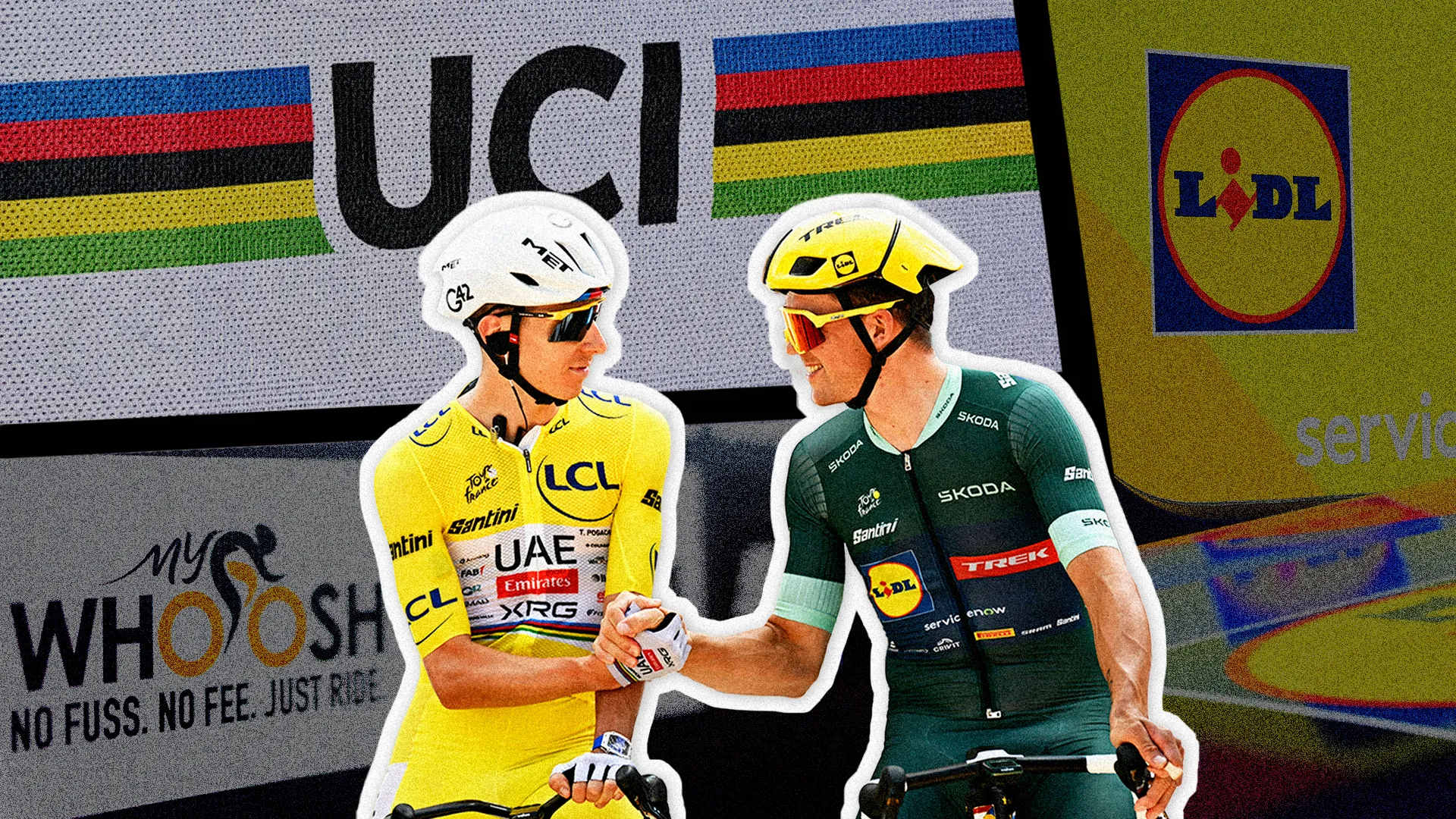
At Spain’s biggest cycling races next year, one sponsor will be ubiquitous: Lidl.
Plastered across the red leader’s jersey at the men’s and women’s Vuelta a España will be the logo of the German supermarket chain; it’ll also adorn barriers and finish gantries at the Volta a Catalunya and the Itzulia Basque Country; and in each and every race, riders from Lidl-Trek, also emblazoned with the discount chain’s red-yellow-blue coat of arms, will be competing. Given the team’s big-spending habits of recent times, it’s not unfeasible that a Lidl rider will win (many) a Lidl race.
The newly announced sponsorship deals – which are in addition to the Lidl Deutschland Tour, and come three years after Lidl was a major sponsor of the 2023 UCI Road World Championships – are another sign of Lidl’s commitment and interest in mass-participation sport; alongside cycling, it has also significantly invested in football and handball. As the company's customer base and profits reach new heights, so too does its marketing strategy. To promote an active lifestyle to its millions of loyal and new customers, it wants to be seen as the supermarket of choice for athletes and active people.
But does Lidl further extending its tentacles into cycling pose a problem? Is there a risk that too much of the same thing risks threatening the sport? To get to the point: is there a possible conflict of interest issue to address?
Lidl is not the only cycling sponsor with fingers in many pies. MyWhoosh, the virtual cycling platform, has been a long-time sponsor of the world’s best team, UAE Team Emirates-XRG, while simultaneously hosting the UCI Esports World Championships. Similarly, MyWhoosh’s rival, Zwift, is the main sponsor of the Tour de France Femmes, while simultaneously sponsoring the Canyon-Sram team.
Elsewhere, French petrochemical giant TotalEnergies had a team competing in the Tour de France this year, while also being a major partner of the race itself. There are other examples: car brand Škoda, as well as bike component manufacturer Shimano, are also linked with numerous different cycling stakeholders. The list runs and runs.
It’s not a situation unique to cycling: similar multi-partnership arrangements are found in other sports, especially football. The UAE-based airline Emirates, for example, sponsors many of Europe’s biggest clubs, as well as the English FA Cup, the world’s oldest competition. Formula One can point to its own examples.
No evidence – let alone suggestion – has ever been raised of private companies interfering with the integrity of cycling competition. But has cycling reached a point where a select number of brands are spreading their wings uncomfortably wide, leaving open the possibility of them potentially having too much influence over the sport?

Power, success, and a particular image
Sponsors have held sway over cycling teams since bike racing began. Bike teams, after all, are funded by external backers, and they wouldn't exist without their support. Companies telling a team it must select X rider for X race for visibility purposes, as much as for competitive reasons, happened at the outset of bike racing in the 19th century and still happens today.

- From Gabba-gate to the wrong energy gels – Why teams stray from their official sponsors, and what happens when they do
- Cycling has the fans, it just needs to monetise them – Can a new style of events and engagement help to solve cycling's funding problem?
- Where do cycling's super teams spend their millions?
He and his team would say different, of course, but do you really think Tadej Pogačar has ridden the UAE Tour four times (and is expected to make his fifth appearance in 2027) because he views it as better preparation for his main season goals than, say, the more competitive and less sprint-focused Paris-Nice or Tirreno-Adriatico? It’s unlikely, but his appearance also serves the commercial and promotional interests of the team’s principal backers to have its headline rider in its state-supported home race. The story repeats across the cycling landscape: riders and teams make certain decisions based on the wishes, and sometimes demands, of those who provide the funds. There is nothing inherently wrong with that.
In the first quarter of this century, major international sponsors have shifted their marketing approach, favouring cross-promotion with similar but different partners to reach as wide and as diverse an audience as possible. "Companies realised a long time ago that sponsoring an event is not enough, as some have visibility but others don’t," Professor Jean-Loup Chappelet, one of the world’s leading sports governance academics, told Cyclingnews.
"Sponsoring an athlete is better. It goes back a long way; look at Adidas and Nike sponsoring runners. They may sponsor an event as well, and there will be signs around the stadium, like there are on the road in cycling races, but the athlete gives them more visibility. As a result, every sponsor now does both: they have a team of athletes and sponsor events."
Professor Simon Chadwick, who is a leading voice on sport’s geopolitics and economics, concurred. "It’s about power and also projecting a particular image: we are successful, and we associate with successful sports teams and events," he said. "Emirates has the money and power associated with many leading football teams [and the UAE men's cycling team – ed], and they’ve successfully established a narrative that it and its associated clubs are the best of everything."
In a statement to Cyclingnews, Lidl said of its various, concurrent relationships: "By partnering with various stakeholders… we aim to support the entire cycling ecosystem. This multi-layered commitment allows us to foster equal opportunities, prominently supporting both men’s and women’s cycling, and to bring the sport closer to a broader audience."
But do these spiderweb-like agreements constitute a headache for sports authorities? "Dense, highly interconnected and deeply embedded relationships exist that are increasingly throwing up contradictions and juxtapositions, meaning we get situations where people are asking questions," Chadwick continued.

"There is no doubt that there is evidence [in other sports] of commercial partners and sponsors seeking to, if not directly intervene to achieve outcomes that they are pursuing, then certainly trying to exert influence."
Evidence of sponsors directly impacting the result of cycling competition is in short supply. What appears more likely, and has been demonstrably proven in a wide range of sports, is that sponsors garner influence at a governmental level. That could mean they earn a seat at the table that decides venue selection for a tournament, or have a word in the ear of a committee member voting on regulation changes.
This is particularly relevant with Lidl: in the ongoing battle to reform professional cycling’s economic model and structural issues, Cyclingnews understands that a Lidl employee is part of the UCI’s reform working group, while at the same time Lidl has become a shareholder in the team-led venture, Collective Cycling Group (CCG). That means the German company has a stake in both projects, which could give it influence over decisions that will shape the future of the sport projects.
"You can’t separate these things: governance, hierarchy, big networks, big money, the state, private equity investors," Chadwick added. "It’s become such a dense network that it’s difficult to even begin to unravel it or draw red lines."
What do the sponsors say?
The possible issues affecting cycling and the weight a small group of sponsors could have over the sport are worth spelling out – even if, it must be said, they are merely hypothetical for this essay, and there is no evidence that such incidents would eventuate.
If a rider is punished due to an in-race incident, could that team’s sponsor, who also has links to the UCI, use its leverage with the governing body to reduce said rider’s sanction? Could a situation also arise in which an event sponsor lobbies a race organiser to tailor a route towards a rider from a team that they also financially back?
Companies might not even need to wield such clout: those in charge of making decisions might be subconsciously swung towards a particular decision, aware of who is paying for the running of the event or the team. That is essentially how soft power works.
"Lidl operates with a strict, structural separation between its commercial marketing partnerships and sporting operations," a spokesperson for the supermarket said. "As a sponsor of race events, our role is strictly commercial – for example, focused on fan engagement and promoting fresh food.
"We have no involvement in, or influence over, race organisation, sporting regulations, or the decisions made by race juries and the UCI. The sporting integrity of the races is exclusively safeguarded by the independent race organisers and the sport’s governing body.
"When Lidl-Trek competes in a race where Lidl acts as a commercial partner, the team is subject to the exact same sporting rules and competitive conditions as every other team. The race organisers and UCI commissaires ensure an entirely neutral competitive environment. There is no structural or operational overlap between Lidl’s race partnership activation and the Lidl-Trek sporting department."
On the Collective Cycling Group, Lidl said discussions to strengthen cycling's long-term sustainability were ongoing and directed us to the UCI for queries relating to its reform working group.
When asked for a comment on the topic, Škoda said: "Škoda Auto has been a long-standing supporter of cycling and works with a range of partners across the sport. Our partnerships are based on clearly defined commercial and sponsorship agreements and do not extend to sorting decisions or competition outcomes. We respect the respective roles and independence of governing bodies, organisers and teams and conduct our partnerships accordingly."
MyWhoosh declined to comment on the matter.

What's the UCI's stance on it all?
Speaking more broadly about the perceived conflict of interest, Chadwick added: "This gets to the battle for the soul of sport. What type of governance is there? Are there conflicts of interest? Who is influencing whom and why, and how are they doing that?
"Where is the money coming from, and why is it coming from there? What do people want in return, and who is taking what? That raises the fundamental issue of integrity: who makes decisions about rules? Sports fans need to know that rules are being created fairly and equitably, not on the basis of whoever paid to be a commercial partner. This is where we get issues around rules, bribery and corruption.
"In general, sport has made some progress in the past 20 years towards being better governed, more transparent, fairer and more equitable. But the reality is, despite all the deeds and good words, governance in sport is still really opaque."
In a statement to Cyclingnews, the UCI said that it has a "clear governance framework to deal with potential conflicts of interest". It said that the "same brand cannot be the main sponsor of two professional teams at the same time", adding that "the principal partners and paying agent… may act in that capacity for one team only." Members of those teams, "which include its sponsors, may have no link with another UCI WorldTour, a UCI ProTeam [equivalent provisions apply to women’s teams] or the organiser of a UCI WorldTour event that is likely to influence the sporting course of events, or to be perceived as doing so."
There are examples in cycling of a sponsor’s logo being emblazoned on different kits: TotalEnergies on its eponymous team’s and Netcompany-Ineos’s; Red Bull, meanwhile, owns Red Bull-Bora-hansgrohe and is on the sleeve of Tudor Pro Cycling’s jersey. There is no suggestion that either sponsor has sought to favour one team or another in competition.
"When a company chooses to acquire sponsorship rights in several areas of cycling, whether teams, events or the UCI itself, this is a commercial decision based on the visibility each partnership brings to its brand. These rules are designed precisely to strike the right balance: allowing our sport to benefit from this investment while safeguarding the integrity of sporting results."
The responsibility to scrutinise potential problems lies with the UCI Ethics Commission, an independent body that reports its annual findings at each year’s UCI congress.

Biting the hand that feeds you
As the UCI alluded to, mid-sized sports like cycling that are dependent on sponsorship revenue just to survive, let alone thrive, cannot be too picky with where the capital that bankrolls athletes, teams, races and federations is coming from. "One of the core elements in this is the feeling that if we don’t agree terms with them [a partner] then they’ll go somewhere else," Chadwick said.
FOMO – fear of missing out – is real. "Of course it is," Chadwick adds. "But it’s not about a rival team or their riders, but a rival sport. You could sponsor cycling, but you could sponsor golf or tennis instead. Whoever secures that big money will secure a competitive advantage. It’s a common story across many sports."
The consequence of that is that it creates an uneasy situation in which the very questions being mused in this article are asked. "What always talks loudest in sport are not the governing bodies, athletes or fans – it’s the money," Chadwick said. "I remember once being with the sponsorship team of one European governing body, and I asked them on what basis they signed deals with partners. Was it an alignment with values, a particular target market, I asked. ‘No’, they said, ‘there's one criteria only – who pays the most’."
Ultimately, that gives further weight to the sponsors: they know that cycling teams and events are desperate for money, and thus often can’t risk an argument with their paymasters.
Yet perhaps this is all simply a case of making a mountain out of a molehill. Chappelet, who has spent decades researching sports governance, particularly in Olympic circles, suspects it might be. "I do not see a conflict of interest between sponsoring a cyclist and a UCI-sanctioned race organiser, or the UCI itself," he said.
History would agree with Chappelet. As previously noted, there is zero evidence of companies using their leverage to swing a decision towards their supported entity; it bears repeating, none of the hypothetical scenarios mentioned in this article (interfering in disciplinary decisions, venue announcements and course design) have ever been recorded, and nor is there any indication that such companies would look to flex their muscles in this regard.
And there’s another point worth addressing: if a sponsor like Lidl or MyWhoosh cut off its funding to cycling, would the teams or races it sponsors even survive? It’s not a guarantee that a replacement sponsor would step up. Don't bite the hand that feeds you, one might caution.
But as long as a select few sponsors continue writing cheques for riders, teams and the sport’s governing body, the uncomfortable, hard-to-breach matter of undue influence will persist in the background. Even with UCI frameworks that are designed to require transparent governance safeguards – and which, on the face of it, do just that – the reality is that part of cycling’s integrity is dependent on trusting in corporate financiers to act morally and ethically for the benefit of the sport and not for their own commercial interests.
You must confirm your public display name before commenting
Please logout and then login again, you will then be prompted to enter your display name.
