Choosing the best road bike is a hard thing to do, but here at Cyclingnews, I am in the enviable position of not only having ridden most of the best bikes in the world, but also being able to draw on our own independent wind tunnel testing to help you make the right choice when dropping what can be really very large sums of money.
All the bikes in this list have been thoroughly tested with many hours in the saddle, as we know full well from experience that just because a bike is fast in the wind tunnel doesn't mean it's also going to be good to ride. Handling, comfort, serviceability, and even the customer journey have been taken into account alongside more empirical data.
If you're chasing every last watt, then our sister guide to the best aero road bikes has more of the dedicated speed machines, but we're now living in an age where all-rounders often boast aero credentials that rival the deep-tubed monsters of the past.
Likewise, if you're planning on racking up the elevation metres then the best lightweight road bikes may offer you more of what you're after, but the best all-rounders now come with such light builds that there's often very little distinction between them and the dedicated climbing bikes of just a few short years ago.
Best overall

The OSTRO is an aero all-round race bike, sitting centrally in Factor's range among the more lightweight-focused O2 VAM, and the hyper-aero ONE.
Its 7.23kg weight (with pedals and bottle cages in size 56cm) is very competitive, the ride quality is enjoyable, and the power transfer feels immediate. The handling is extremely sharp too, but the Tarmac SL8 and Dogma do outshine it in this regard.
At this juncture two years on, the OSTRO is undoubtedly overshadowed by its aero stablemate, especially when it comes to aero performance in our wind tunnel tests, but it is still the 7th fastest bike we've ever tested with a rider on, beaten only by the Tarmac SL8, the Colnago Y1Rs, the Cervelo S5, the Wilier Filante SLR, the Seka Spear, and the Factor One.
In his review, Josh gave it an impressive 96% score, citing the need to pay extra for a power meter as the only real negative, although the factory-specced Goodyear tyres would be first on my list for upgrading.
That's a much simpler fix than swapping out cockpits and crank arms, though. And thankfully, these can be specified as part of the purchase process on Factor's website, saving a lot of hassle down the road.
This is ultimately why I think this takes the honours as the best road bike out there currently; it has the perfect balance of impressive weight, a brilliant aero package, decent handling, and a purchase journey that allows you to tailor it to your fit far more than the Specialized Tarmac SL8, saving you money and hassle. If you want to find out every single reason Josh thought it was so good, then be sure to read his Factor OSTRO VAM review.
Best budget road bike

The Canyon Ultimate exists very much in the shadow of the Aeroad in the pro scene, with most racers in both the men's and women's pelotons opting for the aero option for all stages. The lightweight Ultimate is a very good bike, but perhaps because it doesn't have the race chops it used to it offers a greater range of spec options, with far more options catering to the slightly more wallet-friendly end of the spectrum.
The low weight is going to come in handy when the road tilts uphill, and even the lowest spec options come with carbon wheels and high-quality Schwalbe tyres, meaning upgrades won't be needed for some time. The handling is very snappy, and while I did find the front end a little steep on very steep descents (over 20%) these are few and far between.
It's not the stiffest, nor the most aero, but for the price, the lower-end options offer a brilliant value entry point into fast-handling, lightweight road bikes. What's more, Canyon has mellowed out much of its proprietary tech. My first carbon road bike was an Ultimate, and it had all sorts of unique parts that made getting spares a nightmare, but now things are mostly normal. The bottom bracket is press-fit, and while it's becoming less common, it's still very easy to service or replace.
If this is your first jumping-in point to 'proper' road bikes, then make sure you pay attention to the fit. Even the entry-level builds feature an integrated cockpit. This looks good, and is more aero, but means you can't adjust it to suit your needs. Consult a bike fitter if you're in any doubt.
To find out more, my Canyon Ultimate review should help answer any burning questions.
Best aero road bike
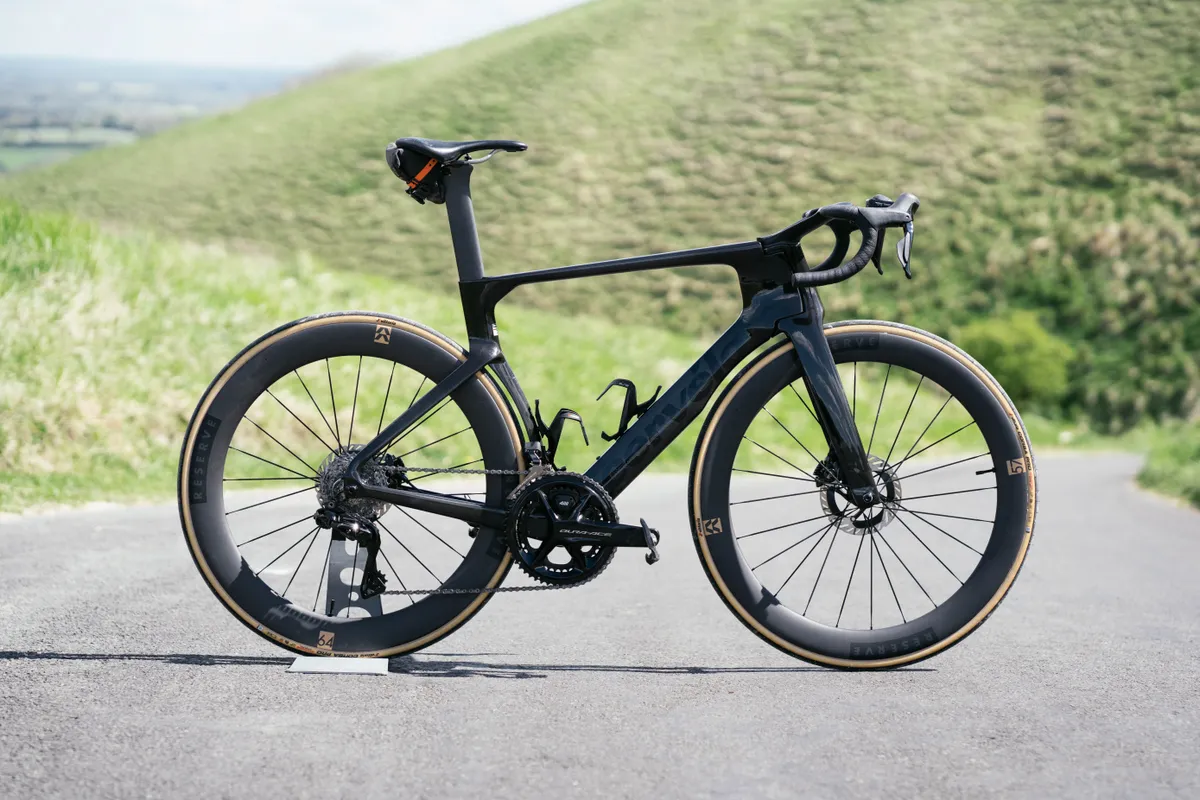
I reviewed the previous S5 as well as this latest, more aero, lighter, faster version that topped our rider-on wind tunnel rankings last year.
Like the old one, the new S5 is almost placidly calm to ride, something which belies the speed of the thing. I'd come home from a ride feeling like I must have been on an off-day, only to discover I had a PR on almost every segment. It's quite bizarre.
The cornering is precise, but also very unbothered. I hit my highest ever speeds on this bike on some local descents, and where I would normally be starting to wonder whether I am actually as immortal as I think when descending, I could have quite happily pondered the day's Wordle, or wondered what I was going to make for tea.
The frame feels very stiff, married up with a cockpit that matches the frame stiffness and wheels too. It takes a short time to spin up to speed, as is the case with many of the best aero bikes, but once you're flying along, increases in velocity are a lot easier to come by than they are with a lightweight bike like the Scott Addict RC.
The wheels feel stable too, even on exposed roads with gusty wind. Where it perhaps falls short against other bikes is when the road tilts steeply uphill. On shallow, sub ~6% gradients, it's perfectly at home, but my first ride on it was 160km with 2,700m of elevation delivered in 10 steep hills. The pro-level 54/40 chainset on my Dura-Ace spec was alleviated by the 11-34 at the back, but SRAM, or at least Ultegra options will give you slightly more mellow gearing if you want to muscle up 20% gradients better than I could.
My Cervélo S5 review goes into more of the details, and what makes it such a great aero bike.
Best lightweight bike

While aero bikes seem to take all the headlines nowadays, as well as having a near total monopoly on the pro scene, I am a staunch believer that if you simply want to enjoy riding a road bike for the pure joy of it, then a lightweight machine is the way to go, and I think there's no better option than the Scott Addict RC.
In the top spec 'Ultimate' that I tested the system weight was 6.4kg, and that was with bottle cages, a computer mount, and pedals. Unsurprisingly, it goes uphill much like a helium balloon accidentally let go of by a disappointed toddler, but what impressed me more was how well it went down the other side again.
The geometry is more or less identical to the Pinarello Dogma F, my North Star for how a bike should handle, but the lower weight meant you could brake slightly later, and in my test machine with more control too, thanks to the new SRAM Red brakes. I think the Dogma perhaps still pips it for handling, as the whole package there feels a bit stiffer and more taut, but the Addict RC is a truly sensational bike for hilly riding and just generally enjoying yourself.
Naturally, given the frame shapes, aero ain't going to be a winning feature. Round tubes doth butter no parsnips in terms of cutting through the wind, but that's not really what the Addict RC is about, and that's fine. Personally, I'd take lightweight and snappy over aero speed, but I am conscious that's not what the general consensus is nowadays.
Read my full review of the Scott Addict RC Ultimate for more details.
Best endurance bike

The Endurace has recently been upgraded by Canyon. We're yet to put the new version to the test, and it's still possible to buy the older one at a discounted price, so it remains a valid suggestion if you're looking for an endurance-friendly bike.
The Endurace is Canyon's sporty endurance bike, and if you want a bike that's fast and exciting to ride, but crucially more comfortable than an out-and-out race bike, this could well be a bike for you.
The Endurace family is pretty large, starting from an entry-level sub €1,000 alloy model and rising to the range-topping CFR model that my colleague Tom tested. In the carbon-framed versions, you're still getting a high-performance road bike, but one that's a lot more user-friendly. The geometry is shorter and a little taller than the racier Aeroad, and its shorter reach in particular really helped me lock into the brake hoods and never feel like I was reaching too far.
The Endurace can be fitted with tyres up to 35mm in size, boosting comfort and increasing the range of tyres you can fit and what you can do with the bike. There's also the stock Canyon VCLS flex seatpost, which adds an extra degree of comfort at the back by providing 20mm of vertical deflection. I didn't feel like this made the bike feel unbalanced, and crucially, thanks to its standard 27.2mm diameter, you can always change it for a rigid unit if you prefer.
The Endurace also comes with a top tube storage compartment, but Tom found his to rattle slightly with the stock Canyon toolkit, so add some foam or sponge here if you hear some extra noise. Several Endurace models in the range also come with the Canyon adjustable CP0048 integrated bar and stem, which allows you to adjust height and width easily. Though it receives criticism in some quarters and will make complex maintenance jobs more expensive, Tom found it works well with Canyon's generally user-friendly geometry and has enjoyed riding with at least three of these bars on different Canyon bikes he's tested.
Read his Canyon Endurace review to get all the other ins and outs.
Best handling road bike
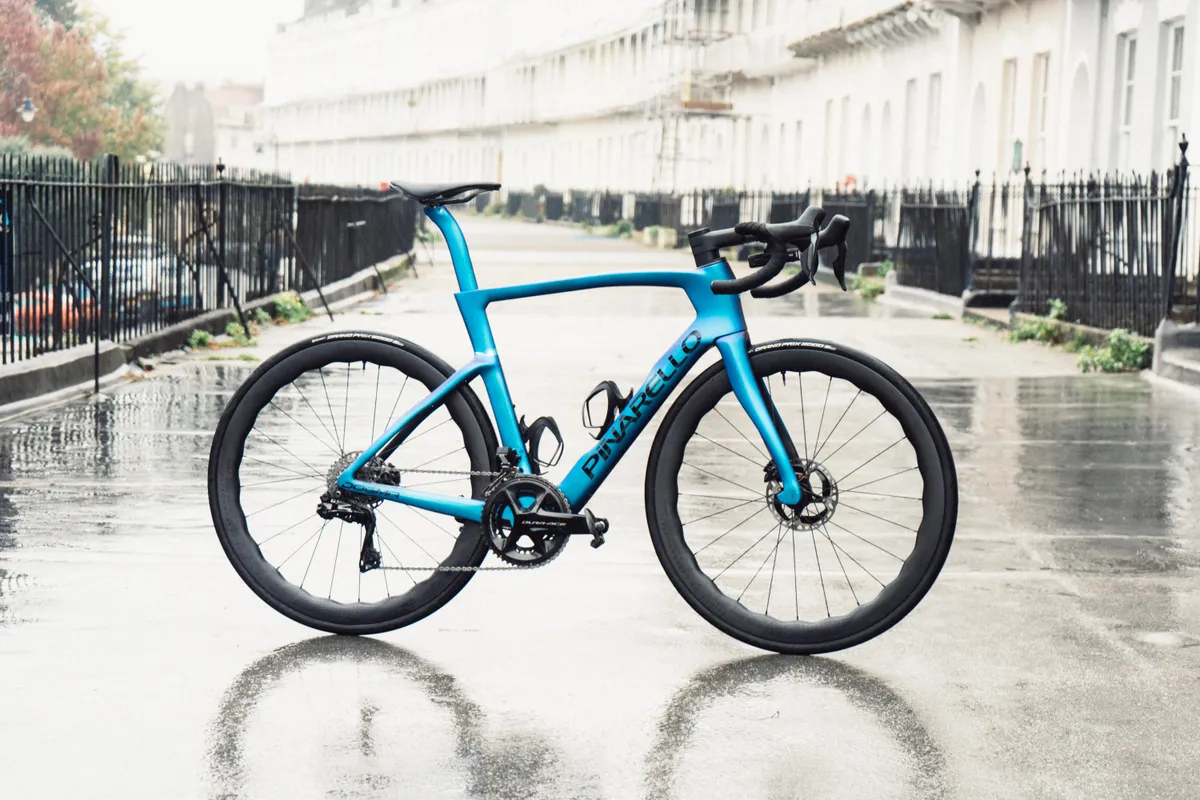
The Pinarello Dogma F is my north star for how a bike should handle. When I went to the launch of the new one I was ready to ride a bike that was just flash, all show and no go, but I came away pretty blown away, having descended alpine descents in driving rain with total confidence.
Further testing over the following six months on my home roads only cemented my love for how it rides. It's sharp and agile, but just remaining the right side of feeling unstable. It's very like the Scott Addict RC in this regard, and the two bikes share very similar geometry, but the Dogma F felt a little more taught with a complete package stiffness that aided how it holds a line a touch more than the Addict. Honestly, it's just an absolute joy to ride.
It is flash, and it is really quite expensive, and there aren't really any budget options, but for pure enjoyment it's hard to beat. It's also competitively light, tipping the scales at 7.2kg in my top spec build, so hills are no issue, and the gearing is a lot more humane than on the S5 for example. It's also sufficiently aero that you're not going to be left wondering what might have been on flat rides.
The stock layback seatpost can be swapped to an in-line option on request, which I would suggest you do if you like a modern position, but other than that I found it quite a hard bike to fault in my Pinarello Dogma F review.
Best all-road bike

This isn't just the only bike I've ever given full marks to, but it's the only product I've given full marks to; it's that good.
You get proper road bike geometry, so it handles with all the excitement and pizzaz you'd expect, but it can take 39mm tyres (with a bit of wiggle room for safety) and that, in combination with the beautifully pliant feel of the steel frame means you can ride over quite grim surfaces all day in total comfort. Light gravel is totally fine with the right setup, and it gobbles up broken tarmac with ease.
I run mine with 35mm tyres and mudguards more or less permanently, and I think running anything less than a 32mm would be doing this bike a disservice, but it's this adaptability that makes it such a winner in my eyes. Mudguard mounts, pannier mounts, a downtube set of bosses for an extra bottle, dynamo routing, modular cable guides that run outside the frame and a normal, separate bar and stem make it a tinkerer's delight; I can swap the stem in five minutes (remember when that was normal?!) and a headset bearing replacement only takes a fraction longer.
Finally, it's also a big favourite with bike fitters, as each frame size comes in a 'tall' variant, with a longer head tube to increase the stack height, meaning you needn't run a huge stack of spacers if you aren't a flexible race whippet.
My Fairlight Strael 4.0 review waxes lyrical about all of the other good stuff I don't have the space to go into here.
Also consider
It'd be easy to simply stuff in a list of bikes we've also reviewed, but that wouldn't be a very useful thing to do. Some bikes, however, we do think are worthy of consideration still but didn't quite make the cut.
The Canyon Aeroad and the Trek Madone are both fantastic machines, but they couldn't quite match the Ostro for all-around performance, and neither were they quite as aero as the Cervélo S5, but neither of those bikes would leave you disappointed.
Likewise, the Van Rysel RCR-F has really very good aero credentials, but the value proposition isn't as good as that of the Canyon Ultimate for those looking to stretch their money, and the low stack height and racy position will be hard to fit for some, though for dedicated racers rather than just enthusiastic road riders it's absolutely worth considering.
The Factor O2 VAM is a brilliant and extremely lightweight machine, as is the new Specialized Aethos 2, but the former is more expensive than the Scott and the integrated seat post is less easy to live with, and the latter does not handle quite so well, but both are worthy of consideration for those after a weight weenie build.
The Specialized Tarmac SL8 and the Cannondale SuperSix Evo are both strong contenders for the 'best overall' spot, but the Factor ultimately won out on grounds of aerodynamics over the SuperSix, and configurability at point of sale over the Tarmac.
Finally, the Ridley Noah Fast 3.0, a bike that I absolutely adored riding, as did several of my colleagues who have thrown a leg over it. It's an absolute hoot to ride, has a very good aero package and is very, very stiff, and for a race machine it's hard to look past but it isn't quite as aero as the S5, and the hyper-modern position means you can't ever really chill out and ride it in a gentle manner, but rather it makes you feel like you have to put the hammer down every single time.
How to choose the best road bike for you

We're well aware there is a bewildering array of options out there. Aero, lightweight, endurance, it can be a confusing landscape so it's natural to have a couple of questions.
Fortunately, we have a whole guide on how to choose a road bike, so if you're absolutely awash with confusion then head there, but otherwise, we'll cover the basics below.
Do I need a road bike?
This is the most important question and one that will depend on the type of riding you intend to do. If you are only going to ride on the road then a road bike is a natural choice, but if you're going to be riding a bit of gravel then perhaps one of the best gravel bikes or best gravel race bikes will be a better choice.
Likewise, if you're primarily going to use it for commuting, then you may well be better served by one of the best hybrid bikes, with flat bars and designed for transport rather than speed.
Don't discount the best electric road bikes either. It can be difficult to tell that there's a motor on board, they're low in weight and they certainly help when you get to a hill.
What sort of road bike do I need?
Another question that it's worth considering carefully.
Are you going to be racing? In which case an aero road bike or all-around race bike may well be the ideal choice for you. However, if you're riding for the fun of it, doing long miles, or weekend club runs you may get more enjoyment from the additional comfort offered by an endurance road bike.
Likewise, the minor weight savings offered by a lightweight climbing bike can make all the difference if you're heading up Alpe d'Huez, but if you live in Norfolk or somewhere else that's as flat as a pancake, you'll not really gain any benefit, although the fast acceleration can be addictive.
Which groupset is best?
At the top end of things, where 12-speed, all-electronic shifting is the norm there is little to separate the main players, so it's all a matter of personal preference.
At the mid-range, now Shimano has introduced Di2 electronic shifting at 105 level, there is still nothing significant between Shimano and SRAM, and while Campagnolo is specced as standard on far fewer bikes it'll still compete perfectly well.
At the lower end, you'll likely find only Shimano and its Claris, Sora and Tiagra or the latest CUES groupsets. For the price they provide excellent performance, and while they don't have 12 speeds or electronic shifting they are a little more user-friendly and cheaper to maintain.
Many of the best road bikes now offer gear ratios going down to 1:1 or below, if you're concerned about cresting ascents; on the other hand, you can find bikes with narrower ranges, if you don't need such low gearing.
If you're still concerned we've a comprehensive guide to road bike groupsets to help you.
What other components are important?
Road bikes are rarely sold with pedals or will come with basic flat pedals, so choosing the best road bike pedals and pedal system for your needs is step one.
Obviously, getting the best road bike saddle that's right for you is important for comfort, as is finding the right handlebars. They're both items which can be upgraded easily and without too much expense, as are road bike tyres.
The most attractive upgrade is often to the best road bike wheels though. Many brands now fit quality wheels to their bikes, which match the price and quality of the bike. But you'll still find bikes across the price range that would benefit from a wheel upgrade.
How do we test road bikes?
The only real way to get a feel for a road bike is to put plenty of miles into it, which is what we do. Collectively we're ridden enough bikes here at Cyclingnews to know what's hot and what's not.
We'll pay attention to the handling, and see how the geometry affects things day to day and when going hell for leather. Are the tyres any good? We'll find out. Is it comfy over eight hours, or even over 18? Moreover, we'll find out if it's easy to live with too; can you swap parts easily, or is it awash with proprietary bits?
We also take a selection of bikes to specialist facilities to measure their performance. We've taken superbikes and aero wheels to the wind tunnel to measure their drag, measured tyres' rolling resistance and more, with the results informing our recommendations and available in full to Cyclingnews subscribers.
There's no substitute for time on the bike, in all weathers, so if we've reviewed a bike you can be sure we've put it through its paces thoroughly to find the hidden gems and highlight any duds so you can spend your hard-earned cash with confidence.
Read our guide to how we test for more details on our review team and our pledge to readers.