Why are you wasting hours of potential riding fun in winter when the best mountain bike lights mean you can ride the rowdiest trails right through to dawn?
Even affordable mountain bike lights are bright enough to push the pace on tasty trails for an hour or more, while more expensive sets will give near daylight conditions for several hours. Helmet lights put their power exactly where you look, so even the tightest corners or steepest drops don't catch you out.
Even so, riding at night will put a whole new spin on your rides, with everything seeming faster and totally fresh – even on local trails you ride day after day. As well as being huge fun, night riding is a great way to maintain hard-won summer fitness into the new year.
The great news is that after huge advances in lithium-ion battery, LED and display tech, light development has slowed down recently. That means proven, reliable designs at every price point, rather than troublesome tech that's been rushed into the after-dark arms race.
So scroll down our list of the best mountain bike handlebar and helmet lights from under £100 to over £500 to find the perfect products for taking your XC, trail, enduro and riding 24/7. If you want to check out our pick of models better suited for on-road use, see our guide to the best bike lights.
Best premium mountain bike light


✅ You want massive wireless power: Self-contained design means no cables or separate batteries to worry about.
✅ Excellent product support: Exposure is legendary for looking after their customers with excellent warranty and repair cover.
❌ You want max power for price: Clever tech and UK build means high price for the lumen count.
❌ You don't like fussy mounts: Mount and light bolt tensioning are a torque tightrope.
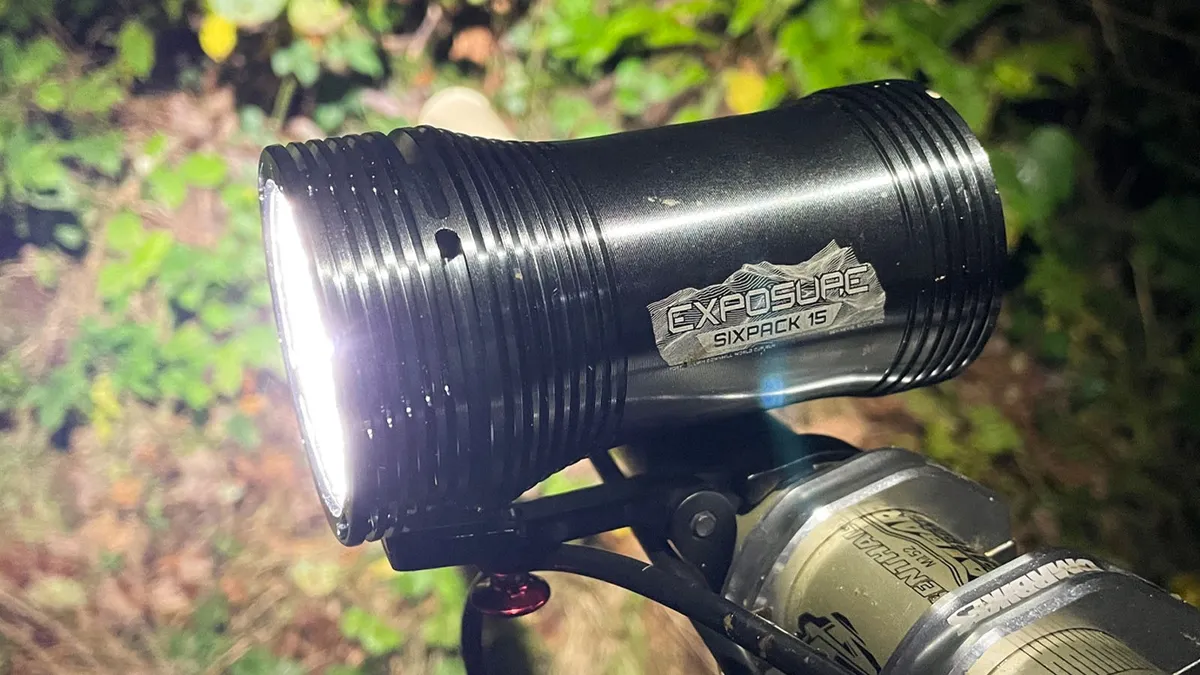
Exposure incrementally improves its lights on a regular basis, and its latest Six Pack Mk15 is its most powerful front light yet - but that's not the biggest news.
The Six Pack now has a maximum output of 6,000 lumens (peak power in Reflex mode) from six white XPL2 (W3) LEDs powered by an internal 20,000 mAH Li-Ion battery that's 17.6% bigger than the last model. The run time ranges from just over two hours to a day and half, depending on which of the seven pre-programmed settings are selected.
Three of those programs use Exposure's Reflex 2.0 technology, which uses onboard accelerometers to calculate when you’re riding downhill or rough terrain and will automatically boost the light's output to max. It will then automatically go back to its regular output when things calm down and dim significantly if you stop.
Self-rationing run times are also slightly easier on the Mk15 thanks to a new colour OLED screen on the back of the light (previous versions had a monotone LED display). The displayed run times (Reflex is by its nature something of a lottery) are actually accurate too, which isn't always the case with other lights. The screen background colour also changes 'traffic light style' as your remaining runtime ticks down.
The big practical news for this update is that the SixPack 15 swaps its bespoke charger and plug design for USB-C. That means it can be fast-charged (minimum claimed time is five hours) from any appropriate socket/plug setup. The light can also be used as an emergency power bank for other USB-C devices.
Exposure has also introduced a new handlebar bracket. The hinged clamp with clip-in inserts for 31.8 or 35mm bars is definitely easier to fit than the previous jigsaw design, and the forward-projecting arm that holds the light is longer for improved clearance on crowded bars. Our test sample had wobble in the projecting arm bolt to start with, but that was sorted by tightening to the maximum torque of 6Nm (it's not marked on the clamp, but we checked with Exposure). Both the steel arm and bar band bolts screw into alloy threads, so be sure to use a torque wrench so you don't strip the threads.
Other mounting options come in the form of stem bolt and GoPro-style mounts available separately from Exposure, but the sheer bulk of the Six Pack means they won't work on some bikes. Whatever mount you choose, the triangular shoe on the underside of the light that engages with the QR mount is a potential weak link. The connection is again a short steel bolt into alloy threads. That creates another torque tightrope between security and stripping, and we'd advise regular checks that it's tight.
Mounting issues aside, the light output from the multiple LED's is excellent with the Six Pack's seven preset programs. Program 1 provides the brightest illumination and benefits from the Reflex 2.0 technology. The 4240-lumen output in the High setting is very impressive, providing a broad beam pattern to capture all the trail features directly in front of you. This gives at least 25 meters of illumination down the trail and a good spread to the sides. Once the onboard sensors have detected you’re heading downhill, the output seamlessly increases to the maximum 6,000 lumens. That's more than enough for most trails, though, so I generally run the light in lower power settings (Program 2 or 3) to avoid any run-time anxiety.
Exposure's quoted run times are actually around 10 percent short of what I got in testing. Even once the counter runs to zero, the Six Pack still gives 30 minutes of low-power 'Reserve' light to limp you home too.
The customer support from Exposure has a reputation for being equally helpful with reasonably priced repairs and spares, as well as a generous warranty program. I even know of several Exposure lights still in circulation literally decades after being bought, which is a big plus in terms of value.
There’s no avoiding the fact that the Six Pack is expensive, but the beam is outstanding for a self-contained light. The new screen and USB-C functionality are useful upgrades, and long-term customer support is top-class.
Best XC front mountain bike light


✅ You want a fancy, focused, lightweight light with lots of features: Great speed beam for the weight with new colour screen wins.
✅ You want excellent customer service: Exposure typically look after their products and buyers for decades.
❌You want maximum lumens for your money: You can get the same peak and practical power much cheaper.
❌You want 100% reliability on all features : My sample would get stuck in peak Reflex mode ruining battery runtimes.
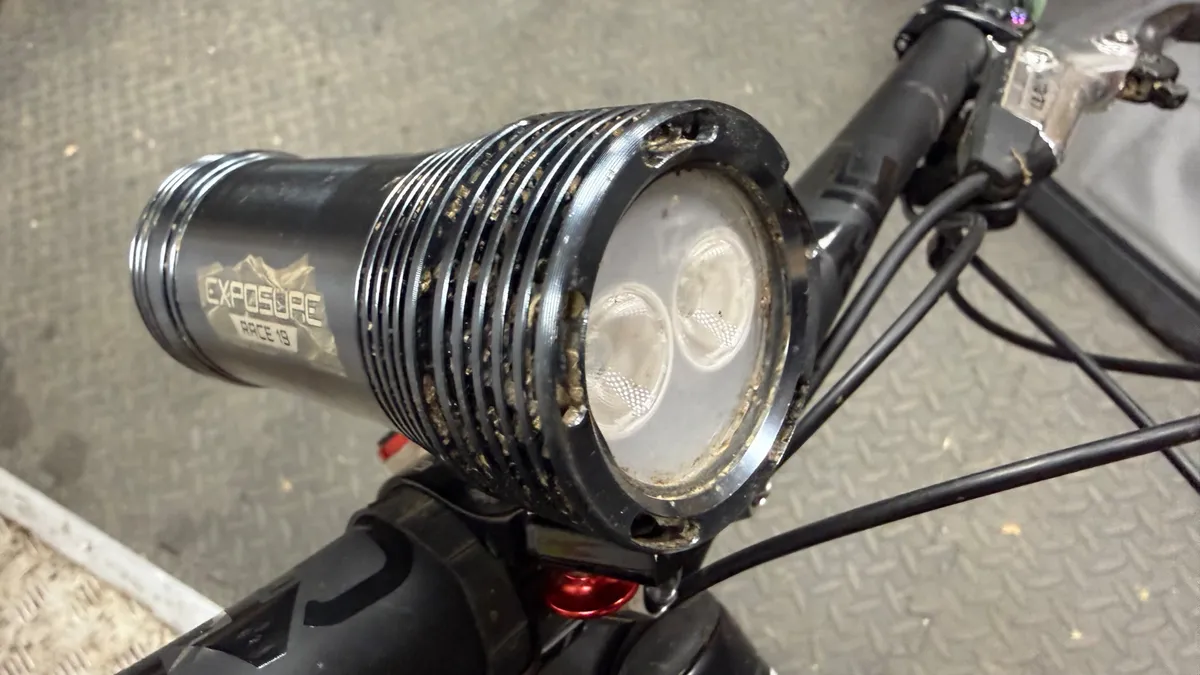
The Race is a lightweight, focused beam light that has been in Exposure's range for decades. This Mk19 is the lightest (222g) and most compact (107mm long and 41mm in diameter at the bright end) version they've made. It still uses their trademark machined alloy cylinder design with carved ribs for cooling, two LEDs at the front and a new coloured OLED screen at the back. Exposure has also introduced USB-C charging on all their latest-generation lights and you get a high-quality fast charger included with the Race.
Peak output is 2,650 lumens in the brightest of the three automatic movement-sensing, self-dimming Reflex+ modes. That drops to 1,800 lumens in the brightest of the four manual modes. The relatively narrow 14-degree spot beam flatters those numbers in terms of distance you can see on simple, straight trails. The sharp cut-off and lack of peripheral coverage can get 'Blair Witch' very quickly on more twisty tech though. That means you'd be better off with the Toro, MaxxD, or the Six Pack (see above) for trail use.
While the brighter colours make reading runtimes easier, the OLED screen on the back of the light is still harder to see than a top-mounted screen. While it's hard to read the digits as you ride, you can't miss the background colour changing from green to yellow to red as your remaining runtime ticks down.
The Reflex+ mode on my sample light would only dim after being totally stationary for several minutes though, rather than when it sensed smoother/slower riding. That meant the claimed three-hour run time dropped dramatically to around an hour. I've had better luck with Reflex on other Exposure lights though, and Will didn't experience issues with his Race sample during testing.
I did have the same potential wobble and bolt-strip concerns with the new bar bracket with the Race as I did with the Six Pack. Although the much lighter weight of the Race means it's all stayed put OK so far.
Looking at the other options in this list from Lezyne, Ravemen and Magicshine will underline the Exposure price premium you're paying for a light that isn't perfect. They are made in the UK with a three-year warranty though. Plus, Exposure has an excellent reputation for repairing faulty lights or refreshing batteries, etc., at reasonable prices, even decades after they've been bought, which is worth factoring in when deciding which light to go for.
Best trail/enduro front mountain bike light


✅ You want excellent tech trail illumination: Multi LEDs and smart optics mean superb light quality for reading upcoming trouble.
✅ Excellent practical performance: Low-profile design, solid mount, excellent reliability and simple operation.
❌ You want max lumens for your money: Outbound concentrate on quality of light not quantity.
❌ You don't want to pay hefty import charges: Delivery charges are high outside the USA and there's currently no established UK distribution.
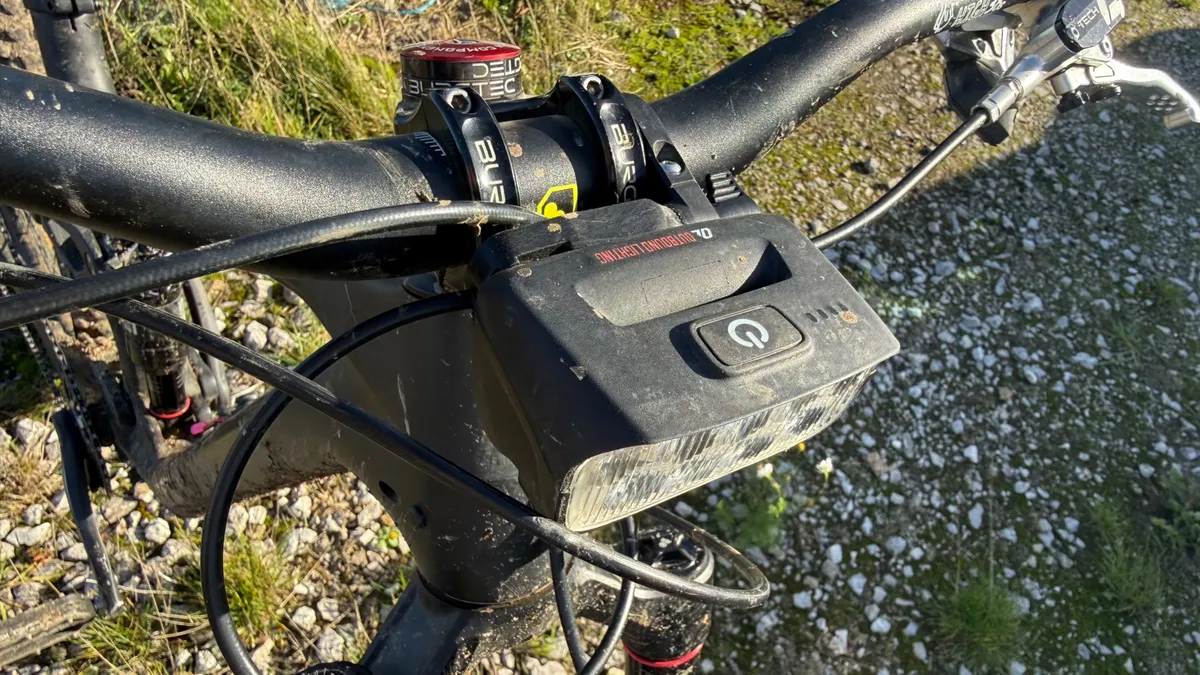
US firm Outbound Lighting is relatively new but is already floating on a raft of rave reviews from users. The Trail Evo is the flagship design of their 'broader is better' philosophy. Translating medium numbers on paper into outstanding night vision on the trail.
The secret lies in the nine double-row LEDs and broad, ribbed flood optic, which spreads light really well across the trail. The carefully curated (and extensively tested) multi-point light delivery means the 3D representation of the trail is excellent, rather than it being flattened by concentrated light.
While it's brighter in the centre for reasonable reach, it dims progressively to the periphery just as your own vision does, and the colour temperature is very natural too. There are no bright spots, dark spots, or other optical glitches to distort your read of the trail either. That all means that while the headline lumens are relatively low, the 'feels like riding in the day' result is outstanding, even compared to much brighter lights.
The transverse rather than inline (torch style) design mounts the battery across the back of the lights. Critically, they're separated by cooling airflow from a big chin scoop so the LEDs and battery stay efficient rather than cooking. Once you've got it bolted into place and learned the clip-in knack, the light is held centrally in front of the stem and it's totally wobble-free too. There's even an optional cable clip to make sure all your control lines stay out of the way under the light.
The final cunning trick is the default Adaptive mode that starts the light at full power and then throttles it back to medium as your eyes adapt. That keeps actual vision levels the same but extends the run time by an hour. Alternatively, you can 'epic up' your Trail Evo by using a plug-in USB-C battery to pass-through charge while you're riding.
Compared to the screen-equipped lights, the four LED 'traffic light' battery communication is basic, and there are only three modes to switch between. That's all you really need, though and the reliability and run time gains from a simpler system are a real practical bonus. My tested run times were 10 percent longer than Outbound claim too, which is a nice change.
Considering it's handmade in the US and the customer support is outstanding by all reports, pricing is excellent, and they offer bundle deals on helmet and handlebar combos too. Unfortunately, shipping to the UK and Europe is expensive, so be sure to factor that into any buying decisions.
Best budget front mountain bike light


✅ Excellent tech for the price: Great screen and loads of Smart Control and charging features.
✅ Rock-solid reliability: I've used several sets for years without a glitch and the waterproofing is outstanding.
❌ You want the longest run times: Extra tech means the internal battery life is relatively short.
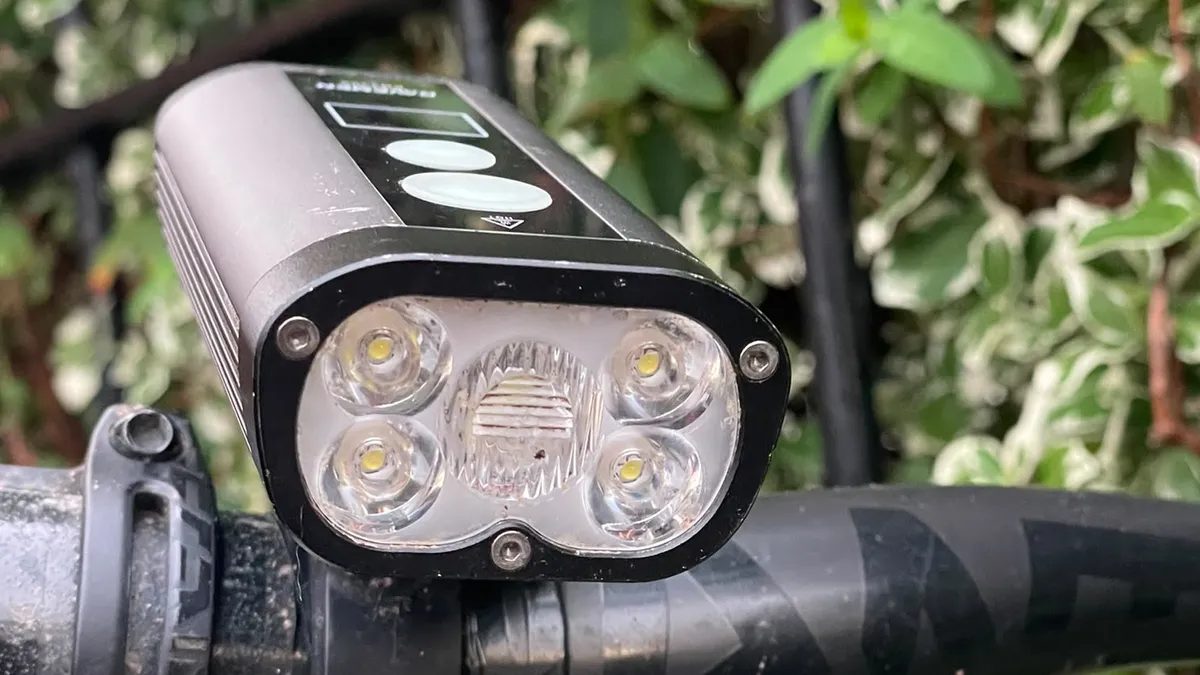
Ravemen's PR2400 has been my top value choice for a decent beam with really useful smart tech and outstanding reliability for years.
Illumination comes from one powerful central refracted LED and four corner spot lights. The MTB mode uses all of these LEDs to give a good balance of width and reach in three 2,400 to 600 lumen outputs. There is a slight central hot spot if you're being picky, but it's not enough to be distracting and the three modes mean you're covered for crazy, cruising and crawling. There's also a road bike menu which just uses the diffused central LED four 900 to 100 lumen outputs. These are all controlled through two central top side buttons which are easy to use with gloves, but you also get a wireless remote switch included too.
A simple but bright OLED screen gives accurate run time and charging information. This is invaluable for rationing the adequate but not amazing run time, so in reality, 3-hour mixed terrain rides aren't an issue. You can also plug a power bank (or e-bike) into the back of the light to boost run times or use the light itself as a power bank.
Sturdy metal flaps over the charge ports give class-leading IPX8 waterproofing and in several years of using several PR2400s intensively, I've never had a single reliability issue. Battery life has stayed decent too, so they're obviously using quality cells.
The previous downside of a round bar-only mount has now been sorted with an optional 'universal' band-on strap for flat/aero bars. Either way, you can slide the light on and off and leave the mount in place so you're not resetting angles and tightening clamps every ride. That leaves only the lack of a top lip/peak as a potential dazzle hazard if you're climbing out of the saddle, but that's a really niche niggle.
The result is an absolutely outstanding all-round, on- or off-road light with a very well-proven reputation at an excellent price.
Best front mountain bike light for beam power


✅ You want the brightest light available: 12,000 lumens is still the biggest output around.
✅ You want max lumens for your money: You always get a lot for your cash with Magicshine.
❌ You're worried about weight and bulk: 12,00g is a chunk of weight and the battery isn't always easy to find a home for on your frame.
❌ You want quality of light over quantity: Max power is overkill for most situations and the beam isn't as smooth and 'readable' as some
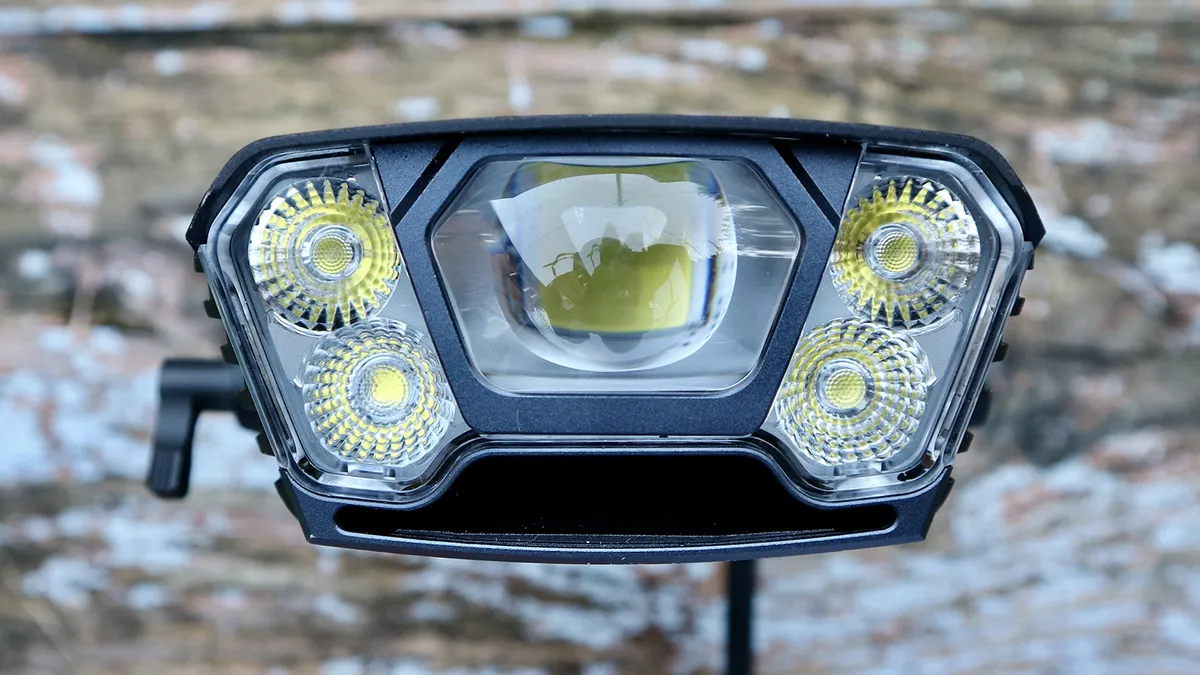
If you want maximum trail illumination, then the Magicshine Monteer 12000 is the light for you. As the name suggests, it kicks out a huge 12,000 maximum lumen – which is more than twice as much as any other light in this article.
The twin clamps on the lamp are designed for 35mm bars, but you get shims in the box to fit thinner diameters, while the separate battery pack has Velcro straps for mounting to your top tube.
The light can be toggled between four different output settings – 12,000, 6,000, 3,000, 1,000 lumen – with claimed 2.1, 7, 11.5, 37 hour run-times respectively. In testing, we mostly used the light in its 6,000 lumen setting on the trail, as the highest setting was so bright, light would bounce back off trees and other nearby objects making it more difficult to see. But on fireroads and open sections, the full power beam extends further and wider than anything else we've used.
Our reviewer, Paul Burwell summed up the Monteer 12000: "With this much power on tap, you can ride as fast at night as you do during the day. And at under $500 you’re doing it for less too."
For more on this light, see our full Magicshine Monteer 12000 review.
Best easy to fit front mountain bike light


✅ Excellent beam: 'Fill rather than far' beam is great for MTB.
✅ Bombproof reliability: Simple design means nothing goes wrong.
❌ You want a fancy display: A simple 'traffic light' is all you get for run time and recharge.
❌ Totally solid mount: Rubber strap can waggle a bit, but it'll fit anything.
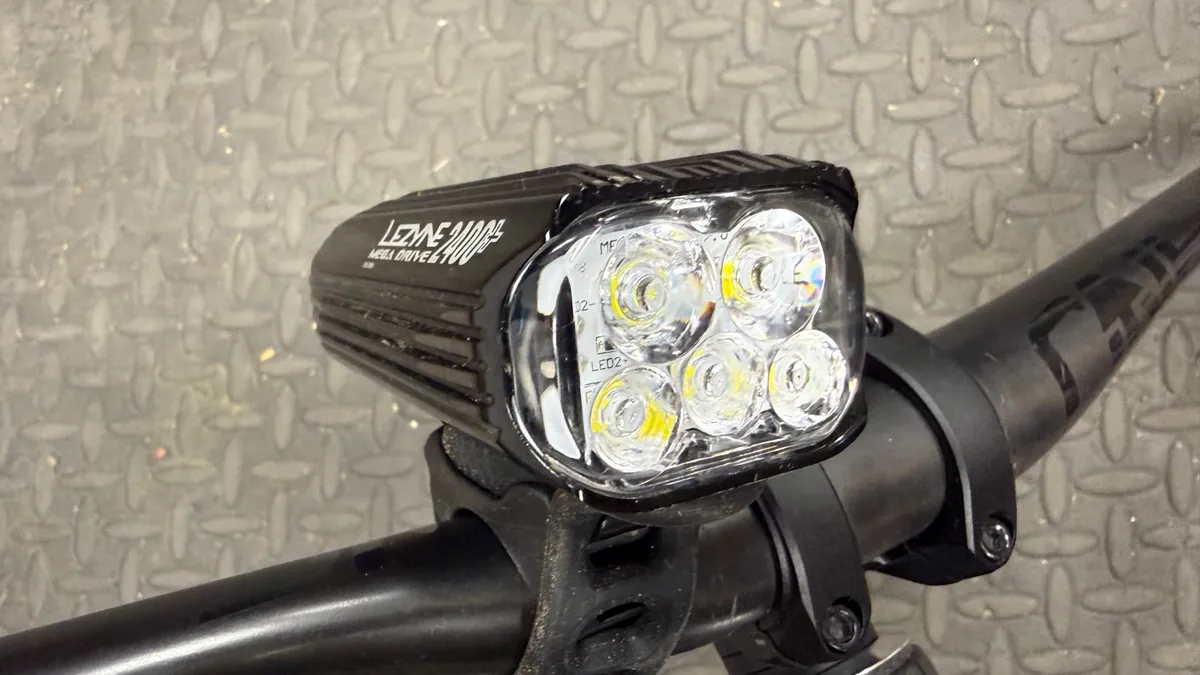
My top-rated, top-value grab-and-go light for years now, the Lezyne 2400+ is a great example of why simple can sometimes be best.
Simple doesn't mean low quality, though and the five LEDs (three medium, two big), built-in battery and CNC-machined casing are all top gear. The output is concentrated on well-graded fill rather than focused for far too, so it's great for twisty, techy trails. There's even a top lip to shield your eyes from glare when you're out of the saddle.
While there's four steady (300 – 2,400 lumen) and four flashing (700 – 20 lumen) modes in the default setting, selecting between them is a nightmare to navigate on the trail.
Race mode is much better; this toggles between 2,400 lumen full power for the sketchy sections or 700 lumen cruise with a single button push. It'll remember if you had it in 'Race mode' when you switch it off/on again too, so you don't have to reprogram each ride.
Extensive fins and efficient design mean I had no issues with ‘thermal throttling’ either. So it keeps running bright as long as you need, rather than dimming to protect itself from overheating.
Charge/discharge communication is limited though. There’s no set up app or wireless/ wired remote options, and the milky 'orange' half-full light actually comes on at 65 percent of run time left. Even after you've emptied the red warning segment, there's still a limp mode that adds 25 minutes of emergency crawl. The high-capacity 9,600mAh battery works as a power bank, and you can 'pass through' charge the light from a USB-C power pack or e-bike battery. As always, that will reduce the otherwise excellent waterproofing rating.
While the rubber strap mount will fit on any bar shape or even a stem/fork leg, it does allow some wobble on really rough terrain. If you find this distracting, then it's definitely worth getting the more secure round bar band mount.
Best mountain bike helmet light


✅ You want a super-light, premium-quality light: Bright enough with barely noticeable weight and a brilliant mount.
✅ Excellent customer support: Exposure has a loyal following for good reason.
❌ You want max power for your money: The lumen to price ratio is half (or less) than that of some competitors.
❌ You want long run times: You'll need an extra power pack for epic adventures.
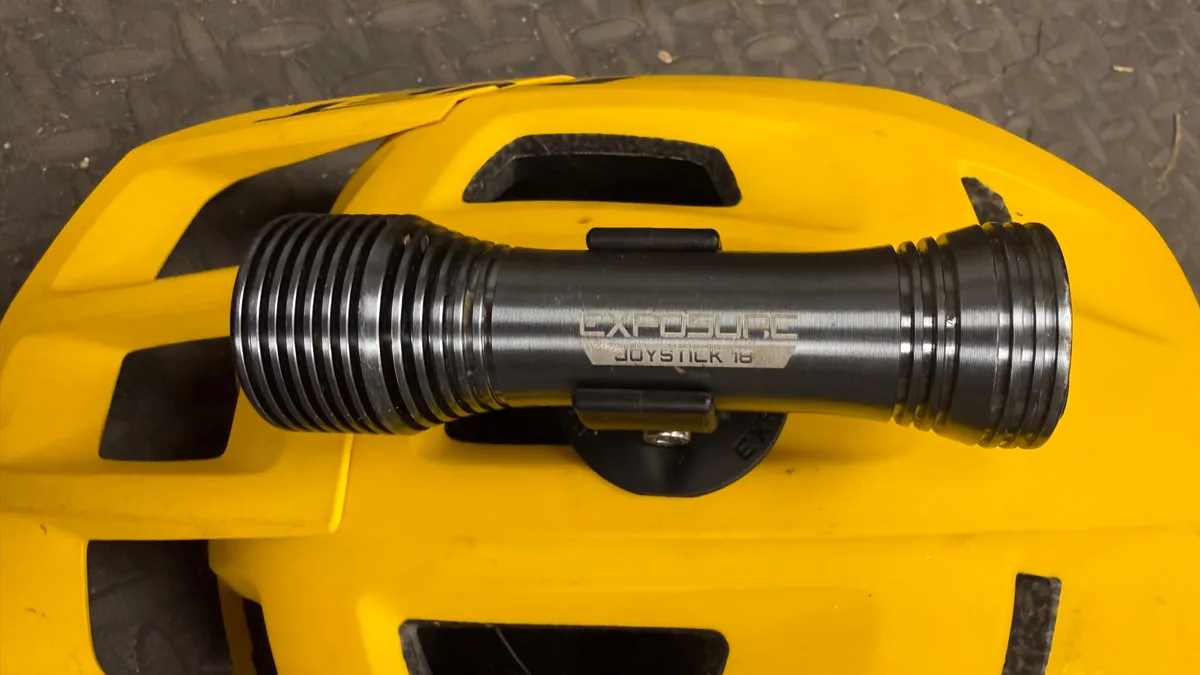
Meet a serious UK mountain biker at night and they'll almost certainly have an Exposure light of some sort on their helmet. And while the range has now been expanded with the more powerful Diablo and Zenith options, the 105g, 1,200 lumen Joystick is still the lightweight icon.
As it's a dedicated helmet light, the beam uses a single high-power LED behind a focused optic to maximise targeted reach. There's still enough peripheral coverage to stop it being disorienting in complicated trail situations or disrupting the fill from a bar-mounted light though.
The ultra-low weight means it basically disappears on your helmet in terms of neck strain. The ingenious double-disc vent clamp now gets a GoPro-style joint for better articulation too. You will need to check that your helmet has a suitable central vent to mount it symmetrically; otherwise you'll need a glue-on base plate.
Run-time and recharge communication is still through a single traffic light LED system, but the 18th version of the Joystick introduces super-fast USB-C recharging.
You can also run the light with a power pack attached, which is super useful for extending the inevitably short run times of the internal cell.
Run times can be managed through the six different 'OMS+' mode menus. The 'tap the light' mode change tech is theoretically great for switching between modes too. You need to set it to the appropriate sensitivity level for your riding though, or it can start self-switching on rough sections of trail – which is the last thing you want.
I've found button operation of this Joystick - and other Exposure lights can be niggly and unit reliability can be variable. But you can always rely on Exposure to look after you in the event of an issue. So while initial cost might seem very high for the bare performance figures, you should factor the long likely lifespan of your light into the value equation.
Best trail/enduro mountain bike helmet light


✅ You want excellent all-round illumination from your lid: Multi-LED design seems way more powerful than the numbers suggest.
✅ Super clever compact design: Low front-of-helmet mount gives great vision and tree clearance.
❌ You want maximum focused reach: The Hangover is the Outbound light you want for more focused depth of vision.
❌ You don't want to pay import duty from the US: Great USA Outbound value gets hammered when the products cross the Atlantic.
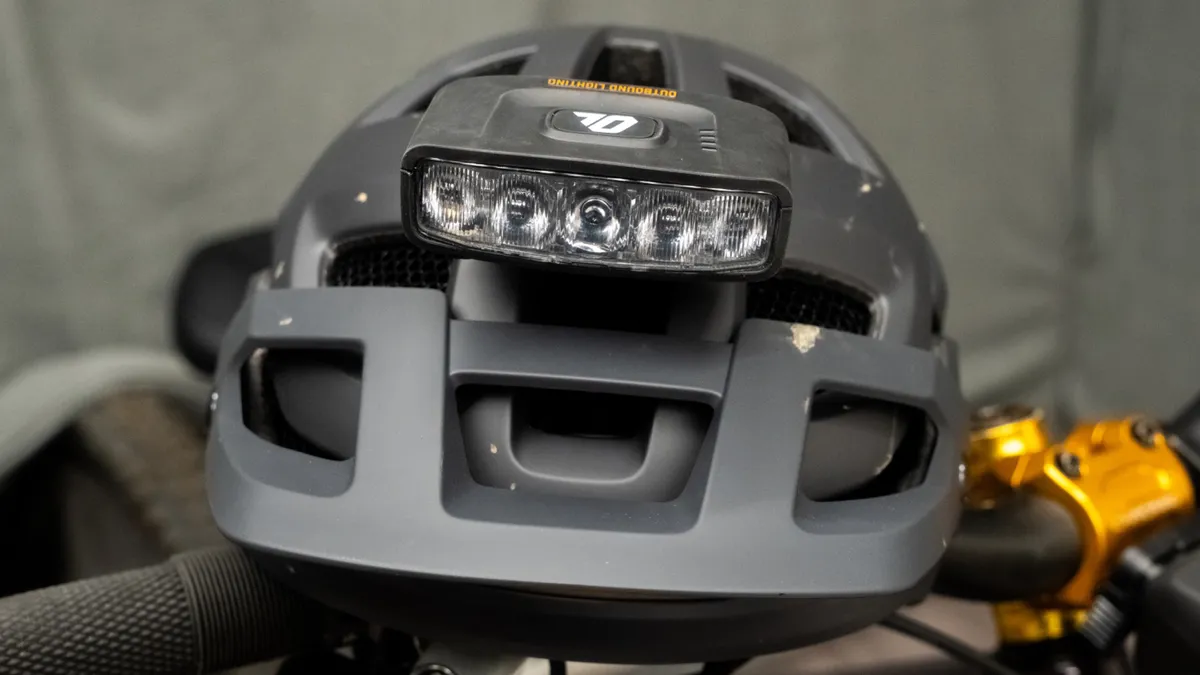
Outbound Lighting offers two US-made helmet lights, but the Portal tested here is the one you want for standout illumination of technical trails.
That's because the five-LED array behind the super-smart optics gives an outstandingly natural and easily interpreted 'read' of the terrain in front of you. Not just from the '3D render' effect of the multiple light sources rather than a shadowy single point source, but also because of the carefully calibrated colour temperature of the LEDs.
The LEDs also operate at a lower current density than most designs for higher efficiency and less heat. A small fin radiator under the chin also chills things out to extend run times from the relatively small battery, so actual tested times were significantly longer than claimed.
If you're riding alone (so that no one can overshadow you from behind), the Adaptive Mode is really smart. It starts with five minutes of high beam before a gradual 30-minute dim to medium as your eyes adjust to the darkness and I genuinely struggled to notice the difference until I blipped it to full power – which then seemed overkill.
Battery and mode communication is via a four micro-LED traffic light strip with an additional low battery flash warning for the 20 min 'get you home' limp mode. Counterintuitively, the sheer size of the stiff top button can make it hard to recognise with winter gloves at first. The need for a hefty press reduces the risk of it switching on accidentally in your kit bag etc. A wireless remote is in the pipeline too.
The low-profile design and rear-mounted 'action camera' style mount keeps the unit low on your lid so there's less chance of catching it on branches and it's very stable too. The Portal is light enough for the forward mount not to strain your neck noticeably either.
Finally, Outbound run their entire operation from design to building and customer service in the US. This includes a three-year warranty with an extended "don't-be-a-jerk" reduced cost repair service policy that covers everything - including gnarly crashes - as long as you have a great story behind it!
US manufacture does mean a hefty import duty price hike if you're buying from elsewhere though, so either find a local distributor (there currently isn't one for the UK) or buy one of Outbound's bundle deals to save a bit of money.
Best budget mountain bike helmet light


✅ You want a super bright spot beam at a great price: 1600 lumens for under £100 is great value.
✅ You want indefinite battery life: Just take reload cells if you're feeling epic.
❌ You want a broad beam for handlebar use on tech trails: While there is some peripheral shine, most of the power goes straight down the line.
❌ You want a fancy display: The Fenix does all its charge communication with a single, not entirely intuitive LED.
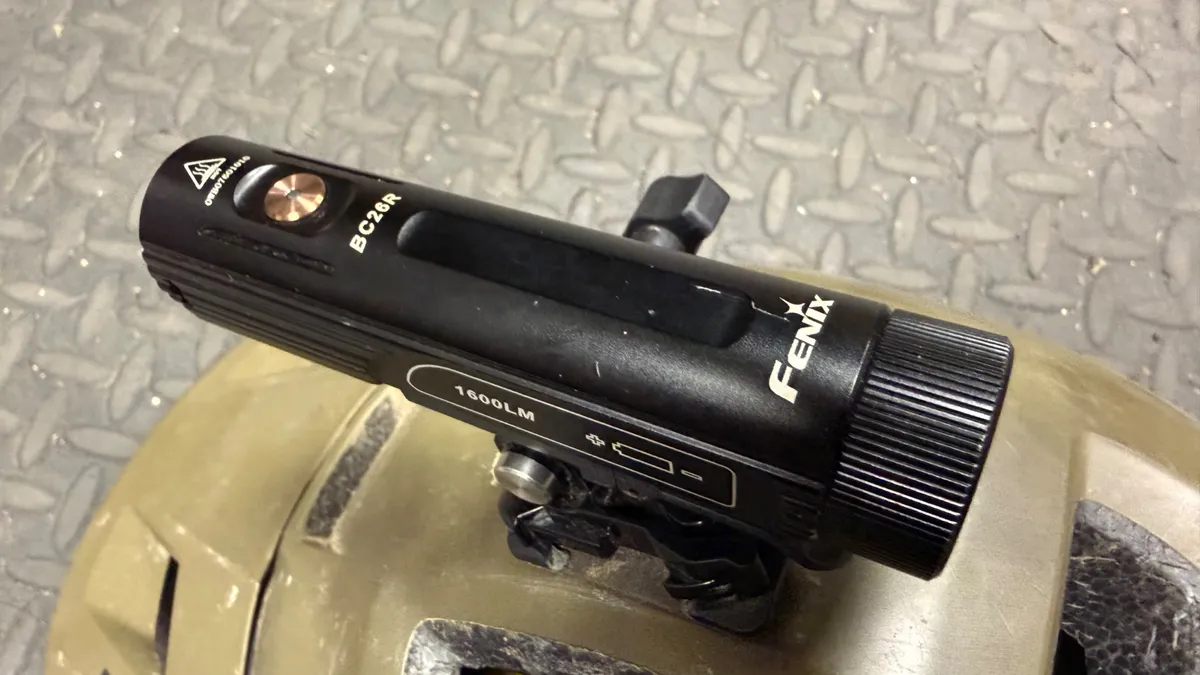
Fenix produce all sorts of high-value, high-power lights, but their compact, powerfully focused BC26R is a particularly great option for helmet use for a whole load of reasons.
Firstly, the single LED is tightly focused for a seriously impressive reach down the trail, which works great in a helmet-mounted context if you use the strapped 'action camera' style mount. You also get a really good, secure, angle-adjustable QR handlebar mount included, which works great for fast, simple gravel-style trails or road work. The lack of wider peripheral coverage reduces context and overall awareness, as well as 'see round the corner' performance on more twisty tech trails though.
My actual tested run times were half what Fenix claim, but they're still good for the size and weight. In warm weather use, the thermal throttle will often cut in to stop overheating and extend run times anyway. There are also 600, 200 and 50 lumen lower settings to eke out your energy.
As a nice practical touch, the flash mode requires a button hold rather than just a press, so you won't strobe yourself silly accidentally. However, the easy-to-press button can turn on accidentally if you chuck it in a kit bag, but on the plus side it's easy to use with winter gloves.
An accidental 'on' is easy to get around by unscrewing the end cap and pulling the single 21,700 rechargeable battery cell out too. Being able to remove and swap the battery also adds the huge advantage of being able to reload the light as many times as you have spare cells for unlimited epic potential. At under £30 a battery, that's awesome value compared to a power bank, and it doesn't compromise the excellent waterproof rating like a power bank does either.
It's worth noting that the light indicator on my sample needed some learning though, as while the green level started flashing very early, it lasts until 50 percent charge. From there, it's red until it starts flashing very shortly before it gives up entirely. Once I'd learned that, reliability has been flawless through two intensive use years. Fenix also offer a limited lifetime warranty and free five-year repair service, which improves already impressive value even more.
Best mountain bike lights comparison table
Model |
Light type |
Max lumens |
Runtime (on max power) |
Weight |
Charger |
Battery capacity |
IP rating |
Exposure Six Pack 15 |
Front |
6,000 (in Reflex mode) |
2hrs 10mins |
411g / 14.5oz |
USB-C |
20,000mAh |
IP67 (dust-tight, fully submersible in water up to 1m) |
Exposure Race 19 |
Front |
2,650 (in Reflex mode) |
1hr 5mins |
222g / 7.8oz |
USB-C |
8,000mAh |
IP67 (dust-tight, fully submersible in water up to 1m) |
Outbound Trail Evo |
Front |
2,200 |
1hr 45mins |
276g / 9.7oz |
USB-C |
10,000mAh |
IP65 (dust-tight and withstands low-pressure water jets) |
Ravemen PR2400 |
Front |
2,400 |
1hr 40mins |
304g / 10.7oz |
USB-C |
8,000mAh |
IPX8 (fully submersible in water over 1m) |
Magicshine Monteer 12000 |
Front |
12,000 |
2hrs 10mins |
1,197g / 42.2 oz |
USB-C |
10,000mAh |
IPX6 (withstands high pressure water jets) |
Lezyne Mega Drive 2400+ |
Front |
2,400 |
2hrs 26 mins |
335g / 11.8oz |
USB-C |
9,600mAh |
IPX7 (fully submersible in water up to 1m) |
Exposure Joystick 18 |
Helmet |
1,200 |
1hr 40mins |
125g / 4.4oz |
USB-C |
4,000mAh |
IP67 (dust-tight, fully submersible in water up to 1m) |
Outbound Portal |
Helmet |
1,650 |
1hr 30mins |
190g / 6.7oz |
USB-C |
5,000mAh |
IP65 (dust-tight and withstands low-pressure water jets) |
Fenix BC26R |
Front/helmet |
1,600 |
1hr 40 mins |
184g / 6.5oz |
USB-C |
5,000mAh |
IPX7 (fully submersible in water up to 1m) |
How to choose the best mountain bike lights
How many lumens do you need for mountain biking at night?
With advancements in LEDs and batteries, it's possible to buy bike lights that are several times more powerful than car headlights. Lights are rated in lumens but it's an imperfect measure because the calculation is based on the LED power and battery charge in ideal conditions. In the real world, lights deal with limitations created by circuitry, and thermal rollback – that is, when a light automatically reduces its output to prevent it from bursting into flames.
Most lights designed for trail riding are rated to a minimum of 2,000 lumens, and the lowest-power bar light we've recommended here is 2,200 lumens. That said, if you're using a bar and a helmet light setup, you can get away with less.
Are bar or helmet-mounted lights better?
In a light system, bar-mounted lights should provide the majority of the lumens, flooding a wide beam down the trail. Mounted below your eye line, this light creates shadows helping you to spot rollers, rocks, and roots as well as creating some depth perception.
Helmet-mounted lights shine where you're looking, helping you see around corners, over rocks and anywhere your bars aren't pointing. This light doesn't need to have the power of the sun and should have a tighter beam pattern than your bar lights.
If possible the best option is to have both helmet and handlebar-mounted lights simultaneously to get the advantages of both setups to illuminate as much of the trail as possible.
Does beam shape matter?
When we talk about lights, lumen count usually grabs the headlines, but the beam shape is equally, if not more important. Ideally, you want something that will have a smooth transition from flood to spotlight with no dark spots or hotspots as this can distract from the trail.
If you're doing lots of high-speed riding and your trails aren't all that curvy, a narrow spotlight beam will suit, but if your local singletrack is twisty and more technical, look for something wide and bright.
What type of battery is best?
Pretty much every light will use a rechargeable lithium-ion battery. Some lights will be completely self-contained, while others will use a separate battery pack.
Self-contained lights eliminate the awkward cables and cumbersome battery packs, however, they are usually bigger and considerably more substantial.
For lights that have a battery pack, consisting of the head and the battery; you'll need to find somewhere to put the power pack, either on your bike or in a backpack. As batteries degrade over time, external packs can be replaced or upgraded, and some brands offer options with different capacities.
How much battery life do I need?
A light that won't last the entire duration of the ride is about as useful as a puffer jacket in the middle of summer. Take into account how long you're planning to ride (keeping in mind that you're probably going to be slower in the dark) and factor in some extra time.
Also, keep in mind that many batteries are affected by temperature, and the cold can have a severe effect on run time. If you live in an area where nighttime temps go below freezing, consider buying a bigger battery or storing it somewhere that's insulated from the cold.
Knowing how much juice your light has left is also vitally important. Some lights have rudimentary green, orange, and red battery indicator lights, while others will show you the time or percentage remaining. Some of the lights in this guide have an in-built backup 'limp mode' that will give you just enough light to get you home if you do get caught short.
Do I need a rear light?
Rear lights for mountain biking are less important as you don't need to be visible to traffic while on the trail. However, if you do need to ride on the road, whether as a connection between trails or in case of emergency, you will need a rear light so that cars can see you in the dark. Rear lights are also a nice safety feature for riding on the road in the daytime. A rear light will make you more visible to drivers.
A rear light doesn't need to be as bright as your front and we recommend looking for a 70-lumen rear light for general countryside and city riding. All rear lights will have at least a constant and flashing mode these days although different brands will offer various power modes and flashing patterns that are designed to increase visibility. Daylight modes differ from standard night modes as they rely on disruptive flash patterns to attract attention.
Fitting commonly uses silicon straps to mount lights to a seatpost, and is easy to attach or remove quickly. While most lights will accommodate a wide range of seat post sizes it is still worth considering fitting options. Especially important if you have a dropper seatpost or are looking to mount your light to seat stays, helmet, or saddlebag. See our main best bike lights guide for rear options.
If riding muddy trails, don't forget to wipe your light down before hitting the roads. Your rear light is in the firing line for getting covered in crud!
How we test the best mountain bike lights
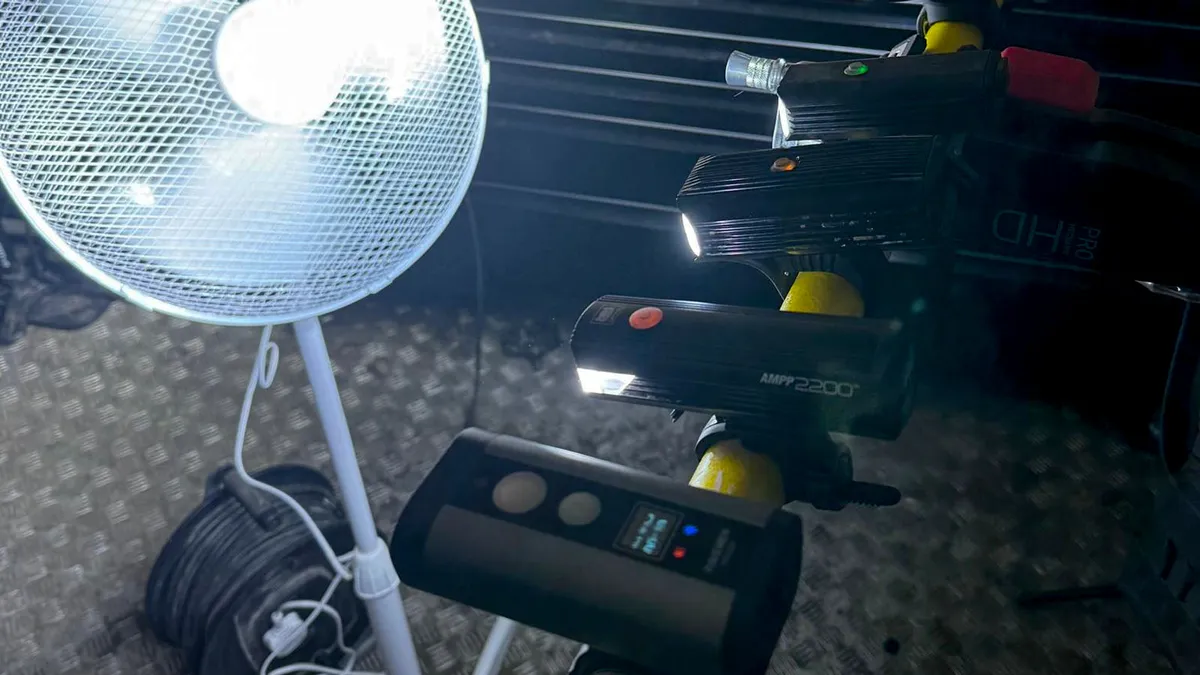
Every light I've recommended here has been put through its paces for months, if not years. I've also tested generations of most of the lights featured in this buying guide. Which means the information here is not only bang up to date, but also properly trail-tested in all weathers.
Testing means beam patterns assessed at speed on tight, twisty, tree-lined singletrack as well as open moors – not just pointed down a garden. Mounts that have been rattled (and sometimes rattled loose) down the roughest descents, and crashed hard when lumens and luck have run out.
All the run times are the averaged results of multiple tests in realistic air-cooled conditions, not just pulled off manufacturers' websites or run without cooling so they overheat and throttle back. Which is why our numbers and conclusions may well differ from other results out there.
For more on Cyclingnews' testing, see our How We Test article.