The best exercise bikes allow you to get a workout and stay fit without leaving home. That may be via an online class or just by pedalling by yourself, perhaps following a training plan or workout routine.
If you're looking to follow a class online, the best known spin-style exercise bikes are from Peloton and Echelon, although both have a hefty up front price and a recurring monthly subscription.
Last updated on 27th February 2026
Whether you have bike riding goals or want to get a bit fitter before summer, now is the time to start your training. We have picked the best exercise bikes that are available today and will allow you to easily complete your workouts at home.
Best exercise bikes
You can trust Cyclingnews Our experts spend countless hours testing cycling tech and will always share honest, unbiased advice to help you choose. Find out more about how we test.
Best budget Peloton alternative

✅ You want spin-style workouts but without the Peloton price tag: Not only is Echelon's exercise bike significantly cheaper to buy, but the monthly membership is also more affordable than Peloton.
❌ You don't have a suitable tablet computer at home: To keep costs down the Echelon Connect Sport doesn't have a built-in screen so you will need to have a compatible device to use for your at-home spin sessions.
This budget Echelon exercise bike, the Connect Sport, offers much of the functionality of its higher-priced siblings but saves money by excluding a front-mounted screen. Instead, owners of this exercise bike will need to bring their own screen, which if you already own a smart device such as a tablet (or want the versatility of owning a separate tablet device) won't be an issue at all. Simply load up the Echelon Fit app on your device, connect the bike via Bluetooth, and you'll have access to all the classes you need.
It comes with a 7kg flywheel, which left us wanting more on occasion, although the magnetic resistance did help to prevent the draggy feeling that can plague some of the more budget exercise bikes. A total of 32 resistance levels offers a good spread of difficulty levels, while the 96 x 51cm footprint is stable enough for all but the most rigorous efforts.
You can make Echelon purchases even more affordable with our Echelon coupon codes.
Best budget Peloton Bike

✅ You want the cheapest Peloton bike option: The basic Peloton Bike is its most affordable exercise bike.
❌ You want to avoid Peloton's high recurring fee: Don't forget to budget in the monthly membership costs.
❌ You want automatic resistance changes: Automatic resistance change is a feature reserved for the premium Peloton Bike +; instead you will need to manually control resistance using a knob adjuster.
Exercise bikes have been in gyms for as long as we can remember, but Peloton has changed the game and reinvigorated a segment of indoor training for the masses beyond the Zwifters. In terms of the Peloton Bike itself, it's really not all that revolutionary; a knob near the handlebars adjusts the resistance, a 17kg flywheel maintains inertia, the saddle and bar position are adjustable without tools and there is no freewheel so you can't coast.
But it's not the bike itself that has created the phenomenon, it's the sweatproof 21.5-inch touch screen at the front. This enormous head unit is WiFi, ANT+ and Bluetooth enabled and runs the Peloton app which features thousands of pre-recorded classes as well as live classes run by professional instructors.
One thing the app doesn’t do is adjust the resistance; you’ll have to do that manually to hit your targets. The higher-priced Bike Plus, seen below, can offer this functionality.
As with any of the other training apps, the sessions range in difficulty from easy spins to disgustingly difficult; there are scenic rides too. Peloton has also added a community aspect to its ecosystem; you can follow and chat with other people who are doing the same class and see live rankings on who is pushing the most watts.
Best premium Peloton alternative

✅ You want a fully functional Peloton alternative: A large touchscreen makes it easy to follow your workout.
✅ You want deathly silent operation: The magnetic resistance gives a very quiet riding experience so your spin classes shouldn't disturb anyone.
❌ You want automatic resistance changes: The 32 levels of magnetic resistance are controlled using the resistance knob mounted on the central strut.
The EX-5S is a more premium step into Echelon's ecosystem, and in this case, there's no need to bring your own screen, since it comes with a large 22-inch sweatproof HD screen mounted up front. A slightly larger footprint helps to offset the top-heavy weight added by the screen, so I found that it remained stable in all workouts, and it's widely adjustable, so it will fit most of the family.
The same 32 levels of resistance provide the variable resistance, however, unlike even the budget smart bikes, it still doesn't offer 'ERG' mode, so all resistance changes will need to be done manually, rather than electronically.
Best Peloton exercise bike
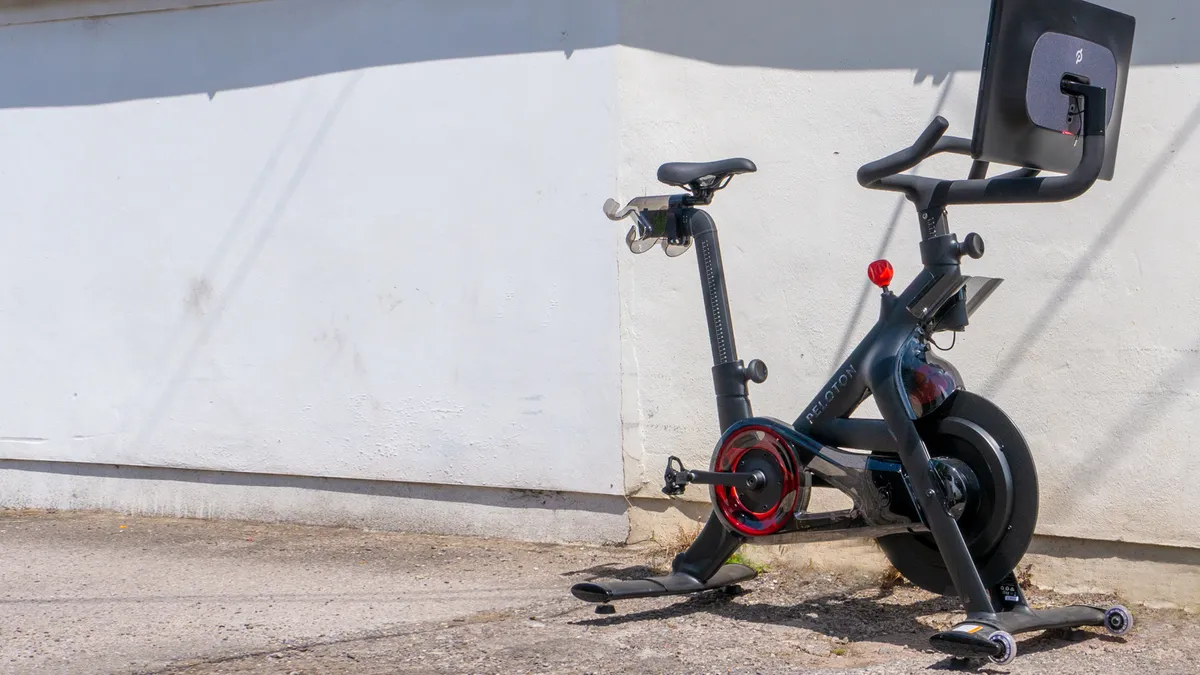
✅ You want automatic resistance changes in the Peloton ecosystem: With the Bike + the drag can be controlled automatically by your online class instructor so you can concentrate on your effort.
❌ You want to avoid high recurring subscription costs: The Peloton monthly subscription is more expensive than Echelon and significantly more expensive than the likes of dedicated cycling apps like Zwift, TrainerRoad and Wahoo X.
Peloton's most recent response to the rise of the smart bike is the Bike Plus. This takes the original Peloton Bike and adds a slew of updates like a larger screen that is more adjustable, more speakers, a better camera, Apple Watch integration, USB-C charging and more. However, for us, it's the integration of 'auto follow' that sets this Peloton apart from its direct competitors.
Auto-follow - perhaps better known as 'ERG' mode among the smart bike scene - allows the app (in this case, the Peloton app) to control the resistance, rather than relying on the athlete to twist the knob on the top tube (though this does still exist). It also includes a power meter to more accurately measure and report on a rider's output. In use, I found this could be a little delayed at times, but it mostly made life easier, not having to remove your hand from the bars to adjust the resistance.
Among this genre, I see the Peloton Bike Plus as the most complete device currently available, but in my opinion, from both a technological and user interface standpoint, smart bikes still win out due to the addition of gradient replication, power measurement accuracy, and the varying choice afforded by third-party app connectivity.
Read our comprehensive review of the Peloton Bike+ for more.
Best for features on a budget

✅ You want a low-priced design that does the basics well: Basic by name and basic by nature, Domyos' budget option may be no frills but it still performs well.
❌ You want an interactive workout controlled via apps: As the Basic Exercise Bike 100 is a 'dumb' bike it can't connect to any apps or offer any advanced ride metrics.
The 'Basic Exercise Bike 100' from Domyos is a very simple design, but while I found that the overall number of features is low, each one is a welcome inclusion that adds to the experience without unnecessarily adding to the overall cost.
Up front, there is a multi-position handlebar that offers no fewer than 10 different positions. There's a small LCD display at the centre that offers the basic ride metrics like speed and time.
There are a couple of small caveats: at higher resistances, I found the resistance pad can start to heat up and smell due to friction. This isn't detrimental to its performance, but will likely accelerate wear over time. Secondly, the Domyos exercise bike's stability can falter during all-out sprint efforts, as it's not the most planted of things. A small trick here: if your floor is flat enough to do so, remove the adjustable feet and place the bike onto an indoor trainer mat for grip. This lowers your centre of gravity by a couple of inches and helps keep it a little more stable.
Those aside, if you're after a simple exercise bike without the big expense, the Domyos 100 is a good place to look.
Thinking about investing in an exercise bike? You can often save on selected models and accessories by checking our Decathlon coupons before you buy.
Best basic exercise bike to design your own workout plans

✅ You want to design your own workouts: The Merach app allows you to build your own custom routine.
❌ You are short on space: At 50kg, you're not going to want to move it around.
Merach's exercise bike offers useful features on a budget. The accompanying app allows you to design your own workout plan and sync your data to Zwift, Apple Health and Google Fit and there's even a gamified ride option.
There are 16 resistance levels to choose from and, in addition, it tilts on its axis through 6 degrees, so you can simulate shallow climbs and descents. The 10kg flywheel is adequately heavy for a basic exercise bike and should help with ride feel. It does contribute to a 50kg claimed weight, so you're not going to want to move the Merach around and will need a dedicated exercise space for it.
Best basic spin bike

✅ You want the gym spin bike experience at home without spending big: The stable frame, 18kg flywheel and riding position feel similar to bikes you would find in the gym.
❌ You want a more interactive or real-ride experience: No connectivity means you aren't able to link the IC7 to any automatic or interactive apps or services.
The Schwinn IC7 is a good at-home replica of the 'spin' bikes you'll likely know from the gym. Its fixed freehub and 18kg flywheel take a little bit of extra torque to get going, but the inertia generated helps to prevent that 'pedalling-through-treacle' feeling you can get with cheaper, lighter flywheels.
The IC7 comes with an LCD display that shows your speed, time, distance, RPM, and estimation of calories burned. Its 58cm width and 45kg weight help to make it stable, and while it's certainly possible to unsettle it, I found that doesn't happen during normal use, even when sprinting.
It also comes with dual-sided pedals, which include SPD 'clipless' pedals as well as a toe clip side, so you can wear your normal shoes, and this also means it's rideable straight out of the box. Like other simple exercise bikes, you will have to bring your own entertainment, but it comes with a screen holder at the front, as well as a bottle holder for your hydration. And finally, its fit is widely adjustable, so it'll be good for the whole household.
The best exercise bikes compared
| Header Cell - Column 0 | Connectivity | Type | Resistance | Adjustable crank length | Virtual shifting | USB charging port | Flywheel weight |
|---|---|---|---|---|---|---|---|
Echelon Connect Sport | Bluetooth | Smart spin-style bike | Manual, magnetic | No | No | No | 7kg/15lb |
Peloton Bike | Bluetooth, ANT+, WiFi | Smart spin-style bike | Manual, magnetic | No | No | Yes | 17kg/37lb |
Echelon Smart Connect EX-5S | WiFi | Smart spin-style bike | Manual, magnetic | No | No | Yes | 13kg/29lb |
Peloton Bike + | Bluetooth, ANT+, WiFi | Smart spin-style bike | Manual & electronic, magnetic | No | No | Yes | 17kg/37lb |
Domyos Basic 100 | None | Basic exercise bike (fixed flywheel) | Manual, mechanical | No | No | No | 12kg/26lb |
Merach S26 | Bluetooth | Basic exercise bike | Manual, magnetic | No | No | No | 10kg/22lb |
Schwinn IC7 | None | Basic exercise bike (fixed flywheel) | Manual, mechanical | No | No | No | 45kg/99lb |
How to choose the best exercise bike for you
With such a wide array of different options competing for the title of best exercise bike, making a decision on which to buy can be daunting. In this section, we'll run you through a few questions to answer and considerations to make, which should steer you in the right direction.
- What type of exercise bike do you want? Do you want a spin bike, a basic model or one with more interactivity - the difference is explained below. Do you want an upright or a recumbent model?
- Do you want interactivity? Do you want to be connected to classes and other riders, or are you content to ride alone?
- Do you want automatic resistance changes? Do you want resistance controlled by a class or are you happy to adjust resistance yourself?
- Do you want to keep abreast of your heart rate, power output and other stats? Not all exercise bikes measure these or have connectivity to other devices.
- Do you have somewhere to keep it? Can your exercise bike stay out all the time, or does it need to be portable and foldable?
- How much do you want to pay? Peloton and some other options require an up-front purchase for the bike then a recurring charge to access classes (although you can rent the Peloton Bike rather than pay up-front).
All you need to know about the best exercise bikes
What types of exercise bike exist?
Exercise bikes can be divided into two distinct categories, firstly there are 'Smart spin-style bikes' which are connected versions of the more typical exercise bikes. A prime example is the Peloton Bike Plus. These bikes take the classic spin-class bike with a fixed, heavy flywheel and manually adjustable resistance and then integrate Bluetooth and WiFi to connect your exercise bike to live group classes with real-life instructors and other cyclists from all over the world, all without leaving home.
Secondly, there is the original. These 'Basic exercise bikes' are pretty much exactly the same as the ones you will find in many gyms. These units rarely offer connectivity to third-party apps but will often have a small LCD screen displaying metrics like speed, distance, and time. They also sometimes have an electrical heart rate sensor that you can hold onto. These exercise bikes come in a variety of shapes and sizes from ones that mimic a regular riding position to recumbent-style bikes where you sit behind the pedals.
There are 'Smart bikes', which employ the technology developed for the best smart trainers and integrate into standalone devices. These devices use ANT+, Bluetooth and WiFi technology to connect to your smart device, whether that be a laptop, smartphone or tablet, which you can then use to run indoor cycling apps. These apps have control of the smart bike resistance to provide structured workout sessions which are realistic and engaging. The best smart bikes have a high level of realism with some even tilting back and forth to mimic gradient.
Each of the above styles of exercise bikes has its place and can cater to a variety of riders' needs and requirements.
What do you want from your exercise bike?
Now you know what types exist, you need to consider what you want to get out of it. Do you want to ride in group classes online? Follow a training plan? Ride on Zwift? Race? Just want to ride?
At first thought, you might think there's only one answer to this question, but once you dig into the details of indoor cycling, you'll start to notice there are a lot of ways to answer. If your idea of indoor cycling is of group spin-style classes with an instructor at the helm shouting instructions with loud music in the background, then a smart spin-style bike will replicate that for you at home. These are mostly reliant on a subscription, and the bike itself is commonly locked to a single software platform.
If you don't want the added complexity and cost of connecting to apps or online classes, and you simply want to jump on, stick some music on and ride, then the budget end of the spectrum will have you covered. Basic exercise bikes are just that: basic. They forego connectivity in favour of low cost, and they are therefore often much less expensive than their smart counterparts, and there's no ongoing subscription to factor into the price.
If you wish to replicate the real-world experience as closely as possible, then a smart bike is likely the best choice for you. This will enable you to connect to indoor cycling apps like Zwift, Rouvy, or MyWhoosh, which will put an avatar of you on the screen in front of you. The gradients of the road will then be translated to your pedals, and you can ride with - or against - other avatars being controlled by like-minded cyclists around the world. This opens up group rides, races, and even the eSports World Championships (if you're good enough, of course). In addition, if you wish to follow a training plan or a standalone workout, alternative apps (like TrainerRoad and Wahoo X) will allow you to do this. Most of these exercise bikes come with their own free app, but a subscription to a third-party app will help you make the most of the gamification available.
How much are you willing to pay?
As with most purchases, your budget - or how much you're willing to spend - will dictate your purchase, because smart spin bikes and simple exercise bikes all come with different pricing models.
Smart spin-style bikes have a slightly smaller initial cost than smart bikes. For example, Peloton's Bike is $1,445/£1,345, but you will also need to pay a $44/£39 monthly subscription to the Peloton app if you want to use it. You can technically still use it without that subscription, but it becomes about as feature-rich as the basic exercise bikes below.
Basic exercise bikes start as low as $100/£100 and grow to close to four figures for those with extra features and improved build quality. These have no ongoing cost, but the cheapest versions can be poorly made and finding spares can be tough.
Flywheel weight and bike footprint
A heavier flywheel will give a more realistic ride feel, as the greater inertia will more closely mimic riding outdoors. Around 5kg is a minimum for enough inertia, as anything less will only really allow you to take on the most gentle of spins.
The downside of a heavy flywheel is an exercise bike that's heavy and hard to move around, so if you're going to want to pack your exercise bike away between uses, it's worth looking for a device with a lighter flywheel and lower overall weight, as well as a smaller footprint. Wheels can be a big help too.
A small format has its own disadvantages, as the bike may be less stable if you're going for all-out efforts. Again, it's likely to be fine for a gentle spin though.
Heart rate, cadence or power?
Some of the best exercise bikes measure cadence (the number of crank revolutions per minute), others measure your pulse (heart rate) via electrical sensors on the handlebars, and others again measure power in watts pushed through the pedals.
All of these metrics can be valuable when used correctly, but power is the most useful if measuring your training for improvements over time. If you're considering a device with electrical heart rate sensors, consider the price difference and how it compares to standalone heart rate monitors, which can be bought for around £25/$30 and paired to your phone (and in some cases the exercise bike itself).
Cadence is a useful metric to have access to, but unless gearing and resistance are kept consistent at all times, it's not a great single metric with which to measure your training.

What is a recumbent exercise bike?
Most exercise bikes put you into a standard cycling position, with the saddle broadly above the pedals and the handlebars out in front. A recumbent exercise bike, meanwhile, positions the rider in a more laid-back position, with the seat behind the pedals, not too dissimilar to a driving position.
It can be a good option for those with back issues, limited mobility or balance problems, as it's easier to get onto and stay sat on.
Thinking of buying a smart spin-style exercise bike?
If you want to join online spin-style classes such as those from Peloton, then a smart spin-style bike will provide the best exercise bike for you.
The next big decision to consider is which of the various software programs most interest you. When you buy one of these, you will be tied into a proprietary platform, so make sure you do your research on what each of the platforms offers.
Thinking of buying a basic exercise bike?
If you're looking for a basic exercise bike, the key things to consider are flywheel weight, stability and adjustability. A lightweight flywheel will have less inertia, meaning it will be harder to keep spinning, and can often feel like pedalling through treacle. A heavy flywheel can take a little more effort to get up to speed, but once you're there it provides a more natural ride feel.
Regarding stability, the main issue here is that cheaper exercise bikes are often designed to be compact, and sometimes designed poorly. This can lead to a small footprint and/or a less stable ride, and it can topple over during intense intervals.
On the adjustability front, this might not be an issue if you're of average height, but for anyone who's on the shorter or taller end of the bell curve, you'll need to make sure it can be adjusted to a suitable fit for you.
If multiple users will ride the exercise bike, make sure that the saddle height can be changed quickly. You might also want to adjust bar height and position for multiple users too.
What other features should I look for?
The best exercise bikes will often have a magnetic resistance unit, which allows you to adjust the resistance you're pedalling against, while lower spec units may have a resistance unit which works by friction on the freewheel. This can result in heat build-up with use and fade.
Higher-spec exercise bikes may have the resistance adjusted automatically, while cheaper models usually require you to change resistance manually. Although it's not a term used so much for exercise bikes as for smart bikes and turbo trainers, automatic resistance adjustment may also be called ERG mode.
If you're going to use a tablet or phone to run an exercise routine, look out for a tablet holder, to avoid needing to prop the tablet up on another surface.
Also look out for one or more bottle holders, so you can keep hydrated during a workout.
Is there anything else I should know?
In order to make the most of your newfound indoor cycling hobby, I would recommend buying two accessories.
The first is a pair of Bluetooth-enabled headphones. These will let you connect to your laptop, smartphone or tablet and watch TV, listen to music or simply hear the workout prompts. Wired headphones are workable, but the cable limits how far away from your screen you can be, and might get snagged on the bike in an accident.
The second is a fan. Pedalling without actually moving means there's no airflow across your body to cool you down, and doing so indoors means there's very little airflow at all. The room in which you ride will quickly become hot and humid, and you will sweat profusely. The secret is to maximise movement of air across your skin to evaporate the sweat as it occurs, so while a blast of air direct to the face might feel effective, a more gentle breeze across your entire body will keep you more comfortable and keep your performance up.
Best exercise bikes: glossary
- Basic exercise bike: Does not usually link up to an app and often has manual resistance adjustment.
- Cadence: The number of times the pedals are turned per minute.
- ERG mode: The exercise bike adjusts the resistance automatically, following the changes in effort level in a workout.
- Flywheel: Driven by the pedals, usually via a belt, to provide inertia.
- Indoor cycling app: An app that runs on a smartphone or other device to deliver a workout, often with a ride simulation. May link to the exercise bike to automatically change resistance.
- Power meter: Measures how much effort you're exerting when riding against the exercise bike's resistance.
- Recumbent exercise bike: An exercise bike on which you sit lower down behind the pedals on a seat rather than above them on a saddle.
- Resistance: The drag created by the exercise bike to make pedalling harder.
- Smart bike: Can be linked wirelessly to an indoor cycling app to change the resistance as you ride.
- Spin bike: An indoor bike with a heavy flywheel and usually without a freewheel, designed for spin classes.
- Spin class: An instructor-led workout with differences in pedalling speed, which can be delivered over the internet or in a group class.
- Turbo trainer: A device that connects to the rear of an outdoor bicycle to provide resistance to pedalling when riding indoors.
How we test the best exercise bikes
When we review an exercise bike, we'll use it over several months to understand how easy it is to live with, what its capabilities and limitations are and everything that makes it one of the best exercise bikes, before we recommend it to readers like you.
If the exercise bike comes with access to classes, we'll follow along, while if it lets you use an indoor app from a different brand, such as Zwift, we'll use that to see how well the two work together.
We'll keep a detailed score sheet for each exercise bike across several factors and offer you a balanced appraisal, as documented in more detail in our guide to how we test.