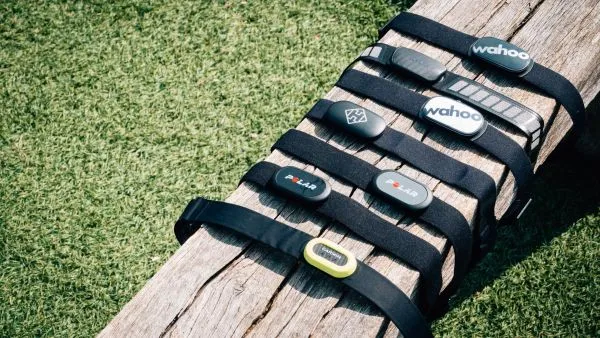
The best heart rate monitors will help you train efficiently and keep track of your fitness. A heart rate monitor will record and/or transmit your pulse rate in beats per minute.
Heart rate monitors fall into two groups, electrical and optical, depending on how they detect your pulse. A chest strap heart rate monitor is the most popular for cyclists and also likely to be the most accurate. An optical heart rate monitor shines light on your skin to detect the passage of blood.
Chest straps transmit pulse data wirelessly via ANT+ or Bluetooth to be displayed and recorded on a bike computer, smartwatch, or smartphone. Some can also store the data on-device.
Some optical heart rate monitors also transmit data to another device, while others, such as smartwatches, display it on the device itself. Again, there's the option of on-device storage.
Here at Cyclingnews, we've tested dozens of heart rate monitors over the years, including chest straps, smartwatches, fitness trackers, and more.
This guide will outline the ones that performed best in our tests and impressed us the most. That includes those that offered the most consistently accurate results, the best battery life, those that did the basics really well for a great price, those that provided clever extra features, the most comfortable and more.
Lower down, we have more on how to choose a heart rate monitor and the features to look for.
28/09/26: Added two new products from Garmin – the HRM 200 and HRM 600.
Best heart rate monitors
You can trust Cyclingnews Our experts spend countless hours testing cycling tech and will always share honest, unbiased advice to help you choose. Find out more about how we test.
Best heart rate monitor for cycling overall


✅ You want the most comfortable fit: Two sizes of chest strap and silicone grippers ensure a close and secure fit.
✅ You want the most accurate data: The combination of excellent fit and the third electrode offers consistently accurate readings.
❌ You want the best value: While the H10 offers excellent performance, the H10 is twice the price of the H9 which shares many of the core features.
❌ You want rechargeable: While the 400-hour battery is great, the Wahoo Trackr's rechargeable battery will never need to be replaced, and will be better for our planet.
Polar claims the H10 is the most accurate on the market - accurate to +/- one millisecond - thanks to a third electrode and silicone grippers to keep it in place. In over two years of testing, I haven't had a single issue, so I cannot refute those claims, and our expert reviewer had no complaints either. With that said, given that most other chest straps here have performed similarly well, I wouldn't buy the H10 for that reason alone.
The reason I would buy it is the super-simple adjustment and extremely comfortable, secure fit. The added bonus of silicone grippers is that you can run it looser than usual without it slipping, and while I don't personally suffer much from chest strap discomfort, I know it's an issue that plagues a few. Swapping to an optical sensor, such as a smartwatch, is one option, but the downside to that is a reduction in the accuracy of your data, which is common with optical sensors.
Comfort aside, the H10 is entirely waterproof, can be worn while swimming and can also record your heart rate variability — though you'll need to use it in combination with one of the brand's smartwatches to take advantage.
It also offers on-device storage, albeit with memory space for just one training session. Otherwise, it can connect to two concurrent devices with Bluetooth, and it uses a CR2025 (2.5mm thick) battery, although some may prefer a rechargeable unit like the Wahoo Trackr at this price point.
Read our full Polar H10 heart rate monitor review.
Best value heart rate monitor for cycling

✅ You want an affordable entry into heart rate recording: The H9 offers excellent performance and reliability at a great price.
✅ You want a comfortable-fitting heart rate monitor: There are two sizes of elasticated chest strap to choose from, and it's also machine washable to keep it fresh.
❌ You want advanced features: The H9 only supports HRV beamed to a compatible device and has no GPS, internal storage, or running or swimming features.
The Polar H9 doesn't come with any added bells or whistles like onboard memory or accelerometers that are found on the H10, and there are heart rate monitors with better battery life. Still, the Polar H9 is my favourite heart rate monitor for 'basic function', i.e. monitoring my heart rate while cycling or running, and the reasons are as follows:
Firstly, my testing has shown the Polar H9 provides reliable, accurate and consistent data whether testing outdoors or indoors. Secondly, while the Garmin HRM Dual is equally accurate, it is a little more expensive. Thirdly, it's a darn sight easier to adjust the strap on the H9 than on the HRM Dual, and finally, when it comes time to change the battery, the H9 can be done in seconds (just pry away the flap with a flathead screwdriver or similarly-shaped utensil) while the HRM Dual requires a tiny screwdriver to remove four small screws.
To cap it off, it's comfortable and stays secure, so unless you're specifically chasing a truly budget price, a huge battery, or need the added features, this is the best heart rate monitor for you.
For more details, check out the full Polar H9 heart rate monitor review.
Best rechargeable heart rate monitor for cycling


✅ You want a rechargeable battery: Easy charging gives the Trackr 100 hours of battery and saves you from rummaging through the drawers for coin batteries before a ride.
✅ You want to ride in the rain: Removing the battery door should mean the IPX7 sealing isn't damaged when changing the battery. The strap has also been updated and should now be less susceptible to corrosion.
❌ You want a longer battery life: 100 hours is a long time, that said it's nothing compared to the likes of Garmin's HRM Dual which has a claimed battery life of up to 3.5 years.
Wahoo replaced its Tickr and Tickr X range with the latest Trackr heart rate monitor. The new Trackr heart rate pod may look similar to the outgoing models, however, Wahoo has made several updates, including a new strap, HRV recording and replacing the venerable coin battery with a rechargeable battery.
While the Trackr takes a hit in battery life compared to coin-powered heart rate monitors, it still features 100 hours of battery life. No longer do you need to keep a stash of coin cell batteries ready for when the battery runs out, instead, the Trackr charges using a magnetic charger that connects to the underside of the pod. The IPX7 waterproofing should also be more reliable now, as the Trackr no longer needs to be opened up to change the battery, which could damage the sealing over time.
Wahoo Tickr straps of the past didn't have the best track record for durability, but it looks as though Wahoo has rectified this with the new Trackr. Instead of using the connector points to mount the pod to the strap, which I found led to corrosion issues, the Trackr pod is now mounted in the centre of the strap, and we expect this to improve accuracy and longevity.
Adjustment of the strap is a fairly straightforward affair, too, but it does require both hands. It holds pretty well, so it should be a one-time job.
For ease of use, the Trackr can simultaneously connect to three devices, which is particularly useful for indoor cycling, as it enables you to control your headwind fan whilst riding on Zwift via your laptop, or track your heart rate via a cycling computer and a phone at the same time.
Best heart rate monitor for battery life


✅ You want the longest battery life: Garmin claims that the HRM Dual has a massive 3.5-year battery life (assuming an hour per day on average), perfect if you're a forgetful charger.
❌ You want an easily adjustable strap: The Garmin strap has a three-part adjustment system that is fiddly to get the fit right.
The HRM Dual is Garmin's answer to budget heart rate tracking, but its retail price is still more expensive than Polar's H9.
With that said, it can often be found discounted, which increases its appeal. Where it stands out is with its claimed 3.5-year battery life (assuming an hour per day on average) and the ability to monitor heart rate variability (when paired with an appropriate app).
Beyond that, the HRM Dual is a reasonably basic heart rate monitor, so it doesn't come with the bells and whistles of onboard memory and swim/run dynamics. Its construction also leaves a little to be desired, as the three-part adjustment system is unnecessarily complex to use. This is frustrating because Garmin clearly knows how to do it well, as the more expensive HRM Pro is by far the easiest to adjust on this list.
Furthermore, it's a good job the battery life is so good, because when it comes to replacing the CR2032 inside, there are four tiny screws which are fiddly and easy to damage. And that assumes you have a screwdriver small enough in the first place, since it doesn't come with one.
Unless you're specifically after huge battery life, then in my opinion, the Polar H9 is a better choice at their respective recommended retail price. I'd buy it at a discount though, and given that's a common occurrence, I've included it in the list.
Read our full Garmin HRM Dual heart rate monitor review.
Best heart rate monitor for Zwift

✅ You want to optimise your device connections: Connecting multiple devices to the Viiiiva and then transmitting the combined data via ANT+ is more reliable.
✅ You want a backup of your ride data: 65 hours of internal storage ensures that if you suffer a corrupt .fit file you will be able to recover your data.
❌ You want a long battery life: The Viiiiva has 160 hours battery life which is considerably less than most other chest strap options such as Polar which has 400 hours.
The 4iiii Viiiiva is soon to be discontinued, but as long as it's still available, it is my pick as the best heart rate monitor for Zwift for a couple of reasons. The first of those is its ability to act as an ANT+ to Bluetooth bridge. Most smart trainers, power meters and heart rate monitors these days can work with Bluetooth, but too many connections can cause dropouts, and some devices, such as Apple TVs and cheaper laptops, have a limit on the number they can work with at one time. Running the smart trainer and power meter via ANT+ to your heart rate monitor, and then transmitting all three data streams via Bluetooth to your laptop, frees up valuable Bluetooth channels so you can listen to music through your headphones, or use your wireless keyboard to talk to your fellow Zwifters!
The second reason is that it also stores up to 65 hours of your ride data, so that if your file is corrupted, you can recover it. Nobody likes to lose their data, but if you race on Zwift in races where dual recording is required, it could save you bragging rights or even prize money.
Beyond those two key USPs, the Viiiiva is a decent all-rounder too. I've not had it long enough to get through 160 hours of riding, but reassuringly, I'm still on the first battery. I've not seen a single power dropout yet, both when connected to an Apple Watch, an iPhone, a bike computer, TrainerRoad and Zwift.
Best budget heart rate monitor with HRV

✅ You want HRV on the cheap: Entry level chest straps typically do away with HRV but this one bucks that trend.
✅ You don't want something rechargeable: The coin cell battery is claimed to last a year, and has an LED to show its status.
❌ You prefer a rechargeable strap: If you prefer something rechargeable, the Wahoo Trackr is the same price.
❌ You want the cheapest strap: Smaller brands like Magene and 4iiii offer similar performance for less money.
The replacement for the HRM Dual, the Garmin HRM 200 is the entry level chest strap from Garmin. The core functionality is largely unchanged from the HRM Dual, but it includes HRV, something not often found on budget-level heart rate monitors.
The pod has been completely redesigned, with a button and LED now on the front. This stops it connecting to devices you don't want it to when kitting up to go out for a ride, with the LED showing whether it's connected or not. When powering up, it also shows a quick reading of the battery status.
The battery door is cleverly designed, with two small prongs built into the strap buckle that open up the battery housing. It comes in two sizes, XS-S and M-XL and in our testing it was very easy to adjust the strap length.
The accuracy was fantastic, with it holding up to the Wahoo Trackr in our testing. Indoors, it did a better job under high intensity, when optical units struggled to register peak readings.
While it's nice to see HRV at this price point, you'll either need to don the strap every morning to get a reading, or sync to a compatible Garmin watch and wear it overnight to get the correct readings. If that sounds a bit much, you'd probably be better off with an optical watch or a ring to track your HRV.
For more details, check out our Garmin HRM 200 review.
Best heart rate monitor for health tracking

✅ You want to track a wide range of metrics 24/7: Whoop tracks everything from heart rate variable (HRV), sleep, strain, and recovery to optimise training and your life around it.
✅ You want easy to understand metrics: The Whoop app packages all the data it records into an easy to understand and trackable format. Whoop can also automatically sync with other training and health apps.
❌ You don't want a monthly subscription: Whoop offers a huge amount of data and insight to take training to the next level, this comes at the cost of a monthly subscription though.
❌ You want accurate heart rate data: Optical heart rate monitors aren't as accurate as electrical detection used by chest straps.
Whoop has replaced the 4.0 with two new devices, the Whoop 5.0 and the Whoop MG. Buying a Whoop 5.0 requires a monthly subscription that not only gives you the wrist strap itself but also access to Whoop's extensive heart rate, respiratory rate, blood oxygen, and skin-temperature monitoring app.
There are three tiers of Whoop subscription. Whoop One (£169/$199 per year) gets you the 5.0 with the core sleep, strain and recovery tracking. Whoop Peak (£229/$239) adds Healthspan, which estimates your 'Whoop Age', plus health and stress monitoring. Whoop Life (£349/$359) swaps to the MG, which adds ECG and blood pressure insights.
Whoop's premise is built primarily on heart rate variability (HRV), which is basically the variation in time between each of your heart's beats, measured in milliseconds. The theory is that a higher HRV (when compared to your individual average) means you are fresher, or more recovered.
Wear the Whoop 24/7, and it will collect this data alongside your activities to monitor your strain vs recovery (incl. sleep) and provide guidance on how to improve. It's a seriously deep data dive that most people won't need, but for committed athletes looking to optimise their life around training, it could be the tool to unlock the next level of performance.
It's clever in that the charger is a portable slide-on battery pack that you wear, and the device itself is waterproof enough to be worn in the pool, the shower, or the sea, so you'll never lose a moment's data. However, bear in mind that charging is necessary every three to four days.
Using the app, you can even relay the heart rate to third-party devices such as cycling computers, should you want to avoid using a chest strap at the same time, and when your Whoop detects an activity, it will not only automatically figure out if it was a ride, a run, mountain biking or more (which it's really good at), and it can then be synced to Strava, TrainingPeaks or Apple Health.
You need to ensure it's tight against the skin for consistent results, but in my testing, I've found it to be accurate enough for its purpose of tracking overall fatigue and freshness, even if the beat-by-beat measurement might be less perfect than chest straps during exercise.
For more details, read our full Whoop 4.0 review.
Best heart rate monitor for women

✅ You use sports bras: The Garmin HRM-Fit is designed to be attached to the lower band of a sports bra, and improves comfort for those who do. Rather than having its own strap, which can get in the way of sports bras, it simply clips onto the sports bra instead.
✅ You want traditional heart rate metrics: It offers all the standard Bluetooth, ANT+ connectivity and heart rate metrics which Garmin's standard units offer, just with a different fit system.
❌ You don't use sports bras: Without a sports bra or similar garment which features a strap around your chest, the Garmin HRM-Fit will have nothing to mount to, making it pretty much useless!
❌ You find normal heart rate monitors comfortable: If you already find that you are comfortable and happy wearing traditional heart rate monitors, you might find the fitment of the Garmin HRM-Fit a bit unnecessary.
The Garmin HRM-Fit is a heart rate monitor designed specifically with women in mind, offering a unique alternative to the traditional chest strap. Retailing at £139.99 / $149.99, it clips directly onto the underband of a medium- or high-support sports bra rather than wrapping fully around the torso. This half-strap design aims to reduce common issues like chafing and discomfort while still delivering the high accuracy of electrode-based monitoring.
During testing, the HRM-Fit proved reliable and comfortable. Pairing was as you'd expect with both Garmin watches and cycling computers, and the readings remained consistent whether cycling, running, or hiking. Once in place, it stayed secure and comfortable, though attaching it can be a bit fiddly at first. The side clips also protrude under a tight jersey, something to consider if you prefer a sleeker look.
Feature-wise, the HRM-Fit ticks all the boxes with support for unlimited ANT+ connections and three simultaneous Bluetooth connections. It also unlocks advanced running dynamics when paired with a Garmin watch, including stride length and contact time, as well as indoor pace and distance tracking. The CR2032 coin-cell battery should last around a year with regular use, and the 3ATM water resistance protects against sweat and rain (though it isn’t swim-compatible).
While the price is slightly higher than Garmin’s HRM-Pro Plus - despite fewer features - it’s a strong choice for athletes prioritising comfort. If you’re looking for accurate data without the drawbacks of a traditional strap, particularly for multi-sport training, the HRM-Fit is well worth considering.
For more details, check out our Garmin HRM-Fit review.
Best premium heart rate monitor

✅ You want a rechargeable Garmin strap: This is the brand's first with a rechargeable battery, and LEDs mean you won't find out it's low on battery mid-ride.
✅ You're a multi-sport athlete: This is a great choice for triathletes or anyone doing multiple sports with running and swim data.
❌ You only ride bikes: The additional features push up the price, which makes it not worth it for those who only cycle.
❌ You want the best value rechargeable strap: There are cheaper options from Wahoo and Magene if you want a rechargeable heart rate strap for cycling.
Garmin's new flagship heart rate chest strap, the HRM 600 replaces the HRM Pro Plus. It's also the first Garmin chest strap with a rechargeable battery instead of a coin cell one.
The pod has had a complete redesign, with a button on the front that puts it into pairing mode and prevents unwanted connections. LEDs show the connection status and the level of battery remaining. To charge, it uses the same cable as Garmin's smartwatches. Garmin claims up to two months of use at one hour a day, and our test results were close to that. After riding 14 hours a week for a month, it needed recharging.
The strap is comfortable and easy to adjust, staying in place even during long, sweaty rides. It comes in two sizes, XS-S and M-XL, and weighs 61g overall, including strap and pod.
In our testing, the accuracy was fantastic, with the HRM 600 producing near-identical stats when worn with a Wahoo Trackr. It transmits HRV, has three Bluetooth connections, and unlimited ANT+. It can even record events on its own, capturing distance, calories, and intensity minutes without needing a cycling computer.
The downside is, if you're only cycling, there's a lot of additional features you're paying for that you might not need. HRV is nice, but not all that useful as you won't be wearing a chest strap all the time. For multi-sport athletes, it's a great shout, but if you're only cycling, you'll get better value elsewhere.
For more details, check out our Garmin HRM 600 review.
Best arm-mounted heart rate monitor for cyclists

✅ You don't like wearing a chest strap: Sitting on your forearm, the Tickr Fit is quick to put on, and doesn't get in the way if you're wearing a sports bra.
✅ You want accuracy: It may be an optical sensor, but in our testing the Tickr Fit was competitive with the Polar H10 in terms of accuracy.
❌ You don't want yet another rechargeable device: Lasting around 30 hours, the Tickr Fit will need regular recharging.
❌ You'd rather have USB-C compatibility: The Tickr Fit can only be charged via USB-A, so look elsewhere if you want all your devices on USB-C.
If you dislike chest straps but still want accurate heart-rate data, the Wahoo Tickr Fit is a strong option. Worn on the forearm, it’s comfortable, easy to adjust, and doesn’t interfere with sports bras or kit. It's affordable, comes with two strap lengths and once fitted, it stays put even during sweaty sessions.
The Tickr Fit uses optical heart-rate technology rather than ECG, but in testing, it proved just as accurate as premium chest straps like the Polar H10. I used it across cycling, running, and hiking, and the data matched up impressively well. It pairs instantly with Wahoo’s app, GPS watches, and bike computers, and the LED lights make it clear when it’s connected - no more guessing if the device is awake.
The armband is waterproof to IPX7, hand-washable, and recharges via USB. Battery life is around 30 hours, so you’ll need to top it up regularly, but the trade-off is never having to swap coin cells again, which is certainly a more eco-friendly approach. The only slight downside is remembering to switch it on and off, and the fact that it’s visible when wearing short sleeves.
Overall, the Tickr Fit makes a nice change compared to chest straps. It’s accurate, comfortable, and versatile enough for indoor training or long outdoor rides. If you don’t mind it being on show and can live with charging, this is one of the best alternatives for riders who want reliable heart-rate data without the discomfort of a strap.
For more details, check out our Wahoo Tickr Fit review.
Comparison table
Model |
Connectivity |
Battery |
Waterproof |
Bluetooth connections |
Added features |
Easy to adjust? |
HRV |
|---|---|---|---|---|---|---|---|
Polar H10 |
Bluetooth and ANT+ |
CR2025 (400 hours) |
30m depth |
2 |
Onboard memory |
9/10 |
Yes |
Polar H9 |
Bluetooth and ANT+ |
CR2025 (400 hours) |
30m depth |
1 |
None |
9/10 |
Yes |
Wahoo Trackr |
Bluetooth and ANT+ |
Rechargeable (100 hours) |
IPX7 |
3 |
None |
7/10 |
Yes |
Garmin HRM Dual |
Bluetooth and ANT+ |
CR2032 (1277 hours) |
1 ATM |
2 |
None |
3/10 |
Yes |
4iiii Viiiiva |
Bluetooth and ANT+ |
CR2032 (160 hours) |
IPX7 |
1 |
ANT+ to Bluetooth bridge, internal memory |
6/10 |
No |
Garmin HRM 200 |
Bluetooth and ANT+ |
CR2032 (up to 1 year claimed) |
3 ATM |
3 |
LED status light, built-in battery door tool |
9/10 |
Yes |
Whoop 5.0 |
Bluetooth |
Rechargeable (14+ days) |
Up to 10m |
2 |
Whoop app, Healthspan, Health and Stress Monitor (Peak and Life tiers) |
8/10 |
Yes |
Garmin HRM Fit |
Bluetooth and ANT+ |
CR2032 (365 hours) |
3 ATM |
3 |
Sports bra fit system |
N/A |
Yes |
Garmin HRM 600 |
Bluetooth and ANT+ |
Rechargeable (up to 2 months claimed) |
5 ATM |
3 |
Standalone activity recording, running and swimming metrics |
9/10 |
Yes |
Wahoo Tickr Fit |
Bluetooth and ANT+ |
Rechargeable (30 hours) |
IPX7 |
1 |
None |
10/10 |
No |
How to choose a heart rate monitor
- What devices do I need to connect to? Most of us have existing tech which your heart rate monitor will need to connect to. Your devices will either use Bluetooth or ANT+, so ensure your heart rate monitor is compatible.
- How many devices do you need to connect to? Some heart rate monitors can only connect to a single device at a time, while others can simultaneously share data with multiple devices.
- What are you using the heart rate monitor for? There are so many units on the market, from simple heart rate trackers to full-blown smartwatches - think about what you will use your device for, and which feature set will work best for you.
- Will it be comfortable? Heart rate monitors tend to be worn for the duration of your exercise, so think about which fit system you find the most comfortable.
- Optical or electrical? If you want the most accurate reading, go electrical. However, optical options can be worn on the arm or integrated into other devices like watches or even earphones.
- What's the battery life? Coin cell operated HRMs tend to have longer runtimes than ones with a rechargeable battery, but you may need to keep a spare coin cell. Rechargeable is more eco friendly and there's no recurring cost.
Everything you need to know about the best heart rate monitors
What is a heart rate monitor?
Let's start with the basics: In the context of sports, it is a wearable device that can read your heart rate data. It will then transmit the data to a device, like a smartphone or a bike computer, that lets you see it in real-time and record it for later analysis.
Unfortunately, as is often the case, there isn't one best heart rate monitor for everyone; each has its pros and cons. Choosing a heart rate monitor is a decision you'll need to make based on your needs, so the first step, naturally, will be understanding what those needs are.
Do you prioritise accurate heart rate data during exercise over the convenience of wearing something all day like a smartwatch? If so, then a chest strap is going to be the best heart rate monitor for you.
Are you a multisport athlete who wants to be able to track your running or swimming metrics in addition to your heart rate? If so, then one of the more high-spec heart rate monitors will be needed, such as the Garmin HRM Pro (for running and swimming).
Alternatively, if your reasons for tracking heart rate are not directly related to exercise, but more that you want to track it in everyday life, a wearable such as a smartwatch or a fitness tracker like the Whoop would likely be a better heart rate monitor for you.
Those are some of the basics, but no doubt, as you've worked through my list of recommendations above, you'll have had some questions about some of the jargon and terminology I've used. Below, I've rounded up some of the more common questions to help you make your decision.
What's the difference between ECG and optical heart rate sensors?
Electrical impulses or beams of light? Which one is best for you?
Since their inception in the 1970s, heart rate monitors have relied on measuring the electrical impulses created by the muscles in your heart as it beats.
It’s similar to what happens when you get an echocardiogram (ECG) at the hospital, only with two or three sensors instead of the twelve commonly used for medical examinations. The electrical sensors measure a small electrical output, and the control unit relays this information to your device of choice (or stores the information for later analysis).
Recently, optical sensors have become more common, especially in multi-sport offerings. These work by shining a light into your skin and measuring the variance in blood flow. While both systems rely on physical contact to gather their readings, optical sensors tend to be used in arm- or wrist-based systems where the variance can be seen.
One problem with this is that a smartwatch is rarely worn as tightly as an elasticated chest strap, and as such, optical systems tend to be more prone to issues over rough terrain or when running, as bumps can briefly break the all-important contact between skin and sensor.
In simple terms, the best thing for measuring your heart rate will almost always be a chest strap, but if you’re curious about general trends and day-to-day heart health too, a wrist-based optical system will likely be more up your street for its comfort, convenience, and the onboard computer that will process the data rather than relying on being paired to a phone or bike computer.
If you want to run a hybrid system, smartwatches will often have the ability to monitor your heart rate independently using the optical sensor on the back, as well as pair with a dedicated HRM strap for more accurate in-sport measurements.
If you’re still in two minds, we have a dedicated guide to wrist vs chest straps, as well as a separate guide to the best smartwatches if those are what you want.
Is a Bluetooth heart rate monitor better than ANT+?
We've got a full explainer of what ANT+ is, but to put it simply, we'd suggest you use a Bluetooth heart rate monitor, because only certain fitness equipment uses ANT+, whereas pretty much every device can connect to Bluetooth.
The primary benefit of ANT+ is an unlimited number of concurrent connections, whereas Bluetooth devices are often capped at two or three. That's generally enough for most people though.
And thankfully, most heart rate monitors will have the capability to do both ANT+ and Bluetooth transmissions simultaneously, allowing you to hook up wirelessly to your cycling computer of choice and non-ANT+ devices like your laptop or tablet at the same time without a dedicated adaptor.
All of the devices featured in this guide are Bluetooth capable, but beware that some of Garmin's older devices (namely the HRM-Run & HRM-Swim) are ANT+ only.
What added features should I look for in a heart rate monitor?
If you run or swim, then a heart rate monitor can do more for you than just measure your heart rate, it can monitor your stride length, vertical oscillation, cadence, and even your swimming pace and form.
Of course, whether you actually need these features is a question to ask yourself, since smartwatches can often do the same, smartphones can often handle the running metrics, and some running shoes offer these added features. It all comes down to what you need and what you already have.
Should I use a heart rate monitor or a power meter for cycling?
Heart rate is often a rider's first introduction to structured training - perhaps beyond 'perceived effort' or a hill and a stopwatch - and it should always remain a key part of the picture, no matter the amount, intensity or type of training an athlete is undertaking.
Within the context of cycling performance, the best heart rate monitors are regularly overshadowed by the best power meters. These are better for monitoring your training since they offer a more immediate and consistent measure of physical output. However, even with a power meter, heart rate should never be ignored.
Heart rate can also help to identify fatigue to prevent overtraining, especially with the help of heart rate variability (HRV). Want to know how? Check out 'what is HRV?'
What do the waterproof ratings mean?
IPX7, IP67, 5ATM? Can someone please make sense of this?
Waterproof ratings are a complex mix of numbers and letters that need a bit of decoding before you can understand their meaning. Luckily, it's pretty easy to do.
IP ratings stand for Ingress Protection, and the two subsequent digits represent protection against solids and liquids, respectively. The first digit, representing protection against solids like dust and dirt, is a rating between 0 and 6. The larger the number, the better the protection, while an X means it hasn't been tested. The second digit, representing protection against liquid ingress - i.e. water - is a rating between 0 and 8, and again, the bigger the number, the better.
ATM ratings focus solely on the waterproof pressure rating. They are most easily defined by multiplying the number by 10 to get the depth at which your device can handle pressure. For example, a device with a 5ATM rating can sustain pressures equivalent to what you'd find in water at a depth of 50 metres.
How often should I wash a heart rate monitor?
When considering chest strap heart rate monitors, if you are particularly sweaty, then make sure you get something that is easily washed. The control unit of most chest straps pops off, and keeping it clean will save you from salt corrosion. Most devices recommend hand-washing after each use, and then a trip through the washing machine after around seven uses. However, since the control unit on Garmin's HRM-Pro is fixed, it needs to be hand-washed each time. Of course, it goes without saying that different rules apply to smartwatches.
What is the best heart rate monitor for Zwift?
For the basic function of tracking your heart rate, this common question is easily answered with 'any of them,' since they are all technically Zwift compatible. However, beyond connectivity, some considerations make some better than others for Zwift and the world of indoor cycling in general.
As touched on above, chest-based heart rate monitors are usually more accurate than optical wrist-based monitors, so if you're after accuracy, make sure any heart rate monitor you use in Zwift is chest-based.
Next, riding on any of the best smart trainers is always a sweaty affair, even if you set yourself up in a freezer, and as such, corrosion resistance is a more pertinent issue than for riding outdoors.
Furthermore, Zwift and other indoor cycling apps can require a multitude of sensors transmitting simultaneously. While all are compatible, if you're running a particularly complex data setup, then make sure you opt for something with both Bluetooth and ANT+ to help avoid unwanted interference issues.
Our pick as the best heart rate monitor for Zwift is the 4iiii, because, alongside being secure, comfortable and accurate (in my testing), it can also act as a Bluetooth bridge for your power meter or your smart trainer. This means instead of connecting multiple devices to your laptop, potentially reaching your limit or causing interference, you can send all the data in one stream, reducing the chance for dropouts.
Does size or weight matter in heart rate monitors?
Sure, the size and weight of something you're going to need to carry on your wrist or your chest are important. You obviously don't want a 3kg house brick strapped to your chest whilst you're trying to run or ride. However, the reason we've not mentioned it in our guide or product recommendations above is that the differences are so small that it's not worth comparing.
A heart rate strap that weighs 19g vs another at 21g won't be noticeable, nor will one that's 8mm thick compared to another at 10mm. Metrics that make more sense to compare are things like battery life, ease of adjustability and how securely and comfortably they stay in place when worn.
What is HRV?
HRV stands for Heart Rate Variability. Your heart doesn't beat at a perfect rhythm, so even at 60bpm, your heart won't be beating every second. The gap between beats can vary by milliseconds, and HRV measures that gap.
This variation is controlled by your nervous system, which makes measuring HRV a very useful method to track your recovery. A HRV that's higher than normal suggests you're recovered and ready for training. A reading lower than your baseline implies that fatigue, stress, illness, or poor sleep is involved, suggesting it's worth easing off the gas for a bit.
HRV varies a lot from person to person, so the key measure is testing it against yourself. It's also more reliable when tested at the same time every day, ideally overnight or first thing before you go to sleep.
Chest straps are the most accurate way of measuring HRV, but they only send data, so you'll need a compatible watch, app, or bike computer to measure it. Optical trackers like the Whoop 5.0 and other smartwatches are less accurate than a chest strap, but they're much more convenient to wear overnight.
We have a detailed deep dive explaining what HRV is, if you want to get further into this subject.
What do the adjustability ratings in this guide mean?
In each of the product recommendations above, I've rated how easily the heart rate strap can be adjusted. Many will only need adjusting every few weeks as they loosen or go through the wash, but if a heart rate monitor is complex to adjust, it can often lead to it being too tight or too loose. You can bet that the one time you find it's slightly too loose is when you're already midway through a ride, and you don't want to have to strip your layers off to be able to adjust it to prevent it from slipping down and becoming a belt.
As part of my testing, I spent time fitting and adjusting each of the straps in turn, making notes to compare how easily it could be done, whether it could be done one-handed, or whether it baffled me more than trying to free a pair of tangled headphones.

Heart rate has been a fundamental aspect of my training for racing, and over the years, I have used countless heart rate monitors. When evaluating these devices, I prioritise accuracy and usability. They need to provide valuable training data and be compatible with a variety of training tools, ranging from GPS computers to indoor smart trainers.
How we test the best heart rate monitors
Our testing for this guide to the best heart rate monitors has been an ongoing process for almost three years.
Unboxing and spec review
Each test starts with an unboxing, during which we make a note of the packaging for its eco-friendliness. All brands use some form of plastic in their packaging, but I usually find Wahoo is the best in this regard.
For chest straps, I then read the care instructions and make a note of washing recommendations, before removing the battery cover in a trial run battery swap, noting the difficulty. Next up comes the adjustment, and working out how easy - or difficult - it is to fit the strap. On the chest straps, Garmin's HRM Pro Plus wins this, with close second-places coming to both Polar options, although the ease of fitting the HRM-Fit onto the understrap of a sports bra is something our women testers have applauded too.
Next, I research the claimed features and qualities of each heart rate monitor and try out these features during testing to confirm they do what they should, and to experience how said features might benefit a user's workout.
Workout usage
In the absence of having a doctor with an ECG machine on hand for all of my workouts, I improvised a way to confirm accurate readings. Throughout testing, I spend time wearing three (sometimes four) heart rate monitors for my workouts - two chest straps and one or two wrist straps - depending on what I'm testing.
This compares the readings for each heart rate monitor against at least two others and lets me weed out any devices with inaccurate data or poor connectivity. As is widely accepted, the chest straps performed best here, while optical wrist sensors tended to struggle to keep up with quick changes up or down, especially when running or mountain biking, as this shakes the wrists more than indoor cycling.
It's fair to say none of the chest straps performed specifically badly in this regard, and when sufficiently tight, the optical units are pretty good too, so the main differentiator in accuracy was actually how often they dropped connection. This is a problem I occasionally experienced with Wahoo's older entry-level Tickr, but the Trackr has been great since it launched in 2024. It was a particular problem with cheap heart rate monitors bought on Amazon, and hence why none of them are featured here.
I then set them all to the same length before wearing them individually to note comfort and how securely they stay in place. Thankfully, all heart rate monitors I've tested have been comfortable enough that they are easily forgotten once in place, but I do find the Polar H10 is most comfortable and secure.
You can find out more about how we test on our dedicated testing methods page.
