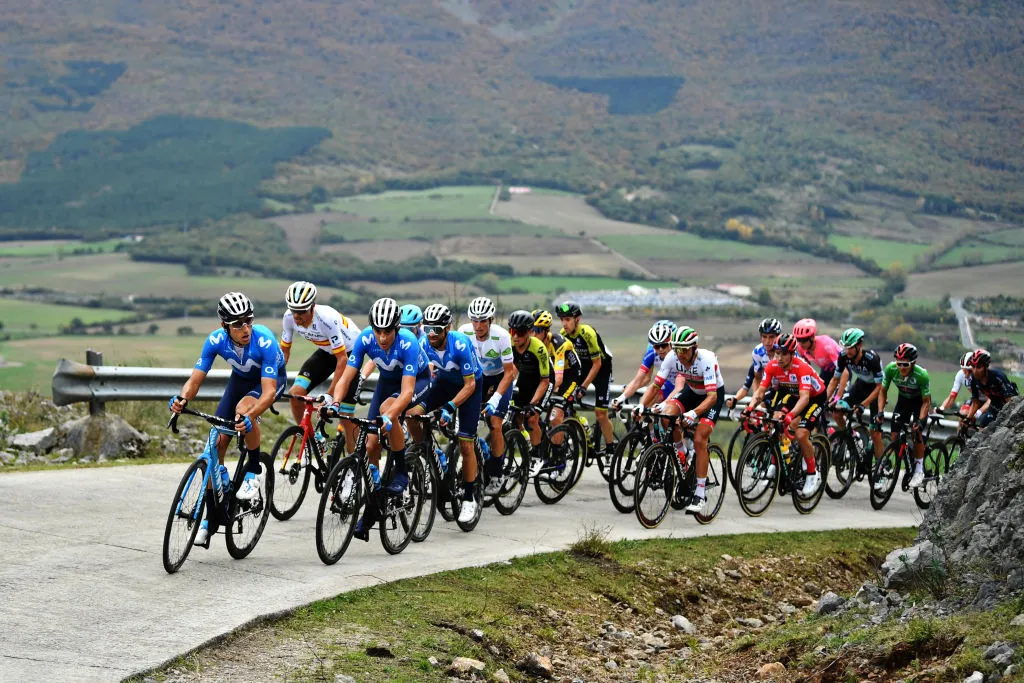
The Vuelta a España will not scale the mighty Col du Tourmalet or Col d'Aubisque on Sunday's stage 6 after coronavirus restrictions have made the race’s planned foray into France impossible.
In similar circumstances to the Giro d’Italia, the Vuelta organisers have had to totally redesign what had been considered the queen stage of the 2020 edition.
“Unfortunately, the stage we had planned for October 25, with the summit finish on the Tourmalet, in the end will not be able to happen,” said race director Javier Guillén after stage 3 on Thursday.
Article continues below“The reason is that, given the state of emergency declared in France, and the restrictions imposed, we can’t, as a race, pass into French territory.”
Stage 6 had originally been set to pack three big climbs into a 136km route that entered French territory at the top of the Col du Portalet. It then went on to the Col d’Aubisque and, finally, the Col du Tourmalet at 2100 metres, one of the iconic climbs at the Tour de France.
The stage will still start in Biescas, near the border, but it will stay nearby and finish atop Aramón Formigal, scene of one of the great Vuelta heists when Nairo Quintana and Alberto Contador combined to put Chris Froome to the sword with a long-distance raid in 2016. In fact, the new parcours is am almost exact replica of that famous day.
The new 146.4km stage still features three climbs but pales in comparison to the Portalet-Aubisque-Tourmalet menu, with a comparatively meagre – but still considerable – 3,040 metres of elevation gain.
The first climb is the category-3 Alto de Petralba, followed by the category-2 Alto de Cotefablo, and they’ll head back into Biescas before taking on the climb to Formigal, which itself isn’t so difficult. The road climbs for 27km from Biescas but official climb is 14.6km at an average gradient of 4.6 per cent.
“We have to be grateful for the collaboration we’ve had with the French authorities and localities, and we hope that when things are back to normal we can repeat a stage which I believe is one of the best we could present on a Vuelta route," said Guillén.
“That said, we’ll still have a great stage on the 25th. The Vuelta won’t be stopping. We’ll have 146km, starting in Biescas and finishing at Aramon Formigal, with three climbs and a first-category summit finish.
"It’s a stage that fits perfectly, because a mountain stage is substituted by a mountain stage. We know we’re going to maintain the spectacle that the riders have so brilliantly given us so far.”