The Spring Classics are regularly seen as a hotbed of tech and innovation, and for good reason. The long distances over brutal cobbled and gravel roads create extreme conditions that push not only the riders to the limit, but their equipment too.
As a result, teams are often forced to adapt, innovate, and sometimes... hack.
Article continues belowOne such recent example can be found on the Cervélo bikes of the Visma-Lease A Bike team, who have been glueing their tubeless tyres into place since last year's Hell of the North.
"We’ve done enough testing together to be sure it holds up in racing conditions. The tyres seat properly in the hooks, creating a solid and reliable fit. If I had any doubts about this combination, we would have conducted additional testing and worked closely with Vittoria and Reserve to improve it."
Despite the limelight currently being on hookless, Visma has had its own instance of wheels falling foul of the cobbles in high-profile fashion too. In the 2022 edition of Paris-Roubaix, Wout Van Aert and Christophe Laporte both had their Shimano tubular wheels 'taco' – essentially fold in half – under the extremes of riding on cobbles after a puncture.
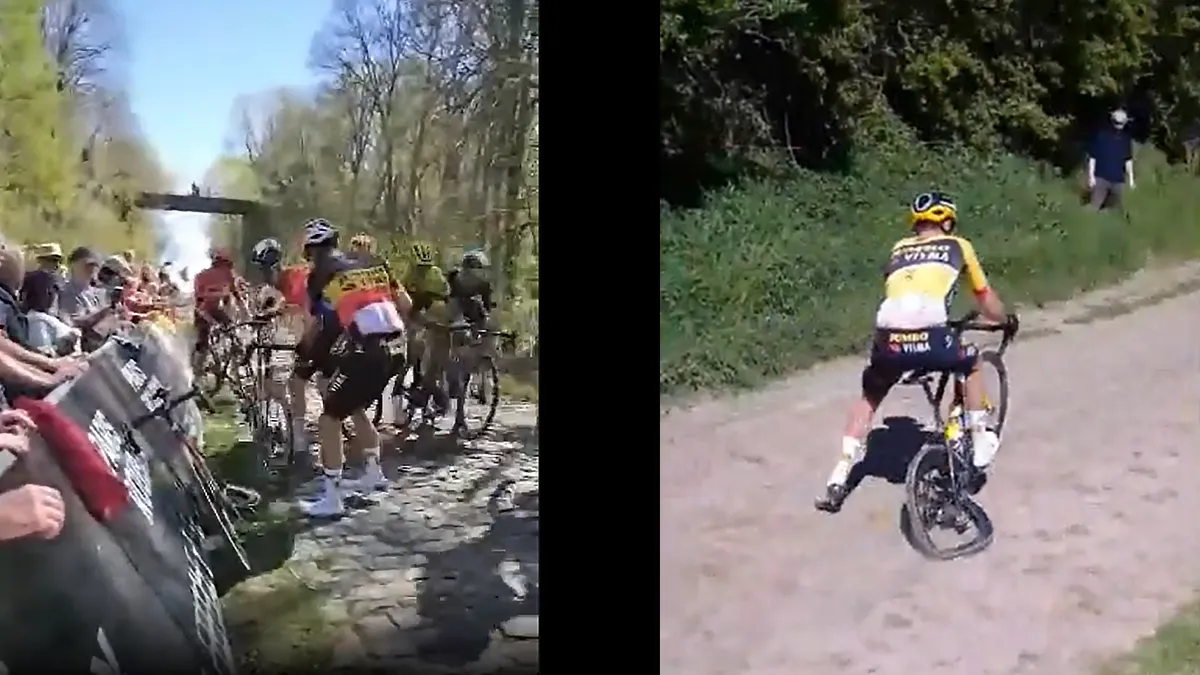
But despite that incident, and more recent examples such as Fabio Jakobsen's crash at the UAE Tour and Amaury Capiot's incident at Omloop Het Nieuwsblad, Drost is keen to point out that the rim-tyre interface isn't their motivation for the glue's use.
"The main reason we started doing this was because we observed some pressure loss during the Classic races, where riders experience hard impacts while running lower pressures. For example, in Roubaix we saw cases where a strong impact caused a small crack in the rim.
"Structurally this is still safe to continue racing [ed: though not recommended or endorsed by Cyclingnews] but sometimes the sealant cannot fully close the crack, which results in slow air loss. Glueing helps keep the tyre and sealant sealed during hard impacts at low pressures or in cases of minor wheel damage or burping."
Burping, for those unclear on the term, is where low tyre pressures combined with a hard impact can temporarily dislodge the tyre from the rim and break the airtight seal created by the outward air pressure. This causes some of the air to escape, or 'burp' out, which results in a slight loss in pressure. Over the course of a long race, repeated instances could massively affect the tyre pressure, which can have knock-on effects in rolling resistance and, worse, the ability to control the bike.
"This is also why we do not apply this in normal (no cobble) races, as we haven’t seen situations that require it there. In addition, our riders are confident in the current setup and do not need any extra 'peace of mind'."
This clarification puts paid to any theory or conspiracy that the glue is to help keep the tyre on the rim in the event of a complete flat, as has been rumoured and previously reported.
Many teams rely on an internal foam air liner - the Vittoria Air Liner, in most cases - to help here too. Despite many of the 'failure' images showing the lime green liner wrapped uncouthly around the wheel and frame, this is likely simple evidence of their widespread use, rather than evidence of any fault or blame. It's impossible to know how many punctures they have succeeded in retaining the tyre, because those instances don't make the headlines.
Drost adds his opinions here, too, reiterating his earlier point. "While [the liner] may help keep the tyre seated as an additional benefit, the starting point should always be the tyre-rim combination itself."
Notably, while tubular glue is a rudimentary solution to the problem of tyre pressure regulation, the Dutch team has also been employing an altogether more complex method at Classics races of recent years too. The Gravaa KAPS tyre pressure system enabled riders to inflate tyres while still riding, using a small compressor-of-sorts located in the hub. Unfortunately, the Dutch company has since gone bust, so it's unlikely that we'll see the tech again this year.
As for whether the teams have more cobble-smoothing tricks up their respective sleeves for this year's races, we'll have to wait and see.
Get unlimited access to our unrivalled 2026 Spring Classics coverage with a Cyclingnews subscription. We'll bring you breaking news, reports, and analysis from some of the biggest races on the calendar, including Milan-San Remo, Paris-Roubaix and the Tour of Flanders. Find out more.