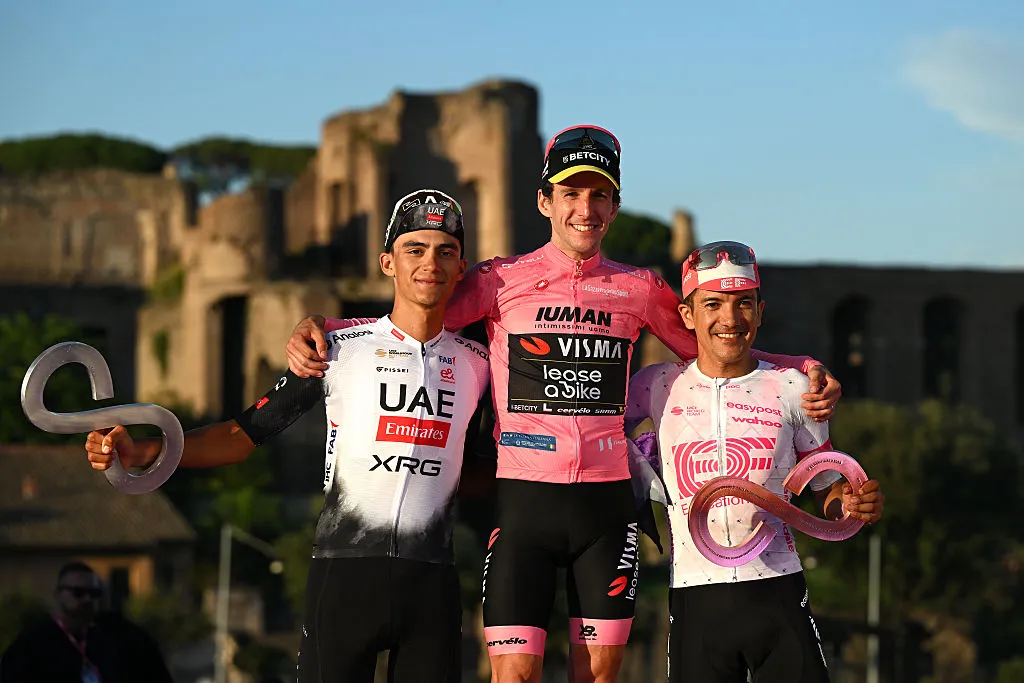
The 2026 Giro d'Italia kicks off men's Grand Tour season on Friday, May 8, and the start of a three-week race with 21 stage wins and several other accolades to be won, alongside the overall victory.
The pink jersey (maglia rosa) is one of four distinctive jerseys up for grabs at a race which includes a further five minor, non-jersey competitions and several other smaller prizes. With a total prize money pot of €1,642,860 available – including €115,668 for the GC winner – there's a lot to be won on the road from Nessebar to Rome.

And finally, we took a look back through the history books to pick out some of the old and defunct classifications and prizes, including the black jersey for last-placed rider – read about those at the bottom of this article.
General classification – Pink jersey

The maglia rosa – the pink jersey – is the grand prize and the icon of the Giro d'Italia. Along with the elegant Trofeo Senza Fine (the 'trophy without an end') it's the reward for the leader in the general classification, the man who completes the course in the quickest cumulative time.
It is equivalent to the yellow jersey at the Tour de France.
Introduced in 1931 and coloured pink because La Gazzetta dello Sport – the newspaper which created the race – is printed on pink paper, the jersey is described in the Giro's Garibaldi roadbook as "a page made of pink fabric where the history of cycling has been written over the past 93 years."
Given that times for riders on flatter stages are taken as one by those in a group or peloton, it's the hilly and mountain stages, plus time trials, which make the difference in this competition. Time bonuses are also on offer, with the top three men on each of the 19 road stages taking 10, 6, and 4 seconds. Red Bull is sponsoring sprints on each road stage which offer bonuses of 3, 2, and 1 seconds.
In the event of a GC dead heat, organisers will decide the standings based on fractions of a second measured in the race's time trials, or stage placings if a time trial hasn't taken place yet.
The pink jersey has gone through a number of different sponsors in recent years, and has another new one for 2026, in the form of the Friuli Venezia-Giulia region.
Alfredo Binda, Fausto Coppi, and Eddy Merckx are the maglia rosa record holders, with five race wins each.
In the race, the leading the GC takes priority over the other classifications, so if a rider is leading multiple classifications, the priority order is: pink, cyclamen, blue, white.

Points classification – Ciclamino jersey

The maglia ciclamino – cyclamen (or just purple) jersey – marks the top points scorer of the Giro d'Italia, more often than not a sprinter. Similar to the Tour de France's green jersey, it is battled over by the riders who accumulate points at the end of each stage.
Since 2014, the points on offer have been weighted towards the flatter stages, which offer more points than summit finishes, meaning it is broadly a sprinter's classification. A single intermediate sprint, usually on a flatter section of the route, on each road stage also offers points, so it's about more than just winning stages.
The 20 road stages of this year's race are separated into five difficulty categories with their own points weightings.
A and B category (stages 1, 3, 4, 6, 12, 15, 18, 21): 50, 35, 25, 18, 14, 12, 10, 8, 7, 6, 5, 4, 3, 2, 1 points
C category (stages 2, 5, 8, 11, 13, 17): 25, 18, 12, 8, 6, 5, 4, 3, 2, 1 points
D and E category (stages 7, 9, 10, 14, 16, 19, 20): 15, 12, 9, 7, 6, 5, 4, 3, 2, 1 points
Intermediate sprints: 12, 8, 5, 3, 1 points
Mads Pedersen won the points classification in 2025, though won't be racing in 2026, while Francesco Moser and Giuseppe Saronni hold the record with four wins apiece.
Mountain classification – Blue jersey

The maglia azzurra – blue jersey – is awarded to the top climber of the Giro, or at least the rider who accumulates to most points on the classified hills and mountains along the way.
With dozens classified climbs spread out over the three weeks of the Giro, there are plenty of chances to rack up points, especially for those strong climbers who consistently make the break of the day – only once in the past 20 years has a podium sitter taken home the jersey.
The mountain classification has been run since 1933 but a jersey – the maglia verde (green) – was introduced in 1974. The jersey has been blue since 2012 to match the colours of the competition sponsor, the Milanese bank, Banca Mediolanum.
Climbs are split into five categories, from the Cima Coppi (more on that below) through to categories one to four, based on the difficulty of the ascent. First-category climbs used as summit finishes get 50 points rather than the usual 40.
Cima Coppi (Passo Giau, stage 19): 50, 30, 20, 14, 10, 6, 4, 2, 1 points
First-category summit finishes (stages 7, 14, 16 and 20): 50, 24, 16, 9, 6, 4, 2, 1 points
First-category (9 climbs): 40, 18, 12, 9, 6, 4, 2, 1 points
Second-category (13 climbs): 18, 8, 6, 4, 2, 1 points
Third-category (17 climbs): 9, 4, 2, 1 points
Fourth-category (9 climbs): 3, 2, 1 points
The Cima Coppi and then first placings obtained on first-category climbs, acts as a tiebreaker for the competition.
Best young rider – White jersey

The maglia bianca – white jersey – is the prize for the best young rider of the race. In essence, it's the same as the general classification, only limited to those under the age of 25 at the start of the calendar year.
The jersey was reintroduced to the race in 2007 after a 12-year hiatus during which time several, more complicated, competitions were awarded.
Evgeni Berzin, Nairo Quintana, Tao Geoghegan Hart, and Egan Bernal are the only men to win the pink and white jerseys in the same year, though Isaac del Toro came close in 2025, winning white after narrowly losing pink on stage 20.
Intermediate sprints competition
This is the first of several minor classifications. UCI regulations state that WorldTour races can only have four leaders' jerseys, so the Giro is limited to pink, cyclamen, blue, and white.
The intermediate sprints also count for the overall points competition, but there's a seperate competition for points scored only in intermediate sprints.
One intermediate sprint (Traguardo Volante or 'TV' on the stage profiles) lies along the way on each of the 20 road stages at the Giro d'Italia.
Points are awarded to the first five riders across the line – 12, 8, 5, 3, 1 – with the breakaway of the day usually scooping up most of them. The top five riders with the most points each day also get €500 to €100 on a sliding scale, and at the end of the Giro, the top five are awarded €8,000, €6,000, €4,000, €2,000, and €1,000.
Fuga Pinarello
Known as the Fuga Pinarello prize since 2013 in memory of double Olympic bronze-medal winner Cesare Pinarello (and unrelated to the bike brand), this competition is another that rewards those who venture out into the breakaways numerous times during the Giro's road stages.
The classification is based simply on which riders spend the most kilometres out of the peloton in the break. There are a few catches, however – only breakaways of fewer than 10 riders are counted, and the move must cover more than 5km of racing.
The 'winner' on each stage takes home €200, while the rider at the top of the standings at the end of the race takes home €5,000.
Unsurprisingly, this award is a happy hunting ground for the wildcard teams.
Fighting Spirit
The final of four competitions which give the breakaways something to fight over on those long, flat days when there's little hope of holding off the sprinters, the Fighting Spirit prize rewards the most combative rider each day, as voted for by the general public.
In other races, this race is simply known as the combativity prize.
By its nature, a more subjective competition than those based on time, points, and kilometres, the Fighting Spirit prize is voted on by fans each day. A poll with a maximum of four riders will run each day from 7pm to 7am on the Giro d'Italia's Twitter page.
The winner each day will ride the next stage with a red number on their back in addition to a €1,000 prize. At the end of the race, the winner takes home €5,000. This prize is awarded on the time trial days as well as on the road stages.
Red Bull Kilometre
Similar to the time bonus sprints in the Tour de France, the Giro d'Italia will incorporate a 'Red Bull Kilometre' in 2026, a sprint separate from the points classification that awards both cash and time bonuses at a point designed to liven up the GC battle.
The sprint can be atop a climb, in the valley between two climbs, early in the stage, late in the stage – enough to keep any contenders on their toes, studiously poring over the road book each evening.
Time bonuses at the sprint amount to 6, 4, and 2 seconds for the first three riders across the line. 15, 8, 5, 3, and 1 points are also handed out at each sprint to contribute towards the overall competition.
With Red Bull's sponsorship, there's a lot of cash available in these sprints: €2,500 each day for the winner (€1,500 and €1,000 for second and third) plus a final prize of €15,000 for the overall winner.
Super Team
This prize is a fancy name for the team classification, which – as it does at other races – counts up the times of the best three finishers from each team at the end of every stage. Add the times together and, much like the general classification, the lowest accumulated time wins.
Daily prizes of €500, €300, and €100 are handed out to the top three teams, while the top five at the end of the race bring in €5,000 down to €1,000.
The result usually sees the top GC squads come out on top.
Cima Coppi
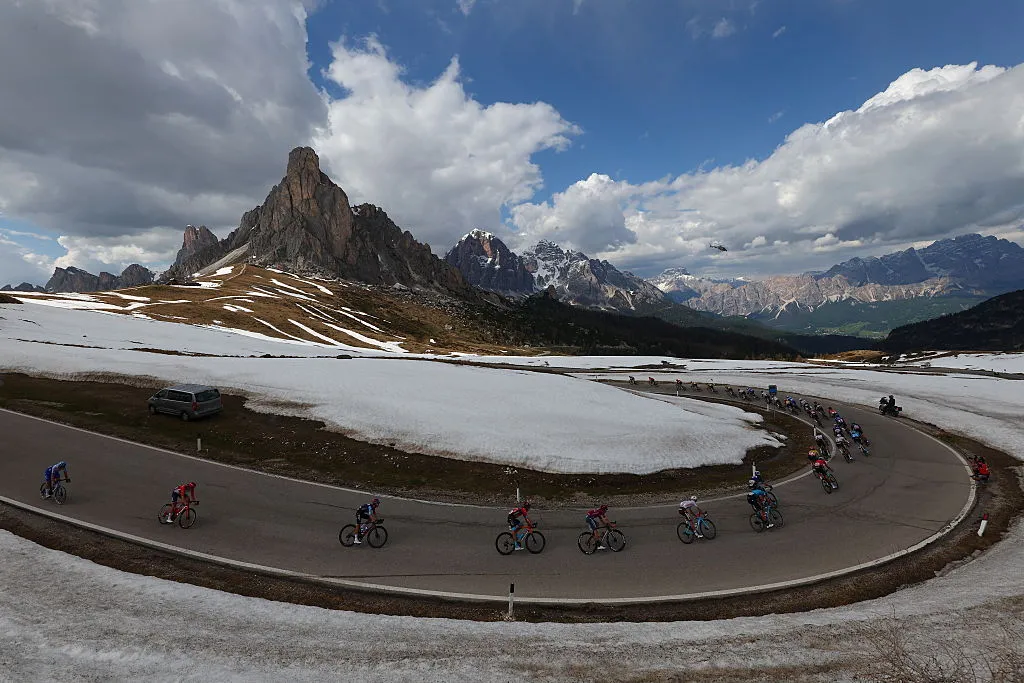
Part of the race since 1965 to honour five-time winner and Italian cycling hero Fausto Coppi, who died five years earlier, the Cima Coppi is a prize handed out to the first rider to pass the highest climb of the Giro d'Italia each year.
Giants of the Giro such as the Passo Pordoi (the Cima Coppi 14 times), Passo dello Stelvio (11) and the Passo di Giau (seven) have hosted the Cima Coppi more than any other climbs. This year, the Cima Coppi honour goes to the Passo Giau for the eight time, peaking out at 2,230m above sea level.
While the Cima Coppi once saw double mountain classification points awarded for riders across the top, the climb now sees a more modest points scale of 50, 30, 20, 14, 10, 6, 4, 2, and 1. The Cima Coppi is also used as a tiebreaker in the event two or more riders are tied for points at the top of the mountain classification.
Along with the points on offer, winners of the Cima Coppi also receive the Vincenzo Torriani Trophy in honour of the Giro's legendary long-time director as well as a cash prize.
Trofeo Bonacossa
This informal award – named for Alberto Bonacossa, former owner and editor of La Gazzetta dello Sport and CONI president – is handed out by a jury of journalists rather than an official Giro d'Italia prize awarded by the organisation. It's awarded to the rider or team who carries out the 'greatest exploit' of the race.
Defunct competitions

The Maglia nera (black jersey) may have only been awarded between the years of 1946 and 1951, but it has lived long in the memory. An analogue to the Tour de France's lanterne rouge, the jersey was awarded to the last-placed finisher at the Giro.
The black colour originated with football player Giuseppe Ticozzelli, who, in 1926, took part in the Giro for the first and only time as an independent racer wearing the black shirt of his team Casale.
An unorthodox racer, Ticozzelli completed three stages of the race – losing a large amount of time along the way as, without a soigneur, he had to stop for food in local restaurants – before being hit by a motorcycle and abandoning.
Luigi Malabrocca won the jersey twice in 1946 and 1947, while Pinarello founder Giovanni Pinarello was the winner in 1951. In the late 2000s a black number was briefly introduced to the race as a nod to the jersey.
The Pirelli sponsored Premio miglior discesista (best descender) prize is the most short-lived of all Giro d'Italia competitions. Announced four days before the start of the 2017 race, it was consigned to the history books just two days later following an outcry from riders, rider unions and fans alike.
Giro organisers picked out 10 downhills – including those coming off the Stelvio and Pordoi – for the competition, which would've awarded 8 points and €500 to the fastest rider on each descent with the overall winner taking €5,000.
The Combination classification has been used intermittently and in various guises over the years, combining the standings of the overall, points and mountain classifications. Between 1972 and 2006 it was run 12 times, with the prize awarding the blue jersey in 1988 (Andrew Hampsten) and 2006 (Paolo Savoldelli).
Between 1993 and 2017, the Giro d'Italia ran two team classifications, the Super Team and Fast Team, the latter a time-based prize (now confusingly known as the Super Team) and the former based on points awarded to the top 20 finishers on each stage. Generally, little attention was paid to the award, and few will have noticed when it was shelved five years ago.
The Azzurri d'Italia award, which ran from 2001 to 2016, was a prize given by the National Association of Olympic Athletes Azzurri d'Italia, a grouping of all athletes who have represented Italy at the Olympics. Points were given to the top three finishers on each stage, which were later totted up, meaning the competition often followed the points classification. Michele Scarponi was the last winner of the prize.
Finally, there was the Classifica isolati, a competition run between 1910 and 1936 to reward the best-placed rider who competed without a team – the 'isolated'. None of these riders won the race outright, though several of them finished in the top five overall. Aristide Cavallini won the classification three times, while two-time Tour de France winner Ottavio Bottecchia won it in 1923.
Giro d'Italia rules

As with the other UCI-sanctioned events that make up the WorldTour and beyond, the rulebook for the Giro d'Italia is standard and in line with the sport's governing body. There's nothing out of the ordinary compared to the likes of the Tour de France or Paris-Roubaix, for example.
However, during the course of a three-week race, some rules and regulations come up more than others, including stage time limits, the three-kilometre rule as well as the various fines and penalties for breaking any number of UCI regulations (illegal feeding, using forbidden technology, deviating during sprints, slipstreaming cars, and so on).
Read on for a summary of the most commonly cited rules and punishments.
Sprint zone rule
This rule, formally known as the 3km rule, means that riders who suffer a crash or a mechanical problem within the final kilometres of some stages will be handed the same finishing time as the group they were with at the time of the incident.
It used to only be a 3km margin, but these days is sometimes extended to 5km, and sometimes isn't in play at all.
It helps to keep the GC intact should a major contender suffer a puncture or crash late on a flat sprint stage. On stages like that, teams of the top GC men will often race up front until the 3km of 5km mark to keep their contenders safe before dropping away and letting the sprint squads do their thing.
There's also the three-second rule, where for gaps to be applied to GC, there has to be more than three seconds between the last rider in one group and the first rider in the next.
Here's a break down of when these rules apply in the 2026 Giro.
Stage | Sprint zone | Time gap rule |
|---|---|---|
1 | 5km | 3" |
2 | N/A | Row 1 - Cell 2 |
3 | 3km | 3" |
4 | 5km | 3" |
5 | 3km | Row 4 - Cell 2 |
6 | 5km | 3" |
7 | N/A | Row 6 - Cell 2 |
8 | N/A | Row 7 - Cell 2 |
9 | N/A | Row 8 - Cell 2 |
10 | N/A | Row 9 - Cell 2 |
11 | 3km | Row 10 - Cell 2 |
12 | 5km | 3" |
13 | 3km | Row 12 - Cell 2 |
14 | N/A | Row 13 - Cell 2 |
15 | 5km | 5" |
16 | N/A | Row 15 - Cell 2 |
17 | N/A | Row 16 - Cell 2 |
18 | 3km | Row 17 - Cell 2 |
19 | N/A | Row 18 - Cell 2 |
20 | N/A | Row 19 - Cell 2 |
21 | 5km | 3" |
Time limit
The time limit is the time in which all riders have to meet in order to continue in the race the next day. It's usually generous, but things can get tight as sprinters battle their way through the mountain stages.
It varies day by day, depending on the difficulty classification of the stage. From A to E, the stages are split into different classes, from easy to hard and time trials.
A: Stages 1, 6, 15, 21: Winner's time + 7% if average speed is less than or equal to 40kph; +8% if average speed is 40-45kph; +10% if average speed is over 45kph.
B: Stages 3, 4, 12, 18: Winner's time + 9% if average speed is less than or equal to 40kph; +10% if average speed is 40-45kph; +11% if average speed is over 45kph.
C: Stages 2, 5, 8, 11, 13, 17: Winner's time + 11% if average speed is less than or equal to 40kph; +12% if average speed is 40-45kph; +13% if average speed is over 45kph.
D: Stages 7, 9, 14, 16, 19, 20: Winner's time + 11% if average speed is less than or equal to 40kph; +12% if average speed is 40-45kph; +13% if average speed is over 45kph.
E: Stage 10 (TT): Winner's time + 30%
Fines and punishments
The UCI has a long table of fines and punishments for various regulation breaches which makes up section 2.12.007 of the road racing regulations. Of course, they all apply at the Giro d'Italia.
It's a document that journalists and fans alike often scramble to check whenever controversy rears its head during a race, so here's a summary of those seen most often during racing.
Deviation during a sprint 'that obstructs or endangers another rider', or punching/pulling/threatening another rider: Relegation to last in group, 500CHF fine, 25% penalty in points and mountain classifications. Disqualification in serious cases or repeated infringement.
Unauthorised feeding: 200CHF fine inside first 30km; 200CHF fine and 20-second penalty inside final 20km; 1000CHF fine from third infringement onwards; 200CHF fine for a 'sticky bottle' for a short period of time.
Rider or team staff disposing of waste or other objects outside of litter zones: 500CHF fine and 25-point UCI ranking penalty on first infringement; 1000CHF fine, 50-point UCI ranking penalty, and one-minute penalty on second infringement; 1500CHF fine, 75-point UCI ranking penalty, disqualification on third infringement.
Sheltering behind or taking advantage of the slipstream of a vehicle: CHF200 fine, 20% penalty in points and mountain classifications, 20-second to 5-minute penalty per infringement.
Pushing off against car, motorcycle, rider; rider pushing another rider; extended push/es from spectator/s: CHF200 fine, 20% penalty in points and mountain classifications, 10-second penalty per infringement.
Holding on to team vehicles, or being pushed/towed/held by a vehicle passenger, or mechanical intervention on rider's bike from a moving vehicle: CHF500 fine, 100-point UCI ranking penalty, and disqualification. CHF500 fine and exclusion for driver and directeur sportif.
Use of forbidden onboard technology device (such as Kirsten Faulkner's glucose monitor at Strade Bianche): Disqualification
Irregular mechanical assistance to a rider of another team: 500CHF fine and 2 to 10-minute penalty per infringement.
Deviation from the race route constituting an advantage (shortcuts): 500CHF fine, 100-point UCI ranking penalty, and disqualification.
Use of sidewalk, paths or cycle lanes that don't form part of the race route: 200-1000CHF fine, 25-point UCI ranking penalty, 20-second penalty, 80% penalty in points and mountain classifications.
Failing to respect the instructions of the organiser or commissaires: 100-500CHF fine.
Unseemly or inappropriate behaviour (usually urinating in public): 200-500CHF fine.