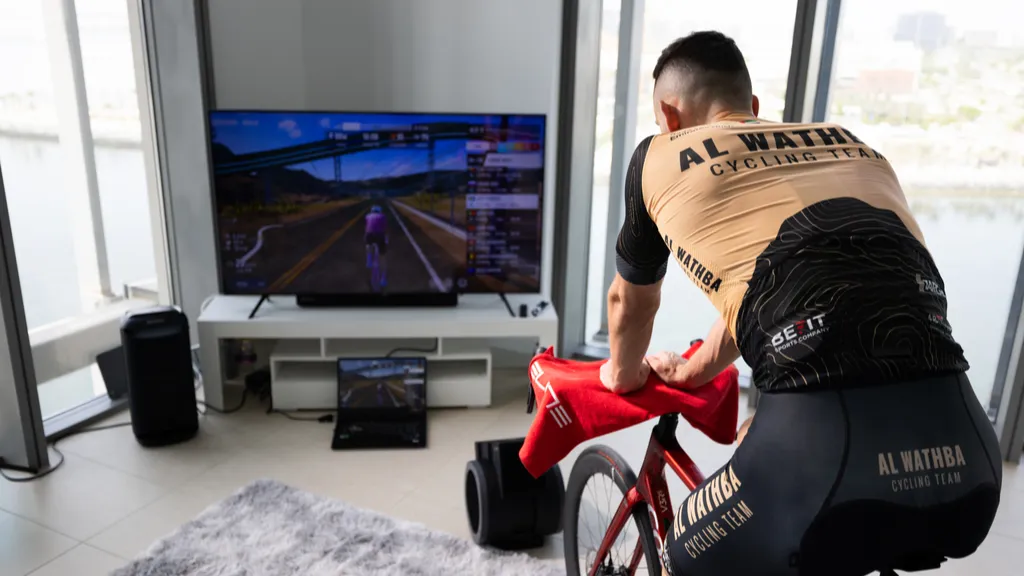
Riders competing virtually on MyWhoosh will have to be ready to provide blood and urine samples, as the indoor cycling platform rolls out a first-of-its-kind anti-doping testing programme.
We’ve seen virtual riding platforms such as MyWhoosh and Zwift aim to crack down on 'robo-doping', where riders digitally manipulate their performance data, but this is a new regime to test riders for physically doping, based on the World Anti-Doping Agency’s (WADA) Prohibited List of banned performance-enhancing substances.
The testing programme will apply to the MyWhoosh virtual events that offer significant prize money, most notably the Sunday Race Club, where weekly prize purses run into the tens of thousands of dollars. MyWhoosh indicated that "as prize-money events continue to grow" it’s becoming increasingly aware of the need to "ensure that competition results reflect genuine performance".
Latest Videos FromCyclingnews
The testing programme, which is carried out by the International Doping Tests & Management (IDTM), comes into force on Sunday, May 10 and will see the first samples taken on Sunday, May 17.
"The introduction of anti-doping and integrity testing is about protecting fair competition and rider trust," said Matt Smithson, Director of Esports & Game Operations at MyWhoosh.
"As our Sunday Race Club grows, the standards around fairness must match the seriousness of the event. Our goal is to protect clean riders and ensure that our global community can trust in the integrity of every podium finish."
How will it actually work?
For relevant races, riders will be required to declare their exact physical location in advance of the event. If selected for testing, they must remain at their declared location for up to three hours after the race, during which the testers would come round to collect a sample.
A rider could be notified of an impeding test shortly before, during or immediately after the event.
Samples to be taken could include urine, a blood sample collected from a vein, or a dried blood spot sample taken from a finger-prick.
Selection for testing is at MyWhoosh’s discretion and could be both random and targeted. The platform says results, performance data, and even intelligence could help target the testing but that racers could equally be selected at random.
If a rider refuses to comply – either through refusal, evasion, or tampering – they would face "severe sanctions such as disqualification, prize money claw-backs, and suspension from the platform."
MyWhoosh did not state the sanctions for a positive test, but they would likely be the same as the above.
The challenges
One challenge would appear to be the spread-out nature of the competitors, who can race from home in any country in the world.
The IDTM, which is carrying out the sample collections on behalf of MyWhoosh, would need agents near enough to the selected rider to reach them within three hours of the conclusion of the race in question. Even WADA struggles with global reach with its out-of-competition testing strategy.
That ties into the cost of the operation, which is likely to be significant. MyWhoosh is already handing out significant prize money, and the bill is set to be footed by the fee-paying riders themselves, but it will be interesting to see how much the whole operation ends up costing.
Another challenge would be the legal basis for all this, and whether a racer could look to challenge the legality of a positive test, either through an appeals process or even in court.
Sanctions would only apply to the MyWhoosh platform, which is, in effect, its own governing body for this programme but has no jurisdiction beyond it, so racers banned from MyWhoosh would not face any restrictions in any other area of competitive cycling. And while this is low-level competition in the grand scheme of things, potential lost earnings and reputational damage could form the basis for legal challenges if a banned rider has the inclination and the cash, so MyWhoosh will need to make sure its system is water-tight from that perspective.
MyWhoosh says its anti-doping programme operates under the 'MyWhoosh Cycling E-sports Rules and Regulations', establishing "a 'private contractual and sporting integrity framework' that draws from recognised international standards, including the WADA Prohibited List."