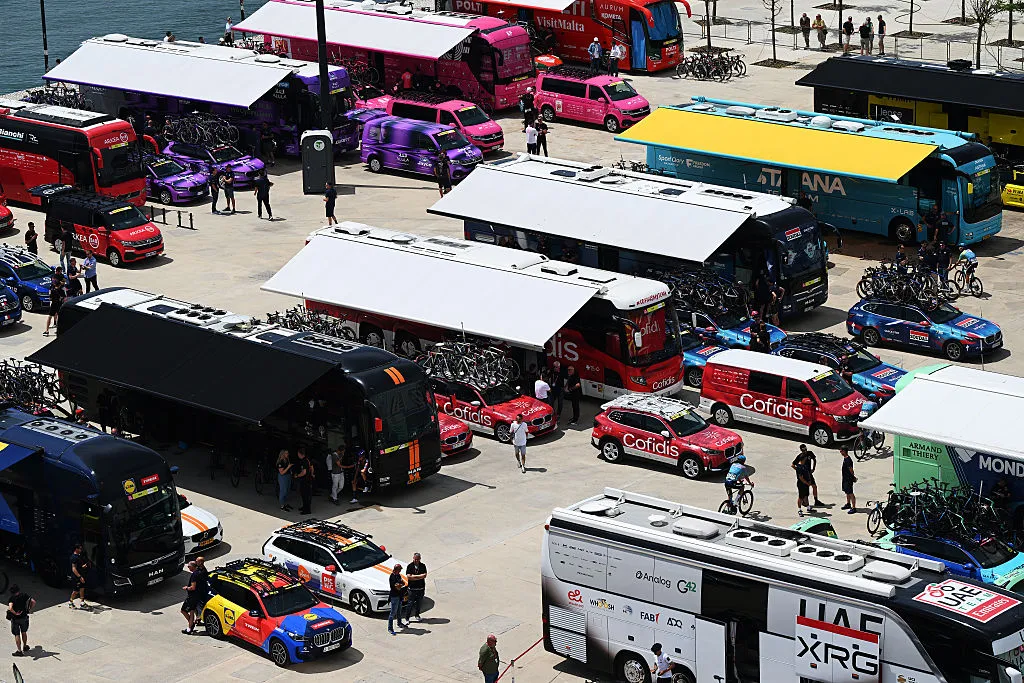
The 2026 Giro d'Italia covers 3,468km of racing, but riders and teams faced a huge extra logistical challenge and an extra 1,000km transfer on Sunday evening to get from the start in Bulgaria to Italy.
Stage 3 finished in the Bulgarian capital of Sofia on Sunday at 5pm local time, after which riders boarded charter flights to Lamezia Terme in southern Italy, about a half hour from where stage 4 starts in Catanzaro at 1:40 p.m. CEST on Tuesday.
Although there are 40 hours between stages, the UCI rules on transfers during Grand Tours specify, "Riders and staff must be able to spend a minimum of 13 consecutive hours in their hotel between two stages".
Additionally, for post-stage transfers of more than two hours during a Grand Tour, organisers must either hold a rest or transfer day afterward, or host a stage of less than three hours that begins after 2 p.m.
"Transfer time includes the time to travel from the stage finish area (or the teams' hotels) to the transfer venue (railway station, airport, port) as well as check-in and boarding time, travel time and connection to hotels," the rules state.
That is why the Giro d'Italia began on a Friday and has a rest day after just three stages.
Long drives, logistical challenges
The Giro has landed in Italy 🇮🇹Rest up, see you on Tuesday! 🩷Il Giro è atterrato in Italia.🇮🇹Riposatevi, ci vediamo martedì! 🩷#GirodItalia pic.twitter.com/Vbsn7nB9ecMay 10, 2026
The transfer is a logistical challenge that has left teams doubling up their team vehicles, bringing in extra personnel and cutting some of the usual recovery 'luxuries' such as food trucks and mattresses that teams usually enjoy.
Get The Leadout Newsletter
The latest race content, interviews, features, reviews and expert buying guides, direct to your inbox!
Race organisers RCS Sport have also doubled up, with a new mini-Grande Partenza infrastructure created in Catanzaro for those who only join the race caravan in Italy. With around 2,000 people in the Giro caravan, it can be a logistics nightmare.
The Bulgarian government reportedly paid RCS Sport €12.5 million to host the Giro Grande Partenza, far more than any Italian city or region could ever pay.
Team expenses such as hotels, fuel and other costs are traditionally largely covered by race organisers but some teams feel they have been forced to 'pay to race' at the 2026 Giro d'Italia due to the extra costs they face travelling to Bulgaria, only a year after the start in Albania.
Grand Tour organisers usually pay a participation fee of around €60,000 per team and provide beds and meals for around 30 riders and personnel. However in recent years, teams have brought in extra staff such as osteopaths, coaches, and chefs, plus extra carers and mechanics. A team for a Grand Tour can include 50 people, with teams having to pay race organisers for extra hotel beds, often paying back more that they receive in the participation fee.
Cyclingnews understands that the AIGCP, the International Association of Professional Cycling Teams, was locked in tense negotiations with RCS Sport about the financial contribution, even before the route of the 2026 race was presented in Rome last December.
According to Escape Collectivea deal was eventually struck with teams receiving around €130,000 each plus flight vouchers with low-cost airline WizzAir worth €5,000 for the flights out to Bulgaria. The AIGCP’s Managing Director, Marc Chovelon, told Cyclingnews that the final figure "fell below the level requested by the majority of our teams."
Planes, buses and team cars needed to transport the 2,000-person Giro caravan
The Giro d'Italia team paddock at the 2025 race (Image credit: Getty Images)
Most riders travelled to Bulgaria on Tuesday evening last week, in time for the pre-race 'suivi médical' checks and UCI blood tests on Wednesday morning. Italians Alberto Bettiol, Diego Ulissi, Damiano Caruso and Giulio Ciccone cobbled together to take a private jet from Milan directly to Burgas on the Black Sea coast. Other riders and staff had to fly to the capital Sofia and then drive five hours to Burgas.
Team staff faced a longer haul, setting off three or even four days earlier for the long drive from their service course headquarters in western Europe to Burgas. The Unibet Rose Rockets teams indicated they faced a 23-hour, three-day drive from their base in the Netherlands to Bulgaria. Some teams were closer but Movistar vehicles had to travel from their base in northern Spain.
Other teams faced similar long hauls and so opted to create two support teams: one for Bulgaria and another one for Italy. Some team staff in Bulgaria will then head north for the Tour de Hongrie that starts on May 13, where seven WorldTour teams will be in action. However some teams simply do not have two buses available nor two sets of team vehicles.
"We have to work with two different teams," Lotto-Intermarché sports director Bart Wellens told Wielerflits.
"There is a part of the staff who only handle the Italian block and a part that is only active in Bulgaria, because you can’t get everything done in Italy on a single rest day."
Some vehicles drove 1,000km south to Greece on Sunday to catch a ferry from Igoumenitsa to Brindisi or Bari in the southern heel of Italy.
Team buses and other vehicles left before Sunday's stage start but faced a race against time to reach Igoumenitsa for a 1 a.m. ferry to Italy. After the nine-hour sail, they still faced a 390 km drive to the team hotels near Catanzaro in the toe of the Italian peninsula.
Some riders have been left without their special mattresses and recovery aids and team chefs are cooking in hotel kitchens.
"Many teams, including ourselves, chose to go to the start in Bulgaria with a minimal number of vehicles. After all, the race there lasts only three days, so we make do with a little less luxury," Wellens told Wielerflits.
"I will be relieved when we reach mainland Italy on day four. Then the worst is behind us logistically, and the stress can ease up a bit. It was a difficult start to organise as a team this year. Let's not forget that when we are on the Italian mainland, there are still a lot of other transfers to do."
Who will challenge Jonas Vingegaard at this year's Giro d'Italia? Subscribe to Cyclingnews for unlimited access to our coverage of the Corsa Rosa. Enjoy unrivalled reporting from our team of journalists on the ground, including breaking news, analysis, and more, from every stage as it happens, plus access to the Cyclingnews app to follow the action on the go! Find out more.
Stephen is one of the most experienced members of the Cyclingnews team, having reported on professional cycling since 1994. Before becoming Editor-at-large, he was Head of News at Cyclingnews. He has previously worked for Shift Active Media, Reuters and Cycling Weekly. He is a member of the Board of the Association Internationale des Journalistes du Cyclisme (AIJC).
You must confirm your public display name before commenting
Please logout and then login again, you will then be prompted to enter your display name.