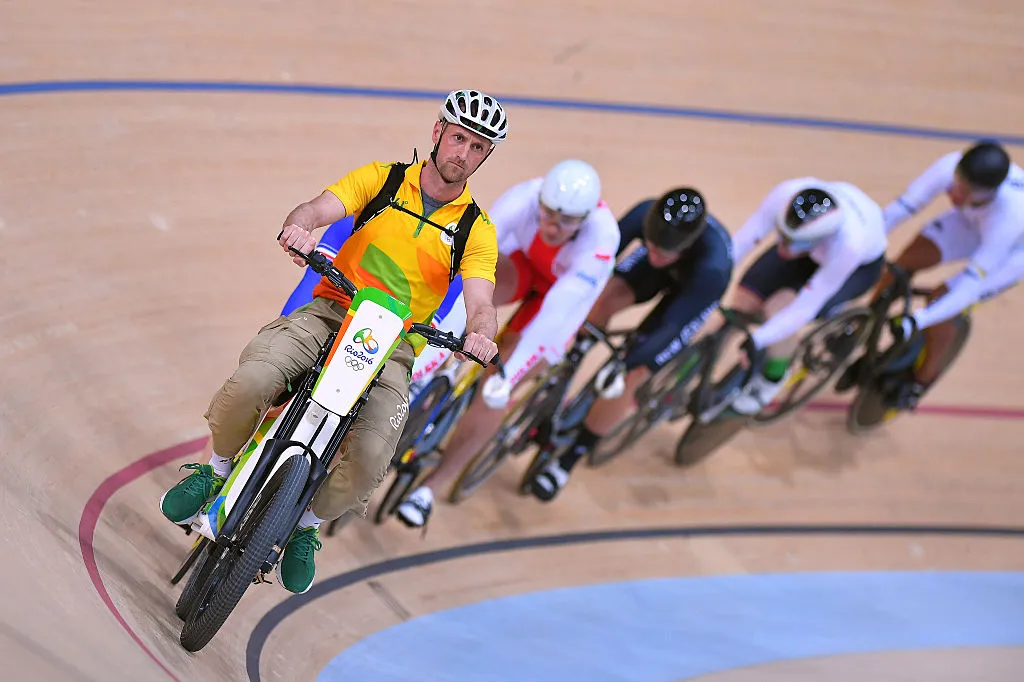
The Olympic Keirin pits the world's best sprinters against each other in this fast, exciting and often dangerous event.
The Keirin starts with riders being held by helpers and taking off from a standstill. However, the Keirin uses a pacer on an electric motorbike to bring the pack of six or fewer opponents up to speed. Before the start, riders draw lots to see where they will be positioned behind the pacer and, after take-off, they must settle into that order as the race begins.
Article continues belowHistory

The Keirin made its debut in the Olympics in Sydney in 2000, 20 years after being added to the UCI Track World Championships as an event. Florian Rousseau (France) was the first gold medalist, while the British have won the last four gold medals – with Chris Hoy in Beijing and London and Jason Kenny in Rio and Tokyo.
The women's event was added in 2012, with Victoria Pendleton claiming the gold in London and Dutch rider Elis Ligtlee staging an upset win over Becky James and Anna Meares in Rio. The Netherlands triumphed again in Tokyo, this time thanks to Shanne Braspennincx.
The beauty of the Keirin lies in its randomness – anything can happen across the three rounds and the 'repechages' that precede the gold medal final.
The competition starts with 30 riders at the Olympics, spread across five heats of six riders each in the opening round. The first two finishers of each heat automatically qualify to move onto the second round (10 riders) while the rest enter the repechage heats, four heats of five riders each. Again, the top two get to move onto Round 2 for a total of 18 continuing and a dozen athletes being knocked out entirely.
Round 2 is safer, with the top four riders in each of three heats moving on to Round 3 and six riders eliminated. Round 3 determines which riders get to race for the medals and which will be racing for seventh through 12th place overall.
The top three riders from the two heats of Round 3 move onto the medal round, where the top three claim gold, silver and bronze.