
The best smart bikes have the features and technology to simulate outdoor riding and optimise your workout in the same session. They are packed full of fun and engaging features, as well as futuristic ecosystems that make training more efficient and effective than ever.
These well-integrated ecosystems are many of the same you can use to track your sessions on the best smart trainers. But here's the kicker: the best smart bikes take it to the next level. Rather than connecting your outside bike to a trainer, smart bikes integrate the bike into their system, with some providing advanced features such as tilting to replicate climbs and imitating the shifting of various gearing styles.

Indoor training and racing has been a firm fixture of my weekly riding schedule since 2018. As part of my role at Cyclingnews, I am constantly changing my indoor training setup to use with the most popular platforms including Zwift, TrainerRoad, MyWhoosh and others. From smart trainers to smart bikes, I test them all for accuracy, responsiveness and how easy they are to live with.
Last updated 23rd March 2026 Newer products have been added and all the product specs have been checked to ensure they are all up to date. The Quick List has been extended to enhance the guide and improve navigation.
Best smart bikes
You can trust Cyclingnews Our experts spend countless hours testing cycling tech and will always share honest, unbiased advice to help you choose. Find out more about how we test.
Best overall

The Wahoo Kickr Bike Pro is the brand's top-of-the-range smart bike, with a unique ability to tilt up and down so that when you hit a climb in the virtual world, the Kickr Bike Pro will change position. It's as realistic as it gets for indoor cycling, with the tilting feature working the muscle groups you would use on a real climb outdoors.
The Kickr Bike Pro will even tilt downwards on a virtual descent, and its motor-driven resistance unit will kick in to give you a rest, as in the real world. In terms of gradient simulation, the Kickr Bike Pro is capable of simulating 15 percent downgrades as well as 20 percent ascents. It's also able to measure up to 2500 watts of resistance, more than enough for all but the most powerful cyclists.
The Kickr Bike Pro's realism extends beyond tilting, with virtual shifting allowing it to simulate the gear ratios of 11 or 12-speed drivetrains from Shimano, Sram or Campagnolo. This is a fantastic feature for cyclists who want to bring that real-world feeling to their indoor cycling setup. The bike also comes with variable crank length and quick, app-driven position adjustment, which you can use to set up your Kickr Bike Pro to match your outdoor bike.
Among other enhancements, the latest Kickr Bike Pro includes a Fi'zi:k saddle and bar tape, a new handlebar shape, on-bike Zwift controls and Wi-Fi connectivity for a more robust internet connection. You can also plug in the Wahoo Direct Connect dongle for a wired ethernet connection to help avoid wireless network dropouts. Finally, Wahoo added on Race Mode to the Kickr Bike Pro, which increases data transmission frequency tenfold.
The only thing lacking in the Kickr Bike Pro, which you get in the latest Kickr Move turbo trainer, is forward and back motion and side-to-side movement as you ride, which can provide a more realistic ride feel. Some riders find the resistance of Wahoo trainers and smart bikes to be unique, bit heavy and less natural than riding outside. This is not a common problem across the board, but it's certainly something to consider when comparing the Kickr Bike Pro to other smart bikes.
Check out our in-depth Wahoo Kickr Bike Pro review, where we put it to the test.
Best for integration

The Kickr Bike Shift is a lower-priced option than the Kickr Bike Pro, making it a more direct competitor with less premium smart bikes, while still offering the benefit of Wahoo's really well-designed and well-integrated ecosystem.
While the Kickr Bike Pro tilts on its axis to simulate climbs and descents, the Kickr Bike Shift has a static ride position. It benefits from a resistance system which is quieter than the Kickr Bike Pro. Although its maximum resistance is slightly less than the Kickr Bike Pro, this isn't something that most users are likely to find a problem.
As with the Kickr Bike Pro, the Kickr Bike Shift's levers can be programmed to replicate gearing from the major brands and there's easy fit adjustability, and in its latest iteration, it even has braking. The Kickr Bike Shift isn't the best-looking smart bike, but function takes precedence over form. Like the Kickr Bike Pro, the Kickr Bike Shift has a unique ride feel, one that is noticeable on Wahoo trainers and smart bikes. Some riders find the resistance a bit heavy and less natural than riding outside, but it is certainly not a net negative. The smooth ride feel is adored by many, and it helps the Wahoo trainers and bikes stand out against the others.
Wahoo offers tight integration between its smart bikes (both the Kickr Bike Pro and Kickr Bike Shift), its Wahoo SYSTM training environment and its Elemnt bike computers, so you can ride the Kickr Bike Shift or ride your bike outdoors if you prefer.
Read our Wahoo Kickr Bike Shift review for more.
Best for Zwift


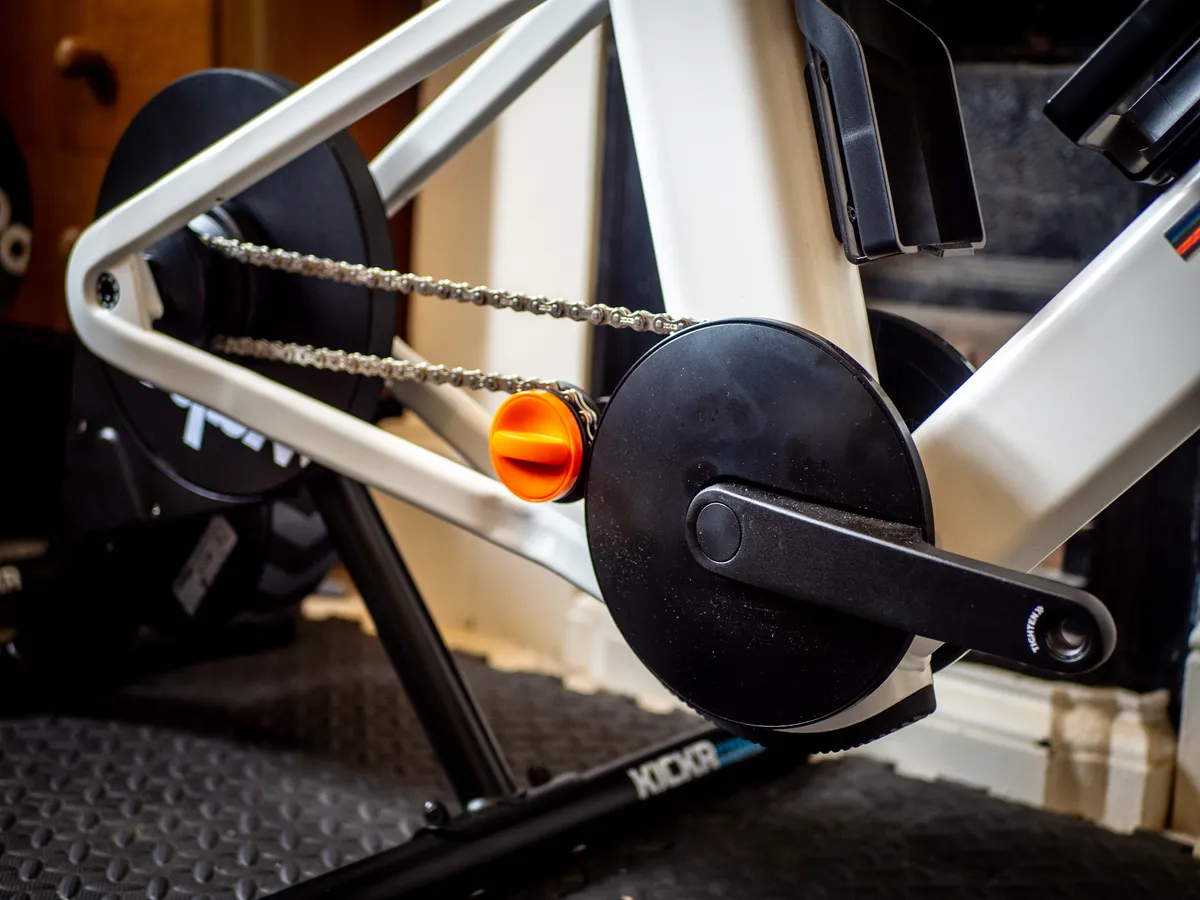
Zwift is by far the most popular indoor cycling platform, so it's no surprise that it has its own smart bike for riding, training and racing online. Rather than design its own smart bike from the ground up, Zwift paired up with Wahoo to create the Zwift Ride.
At the centre of the system is a highly rated Wahoo Kickr Core 2, which handles all the riding and smart features that turn this into a smart bike. The Zwift Ride is essentially the static smart bike frame, which attaches to the Kickr Core 2 in a few simple steps. During testing, the frame offered a sturdy platform when riding, which was a pleasant surprise given the look of the single leg stabilising the front of the frame. Saddle height (for riders between 152cm and 198cm tall) and reach can be adjusted, however, the crank length cannot. It is fixed at 170mm, which is one of the few downsides of the Zwift Ride. Thankfully, there are two bottle cages in the frame for easy-to-reach refreshments while you tackle Alpe du Zwift.
Not only does the frame give you the set-and-forget benefits of a smart bike, but Zwift's Play control buttons are integrated in the Zwift Ride's handlebars. That means you get virtual shifting functionality and full control of Zwift while you ride, no additional purchase required.
The simplified design is considerably more affordable than most dedicated smart trainers, although the controls are designed specifically for Zwift and aren't compatible with other training apps like TrainerRoad and MyWhoosh. This is one of the biggest factors that separates the Zwift Ride from other smart bikes like the Wahoo Kickr Bike Pro or Tacx Neo Bike Plus. If you want to ride on any platform outside of Zwift, you'll have to find a few workarounds to make it all connect.
If you already own a Kickr Core 2 that you use for Zwift and want to upgrade to a smart bike, Zwift sells the Frame on its own, making it an affordable upgrade to your indoor setup. There is an increasing number of trainers from other brands now compatible with the Zwift Ride smart frame, so make sure you check out the latest list of Zwift Ready trainers.
Read our Zwift Ride review for more.
Best smart bike for pedalling analysis

The Wattbike Atom uses a magnetic resistance unit that is much quicker to respond to workouts than comparable smart bikes. Like the Tacx Neo Plus and Wattbike Proton, the Atom has a virtual flywheel rather than a physical one. The Atom also come with accurate power measurement within +/-1%, and a sleek design.
It looks great, is widely adjustable, and comes with a two-in-one road and time trial handlebar setup. The drop bars feature what amounts to dual control levers without the brake levers, and feature buttons which simulate shifting, while at the end of the time trial extensions, there's an adjustable screen holder that can hold smartphones and most tablet computers comfortably.
The handlebar and saddle are adjustable; height is tool-free, but to change the fore and aft, you'll need hex/Allen keys. While the bike offers plenty of adjustment, the cranks are fixed at 170mm, just like the Zwift Ride, and can't be changed like some of the other smart bikes on offer.
The virtual flywheel can handle 2,500 watts of output just like many other smart bikes on this list, more than almost everyone will need. With both Bluetooth and ANT+ connectivity, the Atom is universally compatible, meaning you can use any of the myriad training apps available - or any of the best bike computers - to control your workouts. A standout feature of the Atom is its pedalling efficiency analysis, which you can use to help improve your pedal stroke. Few other smart bikes on this list include such a feature.
If you're going to be exclusively using a smart bike on Zwift, then the Zwift Ride may be a better option. However, the Wattbike Atom and Wattbike Proton (see below) offer a great gym-bike feel packaged into a sturdy frame. The Proton is a bit more affordable, offers easier adjustment, and features a lower step-over.
Read our review of the Wattbike Atom review for full details.
Best smart bike for training

The Tacx Neo Bike Plus is the top product within the Tacx (owned by Garmin) range, and for good reason. It uses a clever electromagnetic drive unit, meaning it can replicate the feeling of a 125kg flywheel for maximum realism. This is "larger" than any other smart bike, giving the Neo Bike Plus a unique ride feel that is beloved by many.
During an easy training ride, it doesn't feel much different to the ride feel of the Kickr or Wattbike. The difference kicks in when you power up for a workout or race. You can also use the Neo Bike Plus without mains power, as it will regenerate the power from your legs.
At the front of the esthetically-pleasing frame, there's a pair of built-in fans that can be aimed directly at your face. This is one of the best features for indoor riders who enjoy pushing themselves to the max. The airflow can even be tailored to track your speed, power or heart rate, should you be after a more interactive experience. Unlike the older version of this bike, the shifters are now much more similar in shape to what you find on a normal road bike, and the buttons can be configured to replicate Shimano, SRAM or Campagnolo shifting.
A built-in display shows you which virtual cog you are spinning, in addition to metrics like speed, heart rate and power, and a tablet holder allows you to mount your phone or tablet. The bike's saddle and bars can be customised depending on your personal preference, and all the fit adjustments can be made by the included levers or a hex wrench. Crucially, the cranks can be adjusted (unlike the Zwift Ride or Wattbikes) with five built-in holes in ranging from 165 to 175mm.
The drive unit can generate up to 2,200 watts of resistance, simulate a 25 per cent incline and offer pedalling analysis to precisely measure how round your pedal stroke is. Power accuracy is claimed to be within one per cent, the same rating as all comparable smart bikes.
Read our Tacx Neo Bike Plus review for full details.
Best smart bike for value

Wattbike's Proton is one of the most affordable smart bikes available, filling a much-needed slot below the more expensive Atom. It's easier to customise the fit of the Proton since it features tool-free adjustment catering for riders from 4'6" to 6'6". It also has a more compact body that is easier to step over when you get on and off.
One of the downsides of the Atom is its peak resistance of 1,800W (versus 2,500W of comparable smart bikes). But few riders will ever break that ceiling. The Proton's design is more compact, so it has a slightly smaller footprint, making the Proton an easier fit in your flat, shed, or living room.
Despite the different design and price point, the Proton mimics much of the Atom's functionality, with an electromagnetic resistance unit and full connectivity via ANT+, BLE. The Proton also supports the FTMS protocol for automatic resistance changes, but it doesn't come with a USB charging port.
The Wattbike Proton can simulate gradients from 0 to +25%, so there's plenty of room to test and perfect your climbing skills. You can simulate between one and 22 gear ratios, but there are some additional downsides. The Proton's 170mm crank length is fixed, and it's fitted with pedals with straps instead of clipless pedals. If you want to ride the Proton with standard cycling shoes, you'll need to swap the pedals out.
Read our full Wattbike Proton launch story for more details.
The best smart bikes compared
| Header Cell - Column 0 | Connectivity | Type | Resistance | Adjustable crank length | Virtual shifting | USB charging port | Flywheel weight |
|---|---|---|---|---|---|---|---|
Wahoo Kickr Bike | Bluetooth, ANT+, WiFi | Smart bike | Electronic, electromagnetic | Yes | Yes | Yes | 9.5kg |
Wahoo Kickr Bike Shift | Bluetooth, ANT+, WiFi | Smart bike | Electronic, electromagnetic | Yes | Yes | No | 9.5kg |
Zwift Ride | Bluetooth, ANT+ | Smart bike | Electronic, electromagnetic | No | Yes (only on Zwift) | No | 5.4kg |
Wattbike Atom (Next Generation) | Bluetooth, ANT+ | Smart bike | Electronic, electromagnetic | No | Yes | No | Virtual 9.28kg |
Tacx Neo Bike Plus | Bluetooth, ANT+ | Smart bike | Electronic, electromagnetic | Yes | Yes | Yes (x2) | Virtual 125kg |
Wattbike Proton | Bluetooth, ANT+ | Smart bike | Electronic, electromagnetic | No | Yes | No | 8.05kg |
How to choose the best smart bike for you
Here's what to consider when choosing the best smart bike for your needs:
- Do I want a smart bike or a smart trainer? Smart bikes are simple and easy. No need to remove your rear wheel or find adapters for your bike. A smart bike also takes wear and tear away from your bike and its components. Smart trainers are significantly more affordable, but if you're fully committed to hundreds of hours of indoor training, a smart bike might be the best option.
- How much do I want to spend? Smart bikes have a high initial price, but the ongoing cost of ownership is zero. Many of the best smart trainers can offer similar features at a lower price, although they come with their own pros and cons.
- Do I want to ride on more than one app? Some smart bikes are designed with a single app in mind. Take the Zwift Ride, for example. While it technically works on other platforms, the controls won't match up, your shifting might not work, and it could turn into a whole mess if you ride on any app but Zwift.
- Do I want a smart bike or an exercise bike? The ongoing expense of a smart bike is basically zero, and they can use a wider variety of apps than most exercise bikes. The majority of smart bikes work with multiple (or all) third-party indoor cycling apps, meaning you don't have to commit to one over another. With exercise spin bikes like Peloton, you are buying into a closed ecosystem, so if you want to change it up, there is nothing you can do on the bike besides the functionality of a basic exercise bike.

Everything you need to know about the best smart bikes
Smart bike or smart trainer?
There are plenty of advantages to choosing a smart bike, however, you might be better served by one of the best smart trainers instead. Choosing a turbo trainer vs a smart bike would offer most of the same features, but instead of an integrated bike, you would mount your own bike to a pared-down version that lets your bike provide the touchpoints.
However, with a smart bike, once you have replicated the fit from your road bike, all you have to do is jump on and start pedalling. There is no need to wheel your road-grime-splattered bike through the house and remove your rear wheel. Dedicated smart bikes are also noticeably more stable than your standard smart trainer-plus-bike setup, and most will be quieter too.
While these features are all well and good, we think the main selling point of a smart bike is the fact that it takes wear and tear away from your bike and components. Wearable parts like chainrings, chains and cassettes are expensive, which adds to the cost of a trainer-plus-bike package.
How much do smart bikes cost
Smart bikes, such as the Wahoo Kickr Bike Pro and Tacx Neo have a high initial price, but the ongoing cost of ownership is zero, aside from any third-party apps you might choose to subscribe to.
There are, of course, more affordable options. Smart bikes like the Wattbike, Kickr Shift or previous generation smart bikes will still offer plenty of performance for most indoor riders without some of the more advanced features like Zwift controls, gradient replication and drivetrain customisations.
It's also worth mentioning that many of the best smart trainers can offer similar advanced features at a lower price, although, as mentioned before, they come with their own pros and cons.
Smart bike or exercise bike?
Both options offer the ability to train in the comfort of your own home, however, I would buy a smart bike for several reasons. Sure, they come with a higher initial cost, but once that cost is paid, the ongoing expense is much lower / zero, and the variety of apps they can use is significantly higher.
To compare: The most popular third-party app, Zwift, has a monthly subscription of £17.99 / $19.99, whereas the most popular of the closed ecosystems, Peloton, is £39.00 / $44.00 per month. More than double.
Smart bikes also offer 'open' compatibility with third-party indoor cycling apps, meaning if you get bored with one, you can try another. Most smart bikes are even accompanied by a free app from the manufacturer if you want to keep the monthly costs down. With smart spin-style bikes like Peloton, you are buying into a closed ecosystem, so if you fall out of love with the entertainment on offer, there are no alternatives short of reverting to the functionality offered by 'basic' exercise bikes.
What's more, technologically, smart bikes are more advanced. They use a power meter to measure your output and they can control resistance electronically, meaning software can set your resistance automatically to help you follow set workouts or hold a specific wattage. Freewheels allow you to coast downhill, and extra features such as tilting, braking and steering add to the realism and interactivity of the ride. It's closer to the experience of riding outdoors, and for us, that's what we want from our indoor cycling, though of course, we appreciate that not everyone is the same.
For a feature-rich system, we'd go for the Wahoo Kickr Bike Pro, but for maximum value for money, it's hard to overlook the Wattbike Atom if you can get it where you live. Dedicated Zwifters might gravitate to Zwift Ride for its lower price and built-in Zwift controllers.
In addition, we believe the more 'basic' exercise bikes will always have a place in the market for those who can't justify the higher investments of a smart device. They forego any of the interactivity, but there are plenty of workout videos you can follow on YouTube, or you can simply lose yourself in Netflix while pedalling.
Whichever you choose, if it gets you pedalling more and helps you to get fitter or feel better, then in our opinion, it's a win.
How we test the best smart bikes
Like many other cyclists, when winter comes rolling around the lure of indoor riding and training becomes increasingly strong. Choosing the best smart bike is going to give you the most convenient indoor experience.
These days, indoor training is more than simply burying yourself in intervals. With racing and social rides becoming increasingly popular, there are lots of factors to consider when reviewing the best smart bikes. Initial set-up is important. We build and set up each smart bike, dialling in our preferred fit and ensuring it connects reliably to secondary devices and services.
Once riding, we will check ERG interval performance with varying lengths of intervals using TrainerRoad before joining some racing and free riding on Zwift and MyWhoosh to see how the hardware and software handle varied riding situations.
To verify the smart bike's power readings are correct across various power durations, from short sprints to long steady efforts, we run secondary power meters to make sure the readings from the trainer are correct.
For more details of our approach to testing and reviews, head to our How We Test page.
