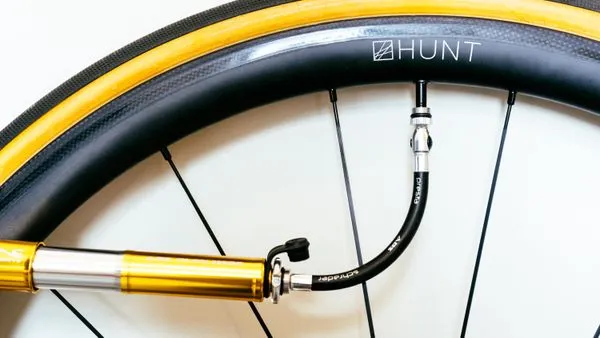
Whether you’re topping up tyres before a ride or fixing a puncture at the roadside, one of the best bike pumps is a kit essential for every cyclist.
Punctures remain an unfortunate reality of going out on a bike ride, even with advances in tubeless technology, so being able to fix one on the go is essential. Along with a spare tube or repair kit, and tyre levers, a pump is one item you shouldn’t leave home without.
The best bike pumps come in several forms. Floor pumps (also known as track pumps) accurately set tyre pressures at home and reach far higher pressures than most handheld options. CO2 inflators are popular for their speed and portability, and electric pumps add push-button convenience. Frame pumps remain an option for riders who prioritise higher pressures over weight and size, though they’re less common today.
While any reasonably serious cyclist should own a floor pump for home use, if I had to choose just one mini pump, it would be the Lezyne Pressure Drive. Mine lasted nearly a decade before sweat corrosion from years of carrying it in a jersey pocket finally took its toll. It performs reliably for road and gravel riding, is well-made, sensibly priced, and includes a built-in valve core tool.
Here's our pick of the best bike pumps we've thoroughly put to the test, followed by advice on how to choose the right one and answers to frequently asked bike pump questions.
Last updated on 14th of July 2026 The product list has been refined and the 'best for' categories have been refreshed to improve clarity and better reflect the strengths of each pump.
Best Mini Pumps
You can trust Cyclingnews Our experts spend countless hours testing cycling tech and will always share honest, unbiased advice to help you choose. Find out more about how we test.
Best mini pump for road


✅ You want a do-it-all mini pump: It will inflate a variety of tyre widths on the go and is a Goldilocks size that will cover you for most eventualities.
✅ You want build quality without paying top dollar: My own original Pressure Drive lasted close to a decade, only failing because I always stowed it in my jersey, where sweat eventually corroded the hose threads.
❌ You want fiddle-free pumping: Here you do have to unscrew the hose, screw it on the other end, then screw the hose onto the valve. All of which takes time, and can be annoying with cold, numb hands.
❌ You want a silent ride: The pump head can rattle on the body. It's easily fixed, but if you don't know the knack to stopping it, it can be a pain.
I've given this the title for best mini pump for road, but really, it's the best overall for a bit of everything. The Lezyne Pressure Drive has long held a reputation for its high quality and durable construction, and its ability to inflate a variety of tyre widths on the go. I'd take it out for gravel riding too; while the volumes and pressures differ, they do ultimately both use air.
Not too small, not too bulky, the Pressure Drive sits firmly in the Goldilocks zone. It's large enough that you can achieve a reasonable pressure - not so much as a frame pump like the Topeak Masterblaster, but certainly enough to get you home even on 25c tyres - but small enough to fit in a jersey pocket or be mounted to a frame behind a bottle cage. It also comes in colours other than black or silver, so you can use it as a visual accessory if you're that way inclined.
Mounted to a frame, the bracket easily shares space with a bottle cage, though the top head can rattle against the body. The trick to getting around this is to simply wrap the body with a few turns of electrical tape. This also has the added use of giving you some emergency electrical tape in a pinch, in case your bar tape comes loose or some such emergency. Yes, it's a bit 'turn a bug into a feature', but it's such a useful and easy fix, I find it hard to mark it down on this front.
Arguably, its best feature is the flexible and detachable hose. This does make it a bit more of a fiddle to use than some, but you get a perfect connection to the valve every time and the hose means you're not transferring a load of force to the valve itself directly, which can have disastrous consequences if you're not careful.
Lezyne pumps have previously earned a bit of a reputation for unscrewing valve cores that aren't done up tight. A welcome update that I'm pleased to see compared to my older model is the inclusion of a valve core tool built into the Schrader end of the hose, allowing you to make sure everything is securely tightened before you start pumping.
To find out more, check out our full Lezyne Pressure Drive pump review.
Best value mini pump


✅ You don't want to spend a fortune: It offers excellent performance and build quality without the premium price tag.
✅ You want to mount it to your frame: There is an included mount, but the key is the lockable piston handle, so the pump won't extend at random if you hit a bump.
❌ You want a built-in hose: A hose protects your valves from shearing forces. They aren't vital, but without them, you do need to be more careful.
❌ You want a small pump: It's narrow, but among the longest of the mini pumps I've tested. It'll certainly fit in a pocket, but it will protrude from the top.
Cheap pumps have improved massively since I bought my first one. This mini pump from Decathlon's in-house brand Rockrider is a lot more premium than the £15 / $20 price tag would suggest. The body is a lovely brushed finish anodised aluminium, and the dual-purpose head screws on rather than just pressing on for a secure connection.
The body is slender and long, and the rounded end of the handle helps when getting to higher pressures, as it doesn't cut into your hand. It doesn't have the knurled grip you'll find on pricier Lezyne or Silca options, but then it doesn't have the same price tag either.
There's no separate hose, so do be careful to brace the head with your hand while pumping to protect the valve from shearing. That said, it does include a locking mechanism to stop the pump from extending, making it a solid option for frame mounting. It sits neatly against a downtube and is totally rattle-free.
The main drawback, as you might have gathered from the specs sheet, is the speed of inflation. For such a long pump, it delivers relatively little air, and the head is rather fiddly. It'll get the job done, but it's just not as easy or quick as it is with other, more expensive options.
If you’re after a dependable, low-cost pump that won’t fall apart after a few rides, this is a strong contender. Like the higher-end Lezyne models, you can easily disassemble the body and replace the O-ring seal. I don't believe Decathlon sells spares separately, but you'll be able to find one that fits with a bit of effort if you want to avoid waste.
Most durable mini pump


✅ You want a pump you can pass onto your grandkids: The Tattico is beautifully made, with premium construction that will stand up to years of hard use.
✅ You want a bigger pump, but don't want a frame pump: It's somewhere between the size of a 'normal' mini pump and a frame pump, so you get additional capacity whilst still just about being able to fit it in your pocket.
❌ You're on a budget: It is five times the price of the cheapest pump in this guide, so certainly not one for those watching the purse strings.
❌ You want a super compact setup: It is the largest of the mini pumps in this guide, and the largest I've come across. It'll just about fit in a jersey pocket, but I prefer to keep it in my frame bag.
The Silca Tattico sits between a standard mini pump and full-sized frame pumps. It's large and relatively weighty, but with that comes exceptional durability.
The additional size makes it an absolute breeze for road tyres, and for larger gravel tyres, it performs better than all but a proper frame pump (or a larger size CO2 canister). The inbuilt hose is totally rattle-free, with a locking head, and the knurled grip on both the head end and the handle end means it's easy to use even in the rain.
It comes with a frame mount and a nicely designed rubber strap to keep it secure, but I usually just chuck it in a frame bag on my gravel bike. It’s definitely large enough that mounting it on your downtube could have a noticeable aerodynamic impact.
It's the nicest to use of all the mini pumps, beautifully made, and gets up to decent pressures as well as having volume enough to not take forever for gravel-sized rubber - why not say it's the best overall then? Well, it has an RRP of £70/$70, which is a lot for an item that hopefully you'll rarely have to use.
If you want the best of everything and don’t mind the size and weight penalty, this is about as good as mini pumps get. But if you just need something to get you home in the event of a flat, you can easily go for a smaller, lighter, and cheaper option, and it’ll do the job perfectly fine.
Best mini pump for gravel


✅ You want a pump for high volume tyres: Road pumps work pretty well for gravel, but 'high volume' pumps struggle to get to road pressures, so this is for you only if you're a die hard graveller.
✅ You value repairability: If a seal should ever go inside, it's a job that takes less than a minute to take the pump apart, replace the seal, and rebuild. You can even clean and service the internals if it's been exposed to particularly grim conditions.
❌ You want a small form factor: The Pocket Drive HV is a little stout, especially when compared so something like the Birzman Mini-Apogee.
❌ You want to mount your pump to your frame: There's no included mount, so it's pockets or bags only for this one.
If you’re running gravel or high-volume all-road tyres, your mini pump choice doesn’t need to focus on reaching extremely high pressures. Instead, look at air volume. Bigger tyres require more air at lower pressures, so a high-volume pump like the Pressure Drive HV is ideal.
The Pressure Drive HV shares many of the advantages of the standard Pressure Drive above, but is specifically tweaked for gravel use. The handle is knurled, making it easier to grip when your hands are wet, muddy, or slippery. That said, I'd have preferred it if the whole pump was knurled - I don't really understand why the body is and the head isn't.
The included hose protects the valve from shearing during pumping, though it does lack the valve core tool addition of the pressure drive. Sadly, the two aren't interchangeable, so you can't swap hoses if that's your plan.
You also can't clip it to your frame as there's no mount included. Given gravelleurs are always awash with cargo pockets and frame bags, I'm sure you'll still find space for it even if your jersey pockets are full - I just toss it in the frame bag and forget about it.
Aluminium can corrode over time, especially if it’s exposed to sweat or grime. The good news is that taking the pump apart, cleaning and lubricating it occasionally, and reassembling it takes very little time and requires no special tools, so you can easily keep it running for years.
Best electric mini pump


✅ You want effortless inflation on the go: The AS2 Pro is the easiest pump to use. Sit back, relax, let the small pocket-sized motor do all the work so you don't have to.
✅ You want the right pressure, even after a flat: Some mini pumps just can't get to road tyre pressures. This can.
❌ You're a forgetful charger: If you let your electric gears go flat it's annoying, but if you forget to charge your pump it could mean an S.O.S. call to a friend for a pickup.
❌ You live somewhere very wet: It isn't waterproof without the included ziplock bag, which is an oversight. It's a workaround that works, but in my opinion something like this should be IPX4 or 5 waterproof.
I’ll admit it, I was sceptical at first too. I’ve always had slightly luddite instincts, but one of my gripes with mini pumps is their inability to reach the higher pressures that 28c (or narrower) road tyres really need for optimum ride quality. Even with the Lezyne Pressure Drive, the mini pump I personally carry, I know that if I puncture, I’m unlikely to get my tyres back up to the 70psi.
When I tested 24 tyres in the lab, I found that running slightly lower pressures made almost no difference to outright performance. Still, it does leave me feeling a bit more nervous about hitting my rims, and it can affect how cornering feels.
The Cyplus pumps, despite their drawbacks, have one major advantage: they can inflate your tyres to a 'proper' riding pressure with minimal effort, and unlike CO2 cartridges, they can be reused. If you're riding road and gravel, the AS2 Pro is the one to go for. If you’re investing in a mini compressor, you might as well choose the version with a screen that lets you set your target pressure. The larger model is too large, and the non-Pro doesn't have a screen.
The AS2 Pro is pocket-sized, USB-C rechargeable, and simple to use, inflating a soft tyre back to full pressure in no time at all. Yes, you do have to remember to charge it, but if you're already running electronic gears then this argument does fall down somewhat. Keep it charged, and it'll serve you well.
There are a few downsides. If you’re using inner tubes with plastic valve stems, you’ll need to use the supplied hose - otherwise the heat generated during inflation can melt the valve, which would be far from ideal. The valve also needs to be positioned at the bottom of the wheel to see the screen while it runs, which is less convenient for tubeless setups, though it’s hardly a deal-breaker.
The main drawback, though, is that it’s inexplicably not waterproof. It comes with a silicone case, but the instructions advise keeping it inside the supplied ziplock bag if you’re riding in the wet. Any freezer bag would do the same job - it’s what I use for my phone in the rain - but it still feels like an oversight on a device designed to be carried outdoors.
Best floor pump


✅ You want fast and easy home workshop pumping: The Joe Blow is the easiest track pump I've used so far. The big base makes it super stable when you're trying to pump a lot of air fast, too.
✅ You don't want to break the bank: Considering I've seen some track pumps priced at nearly £500 / $500, the SRP for the Joe Blow is extremely reasonable.
❌ You want a screw-on valve connection: The quick-lock head isn't quite as secure as a screw on, but it is faster and isn't going to risk unscrewing your valve cores either.
❌ You want fancy materials: The body and base are metal, but the dial, handles, and head are all plastic. The ergonomics are sound, but it doesn't feel particularly premium.
Topeak’s JoeBlow range has a long-standing reputation as a go-to pump by amateur cyclists and professional mechanics alike, and the Joe Blow Sport III is a reliable floor pump (or track pump, if you'd rather) that works well across road, gravel, and MTB setups.
I still have an old Lezyne Steel Floor Drive, but since getting the Joe Blow Sport III, it’s mostly been relegated to backup duty. The Joe Blow is a little faster, largely thanks to its head, which locks on quickly rather than requiring screwing, and it’s far more stable thanks to its wider base. Base stability might sound like a minor detail, but when you’re trying to pump up tubeless tyres quickly, it makes a surprisingly big difference. As a taller person, the extra height of the Joe Blow is also easier on my back.
The handle is plastic, with a grippy top, and the ergonomics are sound, even if it does feel a little cheaper than say a lovely rounded wooden handle. The dial is plastic too, but it's large and easy to read, and comes with a handy movable indicator to give you something to aim for.
If you want absolute accuracy, something like the Lezyne Steel Digital Drive is worth considering. In my own testing with tyres in a lab, I found that as long as you’re in the right ballpark, minor pressure differences have very little impact on performance. For the general cyclist, an analogue dial is easier to read, more responsive, and perfectly adequate. If you need pinpoint accuracy, a standalone digital gauge will do the trick - I use the Topeak Shuttle Gauge Digital.
For more details, check out our full Topeak JoeBlow Sport III review.
Best CO2 inflator


✅ You want maximum speed with minimum kit: It's tiny. Even with a canister too it's about as small as inflation devices get, and is the quickest way to deal with a puncture.
✅ You want some degree of control over your CO2 flow: The built in regulator allows you to control the flow of carbon dioxide, meaning you can avoid over-inflating and having to back off after.
❌ You want hand protection from freezing cartridges: There's no protective sleeve to protect you from the chilling Joule-Thomson effect whereby gasses get colder as they expand.
❌ You want a low-waste solution to inflation: CO2 cartridges are recyclable, but they are disposable by their nature. If you want an environmentally friendly solution then stick to a pump.
I’m not a big fan of CO2 inflators. They feel unnecessarily wasteful, especially when many pumps can get your tyres up to the pressures you want, and that’s becoming even easier as road tyres keep getting wider.
That said, CO2 inflators do have their place, even in my on-bike toolkit. For racing (anything without the support of a team car, like gravel events or semi-competitive sportives), they’re much faster than a mini pump. The downside is that they’re a one-shot system, so if you mess it up, you’re out of luck. Personally, for general riding, I carry both, keeping the CO2 cartridge for situations where a tubeless tyre unseats.
Of all the inflators I've tried while writing the guide to the best CO2 inflators, the Silca Eolo IV is the one I actually take with me in my saddlebag. As you'd expect from the Italian brand, it's extremely well-machined and also pretty no-nonsense. What you get here is a tiny product with easy gas modulation, which relates to a better experience when inflating. It also comes in gravel-specific olive green, which I'm sure is key for some gravelleurs.
It doesn’t come with any cartridges, which can be a bit annoying, but it also means you can choose the size you prefer. There’s also no protective sleeve included. As the compressed CO2 expands, it cools rapidly, and ice can form on the head and cartridge, so be careful not to freeze your fingers. In my experience, sleeves that are included are easily lost anyway, so even when they come with one, I usually don’t have them.
Best floor pump for travel


✅ You want the ease of a track pump on the go: This miniaturised track pump is great for touring, bikepacking, and bike travel, allowing you to reach higher pressures than just about anything other than a track pump.
✅ You want to reach higher pressures: As the head screws on as per any other Lezyne pump, you can focus on pumping, not bracing the valve. A better connection means higher pressures.
❌ You like to pack light: It's bigger and heavier than most pumps in this guide.
❌ You want a quick fire pump: Unscrewing the head, flipping the leg out and getting all set up is a lot slower than some mini pumps or frame pumps.
This is a perfect option for touring, bikepacking, and bike travel in general, as I’ll explain shortly. The key is not to think of the Lezyne Digital Micro Floor Drive as a mini pump, but rather as a miniaturised track pump. Unscrew the head, which keeps the handle secure via the hose, flip out the foot pad, screw the head onto the valve for a solid connection, place your foot on the pad, and pump downwards into the ground rather than sideways. You can easily reach road pressures, and if your pump has a built-in pressure gauge, you can rely on numbers rather than guesswork.
Yes, it's bigger than a mini pump, but it's only a little bigger than the Silca Tattico. If you're bikepacking or touring long distance, you likely have more capacity anyway, and you still can mount it to your frame under your bottles; it's big, but what are you doing with that space otherwise?
There is a high-volume version too, if you only use bigger tyres, but if you have both, I'd go for the high-pressure version.
Where it really shines is on bike holidays. Imagine arriving in Mallorca only to find a flat tyre. You either have a mini pump that won't quite get the pressure you want, or you go to a bike shop and have to awkwardly buy a gel you don't want to make up for the fact that you had to borrow some air. Pack the Lezyne Digital Micro Floor Drive in your hand luggage instead, and you’ll be self-sufficient right from your hotel room.
Best frame pump


✅ You want maximum inflation power on the bike: Frame pumps are bigger, faster, and easier to use than mini pumps.
✅ You want to reach road pressures without CO2: You can get to road pressures pretty easily, especially with the high pressure switch engaged.
❌ You want a light setup: As frame pumps are 2-3 times bigger than mini pumps they're not going to win the grams competition.
❌ Your bike has a curved top tube: Frame pumps do work best with classic, round tubes. Modern frame shapes on carbon race bikes may not play nicely.
You don’t see many frame pumps these days, but I’m a big fan - especially in winter, when I just want to fix a flat quickly before I freeze. Their bigger size also makes them easier to use when your hands are cold.
Of the ones I’ve tried, the Topeak Road Master Blaster ticks the most boxes. Some purists will argue that the Silca Impero is better, and in terms of build quality and the ability to custom paint it to match a bespoke frame, it certainly is. But it’s heavier, significantly more expensive, and can’t reach the same pressures as the Master Blaster. Go for an Impero if you're a fashionista (like me, it is what I have on my bike), but the sensible choice is the Topeak version.
The thing I really like about the Master Blaster is the spring that sits within the handle. It buffers the impact when the handle meets the body, and puts far less stress on the valve as such. Then, when you start to struggle, and you're only getting inflation at the final bit of the pump stroke, you can switch the 'high pressure' switch on, disengage the spring, and add that final bit of pressure. It works really well.
The pump head is rubberised, while the handle end is hard plastic. Both ends feature indents for pump pegs - little brazed-on blobs of steel often seen on vintage bikes to hold a frame pump at both ends - but the included strap makes mounting easy, even if your bike doesn’t have them. I’d recommend protecting your frame at the handle end, though, as it’s less gentle on paint than the rubberised bumpers found on both ends of the Silca Impero.
Best for tubeless setup


✅ You want to set up tubeless easily at home: The Tubibooster X works with the pump you already have to help make seating tubeless tyres a breeze.
✅ You want a semi-portable solution: Want to help a friend set their tyres up? This is a little more portable than a giant air-chamber floor pump if your friend already has a floor pump.
❌ You want a one-device solution: It's a little more convoluted than the easy air chamber floor pumps.
❌ You don't already have a decent floor pump: If your only pump is a mini pump then this isn't for you. You need something that can easily reach 120PSI; if you don't, I'd just buy an air chamber floor pump.
The easiest way to set tubeless tyres up is with a compressor, but for most riders, buying one purely for occasional home tyre changes isn’t realistic. Floor pumps with built-in air chambers offer a popular alternative, allowing you to charge up and release a burst of air, but they’re often expensive. If you already own a decent floor pump, it can feel frustrating to have to buy another one simply because tyre technology has moved on.
Enter the Tubibooster X, a standalone compressed air chamber that makes seating tubeless tyres much easier. Simply attach it to your existing floor pump, charge it up, connect it to the valve, and release the air - then enjoy the satisfying PING of a freshly seated tyre bead. I’ve been using mine for a few years now, and it’s never let me down.
It’s not perfect. The hose is a little short, so it can topple over, but it’s compact and portable, and when I’m done, I can simply use my Joe Blow floor pump to top up the seated tyres.
The Tubibooster X does rely on you having a decent pump, though. If you only own a mini pump, it won’t be much use. So if you’re jumping straight into tubeless for the first time and buying a pump anyway, it’s probably easier to get one with a built-in air chamber.
How to choose the best bike pump
It may appear like the humble bicycle pump is a simple creation. They all pump air from outside my tyres into my tyres, right? More or less, yes, but mostly thanks to differences in tyre sizes and the relative pressures used, there are distinct differences between bike pumps.
In short, you have floor pumps, ideal for use at home before you set off. These deliver air fast and have an accurate gauge to tell you what pressure you're running. While out and about you naturally can't cart something that big around with you, so a mini pump or a frame pump is the next best thing.
These tend to be either low volume but high pressure (for road bikes), or high volume but low pressure (for gravel and MTB). You can mix and match to an extent but we'll get into that later. Frame pumps sit somewhere in between, offering a higher volume of air per stroke, but also higher pressures too.
- Where will you use it most? For roadside flats a mini pump is ideal for portability. For faster inflation at home, floor pumps are the go-to. Small electric pumps are great at balancing portability with speed.
- What maximum pressure do you need? Road bikes typically require higher tyre pressures than gravel bikes, while mountain bikes run at even lower pressures.
- What type of valve compatibility do you need? Check whether the pump supports Presta, Schrader, or both, and make sure it matches the valves on your bike.
- Does the pump have a pressure gauge? Built-in gauges help to avoid under- or over-inflation, though most mini-pumps don't have one. Digital displays are more precise but analogue gauges are usually sufficient.
- Manual or electric? Manual pumps can be more affordable but require more effort and time. Electric pumps are convenient with minimal effort, but most mini electric pumps need recharging often.
Everything you need to know about the best bike pumps
Should I carry a pump on my bike?
Absolutely. A mini pump or a frame pump should be with you at all times on every bike ride. I always leave the house for a ride with one packed. You can get away with using the best CO2 inflators, but they're one-hit. If you run out of gas you're going to be in trouble, so even then we'd say you should have a mini pump with you, along with tyre levers, a spare inner tube, and a bike multi-tool.
How do I fix a puncture?
This depends on whether you’re running inner tubes or tubeless sealant, but in short, you let all the air out, lever the tyre off with some tyre levers, take the inner tube out, find and repair the puncture or replace the inner tube, then reverse the process and inflate with your pump.
There's more to it than that, though. Luckily, we've got a guide on how to repair an inner tube that covers everything in a lot more detail.
Can I use a gravel pump on a road bike?
Gravel pumps add more air into the tyre per stroke, but cannot reach the high pressures needed for road tyres, so we wouldn't recommend taking a gravel mini pump out with you on a road ride. Some mini pumps have high-pressure switches though, making them much more multi-purpose.
Road mini-pumps will take longer to inflate a gravel bike tyre, especially if it's a large one, but will definitely be able to produce the pressures required if you have the patience, so while we wouldn't take a gravel pump on a road ride, we would take a road pump on a gravel ride.
Frame pumps will happily do either job.
What is PSI and BAR?
How much a tyre or inner tube is inflated is expressed in usually one of two measurements which are pretty universal in the bike world. BAR is the metric unit of pressure and PSI is the imperial measurement.
BAR is measured in 0.1 increments but PSI is measured in 1.0 increments. 2.0 BAR is the equivalent of 29 PSI. So when hearing or reading about BAR measurements, the readings will be lower than PSI. The UK and USA seem to refer to PSI more whilst the pro racing world and much of Europe seem to use BAR.
What pressure should I put in my bike tyres?
This all depends on the tyre width and the system weight (you, plus the bike, plus any luggage). There's an amount of trial and error, but there are loads of easy online calculators that'll give you a good starting point. Key to this is having a floor pump that can show you how much air is actually in your tyres.
Thinking on tyre pressure has changed a lot in recent years though, and harder doesn't actually mean faster, so don't just pump them up to the tyres maximum pressure unless you want a very uncomfortable ride.
Do all bike pumps fit all valve types?
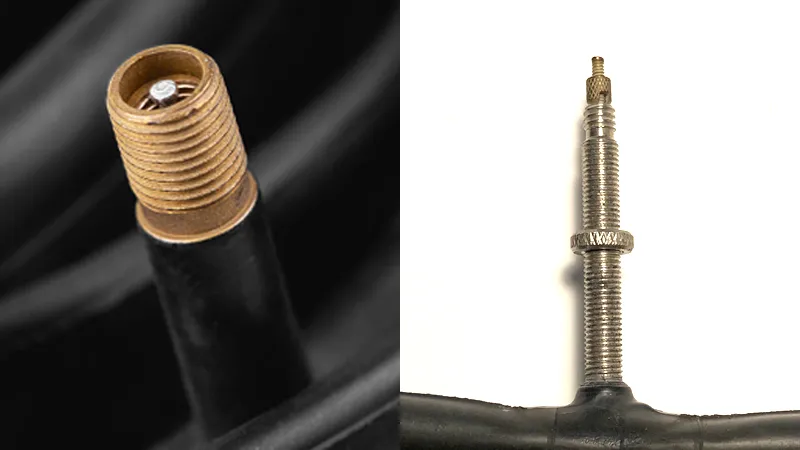
Most, but not all bike pumps will fit both a Presta (the pointy road bike one) and Schrader (the fatter car one) valve. Track pumps will invariably do both, but with mini pumps make sure yours will work with the valves you use.
Tubeless valves tend to be Presta, and so this is becoming the standard for all pumps, but there are some MTB options that will only do Schrader. Likewise, some pumps are Presta-only (and will also inflate the older Dunlop valves sometimes found on budget hybrid bikes), so check which valve type you have and make sure that your chosen pump will work with it.
What's better; CO2 or mini pump?
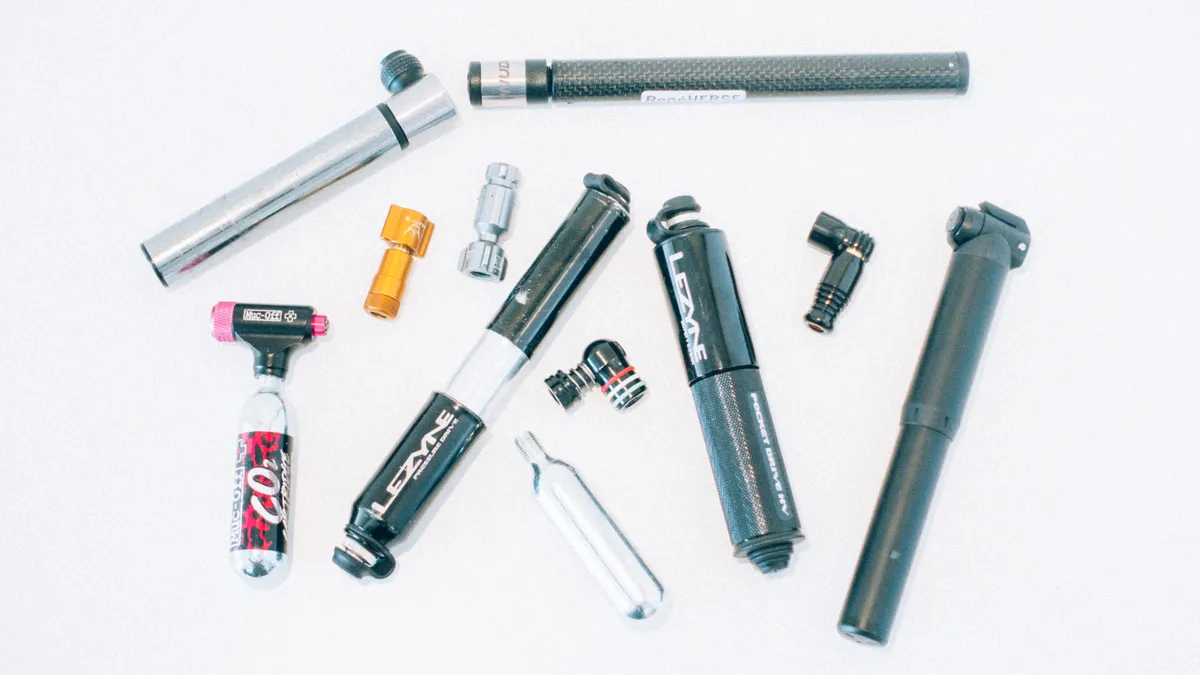
A CO2 inflator will get your tyres inflated extremely quickly, and can even reseat tyres in a pinch. The downside is that the canisters are single-use, so if you take one with you and puncture twice or your tube is still not airtight, you're in trouble. They're also a bit wasteful if you're not racing, and CO2 will also leak out of your tyres overnight, rendering them useless for multi-day trips.
Mini pumps, in contrast, take longer to inflate a tyre with, but the only limiting factor is your strength and energy levels. There is always enough air to pump and it's free. You're also not going to get frostbite from using a pump, unlike some CO2 inflators.
If you're really on the fence, I wrote a whole piece trying to work out which is better, a mini pump or a CO2 inflator?
Should I buy a floor pump?
While you can inflate your tyres at home before you head out with a mini pump, it'll take ages and you won't get the pressures you want. For a gravel bike, it'll take even longer. You could use a car tyre compressor, though these rarely work with Presta valves, but in either case, the one drawback is that you will have no idea what pressure you're running.
A track pump, even a budget one, will allow you to inflate tyres quickly and easily and know what pressures you're running, which is key to producing a consistent ride feel, a faster ride, the right level of grip and protecting your tyres from sidewall damage while out on the road or the trail.
Do I need a reservoir pump?
Reservoir pumps are extremely useful if you need to set up tubeless tyres. Without an inner tube, seating these can be tricky or sometimes impossible using a track pump alone. Reservoir pumps (or other solutions like the Topeak Tubibooster) allow you to deliver a large volume of air in a very short space of time. This pops the tyre bead up onto the rim and allows the sealant to begin its job sealing the tyre.
If you are in the market for a new track pump and are running or want to run tubeless then it's probably a good investment. If you already own a track pump then a separate reservoir like the Tubibooster is definitely a cheaper option and just as effective.
Should I buy an electric tyre inflator for my bike?
Electric tyre inflators like the Cycplus in this guide will save you a fair amount of effort if you regularly inflate a lot of tyres, but they're not a silver bullet. Think of them as a nice luxury item though, rather than a necessity; they can't really do anything a track pump can't do, and when it comes to setting up tubeless tyres they can't provide as much air as quickly as a reservoir pump can.
How I test bike pumps?
Initially, every pump that comes across my desk gets the usual eye-over. Ergonomics, features, and things like build quality, you can get a good deal of information on just by having a play, especially with a pile of other pumps on hand to compare to.
There's no substitute for actual, repeatable testing, though. Most pumps come with a stated maximum pressure, which you will not get anywhere near unless you're either very strong, very patient, or both. Each pump in the guide will get a road tyre up to at least a pressure sufficient to allow you to get home. Some may take longer than others to get there though.
As well as taking them out riding with me, each pump was also pitted against the same 28c Specialized Turbo Cotton Hell of the North tyre with the same latex inner tube. Each was given 100 strokes, with the pressure afterwards recorded using a standalone Topeak pressure gauge. The more pressure it achieved in 100 strokes the faster it is to inflate your tyre.
For more info on Cyclingnews' testing, head to our how we test page.

Meet the tester

They're often overlooked nowadays in favour of a CO2 inflator, but I always go out with a mini pump or a frame pump. I've been let down in the past by some, and over the years I've honed in on what is the sweet spot between portability, capacity, and weight. Your own middle ground might sit somewhere else, but I always err on the side of reliability.