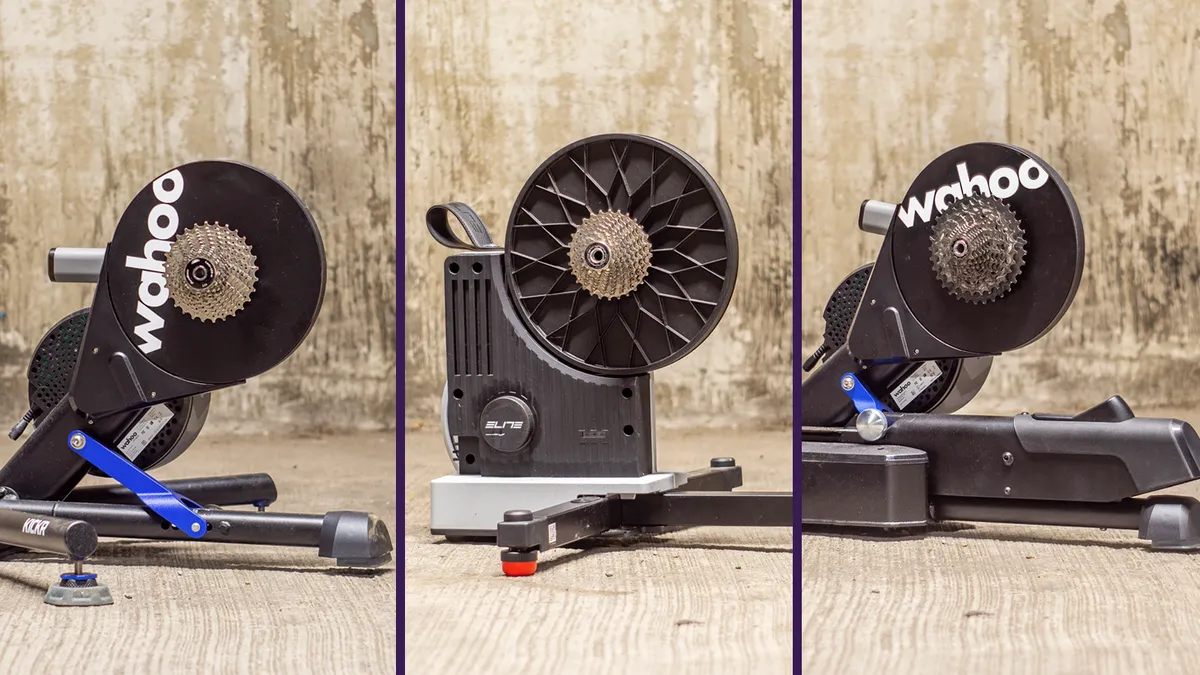
Indoor training continues to grow in popularity. That’s in large part due to the sophistication of modern indoor apps, but also to the wide range of trainer hardware available.
Gone are the days of bolting your back wheel to your trainer and staring at your garage wall; modern indoor training is engaging and interactive and offers the chance to race and ride with others around the globe. If you can’t find any real people to ride with, you can co-opt a group of pacers to ride with you.
Allied to this is the increased affordability of the best smart trainers, which can work with an indoor cycling app to vary how hard the ride is, link to other hardware and record your stats to pour over post-ride. We’ll run through the indoor training hardware options and explain their pros and cons.
A wheel-off smart trainer offers a rich riding experience (Image credit: Josh Croxton)
The major advantage of a smart trainer over a ‘dumb’ trainer is that a smart trainer will connect to other devices and indoor training apps, whereas a dumb trainer acts essentially independently and requires you to change the resistance manually.
It can still be used with a training app, but the experience isn’t as smooth and won’t follow the contours of a route precisely.
A smart trainer will automatically vary the resistance that you pedal against, so when the app says you’re climbing, pedalling will get harder and when you go downhill, it will ease up – it’s a much more realistic experience.
A smart trainer will measure your power output and pedalling cadence too, so you’ll have stats on your performance during a workout.
Get The Leadout Newsletter
The latest race content, interviews, features, reviews and expert buying guides, direct to your inbox!
Unlike a dumb trainer, a smart trainer can also vary resistance automatically as you ride, to ensure a consistent power output. Called ERG mode, this is great for ensuring that you stay in your desired training zone and for following intervals.
The price of smart trainers has dropped significantly too, so you can pick up a basic model for little more than the price you’d have paid for a non-smart trainer a few years ago.
And why are most trainers now wheel-off?
'Wheel-on' trainers are now almost extinct (Image credit: Tacx)
Alongside the shift to smart trainers, the majority of trainers are now wheel off, also called direct drive.
In a direct drive trainer, your bike’s rear dropouts are anchored to the trainer and the chain passes over a cassette mounted to the trainer. In contrast, while a wheel-on trainer is also clamped at its dropouts, the wheel engages with a roller on the trainer to turn the trainer’s flywheel and resistance unit.
A direct drive trainer avoids wear on your tyre – wheel-on trainers need a specific trainer tyre if used a lot, which is made of a harder-wearing rubber. It also avoids slippage under harder efforts and offers a more realistic ride feel.
Wheel-on dumb trainers do have their place though; in general, they’re more portable than direct drive trainers and so are good to take to events and races for warm-ups. Setting up is less messy than a direct drive trainer too, as you don’t have to fiddle with the chain and derailleur.
What other indoor training hardware options are there?
Rollers are tricky to learn to ride but will help you to ride more smoothly (Image credit: Tacx)
Another option to consider alongside a smart trainer is a set of rollers. They’re tricky to get used to, as your bike isn’t supported. That’s good for your balance – the risk of falling off the side is an incentive to pedal smoothly, although many rollers have a parabolic shape or a lip that helps keep you centred and lowers the risk of falling off.
Although many rollers don’t have smart features, the Elite Nero, for example, does offer automatic resistance variation and so can be used with indoor apps.
The Wahoo Kickr Rollr trainer avoids the falling off problem by holding your front wheel in place. It will vary resistance automatically and measures your approximate power output, although for more accuracy you’ll need a separate on-bike power meter.
Rollers have the additional advantage that they’re quick to set up, as you don’t need to clamp the frame or remove your rear wheel, again making them a good pre-race warm-up option. Feedback Sports’ Omnium rollers are even more compact and portable, but do require removal of the front wheel.
The Kickr Bike Pro is an all-in-one indoor trainer (Image credit: Wahoo)
The deluxe option is a smart bike. This incorporates the smart trainer into a complete indoor exercise bike. If you have a dedicated indoor training space/gym, a smart bike avoids having to take your outdoor bike indoors and fiddle with the wheels before each ride. Smart bikes are, in general, large and heavy though, so you won’t want to move one around much. They’re also expensive.
The exception is the Zwift Ride smart frame. This is a dedicated indoor bike that hooks onto a standard smart trainer. It’s more affordable than other smart bikes, but ties you into the Zwift ecosystem, although it now works with Rouvy too. It can be bought with a Kickr Core 2 trainer for a complete indoor bike, or can be used with a range of other trainers, although not all trainers are compatible.
The Zwift Ride V2 was launched in Autumn 2026 and has more adjustability built in, including variable crank lengths.
What is Zwift Cog and Click?
Zwift Cog provides virtual shifting, so you don't need to use your bike's derailleurs (Image credit: Zwift)
Another option to consider is the Zwift Cog and Click system. Again, this works with Zwift and Rouvy only, but offers a simpler set-up, with a single sprocket in the orange cassette. This works with the Zwift Click controllers to provide virtual shifting, so there’s no need to use your bike’s derailleurs; it’s faster and quieter too.
The pair of Click controllers are fixed to your handlebars and allow you to control virtual shifting. They offer additional buttons that you can use to control the Zwift app from your bars too.
Zwift Cog and Click tie you into using the Zwift and Rouvy apps, but there’s a wide range of direct drive trainers that are now sold with the system or are marketed as Zwift Ready with an orange tag on packaging.
Paul has been on two wheels since he was in his teens and he's spent much of the time since writing about bikes and the associated tech. He's a road cyclist at heart but his adventurous curiosity means Paul has been riding gravel since well before it was cool, adapting his cyclo-cross bike to ride all-day off-road epics and putting road kit to the ultimate test along the way. Paul has contributed to Cyclingnews' tech coverage for a few years, helping to maintain the freshness of our buying guides and deals content, as well as writing a number of our voucher code pages.
You must confirm your public display name before commenting
Please logout and then login again, you will then be prompted to enter your display name.