The route of the 2027 Giro d’Italia Women was revealed on Tuesday and presents the peloton with a tough nine days of racing. With four mountain days, including an uphill time trial, and five flatter stages, it will be interesting, but it seems a little like an enhanced version of the 2026 race, won so brilliantly by Demi Vollering (FDJ United-SUEZ), with everything turned up to 11.
Since taking over the organisation of the women’s Giro in 2024, RCS, which organises the men’s event, has done a good job in modernising and increasing the visibility of what remains the second biggest race in the women’s calendar. Of course, visibility was helped this year by the date change, which the previous organisation requested, but with the power of RCS behind it, the race has been to places and climbs it would otherwise have been unable to reach.
However, despite that obvious progression, the 2027 race route is not a step forward, just much, much more of the same. The race has been made punishingly difficult, thus reducing the number of riders able to compete for the podium, and it could either be won on the first mountain top finish on stage 4, or we may be faced with a desultory stand-off, riders waiting for the final day.
The 2027 Giro is, in fact, shorter than this year's edition, though not by much. Organisers have slated 1,132km, as opposed to last year’s 1,151, which was reduced from the original distance after the Colle delle Finestre stage was truncated for safety reasons.
However, next year’s race includes a whopping 17,450m of vertical ascent, more than 5,000m more than 2026. And we all know by now that harder is not necessarily more entertaining.
Of course, we don’t yet know whether Vollering will defend her title next year, but she has developed into the most outstanding stage racer of her generation, able to climb better than almost everyone, with the punch to create gaps and the engine to maintain them. With more climbing and the retention of the mountain TT from the 2026 race, the route plays into her hands, reducing, rather than increasing jeopardy.
But it’s not about whether Vollering wins or not; whether the race was harder or easier she would probably still win, such is her class and strength and that of her French team. It’s about entertainment and engagement, getting eyes on the sport and keeping them there, and for that, as in all sports, there needs to be jeopardy.
Get The Leadout Newsletter
The latest race content, interviews, features, reviews and expert buying guides, direct to your inbox!
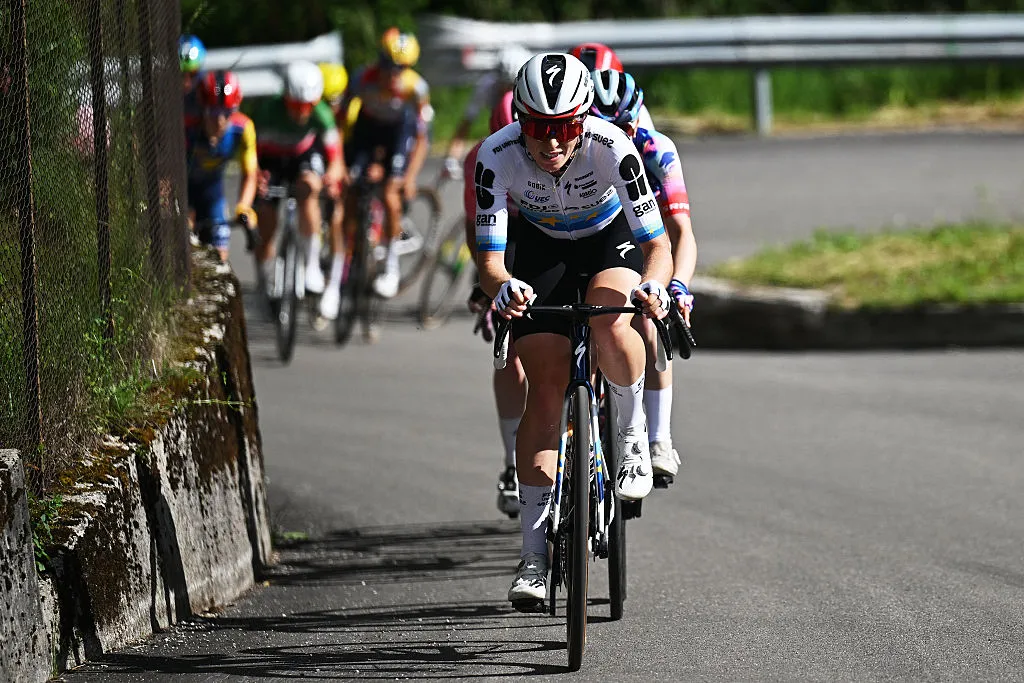
The 2026 Giro d'Italia Women was decided inside the final 40km of the last stage (Image credit: Getty Images)
Jeopardy is why the 2026 Giro was so brilliant. With 40km of the final stage left to ride all three places on the general classification podium were up for grabs until Vollering played her card, eventually winning the GC by 30 seconds with a jaw-dropping ride. I was on my feet from the moment she attacked until she triumphantly crossed the line, awestruck by her performance while simultaneously feeling for Anna van der Breggen (SD Worx-Protime) as her grasp on the pink jersey slipped away. The day had everything I wanted from sport.
And all that happened on a stage with only 2,100m of vertical ascent, just a bump in comparison to next year’s trio of Alpine stages.
Bigger isn’t better, harder isn’t more entertaining
Let’s start with the mountain time trial. It’s the second consecutive edition with such a stage, and last year the TT set up that thrilling final, Van der Breggen’s win startling her rivals as she moved into pink. But such a stage influences the GC hugely, and to include a near facsimile the following year is too much. In a race of only nine stages, to have such a similar defining stage each year lacks imagination.
Like the entire race, this year’s TT is shorter than in 2026, but unlike last year, it’s unrelentingly uphill and will produce some notable time gaps. Better might have been a more sporting time trial, flatter, allowing those specialists who are slightly less capable in the mountains to stay in touch with the overall lead and add some of that crucial jeopardy into the final day.
Don’t get me wrong, of course there is a place for brutal TTs, but we had one last year, so why do it again so soon? Even in a nine-day race there’s also a place for stages with 3,500m climbing, we had one last year, after all, but three in one week? Add in that TT, and we have four stages in the mountains likely to produce sizeable time gaps, especially when two of them are mountain top finishes.
Sarah Gigante (AG Insurance-Soudal) will be a threat on the mountain top finishes) (Photo by Luc Claessen/Getty Images) (Image credit: Getty Images)
Perversely, those mountain top finishes could be the saving grace, allowing the real lightweight climbers like Petra Stiasny (Human Powered Health) and especially Sarah Gigante (AG Insurance-Soudal), who came close to winning the 2025 race, to challenge. For them descending is the problem and without that to challenge them they could challenge Vollering.
The first of those 3,500m days comes on stage 4 with the final climb to the Passo della Presolana, if that doesn’t decide the final podium, stage 6 will, with even more vertical ascent over two climbs of almost 20km.
The one saving grace about the three Alpine stages is that they get progressively harder, but we really could see the GC all but decided on day four, and if it’s not we could have three days of pure grinding stalemate, the favourites waiting for the final day to make their bid for glory.
The flatter days are the saving grace
On the other hand, RCS has provided some real interest for the five flatter days, even if they do all contribute to the total amount of climbing metres.
Last season the same sprinter won each of the three opening stages, Elisa Balsamo (Lidl-Trek) eventually taking four victories in total. This year there’s less for the fast women, with each of the opening three days covering much more climbing than last year’s corresponding stages, the second stage has as much as 2,100m of climbing, though the run into Genoa is relatively flat before an uphill kick to the line.
Perversely, this could be very good for Balsamo, who deals with punchy climbs brilliantly, but it doesn’t matter who wins, it matters that the race interesting and entertaining, and stages like these invite attacks, uncertainty and miscalculation in the chasing bunch. It doesn’t even matter if they all end up in bunch sprints with the same rider winning, provided there is some of the crucial sporting ingredient: jeopardy.
Elisa Balsamo (Lidl Trek) won stage 3 of the 2026 Giro d'Italia after a surviving the punchy climbs around Buja (Image credit: Getty Images)
While it won’t affect the racing, the location of the route also fails to show off what is arguably the most beautiful country in the world. When we first saw the overview map of the nine stages the first thing we noticed was a huge expanse of empty space – where is the race? It seems as though the entire event has been geographically swept into the top left-hand corner.
Of course, nine stages limit where the race can go, and long transfers are hard on riders and race staff alike, but with its diversity and distinct regions, it’s a shame we won’t see more of Italy.
The Giro is always a great race, and since RCS has been in charge it’s far better organised and executed, with better coverage and more fans at the roadside. That is to be applauded, what is not is constantly making races harder but not more interesting, and we should hope for a more even parcours in future years.
The road season might be at an end, but Cyclingnews isn't slowing down. Subscribe for unlimited access to our comprehensive news coverage, industry-leading CN Labs testing, expert columnists, and so much more. Plus, the Cyclingnews app means you can stay up-to-date wherever you go! Join today.
A recent addition to the Cyclingnews staff, Owen Rogers is an experienced journalist, working as a freelancer covering the sport for various magazines and websites for more than 10 years.
Initially concentrating mainly on the women's sport, he has covered hundreds of race days on the ground and interviewed some of the sport's biggest names.
Living near Cambridge in the UK, when he's not working you'll find him either riding his bike or playing drums.
You must confirm your public display name before commenting
Please logout and then login again, you will then be prompted to enter your display name.