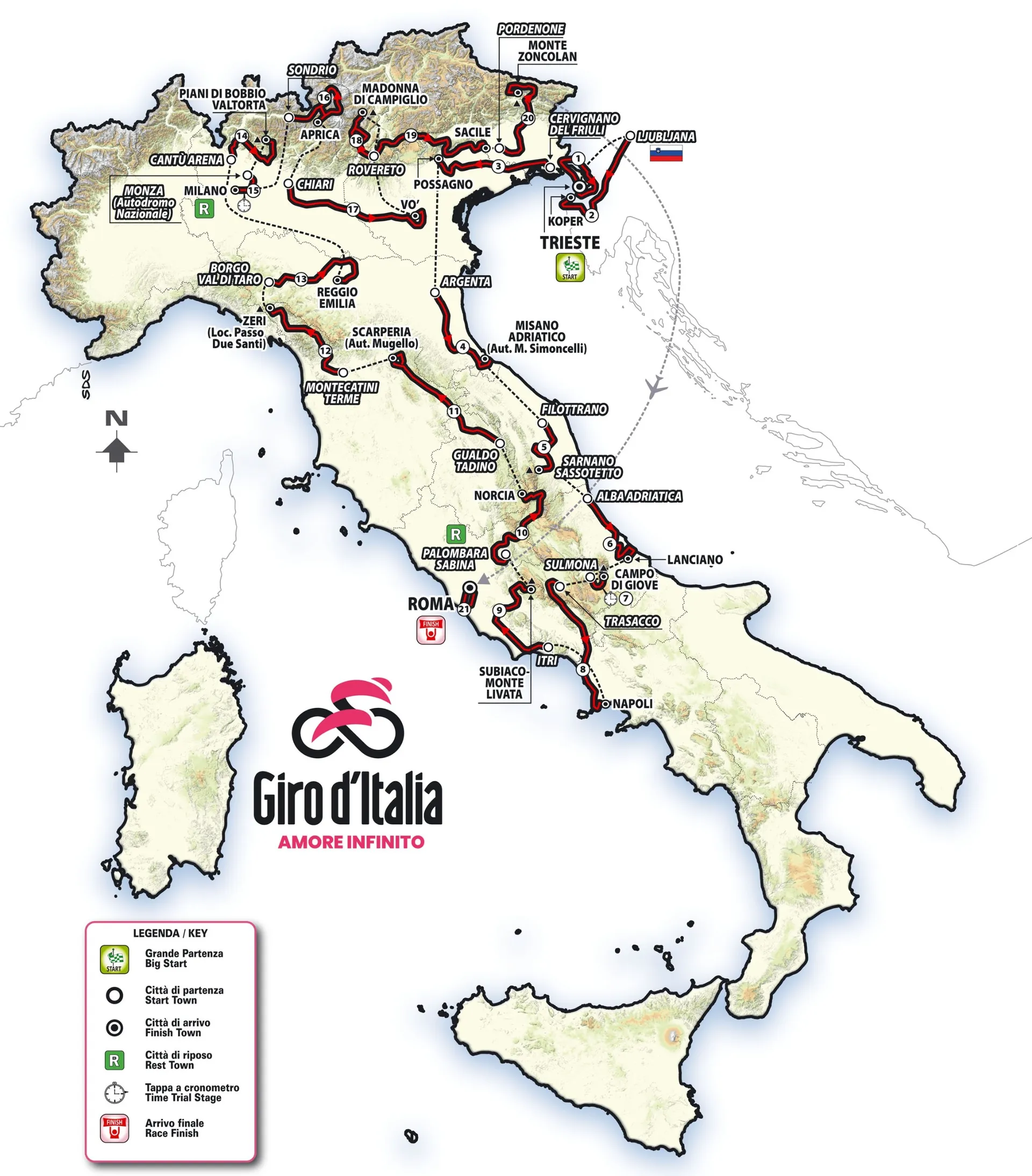
With seven summit finishes, plenty of punchy terrain, and some brutal high-mountain stages particularly in the final week, not to mention one of the race's two time trials being uphill, the 2027 Giro certainly leans towards the climbing specialists.
It all kicks off on Trieste on May 8, 2027, and finishes in Rome on May 30, covering 3,418.9 kilometres and taking in 50,250 metres of elevation gain in total.
Here, we go through the route stage-by-stage to see what's in store for the pink jersey hopefuls next May.
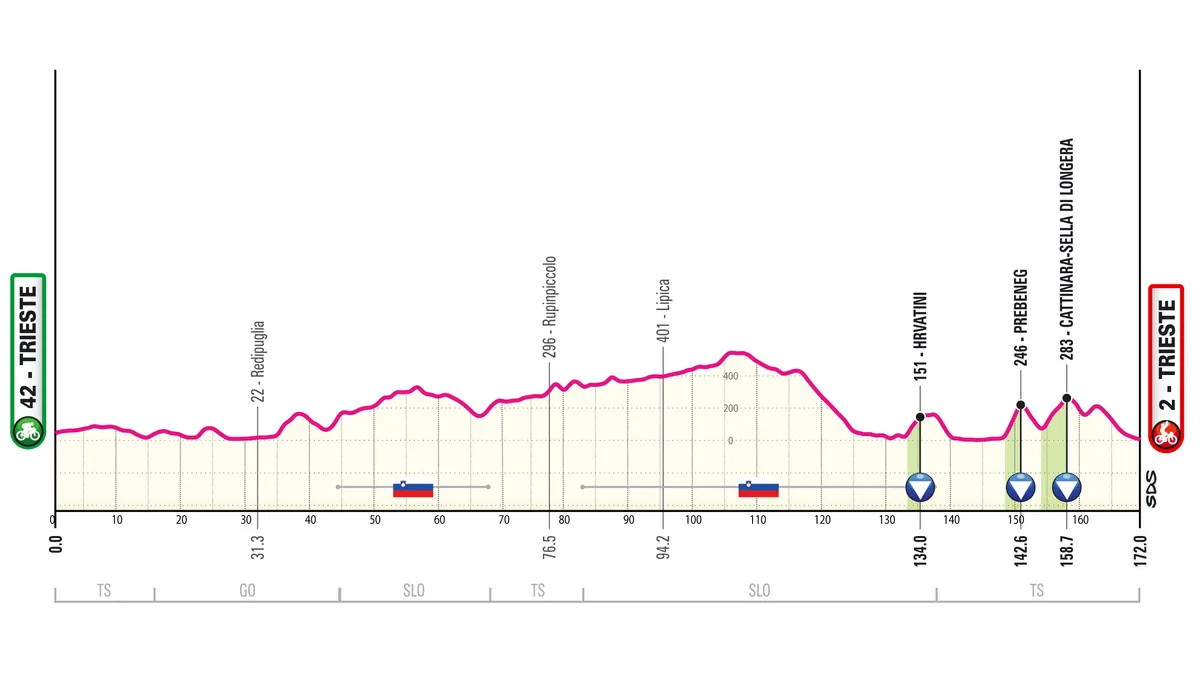
Stage 1: Trieste – Trieste, 172km
(Image credit: Giro d'Italia / RCS Sport)
The first pink jersey looks to be going the way of a puncheur, with an opening stage that ventures over the Slovenian border and features three short climbs in the final 40km, plus a downhill run to the line. It should be an explosive and exciting start to the race.
Stage 2: Ljubljana – Koper, 166km
(Image credit: Giro d'Italia / RCS Sport)
After the stage 1 foray, stage 2 takes place entirely in Slovenia, and it's another punchy one, with a short sharp climb topping out just 3km from the line and followed by a fast dip down into Koper. Attacks will fly.
Stage 3: Cervignano del Friuli – Possagno, 163km
(Image credit: Giro d'Italia / RCS Sport)
A third successive stage that suits puncheurs and aggressive riders, with two modest categorised climbs and a false flat drag towards the finish another chance for the attackers to get rid of the sprinters.
Get The Leadout Newsletter
The latest race content, interviews, features, reviews and expert buying guides, direct to your inbox!
Stage 4: Argenta – Misano Adriatico, 151km
(Image credit: Giro d'Italia / RCS Sport)
The pure sprinters finally get their chance on stage 4, with very few complications on the run from Argenta towards the Marco Simoncelli motor racing track, where the sprint will be contested.
Stage 5: Filottrano – Sarnano-Sassotetto, 139km
(Image credit: Giro d'Italia / RCS Sport)
The proper climbing action comes early, with a first summit finish on stage 5. The organisers have only given this a three-star difficulty rating but the final climb to Sarnano-Sasotetto measures 13.1km at an average gradient of 7.4% and maximum pitches of 14%. It's a rude awakening and will provide an early indication of who's where in the fight for pink.
Stage 6: Alba Adriatica – Lanciano, 148km
(Image credit: Giro d'Italia / RCS Sport)
Stage 6 is another stage that could see a sprint, or could something a bit more dramatic, with 1,700 metres of elevation gain on a route that climbs steadily for the final 10km.
Stage 7: Sulmona – Campo di Gove, 19.6km (ITT)
(Image credit: Giro d'Italia / RCS Sport)
The second big general classification test of the 2027 Giro comes with the first of the two time trials, this measuring 19.6km but crucially heading uphill for pretty much the whole thing. The categorised part of the climb to Campo di Giove measures 12.5km at a modest average gradient of 4.4% but there are pitches of up to 9%. It's not quite a pure mountain time trial but it's far from a flat one and should provide an interesting test between the pure time trial specialists and the climbers.
Stage 8: Trasacco – Napoli, 219km
(Image credit: Giro d'Italia / RCS Sport)
Napoli is most openly associated with sprints, and we should see another one again here, though the undulating terrain in the finale and the rise to the line make it one for the lighter and more versatile of fast men.
Stage 9: Itri – Subiaco-Monte Livata, 180km
(Image credit: Giro d'Italia / RCS Sport)
An action-packed opening week closes with a second summit finish and third obvious GC flashpoint. The final climb of Monte Livata measures 13.9km at an average of 6.9%. Bigger mountain stages follow later in the race but by this point, after the time trial, things will be taking some sort of shape, and the favourites will surely hit out against each other towards the top of the climb.
Stage 10: Palombara Sabina – Norcia, 218km
(Image credit: Giro d'Italia / RCS Sport)
The second week opens with an interesting stage that features a tricky pair of climbs in the finale and a fast descent to the finish in Norcia. It looks like prime terrain for a breakaway.
Stage 11: Gualdo Tadino – Scarperia, 220km
(Image credit: Giro d'Italia / RCS Sport)
Another sprint stage with a complication. Some teams may look to use that late climb of Vetta Le Croci to drop the pure sprinters, but they have just under 30km to get back in to try and contest the victory, on another motor racing circuit.
Stage 12: Montecatini Terme – Zeri (Loc. Passo due Santi), 173km
(Image credit: Giro d'Italia / RCS Sport)
Our third summit finish of the Giro takes us up the Passo Due Santi, a short one at 8.7km but viciously steep at an average of 8.7% with pitches well in the double digits. We're not expecting huge gaps but it's an important test where any weakness can actually be punished heavily.
Stage 13: Borgo Val di Taro – Reggio Emilia, 176km
(Image credit: Giro d'Italia / RCS Sport)
There's still a climb in there, but finally, something pretty much nailed on for the pure sprinters, so expect a drag race in Reggio Emilia.
Stage 14: Cantù Arena – Piani di Bobbio/Valtorta, 187km
(Image credit: Giro d'Italia / RCS Sport)
We've already had plenty of summit finishes but stage 14 marks the heaviest climbing stage so far, with 4,900 metres of elevation in this route that sets out from the Lombardy region and heads over the Madonna del Ghisallo climb used in Il Lombardia. Three further ascents follow before the final climb up the Piani di Bobbio, which measures 10.1km at an average of 9%. That's brutal, and coming at the end of a heavy climbing day, it's a huge day for the general classification contenders.
Stage 15: Monza – Milano, 37,3km (ITT)
(Image credit: Giro d'Italia / RCS Sport)
The second week closes with another huge test for the pink jersey hopefuls, in the form of the race's second time trial. Unlike the first, this is pan-flat, from Monza to Milan, and pretty long at 37.3km. It's one for the pure TT specialists, and one where the weaker of the GC contenders against the clock could take some pretty heavy blows from a time-loss point of view.
Stage 16: Sondrio – Aprica, 192km
(Image credit: Giro d'Italia / RCS Sport)
The final week opens with one of the hardest Grand Tour stages we've ever seen. There are 5,700 metres of elevation on this brute, which is extraordinary. What we have is a sandwich of Giro icons, with a double ascent of the mighty Mortirolo either side of a first trip up the Gavia since 2014. The Mortirolo has seen some historic Giro moments over the decades, with savage gradients, while the Gavia takes the riders up into the snowline at 2,600 metres of altitude – it's the 'Cima Coppi' as the highest point of the Giro. The final climb to Aprica is more of a drag but by that point the race will be in pieces and riders will be only be dragging their weary bodies towards the line. A monstrous day.
Stage 17: Chiari – Vo', 194km
(Image credit: Giro d'Italia / RCS Sport)
After that mountain monster, we pick up the theme of the opening days with a largely flat stage that throws a couple of short climbs into the finale – perfect launchpads for late attacks.
Stage 18: Rovereto – Madonna di Campiglio, 154km
(Image credit: Giro d'Italia / RCS Sport)
The second of three big mountain stages in the final week, this one features 4,500 metres of elevation over the course of five big climbs. The final climb to Madonna di Campiglio, at 12.5km and 5.7%, is not super difficult, but it's what comes before that matters, and that will drain the legs well in advance. This looks like one of those classic Giro mountain stages where there's a huge fight for the breakaway and chaos ensues for basically the whole day.
Stage 19: Rovereto – Sacile, 199km
(Image credit: Giro d'Italia / RCS Sport)
Another interruption to the climbing-fest in the form of yet another largely flat but still punchy day of racing. At this point, how many sprint teams will be left, and how much strength will be left? Stages like these so late in a Grand Tour are often ripe for breakaway action.
Stage 20: Pordenone – Monte Zoncolan, 180km
(Image credit: Giro d'Italia / RCS Sport)
The Giro d'Italia will be decided at the summit of the Zoncolan, a beastly climb measuring 10.1km at a barely believable average gradient of 11.9%. It's fairly new to the Giro, with no visits before the 21st century, but it's becoming one of the race's icons, and is certainly in a bracket with the Angliru as one of the hardest climbs in professional cycling. With 3,600 metres of elevation, this stage is the lightest of the final week's mountains stages on paper, but this final climb overcomes those statistics on its own, to make this a pivotal – and final – juncture in the battle for the pink jersey.
Stage 21: Rome – Rome, 131km
(Image credit: Giro d'Italia / RCS Sport)
The 2027 Giro concludes with a short stage in Rome made up of laps of a circuit through the Italian capital. Whatever sprinters are still standing will have the chance to fight for the final stage win before the overall champion is crowned.
The road season might be at an end, but Cyclingnews isn't slowing down. Subscribe for unlimited access to our comprehensive news coverage, industry-leading CN Labs testing, expert columnists, and so much more. Plus, the Cyclingnews app means you can stay up-to-date wherever you go! Join today.
Patrick is an NCTJ-accredited journalist with a bachelor’s degree in modern languages (French and Spanish) and a decade’s experience in digital sports media, largely within the world of cycling. He re-joined Cyclingnews as Deputy Editor in February 2026, having previously spent eight years on staff between 2015 and 2023. In between, he was Deputy Editor at GCN and spent 18 months working across the sports portfolio at Future before returning to the cycling press pack. Patrick works across Cyclingnews’ wide-ranging output, assisting the Editor in global content strategy, with a particular focus on shaping CN's news operation.
You must confirm your public display name before commenting
Please logout and then login again, you will then be prompted to enter your display name.