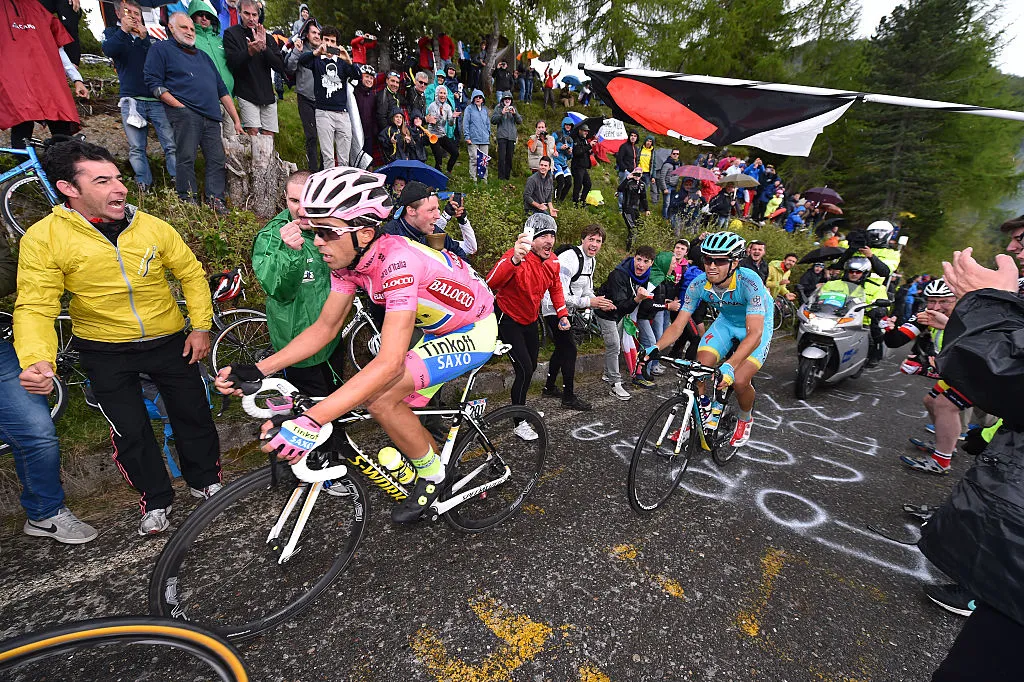
The Giro d'Italia looks set for a return to its roots next year, with multiple media outlets currently reporting a wealth of full-blown, third-week mountain stages across classic climbs like the Mortirolo, Zoncolan and Gavia, as well as its first Grande Partenza on Italian soil since Turin in 2024.
The full 2027 route presentation is due on November 3 in Rome, unusually early for the Giro, as last year's equivalent event was in early December. But that fast-approaching date hasn't stopped media outlets, including Tuttosport andTuttobiciweb, from already revealing a considerable amount of detail about next year's men's race.
In striking contrast, little to no information has yet emerged about the 2027 Giro d'Italia Women's possible route for next year, also due to be revealed in Rome on the same date as the men's event. Almost all that is known so far is the Giro d'Italia Women's calendar dates: May 29 to June 6.
Regarding the men's race, perhaps the most notable development - if predictions are correct – could be its very traditional format, starting with that first 'home' Grande Partenza in three years.
As has been widely rumoured, the Giro is expected to kick off in the north-eastern city of Trieste on Saturday, May 8, with – like last year – a mass start stage and another chance, 12 months on, for the sprinters to take the first maglia rosa.
The first week likely will conclude with a bunch sprint, too. After weaving its way through the easterly Friuli region and then on down through the Romagna and Abruzzo, the 2027 route brings the Giro to its most southerly point with a mass dash to the line on Naples seafront on stage 9. In between, there is expected to be room for an uphill time trial, possibly taking place on the slopes of Gran Sasso, the Apennines ascent often used for a first major sortout in the Giro. Then it would be anything but surprising for there to be at least one other hilly stage through the Abruzzo region, too.
Having reached Naples, the Giro should then head northwards. The second week is predicted to include a stage on the Mugello motor racing circuit, another very hilly one through the Emilia-Romagna region, and a possible summit finish stage in northern Tuscany on the previously unused 23km ascent to Zum Zeri.
If Zum Zeri could be one crunch moment of the second week, another will likely be on Saturday, May 22, thanks to a summit finish at the Piani di Bobbio ski station, just a stone's throw away from the Il Lombardia start/finish town of Bergamo. A third key moment could well be the time trial at the Monza motor racing circuit, 24 hours later, the last chance for the TT specialists to make an impact prior to a third week of ultra-hard climbing.
Get The Leadout Newsletter
The latest race content, interviews, features, reviews and expert buying guides, direct to your inbox!
Following the 2026 edition, where almost all of the classic Alpine and Dolomite mountains went missing from the Giro route, a significant number are back on the menu for 2027. Following a second rest day, the opening stage of the third week from Sondrio to Aprica could well be the toughest of the entire 2027 Giro, featuring a staggering total of nearly 6,000 metres of vertical climbing.
Starting with one of the Giro's best-known ascents, the Passo del Mortirolo, for the first time of two, stage 16's climbing challenges are then expected to continue with the Passo Gavia – peaking at 2,618 metres above sea level, the high point or Cima Coppi of the race and where organisers and fans will be holding their breath to see if the often unpredictable May weather doesn't force a last-minute cancellation.
As if that wasn't enough, another ascent of the Mortirolo on its steeper side, the Mazzo Valtellina, follows, and to finish off an already brutally hard stage, there will be a final climb to Aprica. This gentler third-category climb was last used by the Giro in 2015, on a day when Mikel Landa won the stage and overall winner Alberto Contador came within a whisker of losing the race thanks to an untimely mechanical on a descent, but then battled back to destroy the opposition and sew up the GC for good.
By this point, the battle for the maglia rosa will be in full swing, but there will be more to come. The last three mountain days of the race, probably starting on stage 18 to Madonna di Campiglio on Thursday, May 27 – yet another historic ascent for the Giro – are sure to see more climbing sparks fly, then another stage through the Dolomites is thought to be taking the race into Austria for its one night on foreign soil.
The last showdown, though, is expected to come on the mighty Monte Zoncolan on stage 20, last tackled in 2018, when Chris Froome laid a key foundation of his overall victory, battling back from injuries to take an unexpected stage win.
All that will be left will be another 'classic' feature of the modern-day Giro, an enormous transfer south to Rome for a last day of evening racing in the shadow of the Capitol. As in Trieste three weeks beforehand, stage 21 is expected to end in a bunch sprint, but by then the maglia rosa will be far out of reach of the fastmen.
If all is confirmed, the news of the difficulty of next year's route, particularly in the third week, may serve as something of a deterrent to those hoping to make their mark in the time trials. However, the most important ingredient that could tempt the likes of specialists like Remco Evenepoel (Red Bull-Bora-Hansgrohe) to take part in the Giro has yet to become public.
The total number of kilometres for the Giro's two time trials remains unknown, and it may only be on November 3 in Rome that that pivotal piece of information eventually emerges. After which and just like in the 2027 Tour de France presentation last week, the time trial distance and its implications regarding exactly who will take part will likely dominate many of the headlines and debates that follow.
The road season might be at an end, but Cyclingnews isn't slowing down. Subscribe for unlimited access to our comprehensive news coverage, industry-leading CN Labs testing, expert columnists, and so much more. Plus, the Cyclingnews app means you can stay up-to-date wherever you go! Join today.
Alasdair Fotheringham has been reporting on cycling since 1991. He has covered every Tour de France since 1992 bar one, as well as numerous other bike races of all shapes and sizes, ranging from the Olympic Games in 2008 to the now sadly defunct Subida a Urkiola hill climb in Spain. As well as working for Cyclingnews, he has also written for The Independent, The Guardian, ProCycling, The Express and Reuters.
You must confirm your public display name before commenting
Please logout and then login again, you will then be prompted to enter your display name.