
Whether you’re in the habit of travelling abroad with your bike, or planning your first foray into cycling holidays, investing in one of the best bike bags, bike boxes or travel cases for bikes would be a great place to start.
Flying with your bike can be daunting, especially when you hear horror stories about bikes getting damaged in transit. Choosing the right bike bag, travel case or box is one surefire way to protect your pride and joy from heavy-handed baggage handlers at the airport.
Another important part of travelling with your bike is taking out insurance, to be prepared for all eventualities. If the unthinkable happens, and your bike doesn’t arrive in one piece, then you’ll be glad you took out one of the best bike insurance policies ahead of time. Some of them even cover your bike while travelling.
To offer the most useful possible reviews, we’ve put many of the bike bags in this guide to the test, flying with them and assessing packing procedures and durability in transit. Our favourite bike bag has to be the Evoc Road Bike Bag Pro, thanks to its internal structure and easy packing process. That said, there are plenty of other options that are worth considering. Read on for our pick of the best bike travel cases, plus buying advice lower down the page on how to choose the best bike travel case for your needs.
Once you’ve got your box, bag or case sorted, be sure to check out our top tips to make travelling with your bike cheaper and easier.
Last updated on 13th March 2026
Like many riders, I have been craving a little winter sun and have been lucky enough to get away a couple of times already this year. That means I am well-versed in packing bikes, navigating airports and all the logistics that are required around traveling with a bike.
Best bike bags, travel cases and boxes
You can trust Cyclingnews Our experts spend countless hours testing cycling tech and will always share honest, unbiased advice to help you choose. Find out more about how we test.
Best for road bikes
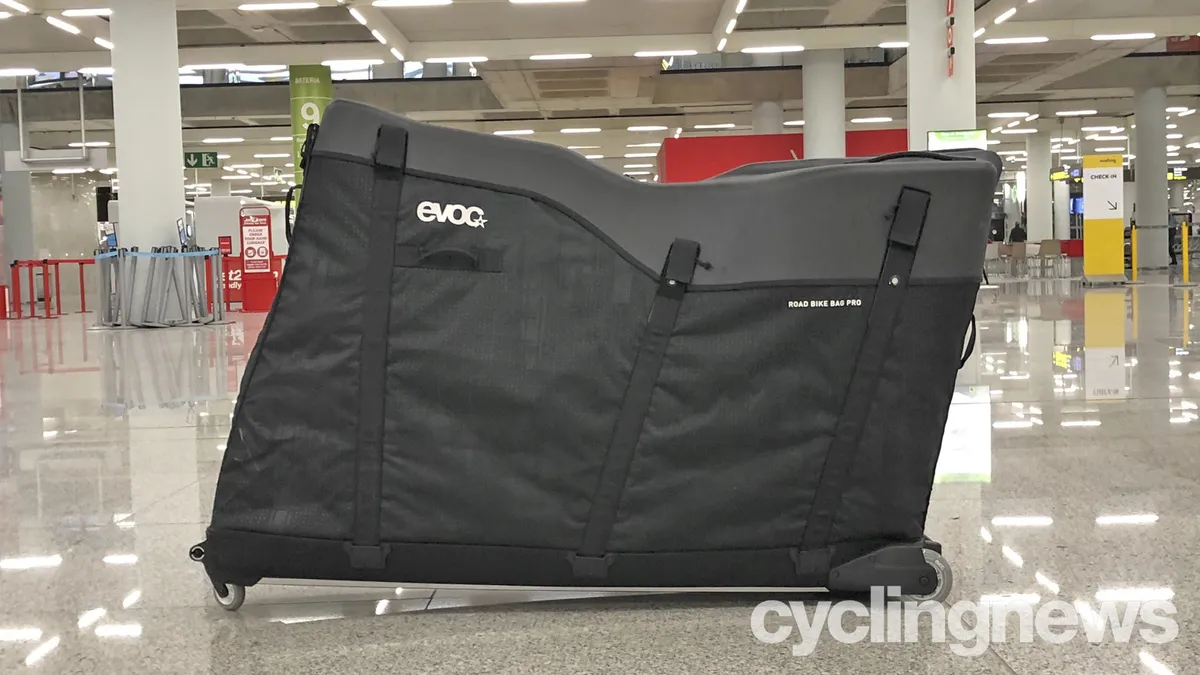
✅ You want good protection without too much weight: A soft middle section keeps weight down, while a hard top section protects.
✅ You want easy packing: Just the pedals and wheels need removing.
❌ You want easy manoeuvrability: The single front wheel and fixed rear wheels can make moving the loaded bag around tricky.
❌ You want a lower price: Evoc's bag is towards the expensive end of the price range.
The Evoc Road Bike Bag Pro combines a soft lower and hardcase upper, offering an overall protective bag that isn’t too heavy. Included is an internal aluminium tray that attaches to the bike’s axles within the bag. This holds everything secure and tucked away while in transit. This can also double up as a workstand if you remove the pedals, which is a nice additional feature.
In testing, I found packing to be very straightforward, with only the wheels and pedals needing to be removed, though some people may need to lower their seatpost as well, depending on the size of the bike. The frame is secured in place with a series of Velcro straps and purpose-built padding. There are individual wheel bags for securing the wheels separately, and the handlebars are protected by a dedicated padded section as well.
In addition to the bike, there’s plenty of extra space that you can fill with kit, doubling up as extra padding. There are internal pockets for tools and pedals, which prevent them from moving around and causing damage while on the move, while an external pocket for the front wheel keeps it protected while in transit.
Manoeuvring the loaded bag is made easy by two fixed rear wheels and a front trolley wheel, though we found the single front wheel had a habit of tripping over if it was pulled in the wrong direction. That said, Evoc has added plenty of handles that help you to move the bag around.
If you want to see how easy it is to pack a bike into the Evoc Road Bike Bag, check out our Instagram reel for how quickly Josh can unpack his bike for proof.
Read more details in our full Evoc Road Bike Bag Pro review.
Best for minimal disassembly

✅ You want the easiest packing: Just the wheels need to come off.
✅ You want padding and accessories: There's plenty of padding included, and you can buy extras like a derailleur protector.
❌ You want compact luggage: The minimal disassembly results in a large box
❌ You want a box that doesn't drift: The four casters can make moving the bag around awkward, particularly on sloping surfaces
If you’re looking for minimal disassembly, look no further than the Scicon AeroComfort 3.0 TSA. The beauty of this bike bag is that you don’t need to turn a single bolt to pack it (unless, of course, you have thru-axles); you only need to remove the wheels.
Once my bike was attached to the rigid Frame Defender metal base, it slotted in securely using the quick-release or thru-axles. Alongside the square metal tube internal structure, Scicon has included plenty of additional padding, plus a gear bag that secures to the base beneath the downtube, so you can store all the sundries you need once you arrive at your riding destination.
The bike straps into the bag securely, and the 360-degree wheels allow for easy one-handed dragging of the combined 9kg bag and bike weight. Although the four wheels limit the risk of toppling, all the wheels are casters, so it tends to drift a little on uneven surfaces. While this wasn't too much of an issue when we were navigating airports, it can cause a few issues for the baggage handlers, and we have seen them stack Scicon bags upside down on baggage carts on multiple occasions to stop them from rolling away. To counter this, I would recommend adding some additional padding for your handlebars and shifters to avoid any damage.
Read more details in our full Scicon AeroComfort 3.0 TSA review.
Best for integrated handlebars

✅ You have tri bars: There's room for a tri bike in the box without removing the bars.
✅ You want a rigid box: The Bike Box Alan range is fully rigid, which should offer more protection in transit.
❌ You want something smaller: Getting the box to and from an airport can be tricky.
❌ You want easy storage: You'll need considerable room to store the box between uses.
Based in Yorkshire, UK, Bike Box Alan produces several hardcase bike boxes. We’ve recommended the Triathlon Aero Easyfit because it’s the largest box they make, with a maximum width of 50cm. That means there’s no need to disassemble the front end of the bike to pack it away.
All you need to do to store your bike in the Triathlon Aero Easyfit, is remove the wheels and pedals, and then you’re good to go. This box is a great option for most bikes, whether it’s road, time trial or triathlon, regardless of complex integrated handlebars or cable routing systems. If you don’t want the extra hassle, this is a solid option.
Everything is secured in place with Velcro (and it’s some of the grippiest stuff we’ve ever encountered), while the wheels store away in their own dedicated section. If you’ve had any trepidation with some bags about leaving things like derailleurs on the bike, rest assured that while testing, we had no issues leaving the rear mech and hanger in place.
To be able to fit the bike in the box with the handlebars fitted means the case is considerably wider than most other bags and cases. That means you need to factor this in when organising transport to and from the airport. The wheels work well, so rolling the case around was easy enough.
There are six different colours of boxes available to choose from; we tested the red version. You can also choose customisable stickers, and the box carries a 7-year manufacturing warranty as well as a range of spare parts.
Alternatively, if you're travelling with a road bike, then the Bike Box Alan Premium may be a better option. The hard case box claims to fit road bikes up to 65cm in size, and since we found that our 58cm test bike had plenty of room to spare, we’re confident that claim is true. Like the triathlon version, this case is super sturdy and hard-wearing and also comes with a seven-year warranty.
You can read more details in our full Bike Box Alan Triathlon Aero Easyfit review.
Easy to manoeuvre

✅ You want easy manoeuvring: The tall rather than long shape makes moving the packed case around easier.
✅ You want good protection: As with the Bike Box Alan, the rigid case is more protective than a soft case.
❌ You don't want to disassemble your bike: Topeak's case requires significant tool work to pack.
❌ You want to avoid overweight fees: The case alone weighs almost 13kg.
The Topeak PakGo X is a hard case on wheels that positions your bike with the fork facing the ground and the tail up in the air, resulting in a more upright construction that’s easier to manoeuvre around the airport. Think carry-on luggage you’d recognise on every flight, but super-sized.
Orientation aside, the protection offered by the PakGo X is well considered, with several protective elements that are clearly labelled to make packing as simple as possible. In testing, we found it was very easy to figure out which piece went where, and we appreciated how every part of the bike was both protected and securely held to avoid any movement in transit. It does require some disassembling, with the removal of the bar and stem, saddle and seatpost, rear derailleur, and wheels, but thankfully, there’s a place for everything.
Something to be aware of is the weight. Topeak lists it as 10kg for the case alone, but obviously, it will weigh a lot more when you travel with it. Plus, the additional protective pieces that hold your bike securely add almost 3kg to the overall weight, so unless you’re travelling with a very lightweight road bike, you’re likely to incur some overweight fees.
Read more details in our full Topeak Pakgo X Bike Carrier review.
Best budget bike box

✅ You want an affordable option: It comes at a more accessible price point than some premium boxes.
✅ You want good manoeuvrability: The Evoc Bike Travel Bag Steel is easy to move around.
❌ You want the maximum possible protection: This is a hybrid soft bag, not a full hard-shell case.
❌ You don't want to disassemble your bike: There's a bit of work required to get your bike ready to travel.
You don't need to spend loads of money to find a travel bag that balances protection, practicality and price well. The Evoc Bike Travel Bag does exactly that, offering a hybrid design that combines the durability of a hard case with the flexibility of a soft bag.
The reinforced structure and internal frame fixation system help keep the bike stable during transport, while EVOC’s VAFFE (Variable Frame Fixation Equipment) system secures the frame inside the bag. It also includes a block to stabilise the drivetrain, helping to prevent movement in transit, keeping those delicate components protected while on the move.
It’s designed to accommodate a wide range of bikes, including road and gravel, and supports wheelbases up to 126cm. Replaceable skate wheels make it easier to manoeuvre through airports, while the external card pocket makes it easy to identify on baggage carousels.
At 8.6kg, the bag offers a good balance of protection without the bulk of a full hard case. It also folds down for easier storage between trips, which is useful if you don’t have much space to store it.
While you’ll still need to remove the wheels and do some basic disassembly to pack your bike, the Evoc Bike Travel Bag comes at a more accessible price point than many premium cases, and offers a decent amount of protection as well.
Integrated repair stand

✅ You want a small packed size: The Thule bag is easier to store than many alternatives.
✅ You want a repair stand too: There's a repair stand built into the case's structure.
❌ You want less bike disassembly: Don't forget to pack your torque wrench.
❌ You want a lower price: Thule's box is towards the expensive end of the price range.
Many of the bike travel cases listed here will require some disassembly before you pack your bike away, though it’s considered a major inconvenience by many. With the Thule Roundtrip Bike Travel Case, you still have to do some tinkering, but the brand has been smart enough to lean in and embrace that concept and has even made a feature out of it.
Acknowledging the faff that comes with rebuilding your bike when you reach your destination, Thule have designed this hard case travel box to come apart and combine to form a workstand, which you can use to make reassembly of your bike a lot easier. There’s even a clever triangle that you can rotate to match your desired front axle standard.
The work stand is good enough to use to keep the bike supported and at a comfortable working height while you either prep it for travel or prep it to ride. Although we have a list of the best bike repair stands, you might be able to get away with a two-for-one purchase if you aren't much of a home mechanic.
What to look for in bike bags, travel cases and boxes
There are quite a few considerations when choosing the best bike bag or case for your bike. We'll break these down below to help you make an informed choice of the best bike bag for your needs.
- Hard case or soft bag? Hard-shell cases offer the highest level of protection but tend to be heavier and bulkier. Modern soft bags with reinforced frames can offer similar protection while weighing less and often collapse down for easier storage.
- How important is weight? Bike travel cases can be heavy before you even pack your bike. Most airlines allow around 23kg / 50lbs for checked luggage, so a heavy case can quickly push you over the limit once your bike, tools and kit are inside.
- Will your bike fit? Always check the maximum wheel size and wheelbase supported. If you’re also a mountain biker with 29er wheels, an XL frame, or a bike with integrated handlebars or aero bars, you should pay particular attention to internal dimensions.
- How much disassembly is required? All travel bags require the wheels to be removed, but some also require the handlebars, seatpost and/or rear derailleur to be removed. More disassembly means more tools and more time rebuilding your bike at your destination.
- How easy is it to move around? Bike cases can be awkward to manoeuvre through airports and train stations. Look for features like multiple handles, smooth-rolling wheels and stable bases.
- Where will you store it at home? Hard cases take up significant space when not in use. Many soft bags can fold or collapse, making them easier to store between trips.
Travelling with a bike: Frequently Asked Questions
Do I need to worry about wheels and handles?
For something designed to help you move around with a bike in tow, bike travel cases and bike bags can be, unsurprisingly, awkward and cumbersome to move around with.
If you want to avoid a back injury, a set of wheels should be a minimum requirement, especially if you're walking much after you land - some bike bags even use easily replaceable roller blade wheels, as they're prone to damage when being loaded and unloaded.
In addition, you'll want plenty of handles to help you hoist your bag onto a conveyor belt or into the back of a car.
Do I need to remove my derailleurs and rotors?
Take them off. Just about every bike bag out there comes with some sort of protection for your rear derailleur and brake rotors, but airlines have a knack for rendering them ineffective.
Learn from our mistakes and just take them off. The last thing you want is to start your holiday with a bent rotor or a broken derailleur hanger. If you are removing disc-brake rotors, don't forget to put a brake block in the calliper to prevent the pads from sticking together or the pistons from getting stuck - in a pinch, a folded-over business card works, too.
What's the fastest way to get my bike back together?
Saddle height and bar roll aren’t something you often think about until either one is a little bit off, and the last thing you want to do on your riding vacation is to pull over constantly and faff with minor adjustments. A couple of dots and lines with a paint pen will allow you to replicate your preferred position on the bike first try, every time.
Should I add extra padding?
Yes, we have just spent the last few hundred words saying how great the best bike travel cases, bags and boxes are, but there's nothing wrong with a bit of added peace of mind.
Some bags come with foam tubing, however pipe insulation is perfect for an extra layer of protection. You can also pop into your local bike shop, and if you ask nicely, they're likely to have plenty of spare packaging from a newly unboxed bike.
If you have a few spare kilos in your bike bag once it's packed, throw your shoes, riding clothes, bars and gels and whatever else will fit without tipping your bag over the limit. If you've paid for 23kg / 50lbs, you may as well use it, although be aware that some airlines stipulate that a bike bag should contain nothing but your bike.
Do I need to deflate my tyres?
When you’re packing your bike, take a second to let the air out of your tyres. Airlines don’t allow anything pressurised into the cargo hold because it violates civil aviation safety regulations.
Before the engineering types slide into the comments, yes, we know that the cargo hold is pressurised to ~10,000ft, which will only add ~3-4psi to your tyres, and it’s extremely unlikely a tyre will burst in transit.
The reason you need to take this step is that if you do send your bike through with the tyres inflated, there is the distinct possibility that an airline employee will pull your bag aside and attempt to deflate them. At the very least, it'll mean someone heavy-handedly rummaging through your neatly packed case, but we’ve heard horror stories of bags and tyres being cut.
Avoid the drama and just let the air out. If you're running tubeless, drop them to a reasonable PSI that won't result in a sealant shower.
Our top tips for packing your bike
If you need to remove your handlebars, put the faceplate back on your stem so you don't lose the four bolts.
If you need to remove your stem, refit the top cap, then a zip tie around the steerer will keep your fork, headset and spacers from rattling loose. Be careful not to damage the steerer when cutting the zip tie off.
If you have Di2, unplug the battery. At the very least, it'll save some battery life, but it may also prevent your tightly packed derailleurs from shifting in transit and overworking the motor.
If you have an internal seatpost wedge clamp, remove and pack it safely. You don't want to spend the first hour of your trip fishing it out of your frame.
Take a spare derailleur hanger with you. For the price, it's worth having a spare anyway, not least when thousands of miles from home. Some airlines will let CO2 cartridges through, but others will stop the bike and remove them. If you're going to risk it, make them easy to find so the baggage handler doesn't have to empty your entire bag.
Is there anything else I should consider?
If you're using zip ties to hold things in place, you'll need cable cutters or scissors, in your case, for unpackaging at the other end. You'll also need more ties for the return journey. Maybe pack a screwdriver that'll allow you to undo the zip ties without cutting them. Not only does it save you zip ties, but it also saves the planet from a little bit of single-use plastic.
Take your tools. If you're having to disassemble your bike to fit it in the box, you'll need to reassemble it at the other end - make a note of the tools used and don't forget to pack them. Especially your torque wrench. You don't want a 90km/h descent of Alpe d'Huez with badly torqued carbon handlebars.
Bottles are a great hardshell for storing potentially damaging things - e.g. allen keys, or items that will pop if crushed - gels, suncream, toothpaste. Wrap them in a carrier bag, though, or you might have oddly flavoured water on your first ride. Shoes are equally useful for this.
If you've got space in the bike bag, wrap your cycling kit in plastic bags and fill the gaps. Not only does this leave room in your other bag, but it will also act as padding.
Don't forget food. Your riding holiday is likely going to involve increased mileage, and speaking from experience, you can't always trust the local tuna sandwich.
How we test the best bike travel cases
The crew at Cyclingnews is a dedicated group of cyclists who, just like you, care deeply about their bikes. When we travel, we have to trust baggage handlers just like you.
We're lucky to be able to travel a lot in the course of sharing all kinds of relevant cycling technology with you, so we take the opportunity to try out different cases and hope we get a working bike back at the other end.
To test each bike travel case, we carefully go through the packing process to determine how easy it is to pack and unpack a bike. We test this with a range of different bikes to determine if there are any limitations relating to bike type or size.
The real test is actually travelling with a bike and every case we have tested has been passed through the indiscriminate hands of airport baggage handlers to test whether they protect our bikes in transit.
Every experience informs the next and we are sharing a collection of options we think are the best available for a whole range of different needs.
