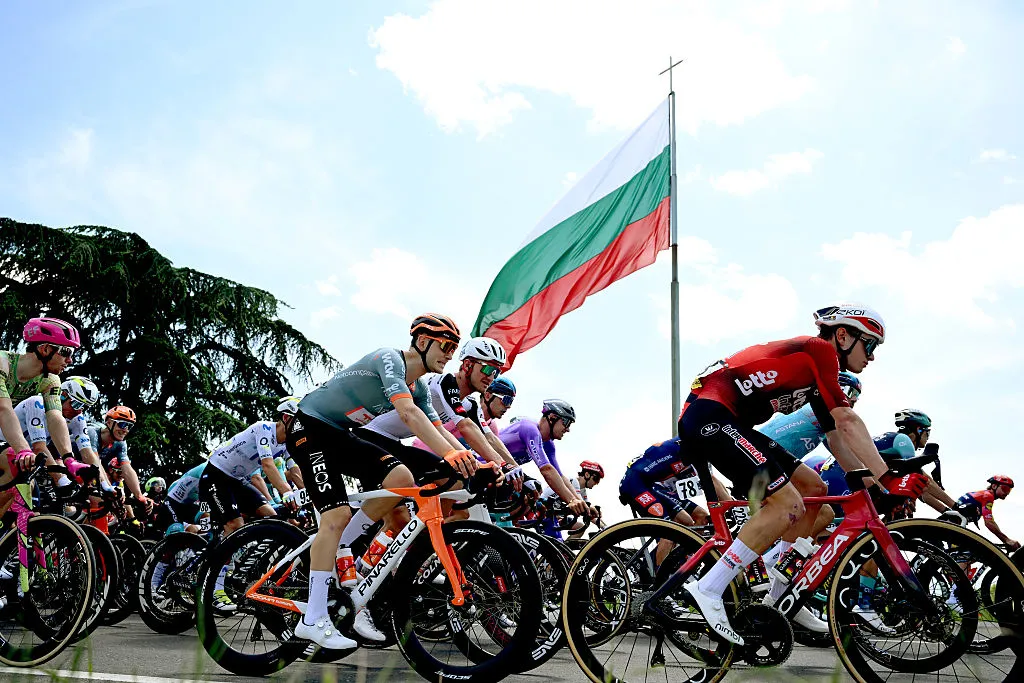
Riders, team staff and bikes transfer by plane to southern Italy from Bulgaria on Sunday, teams bring in fresh logistical backup
The Giro d'Italia peloton will leave Bulgaria to travel to Italy on Sunday evening in time for the race's first rest day on Monday(Image credit: Getty Images)
The Giro d'Italia returned to Italy on Sunday evening, with riders undertaking a long transfer involving a flight from Bulgaria before heading to their hotels for a first rest day on Monday prior to the stage 4 start in Catanzaro.
A few riders made the trip wearing Covid-era face masks to avoid the risk of picking up an illness on the flight, with pre-race favourite Jonas Vingegaard lamenting the need for additional travel only three days into the race.
"I would have preferred to skip that trip, and I brought my mask and hand sanitizer," he told Feltet.
But rider worries aside, the 1,000km transfer, complete with a time change and a flight of an hour and 45 minutes, was expected to be quite straightforward – unlike a couple of decades ago, when it was much more of a hit-and-miss affair.
"I remember my first Giro, and the year we started in, where was it – La Maddalena," Jayco-AlUla sports director Steve Cummings recalls of the 2007 race, which began on a small island off another island, Sardinia, several hundred kilometres west of the Italian mainland.
"And at some point, we were supposed to spend a couple of hours on a boat, and we ended up being on it for something like 12 hours.
"I said to [directeur sportif] Sean Yates, 'Hey, what's going on here?' and he said, 'It's the Giro, man, you gotta get used to it.'"
Get The Leadout Newsletter
The latest race content, interviews, features, reviews and expert buying guides, direct to your inbox!
Fortunately, at least for the riders, such transfers have improved drastically, Cummings said, even if the lengthy transfers for team vehicles and staff overland to Bulgaria sparked a multitude of comments amongst the participating squads.
Sunday evening – albeit with the major caveat, Cummings added, of what actually happens to the flights – the expectation was for the exit from Bulgaria to be straightforward, with each team having 18 seats allotted to them for each Sunday evening flight. Eight are for the teams still with a full quota of riders, and a further 10 for staff.
With riders waking up in Italy near stage 4's start, they will be able to treat Monday as a fairly normal rest day, taking in a ride, once their bikes arrive.
"It's a good way to do it anyway, and so then we take our luggage with a personal bag and everything else goes on a cargo plane, which arrives tomorrow in Italy, with all the bikes and all that stuff," Cummings said.
"It's a bit early to draw full conclusions, but I don't think it should be too bad, going into it all, I think it's been quite well organised."
What will stay in Bulgaria for all the teams are the vehicles – team cars, buses and mechanics' trucks – which, in many cases, will then be used at the five-day Tour de Hongrie, Cummings says.
"We've only got seven riders going across to Italy, because we lost Andrea Vendrame, but there's only a number of staff going across [including three directeurs sportifs – Ed.]
"The others who are here now will go to Hungary, then drive back from there. So it's fair to say that if it wasn't for the Tour de Hongrie, it'd be a lot more complicated. Otherwise, to get back to the Giro again in time would be just too far to drive."
The staff staying on in Hungary face a 750km drive to the southern Hungarian city of Gyula, where a 2.HC race will start on May 13. Seven WorldTour teams from the Giro, as well as Polti-VisitMalta and Pinarello-Q36.5, will be taking part.
But the other squads in the Giro will have a much longer drive back to team headquarters, mostly in Western Europe, so roughly twice the distance.
As for the riders themselves, Cummings expects most to be in the team hotels by midnight Italian time, with on-the-move meals – some provided by organisers, others by the team's chefs – consumed at the airport during the wait.
Then it's back into regular Giro d'Italia mode, where, as Cummings says, although the transfer shouldn't be too much of a strain on riders so early in the race, it's still an operation which needs some extra attention.
"I don't think it should affect them too much at this stage. You know, sometimes days off can be tricky if you're really feeling the fatigue, but I think right now everybody's still relatively fresh," he said.
"You don't need like super compensation, I don't think that's going to be a big factor. But nevertheless, you still have to be careful, particularly about what you eat, so you get a good balance of recovery and activation.
"It just seems to be a much more straightforward process, though, because of the nutritionists and so on."
Obviously, riders' activity on Monday will be affected by how the flight and transfer have gone, but in principle, most will only have an easy training ride and perhaps a recon of some of the route or the stage 4 finish at Cosenza, Cummings says.
"It'll depend on where your hotel is – if you can get on part of the course, it's always an easy option to take. You don't want to start getting in the car and driving particularly far to see a recons. But if you're there and you can see the finish, it'd make sense to do that."
Who will challenge Jonas Vingegaard at this year's Giro d'Italia? Subscribe to Cyclingnews for unlimited access to our coverage of the Corsa Rosa. Enjoy unrivalled reporting from our team of journalists on the ground, including breaking news, analysis, and more, from every stage as it happens, plus access to the Cyclingnews app to follow the action on the go! Find out more.
Alasdair Fotheringham has been reporting on cycling since 1991. He has covered every Tour de France since 1992 bar one, as well as numerous other bike races of all shapes and sizes, ranging from the Olympic Games in 2008 to the now sadly defunct Subida a Urkiola hill climb in Spain. As well as working for Cyclingnews, he has also written for The Independent, The Guardian, ProCycling, The Express and Reuters.
You must confirm your public display name before commenting
Please logout and then login again, you will then be prompted to enter your display name.