Zero to hero? Wind tunnel testing the new Look 795 Blade RS
A lightweight do-it-all aero bike with some interesting aero features aimed to balance performance with practicality. But does this work in the tunnel?
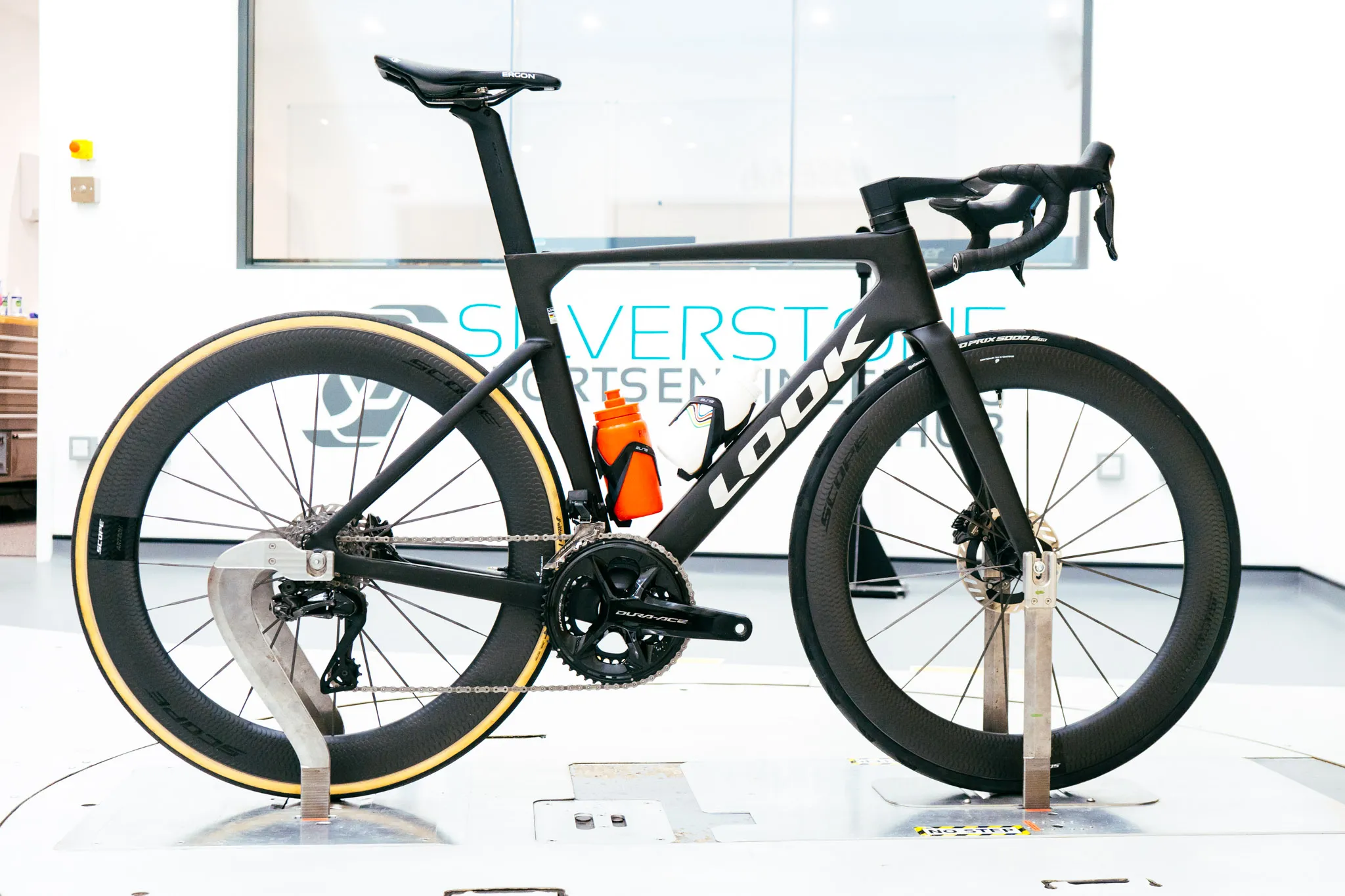
In a world of some fairly extreme aero machines being released, the Look 795 Blade RS looks almost conventional in its appearance.
Svelte tube profiles that rely on squared off ends for aero performance and more standard clean lines rather than sharp angles and flared elements result in a bike that looks like a rather normal bike.

Got a burning question you want to ask Josh, Will or Tom from the CN Labs team? Now's your chance!
For the next few days, you can submit your questions via the comments section at the link below.
Ask our Labs experts anything about wind tunnel testing, aero bikes, equipment and more – AskCN
Interestingly this is Look's out-and-out aero machine, but it doesn't resemble the deep profiled aero bikes from the likes of Factor, Van Rysel, or other brands. It does however have a rather narrow front profile, something the Factor ONE and Tarmac SL9 have all pursued with the leading edge of the bike often being one of the more important elements when it comes to overall aerodynamic performance of a bike.
The bike doesn't come with dedicated aero bottle cages, like the ENVE Melee V2 or Trek Madone, but the bottle boss placement and tube shapes are designed to limit the negative impact that fitting a 500ml round bottle tends to have an aerodynamic performance.
Tyre clearance is claimed to be 34mm, while Look states that the bike can come in at 7kg fully race ready. What that means is not specified, but we'd hope that means with bottle cages, computer mount, and pedals fitted.

The protocol
We're now somewhat dab handed when it comes to conducting these wind tunnel tests and for this latest round we followed the same protocol as previously.
We're already outlined in great detail how we went about testing in our 2025 aero bike shootout article if you want to go over it in all it's glory there.
However I'll outline the main principles here as well.
- Bike only:
This is the first test, and involves the bike being tested as stock with the wheels that it comes with and all components as standardised as we can.
The position is adjusted to be as close as possible between bikes in terms of size, handlebar width, stack, and seat height, but the saddle, groupset, and all the components are as sold.
This allows us to test the bike as is without the added complexity of a riders legs acting as large moving pistons disrupting the airflow. Although not attributable to real world, it can show some interesting differences between bikes that may have data that suggests they are fast, but not necessarily in the real world where a rider is present.
- With a rider:
Obviously no bike can be ridden without a rider, so testing with a rider present on the bike is essential for actual real world applicable testing that matters to you.
Some bikes are designed with riders on them, while others are not. Comparing the two tests can give us an indication of who has followed certain design methodologies.
The only issue is that, even while keeping rider position as consistent as possible, it is difficult to keep the margin of error as small as the frame-only. The margin for error is greater, yes, but still gives us a good idea of good performing bikes, bad performing ones, and standout offerings.
- Bike only, control wheels
Wheels make up a descent amount of aero performance for a bike as they are one of the first things the air hits and the last that it leaves.
We use a standardised set of wheels (Enve SES 4.5) and tyres (28mm Continental GP5000 S TR) because some of the test bikes come with 40mm wheels and 28mm tyres, while others came with 60mm options and 30mm tyres. There is also the fact that some frames are designed to perform best with certain wheels, while others are not.
Testing with a control set of wheels allows us to test the frame, fork, and components in isolation somewhat to the effect of a synergistic wheelset.
We can also infer some wheel performance testing from doing this, as some wheels test worse than the control ones, and others better.
All testing was done across yaw angles (the angle the wind hits the bike) of -15°, -10°, -5°, 0°, 5°, 10° and 15° to allow us to assess crosswind performance.


View Original

View Original

Testing itself is conducted at 40km/h as a decided speed that the majority of buyers may expect to go on their faster-paced grouprides, group events, or giving a road bike time trial a go. Rather than the 45kph+ that WorldTour pros race. We appreciate everyone will go faster than this at points, but that'll mostly be with the support of a tailwind or a hill.
Bike-only tests collect data for 10 seconds at each yaw angle, as there is less noise (messy data) and variance here, while With-Rider tests are done for 30 seconds each time to reduce the amount of noise we get from the tests and reduce the error margin.
To try and standardise things we ensure all testing is done in the same gear, so rear mech placement is similar, and with the same front tyres as they are the first thing the wind impacts. Position on the bike is kept as close as possible between bikes thanks to a laser outline so body position has limited impact on the results.
Two Elite Vico cages with Elite Fly bottles are fitted to each bike, save for when the bike comes with aero bottle cages as standard such as the ENVE Melee V2. This is because those are included parts of a bike, and people are unlikely to remove them (in favour of something nominally worse) so it is worth testing them as part of the entire system.
We have done a piece about the impacts of round bottles versus aero bottles if you want some homework.
We also still have our trusty Trek Emonda ALR control bike for the baseline testing. We test this at the start and end of each test day to ensure that conditions have remained consistent throughout the testing day. It hasn't changed since we started doing these tests, so allows us to ensure 2025 and 2026 testing days are comparable.

The results
Bike only
You can see here that the Look performs far better than our Emonda, and close to the Factor ONE. Look does state that the bike shaves 15 watts off the performance of the previous generation at 50kph, while performance across -15˚ to 15˚ Yaw was also an important part of development.
The Blade is actually closer to the performance of the Factor at the more extreme Yaw angles. Often more bladed tube shapes can perform well here acting as a sail, but only to the point at which they stall. Round tubes, like the Emoda, struggle here.
Total drag for the Look 795 Blade RS was 35.42 watts faster than the Emonda baseline. More impressively, it was a massive 11.3 watts faster than the previous generation 795 that we tested previously.
It also places it just shy of 5 watts behind the Factor ONE in first place for our bike-only testing.
With rider
When we add a rider to the equation, essential for the real world, performance is relatively better, with the Look actually beating the Factor at the more extreme yaw angles.
These are more prevalent at lower speeds, blustery conditions, and when riding in a bunch, so the bike seems well primed to perform well in more real world conditions.
However, we can see that the 2026 testing conditions were slightly faster than the 2025 based on the Emonda baseline testing, so although the Look performs well, it may be a watt or so slower than our measures when compared to previous test bikes.
With a rider present, the Look jumps up the table comfortably into the top quarter. 22.9 watts faster than the Emoda and just under 5 watts behind the Cervélo S5 at the top.
It's worth caveating that with a rider, not only is the error margin greater, meaning the bike could be anywhere from 3rd to near last, but the differences between frames are also smaller. The fact is that a rider makes up most of the drag, while large moving legs disrupt that smooth airflow massively.
This is why a clean front end and trailing edge can really help in real world aero performance, as well as deeper section wheels. It helps reduce the drag at the front of the bike, while also sometimes helping in smoothing the airflow coming off the back of the rider.
Control wheels
Interestingly, when we add the control wheels to the equation, the Look suffers badly, dropping down the table and 7.09w behind the Factor ONE and 2.72w slower than with the standard wheels.
This is likely due to the bike being tested initially with the Scope Artech 6 wheelset, which is deeper than our ENVE 4.5 control wheelset and a very sold aero performer as we have tested ourselves.
An intriguing aside, the Argon 18 Nitrogen Pro also came with the same wheels (albeit it modified versions to better suit the frame), yet it suffered less when we switched to the ENVE wheels. It looks like the Look does perform exceptionally well with those Scope Artechs.
This may look damning for the Look, but it's worth bearing in mind that the bike performed relatively better with a rider present than just the frame-only, which is how we tested the control wheels.
Even taking the same penalty of switching the wheels and applying this directly to the rider-on tests, the Blade 795 RS remains in the mid-table cluster which includes the likes of the 2026 Cannondale SuperSix Lab71 and aero focussed Van Rysel RCR-F.


View Original

View Original

The conclusions

- Most aero socks are a waste of money: Here's the wind tunnel verified proof
- Wind tunnel tested: Who makes the fastest deep aero wide gravel wheels?
- Fastest frame, fastest wheels, and a potential 22-watt upgrade: The Factor Elara wind tunnel tested
- What are the fastest UCI-legal road wheels? Wind tunnel testing the big-name brands and Chinese contenders
- Behind the scenes in the wind tunnel: Watch our latest video to see how a testing day unfolds
Look designed this bike to be fast in the real world, with bottles mounted and a rider present. Given that the 795 Blade RS performed relatively better with a rider on the bike, we can say that to that end Look has done a very good job. It has also eclipsed the aero performance of the previous generation bike as a frame-only and rider-on model which is mightily impressive given the visually limited differences.
Some of the aero performance is clearly from being tested with a class-leading set of deep section 60mm wheels versus some bikes that were tested with 40mm options. However, even with that accounted for, it's a solidly performing bike.
A race-ready weight of 7kg claimed is also impressive and up there with all-rounder aero bikes that don't fully sacrifice light weight. My favourite addition to this bike though is the handlebar system.
On the face of it, it looks like a one-piece bar and stem, but the reality is that it is a very smooth and clean two-piece system. Given that many one-piece systems can cost in excess of £500 and be a pain to switch, this two-piece system offers easily adjustability to change reach and bar width.
The reason this is so helpful is that, as our tests have shown, the rider makes up the largest proportion of drag in the full bike and rider equation. Having the option to adjust the geometry more to accommodate a more aerodynamic position that can be sustained for a ride is going to offer a far larger potential aero gain than the small differences between frames.

Freelance cycling journalist Andy Turner is a fully qualified sports scientist, cycling coach at ATP Performance, StemNotes, and Venturi Dynamics.
He spent 3 years racing as a UCI Continental professional and held a British Cycling Elite Race Licence for 7 years. He now enjoys writing fitness and tech related articles, and putting cycling products through their paces. Predominantly road focussed, he is slowly venturing into the world of gravel too, as many ‘retired’ UCI riders do.
When it comes to cycling equipment, he looks for functionality, a little bit of bling, and ideally aero gains. Style and tradition are secondary, performance is key.
- Josh Croxton Associate Editor (Tech)
You must confirm your public display name before commenting
Please logout and then login again, you will then be prompted to enter your display name.
