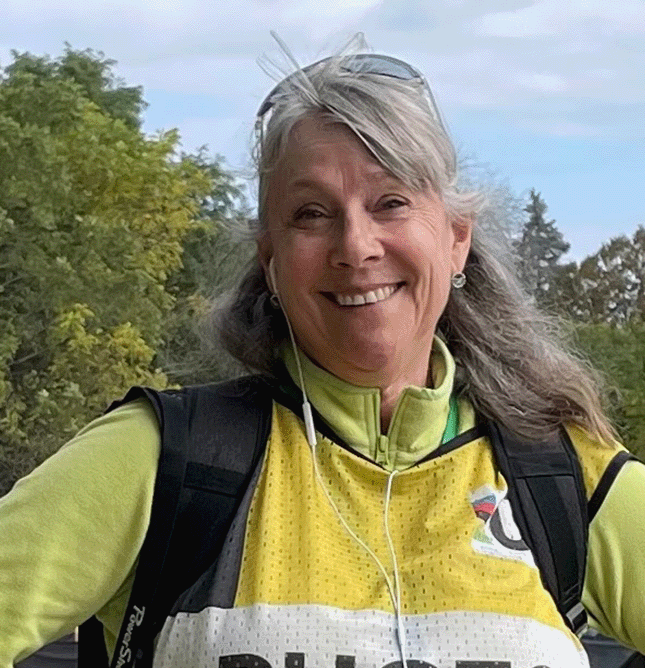
What keeps members of an elite rider's support crew from sleeping the night before racing in Emporia? Rain and mud. We spoke to mechanics for riders like Alexey Vermeulen and Carolin Schiff to find out more about their critical role
'Big Tall' Wayne Smith, who has worked with Peter Stetina for years, takes care of a bike at Stetina's Paydirt(Image credit: Linda Guerrette l Stetina's Paydirt)
The difference between a great race and a good race at Unbound Gravel 200, or even simple survival, can often come down to a missed gel, a dropped bottle or a flat tyre. To be fast and successful on dirt, or mud, is all about clean precision at the mid-race Feed Zones for elite riders.
Yes, weather is probably the hottest topic at Unbound Gravel every year, but it's not just the dust versus mud for the conversation, with showers Thursday night and into Saturday morning a good bet this year. Temperature and humidity also impact decision-making for how much nutrition to carry and hydration needed.
That's where the Feed Zones are critical, and the strategies designed by support crews and mechanics. Each athlete, on a mega-squad or a privateer, have a staff behind the scenes. Their work begins weeks in advance and continues through the NASCAR-like service areas, formerly only two called Checkpoints and now three Feed Zones on the course. New separation from the age-group zones, still called Checkpoints, was implemented by Life Time for safety and a more fair playing field for the elite riders.
No longer 'rest stops', these are for hydration hand-offs and equipment pit stops. It can make or break a rider's chance to finish without bonking or riding inoperable equipment like a deflated tyre or broken derailleur.
The stakes are high to stay at the front of the race for prize money and prestige. A 10-hour ride can be disrupted in a matter of minutes. So how does it work in the middle of the race with support crews to stay out front?
Cyclingnews asked some of the best mechanics three questions each: what has worked in the past, what issues create nightmares, and what will be most critical this year? Here is an Unbound Gravel roundtable from the mechanics themselves.
Wayne Smith, Canyon x DT Swiss ATR
Key riders in 2026: Carolin Schiff, Larissa Hartog, Nele Laing, Bradyn Lange, Mathijs Loman, and Peter Stetina in advance of Unbound XL (Thursday)
Get The Leadout Newsletter
The latest race content, interviews, features, reviews and expert buying guides, direct to your inbox!
The biggest 'win' you have had at Unbound 200:
The biggest win is just a simple smooth aid station. Simply saying, the athlete comes in, gets what they need, and heads out. This doesn't always mean just a hand-up, or a quick hydration pack. Sometimes this means a speedy wheel change, quick wash and lube. It's always nice when you can surprise the athlete with the speed of a repair, or a fix, and get them going again.
What keeps you up at night pre-race?
Being unprepared keeps me up at night. I typically start my planning as soon as the course is released. Checking street view, looking for the best spot, then having some alternatives. I want to make sure we have cold drinks if it's hot, and wash supplies, and a dry towel if it's muddy. I try to run through every scenario in my head, and make sure we're prepared for it.
Will one of the three Checkpoints be most critical this year?
I think aid 2 will be the most crucial (for the pros). Athletes will have almost 70 miles between aid 2 and aid 3, and that's a lot of nutrition to prepare for. If there's a miscalculation on nutrition at aid 2, it can create quite an uncomfortable race for the rest of the race. I also believe this will be more of a big deal for first timers. The athletes who have ridden Unbound previously will be familiar with the long distance between aid stations.
I would say not having any major mechanicals so far at this race. A lot can happen in 200 miles. Especially my first year there wrenching for Alexey, they had some super bad mud that was ripping people's deraileurs off. So being able to make it through that race with no mechanicals was important to me.
What keeps you up at night pre-race?
Just making sure the bike is fully dialed in. I always wake up and have to go and double check different things on the bike even though I know I did it, just to put my mind at ease. To me, this is how Alexey makes his living, so it can get stressful on race day, just hoping everything is running smooth. It's always a sign of relief at the end when he tells me the bike ran perfectly.
Will one of the three Checkpoints be most critical this year?
To me there are two critical checkpoints. First is mile 42 - you can see how the field is doing and how the bike has been holding up. Second would be mile 154 - the race is almost done, but a lot of people either are broken, or they have the mentality to do that final push a lot can happen in that last push.
Haley Smith (Factor Racing) has a detailed pit stop at The Traka 360, on her way to fifth place in 2026 (Image credit: @ Gravel Earth Series l @ The Traka)
This will be my third year working the pro level 200. The biggest success I've had for check points at Unbound is when I'm able to just tell the rider time splits and hand them a fresh bottle. No work is good work at a check point.
What keeps you up at night pre-race?
The things that keep me up at night before Unbound are the sudden weather changes, which can lead to creating new tire set-ups and race plans.
Will one of the three Checkpoints be most critical this year?
The fact there are three checkpoints and it looks like it's going to be a mudder makes it logistically a nightmare. We now need more staff to ensure a successful feed at each check point, because, being able to reach each aid station poses some difficulty.
Paradoxically, as a mechanic, our wins are measured by the absence, not the presence, of excitement. We pray and prepare so that our athletes come through each checkpoint, demonstrating poise against the elements, their bikes in sound mechanical shape despite the conditions and that we are ready for any unknowns. If our athletes enter and exit the checkpoint without so much as a bit of drama, we know we did our job well.
The alternative, the presence of excitement, a flat tyre, a botched wheel change, a missed bottle hand-up, seconds lost, are all examples of mistakes that can lead to a death-by-a-thousand-cuts scenario as every minutiae contributes to the sum total. Mechanics dread excitement.
What keeps you up at night pre-race?
Simply put: RAIN. Torrential downpours, sweeping thunderstorms, and sudden tornado warnings. While the event has been spared from inclement weather the past couple of years, rain always remains a high concern. Having personally grown up and ridden extensively in a plains state not too dissimilar from Kansas, a single black cloud on the horizon can suddenly envelop a beautiful, warm, sun-drenched day with a cold, dark curtain of misery. Worse still, beyond the potential for hypothermia for those unlucky riders who can't find cover, is the MUD.
We all know the destructive capacity the Kansas plains' mud carries. Its unrelenting, viscous, tar-like consistency instantly hinders those who encounter it, a potentially Sisyphean task even to trudge. It is guaranteed to destroy your equipment and even you if not quickly addressed. The rain and subsequent mud, like any forces of nature, have no biases. These phenomena do not care how fit you are or how good your odds were the morning you started the race; they must simply be reckoned with. As a result, we will obsessively check every weather app like madmen until this upcoming Saturday.
Will one of the three Checkpoints be most critical this year?
It might be cliché, but all the checkpoints are CRITICAL in our opinion. However, if we have to pick one, the third checkpoint is the most important. It is the make-or-break point. With the longest distance between stops, athletes will be the most exposed and vulnerable arriving at the third checkpoint from the second. This stretch is where fatigue, hunger, and dehydration can potentially set in, making it easy to lose hope and for the mind to wander. Additionally, some of the roughest portions of the course are often located here, increasing the odds of mechanical issues as riders continue to push through.
The third checkpoint is an oasis from all that. A brief reprieve and a bit of reassurance that you can not only make it to the finish but might find some glory at the end. Given this, our crew will be paying extra attention to the third checkpoint.
Mud caused pro and elite riders to dismount bikes at D Hill just 10 miles into Unbound Gravel 200 in 2023, making the first Checkpoint, or Feed Zone, critical to regain positions in the race (Image credit: Life Time)
The biggest win I have had in past editions may not be the fastest feeds but clean and consistent feeds. Getting everyone what they need with no drops and smoothly. Smooth is fast.
What keeps you up at night pre-race?
Rain and mud are what keeps me up at night for planning the race. This could change bike, gearing, and tire choice. In years past, it was unknown until the race started. In addition, if it is muddy and we need to clean bikes in feed zones this can really change our staff and riders treat each feed zone, ready to wash or ready for fast feed.
Will one of the three Checkpoints be most critical this year?
I think Feed Zone 1 will be the most critical. As there are potentially muddy sections prior, and MMR soon after. Also the pace will most likely be high and still large groups. So a good feed is critical here, and if it is muddy we will need to be prepared to wash bikes.
Subscribe to Cyclingnews for unlimited access to our gravel cycling coverage in 2026. We'll be on the ground at the biggest races of the season, bringing you breaking news, expert analysis, in-depth features, and much more. Find out more.
Jackie has been involved in professional sports for more than 30 years in news reporting, sports marketing and public relations. She founded Peloton Sports in 1998, a sports marketing and public relations agency, which managed projects for Tour de Georgia, Larry H. Miller Tour of Utah and USA Cycling. She also founded Bike Alpharetta Inc, a Georgia non-profit to promote safe cycling. She is proud to have worked in professional baseball for six years - from selling advertising to pulling the tarp for several minor league teams. On the bike, she has climbed l'Alpe d'Huez three times (not fast), and spends time on gravel around horse farms in north Georgia.
You must confirm your public display name before commenting
Please logout and then login again, you will then be prompted to enter your display name.