'A dealmaker or a dealbreaker' - Canyon embraces big gravel tyres with the launch of the new Grail
The new Grail is both faster and heavier than the outgoing bike

Canyon has launched a brand new edition of its Grail gravel bike today.
Like a lot of gravel bikes being launched right now, such as the Factor Elara and the Scott Addict gravel, the new 3rd generation Grail is a dedicated big-clearance, aero-focused gravel race machine.
We spotted what we believed to be this bike in prototype form at The Traka back in late April, speculating at the time whether the Grail would be joining the big gravel tyre club. We know now the answer to that question is a resounding yes.
As it did with the Grail RIFT, Canyon has flirted with its own embargo and has also been teasing this bike for over a week on social media, and by now, most will know the new Grail has arrived.
The Grail, regarded as one of the best gravel bikes for several years, was starting to stand out for its conservative official max tyre clearance of 42mm. Whilst there's nothing wrong with running a 42mm tyre, things are only going one way when it comes to gravel race bike tyre sizes and trends.
Now, it seems Canyon has answered in kind with 57mm tyre clearance front and rear.
The new bike isn't quite as light as the Gen 2 model. Canyon quotes 989 grams for a raw, medium-sized frame, 1095 for a CF SLX model and 1128 for a CF. It does make the point that overall the bikes are faster than the previous one, though.
The latest race content, interviews, features, reviews and expert buying guides, direct to your inbox!
There's more than just tyre clearance to go over here, though. We have all the new bike details, have logged several test rides on the new bike, and have verified the max claimed tyre clearance ourselves for you.

The 3rd generation Canyon Grail
We'll stay on tyre clearance for just a little longer. The Grail has 57mm clearance now, with a claimed 4mm ISO clearance around the tyre. Everyone will be happy, and the spec sheet will look good, but I get a slight feeling when listening to Canyon speak about the bike that it's still not completely on board with the big tyre philosophy.
It sounds like the clearance was partly just boosted because it was requested by pro riders like Rosa Klöser, who insisted that her future gravel bike would have to have big tyre clearances, and not because the brand was all in on big tyres.
Canyon says it 'watched, waited and listened whilst the internet debated whether wider tyres make you faster'.
The brand says the Grail was intended to be 2x compatible, which would have held clearance to a maximum 50mm figure, but riders like Klöser demanded bigger numbers.
To execute the 57mm clearance, Canyon has used a thin yet completely solid section of drive-side chainstay; it's the same workaround Lauf uses in its Seigla frame, which also has the same clearance number.
Bikes will come fitted with 45mm tyres. Canyon calls this a 'baseline from which riders can explore'. There will also be no suspension-equipped 'RIFT' models in the range. The brand explained that the large-volume tyres will take care of further off-road smoothing duties.
Canyon has also created a tyre pressure setup calculator with Pirelli, which can be found within the Canyon app to help riders dial in their optimal tyre pressures.

Aero testing


View Original

View Original

It's clear to see from looking at the Grail that aerodynamic performance has been a consideration, and it's a factor for any competitive gravel race bike launching right now.
Canyon makes the point that the longer you are racing, the more aero matters. This will certainly be a factor in events like the Traka 360.
The brand has tested at 35km/h, which it says is real-world gravel race pace. Testing occurred at the GST Wind tunnel in Immenstadt, Germany, and the brand uses a moving-leg dummy to replicate a rider's pedalling motion.
Let's start with a question many will want to know: how much faster is it than the old bike? A 3rd Gen Grail with 40,45, and 55mm tyres is faster than a Gen 2 bike with 40mm rubber. By up to 6.3 watts.
Canyon also tested against some competitors and listed them, something not every brand does when comparing to the competition.
You can see the table for yourself above, but the Gen 3 bike was faster by a few watts than the Rose Backroad FF, Factor Ostro Gravel and Cervélo Aspero.
Canyon tested each bike model with the same wheelset, leg model, and 45mm tyres. The wheels had a spec of 50mm depth, 27mm internal width, and 38.5mm external width.
Aside from aero testing, there's scope for rolling resistance to offer greater gains off-road; certain 50mm+ tyres can offer their own rewards when combined with the right tyre pressures off-road. The Grail's new clearance will allow riders to take advantage of those gains too.
Features and geometry
Canyon says that the Grail was well regarded in the handling department and didn't want to mess with its handling formula.
The bike's wheelbase has been extended by 10mm to accommodate the big tyres, and the chainstays are 10mm longer, but the brand says the 'handling dynamics remain the same as on the Gen 2 Grail' and the head and seat tube angles are the same.
The stack has changed and has been lowered by 15mm 'in response to gravel racing's rising speeds'; the reach number is the same, and shorter stems are specced on bikes. For instance, a medium arrives with an 80mm stem.
This generation of the Grail in CFR and CF SLX models has also received the Canyon Pace bar technology. This provides simple handlebar width and height adjustment of 50 and 20mm respectively.
Bikes arrive with Canyon Control handlebar drops, but these can be removed and switched out for several alternative options. Adjustable bar widths range from 370mm to 420mm.

There's also a new seatpost in the form of the SP0093 VCLS (vertical comfort lateral stiffness) unit, an aero-profiled post which Canyon says provides 25% more compliance than a rigid unit. Canyon also claims it offers the same amount of deflection regardless of a rider's seatpost height.
The frame uses a PF86 bottom bracket standard, primarily for clearance and stiffness according to the brand.
There are also some new frame storage bags for the Grail from the Bavarian brand Cyclite. Canyon has developed lightweight, top tube and frame storage bags for the Grail whch save a couple of hundred grams over the previous bags; they also don't affect aero performance much.
A few features aren't on every model. Load downtube storage can only be found on the CFR and CF SLX models, and the Fast Fender mounts don't feature on the CFR model.
Another new release comes from Canyon in the form of a new pair of carbon wheels from the brand. Canyon launched its own range of carbon wheels with the Grizl gravel machine last year.
The new 50 CF wheels will come on the CF 7 and CF SLX models, or retail on their own for €999. Spec-wise, the wheels have a 27mm internal width and 38.5mm external width. The 50mm rims are laced onto DT Swiss 350 hubs, and the overall weight is a claimed 1675 grams.
Initial riding impressions

I reviewed the previous-gen Grail, attended the launch of the suspension-equipped Grail RIFT and raced the Traka 100 on it.
I’m familiar with the Grail platform, and I really like it. Until now, I have considered the Grail a performance gravel bike that’s a strong all-rounder, user-friendly and fun to ride.
When I saw the new Grail, whilst I thought it looked good with its aero tube shapes and chunkier aero seatpost, I was hopeful that the previous Grail’s nimbleness hadn’t been done away with, despite the brand saying the geometry numbers and ride characteristics were very similar, though the Gen 3 bike is 15mm lower at the front.
Canyon sent me a Grail CF SLX 8 AXS model to ride in the eye-catching Strawberry Shake colourway. The bike as pictured comes in at €5,499, and my size small test model came in at 9kg out of the box with two bottle cages, a frame storage bag and tools, frame bags and sealant.
After my first ride on the bike, my fears had been largely allayed. In short, the Grail still feels like a Grail. The solid handling and manoeuvrability are still there; it's not just a point-and-shoot straight-line aero machine.
It's a little heavier; my size small at 9kg isn't exactly featherlight, but it doesn't feel like it holds the bike back particularly.

I don't feel much vibration damping from the aero VCLS seatpost, which I am also testing on the road with the latest Endurace; fans of the brand's older round leaf spring style VCLS post of old may be left wanting, and for me, that post did provide more compliance.
The ride is without a doubt solid, fast where it's needed and capable in the techy sections. The overall ride hasn't set my soul alight yet, though. This bike has been designed with speed in mind; I want to see what it's like to live with as a general gravel machine.
The bikes come stock with Schwalbe G-One R 45mm tyres, but I have fitted some 2.2" Continental Dubnital tyres to check clearances for myself, and can verify the big rubber does fit comfortably. Certainly more easily in the front than on the Factor Elara we recently tested. So if you want to go up to 57mm, you can.
Specs and pricing
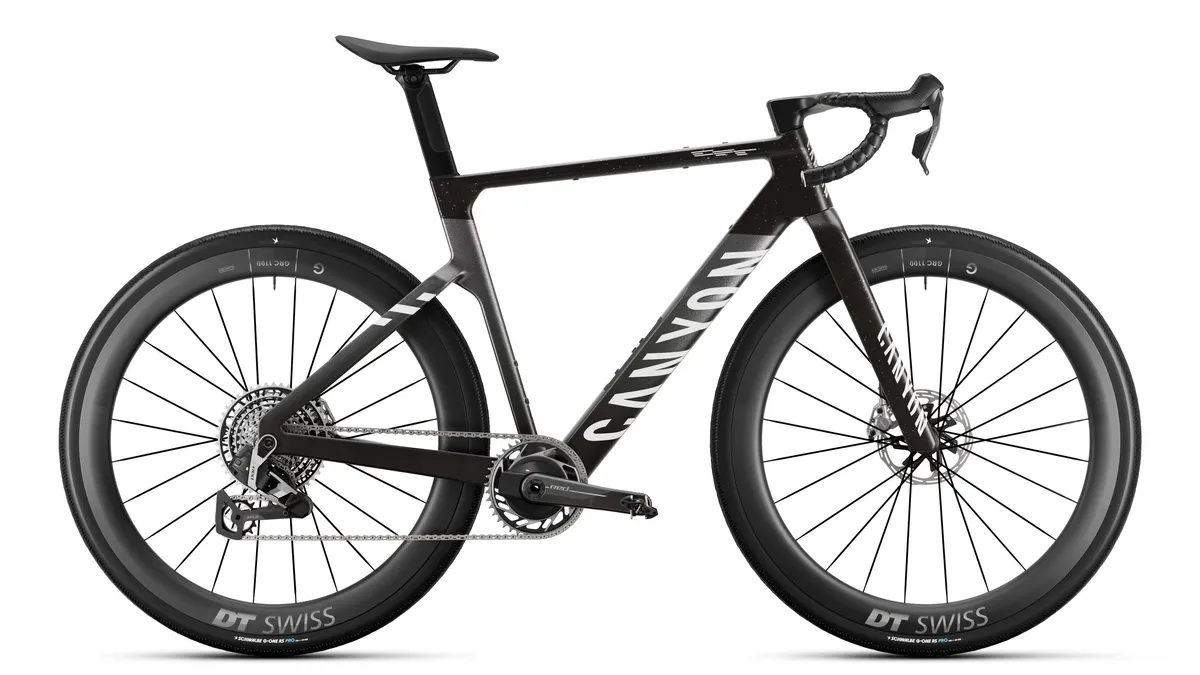
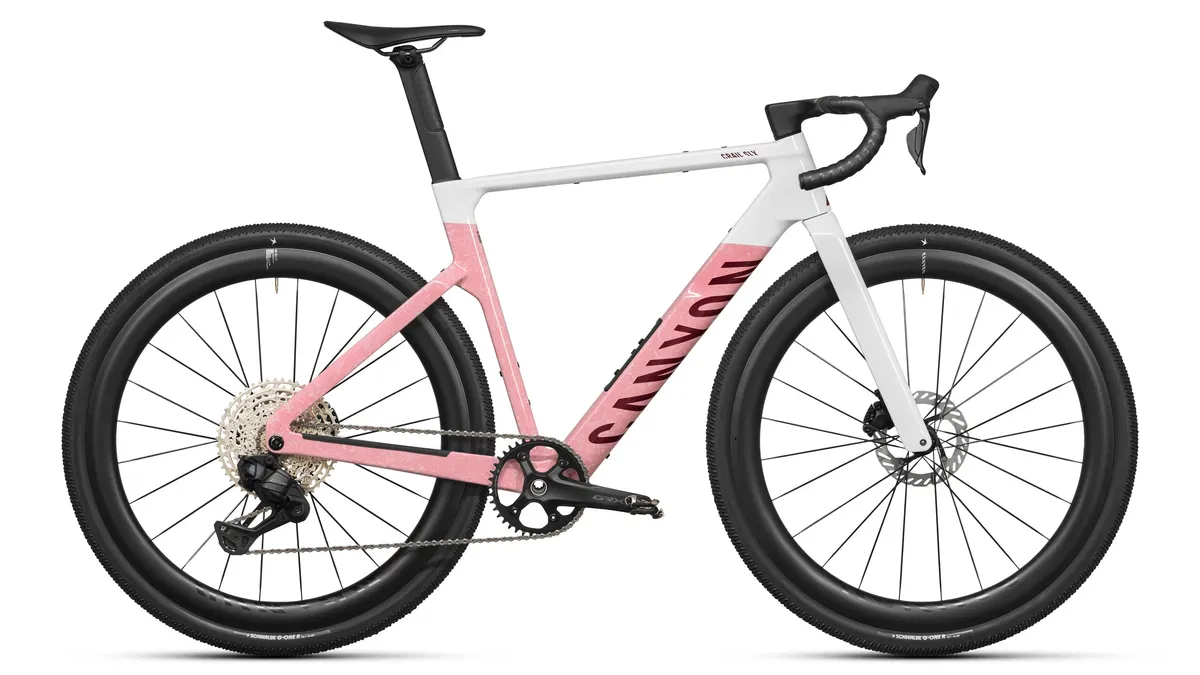
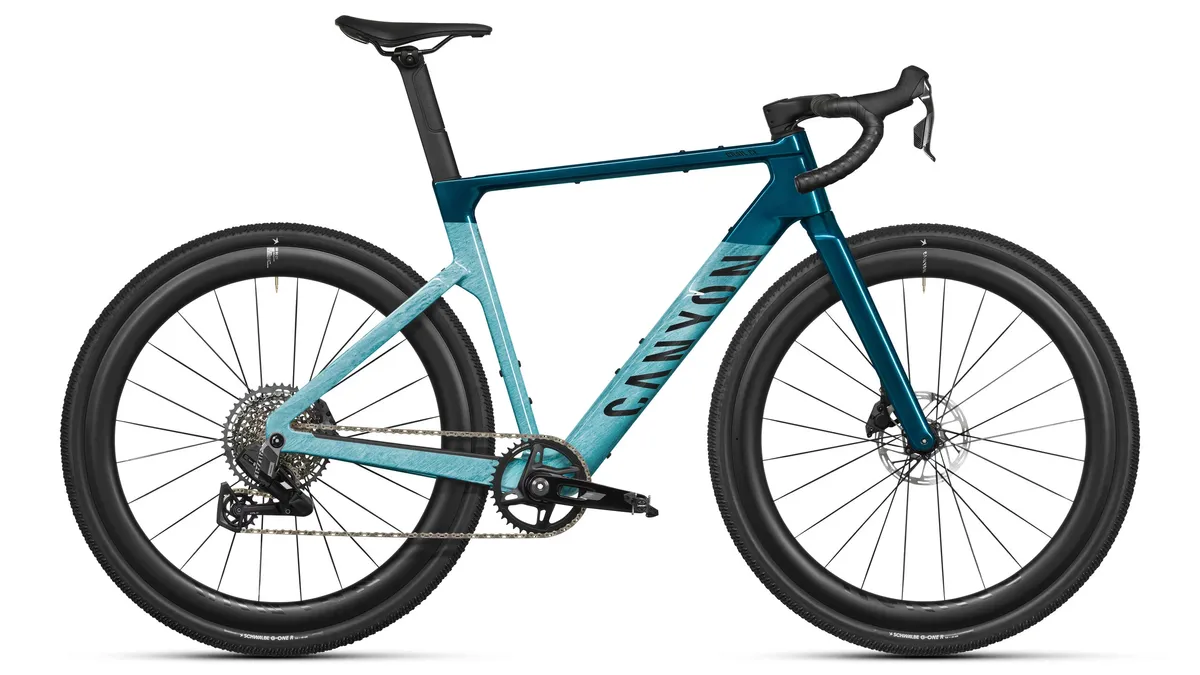


Six Grail bikes will be available across three frame tiers: CF, CF SLX and the top-tier CFR bike. Two models will be available in each frame version, and there are eight colourways to choose from.
Access to the new range starts with the base CF 7 model, which starts at €2,499 / £2,499 for a Shimano GRX 610 mechanical groupset-equipped bike with Newmen wheels.
The CF CLX tier bikes start at €4,999 / £4,799 with SRAM Force XPLR and DT Swiss GRC 1400 wheels.
The top-spec CFR bikes start at €6,500 / £6,200 for a Shimano GRX R825 build with DT Swiss GRC 1100 wheels, and rise to €8,000 / £7,600 for the top-spec SRAM Red XPLR-equipped bike with the same wheelset.
The Cyclite bags are available separately; the Cyclite top tube bag costs €69,99 and the midloader bag €124,99.
Something to note: the CF bikes don't come with a frame storage hatch, and the CFR bikes do not have Canyon integrated fender mounts for the fast fit system.

Tom joined the Cyclingnews team in late 2022 as a tech writer. Despite having a degree in English Literature he has spent his entire working life in the cycling industry in one form or another. He has over 10 years of experience as a qualified mechanic, with the last five years before joining Cyclingnews being spent running an independent workshop. This means he is just as happy tinkering away in the garage as he is out on the road bike, and he isn’t afraid to pull a bike apart or get hands-on with it when testing to really see what it’s made of.
He has ridden and raced bikes from an early age up to a national level on the road and track, and has ridden and competed in most disciplines. He has a keen eye for pro-team tech and enjoys spotting new or interesting components in the wild. During his time at Cyclingnews, Tom has already interviewed some of the sport's biggest names including Mathieu van der Poel, Tadej Pogačar and Alberto Contador. He's also covered various launches from brands such as Pinarello, Ridley, Specialized and more, tackled the Roubaix Challenge sportive aboard his own rim-brake Cannondale SuperSix Evo, tested over 20 aero helmets in the wind tunnel, and has created helpful in-depth buying advice relating to countless categories from torque wrenches to winter clothing.
You must confirm your public display name before commenting
Please logout and then login again, you will then be prompted to enter your display name.
