Fastest frame, fastest wheels, and a potential 22-watt upgrade: The Factor Elara wind tunnel tested
Factor's new gravel race frameset and super-wide Black Inc gravel wheels blow away the competition to top the leaderboard

It's not difficult to work out how the Factor Elara came into existence. Its super-wide fork is uncannily similar to the brand's aero road hotshot, the ONE, and from that point backwards through the frame, it's a clear shot at the best gravel race bikes on the market, with the design straight out of the modern gravel race bike playbook as a combination of aero, big tyre clearance, and racy geometry.
Ahead of the bike's launch, my colleague Will has been testing it for an upcoming review. That'll come once he's back from his late-summer holiday trudging around the Scottish Highlands, but through a stroke of good timing, we were booked in at the wind tunnel last week, so we couldn't resist seeing how it stacked up against the likes of the S-Works Crux 5 and the Wilier Rave SLR we tested earlier in the year, plus the new race-ready Giant Revolt too.
We were also keen to see how the new super-deep Black Inc gravel wheels fared against the new Enve G SES 6.7 Pro, Zipp 303 XPLR and more. More on that later.
Despite our local van hire company's best attempts at blocking us by sending the smallest van in their fleet, I put my childhood Tetris obsession to good use, loaded it up to the hilt, and headed east from Cyclingnews HQ to the Silverstone Sports Engineering Hub.

Protocol
To ensure a fair and comparable test against the bikes we tested back in May, we matched the protocol from that test.
I'll outline some of the important bits below, but to save going over the details of (and reasons for) the protocol and sending you half to sleep, I'd suggest heading over to that gravel bike wind tunnel group test, where the details are outlined in full for those who want to get nerdy.
What's important to know here is that everything was tested in exactly the same way as before, against the same baseline bike on each day to get an accurate comparison of how aerodynamic each gravel bike is relative to the others.
This meant testing at a wind speed of 35km/h, and at seven different yaw angles (the angle at which the wind hits the bike): -15°, -10°, -5°, 0°, 5°, 10° and 15°.
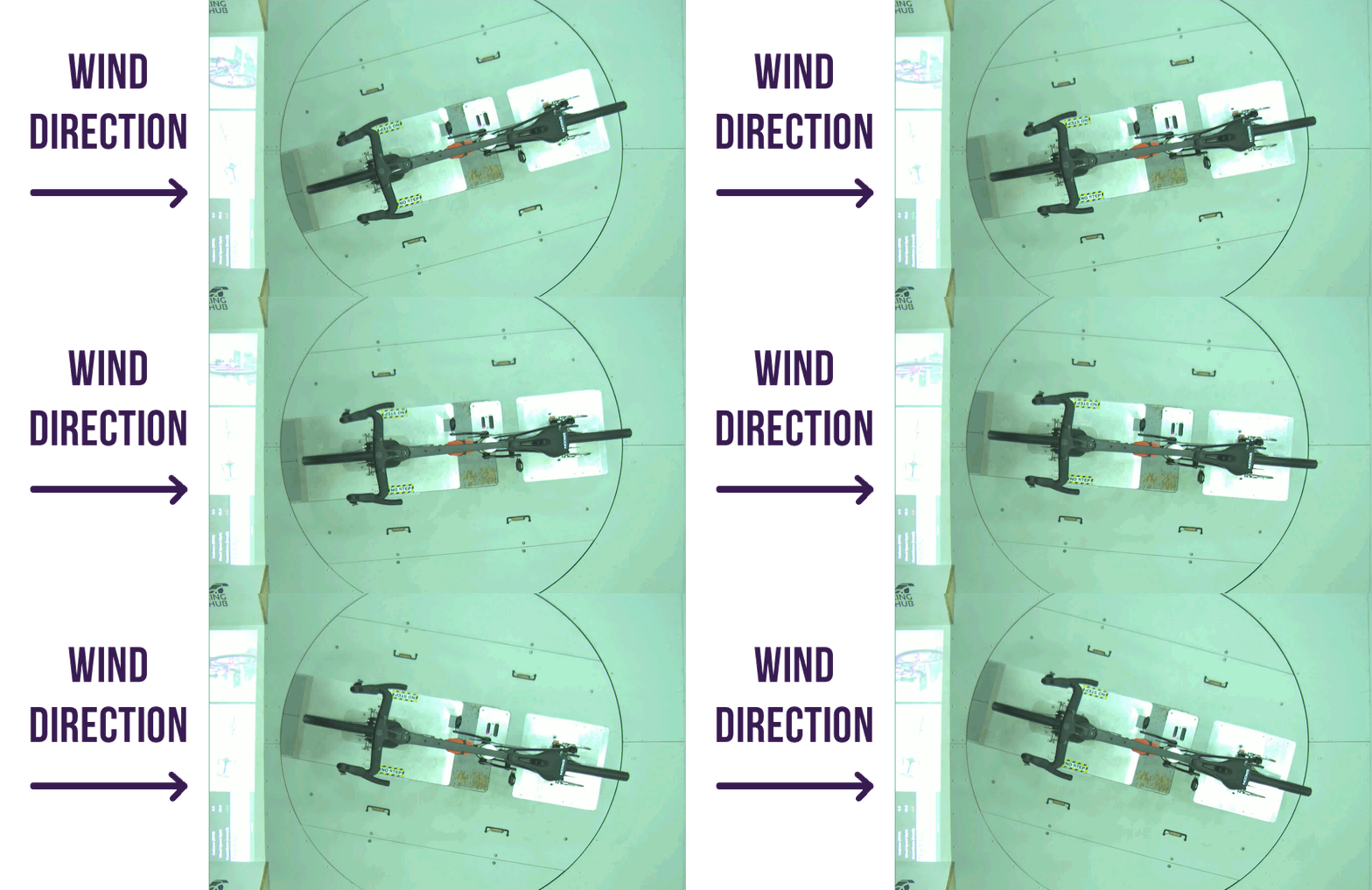
It also meant using the same position as all other gravel bikes we've tested, as well as using the same tyres (45mm Pirelli Cinturato Gravel RH), bottles (Elite Fly), saddle (Ergon SR AllRoad), and anything else that can be controlled.
And as ever, we tested each bike in three ways:
- With a rider, with the stock wheelset
- Without a rider, with the stock wheelset
- Without a rider, with a pair of 'control' wheels (Enve G-SES 6.7 shod with 50mm Vittoria Terreno Dry tyres)

A few quick caveats and disclaimers
Like many of today's gravel race bikes, the Factor Elara is designed around tyres wider than the 45mm and 50mm tyres we tested with here, and this could adversely affect the results in comparison to a bike designed around narrower tyres. We don't know for sure by how much, if at all, but it's a caveat worth mentioning. Unfortunately, our time in the wind tunnel is limited, so we can't test every bike with every tyre size.
In time, we will likely adjust our gravel testing protocol to focus more on these wide-tyred race bikes. I think anyone interested in the aero data of gravel bikes is going to primarily be interested in 'gravel race' bikes, which as a category is converging towards wide tyres as the norm.
And with all that said, we're aware that aero data is only one piece of the puzzle of defining whether a bike is good or bad. Weight, tyre clearance, comfort, price, serviceability, reliability, and brand aftercare are just some of the other factors (no pun intended) to consider when buying, all coupled with the purpose and type of riding you plan on doing.
Results
I'll get stuck right in with the headline result: The Factor Elara is the most aerodynamic gravel bike we've ever tested, by a pretty significant margin, in both of our bike only tests, and it's on the podium in our 'with rider' test too.
The coefficient of drag at each of the seven yaw angles, for the three tests, looks like this:
I appreciate that's not the most visually useful graph, since the with-rider test and the two bike-only tests are quite far apart, but if you're nerdy enough to care about the specific values, you can hover over and you'll get to see the exact CdA at each yaw point. Otherwise, keep scrollin', as I've already done the calculations that help to show what that means.
Using an average of those seven points, weighted according to the methods set out by Nathan Barry's 2018 paper – A New Method for Analysing the Effect of Environmental Wind on Real World Aerodynamic Performance in Cycling – I have solved for watts using the following equation.

I did this at two speeds. Firstly at 35km/h, as this is the wind speed we tested at. Then again at 40km/h, so we can compare it against the road bikes we've tested too.
The point of this is to see how much energy (in watts) is required to overcome the aerodynamic drag (aka, the wind) in an average real-world riding scenario. If Bike A requires less energy than Bike B, we can deduce that assuming all else is equal (tyre drag, weight, drivetrain friction, etc), then you will be faster on Bike A for the same amount of effort.
And for context, when comparing aerodynamic drag in watts, the differences between bikes will shrink at slower speeds; if there's five watts between bikes at 35km/h, it'll be around three watts at 30km/h, and two watts at 25km/h. This is because power grows to the cube of speed (as shown in the equation above).
It goes the other way too. For a fun example, if something is a mere two watts better off at 25km/h, it's not 20 watts better at 250km/h, it's actually 2000 watts better! This is because you're increasing the speed by 10x, so you need to increase the watts by 10 to the power of three, or 1000! Good luck riding a bike at 250km/h though.
Sorry, I promised not to bore you half to sleep… shall we look at the results in detail?

With its stock wheelset - the Black Inc Sixty Four Gravel - shod with the 45mm Pirelli Cinturato Gravel RH tyre, and in the 'bike only' test, the Factor Elara is 9.64 watts more aerodynamic than our baseline bike (an old Trek Emonda ALR road bike that stays unchanged between all tests).
As a more useful comparison, that's 2.97 watts better (at 35km/h) than the next most aero gravel bike we've tested, Argon 18's Anti Matter. And compared to the least aerodynamic gravel bike we've tested, the Lauf Seigla (with round bars and external cables), it offers a huge 22.38 watt gain.
The results with a rider (me) atop the bike place the Elara in third place behind the S-Works Crux 5 and the Wilier Rave SLR ID2.
It's important to note that adding a rider into the equation reduces the accuracy of the test (since the rider can't hold a perfectly still position). We've calculated an error margin of 2.8 watts on the day, and with that taken into account, the Elara can still lay claim to top spot, even if it wasn't the outright most aerodynamic in the raw data.
It's also worth adding that the Elara is a heavier bike than the Crux 5, but I've intentionally not quoted the weights because the Elara we tested here was a SRAM Force-equipped model, versus the SRAM Red equipped Crux.
And in our third test, which swaps out the Black Inc wheels for a pair of 'control' wheels that lets us see how the frames alone compare, the Elara is on top once again. This time with a slightly smaller margin. This essentially tells us that the frame alone is the fastest of all that we've tested, but that the Black Inc wheels are pulling their weight in making the bike faster too.

In fact, when you look at how each bike tests with their own wheels against the Enve wheels, the Factor Elara was affected the least. There was a 1.79 watt improvement when switching wheels (and, remember, we've swapped tyres too) which is the smallest gain of all the bikes we've tested.
Compared to road bikes
Since we test all bikes against our baseline Trek Emonda, we can also see how the Factor Elara stands up against the road bikes we've tested too, including the mega-aero Factor One, which is the fastest bike we've ever tested.
It won't be that fast, let's not get excited, but it's an interesting comparison nonetheless. Given the Elara's aggressive position, we can gauge if it could hold its own as a one-bike-does-everything solution.
Out of context, the graph above makes the Elara look quite poor, but remember, it's the fastest gravel bike we've tested, and we've tested a lot more road bikes than gravel bikes to date.
Importantly, it comes in just 10.45w slower than the Look Blade 795 RS we tested in 2024. That's really impressive considering the Elara was tested with 45mm knobbly gravel tyres, versus the Look's 25mm road tyres.
If we were to test both with a 32mm road tyre (which, to prevent lawyers coming after me, wouldn't be ETRTO compliant given the width of the Black Inc wheels), I imagine that deficit would mostly (if not entirely) disappear. Next time we're at the tunnel, I'll figure out a way to test this theory.
And finally, with the rider on the bike, that deficit grows to 20.06w between the Elara and the slowest modern road bike – the Cinelli Aeroscoop. However, this is because the position of the gravel bikes is different to the road bikes, putting the rider in a more upright (and thus, less aerodynamic) position, so there's more rider drag in the equation.
Compared to Factor's ONE aero bike, we're looking at a deficit of 33.99 watts. However, if we were to roadify the position of the Elara to match that of the ONE as closely as possible, we'd be able to reduce that gap. Exactly how much by, though, is unknown.
Conclusion
Based on the spec sheet and our wind tunnel test results, it's safe to conclude that the Factor Elara is a best-in-class gravel race bike at the time of its launch. It's the most aerodynamic gravel bike we've tested in both bike only tests, and can lay claim to top spot with a rider, too. Meanwhile, the clearance is rated for 57mm tyres (according to the brand) and the wheels are bang up to date with the gravel race trend, thanks to their 64mm depth and 30mm internal width.
As mentioned up top, my colleagye Will has the bike in for testing. He's penned his early impressions in our Factor Elara launch story, but will wrap up the review in the next couple of weeks, so we can see how the aero data translates to the real world, and get his perspective on stiffness, comfort, and what it's like to live with. You can expect his in-depth write up, followed shortly thereafter by a video review, which will go live for Cyclingnews subscribers ahead for early access, before later going onto the new Cyclingnews Tech YouTube channel.
Give that a follow, if you're not already, and we'll see you next Thursday for more wind tunnel test results of another new bike that I'm afraid I can't name right now.


Josh is Associate Editor of Cyclingnews – leading our content on the best bikes, kit and the latest breaking tech stories from the pro peloton. He has been with us since the summer of 2019 and throughout that time he's covered everything from buyer's guides and deals to the latest tech news and reviews.
On the bike, Josh has been riding and racing for over 15 years. He started out racing cross country in his teens back when 26-inch wheels and triple chainsets were still mainstream, but he found favour in road racing in his early 20s, racing at a local and national level for Somerset-based Team Tor 2000. These days he rides indoors for convenience and fitness, and outdoors for fun on road, gravel, 'cross and cross-country bikes, the latter usually with his two dogs in tow.
You must confirm your public display name before commenting
Please logout and then login again, you will then be prompted to enter your display name.
