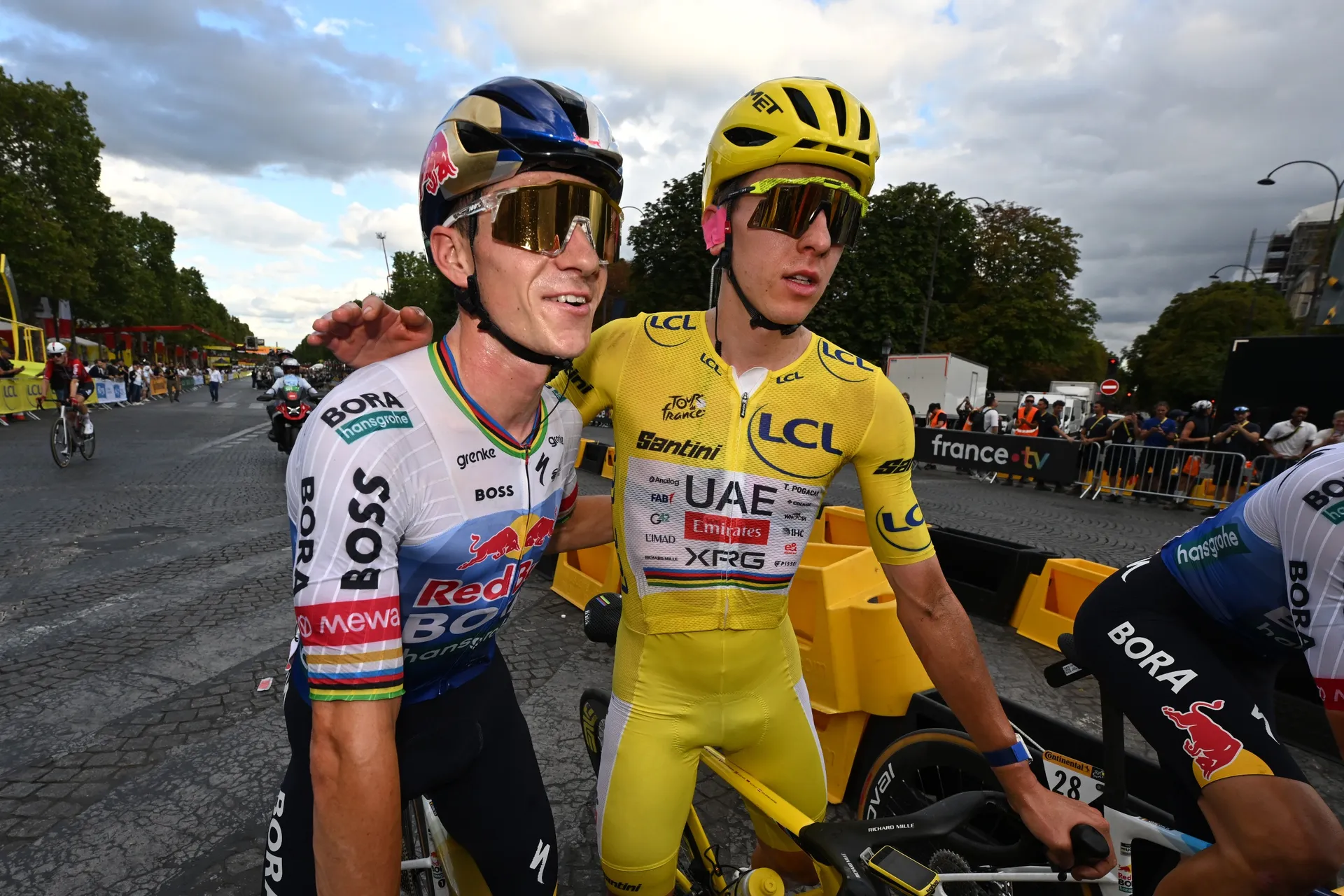
Not since Bradley Wiggins won the 2012 Tour de France have there been as many individual time trial kilometres on the route of cycling's biggest race, with the 71km included on the 2027 route swinging the balance towards the best ITT rider in the peloton and four-time World Champion Remco Evenepoel.
While no route can really be anti-Tadej Pogačar, this is about as good as it can get for the Belgian, with only three summit finishes and almost all of the hardest climbs being backloaded in the second two thirds of the route. Runner-up in 2026 to the Slovenian, Evenepoel will surely be back at the Tour in July, with his eye on at least a repeat GC performance.
Red Bull-Bora-Hansgrohe team boss Ralph Denk didn't go over the top with his assessment of the route and the advantages Evenepoel might seek to gain, but it is clear that a more TT-heavy Grand Tour will always suit his attributes.
"A dream Tour profile for Remco Evenepoel? Hmm, I see that a little differently. More nuanced," he said to Het Laatste Nieuws at the presentation in Paris, before conceding that, on paper at least, stages 7 and 16 being mostly flat races against the clock should play into their hands.
"In 2012, when Bradley Wiggins won, there were even more than 100. But anyway, it's not bad at all for us, let's say. Remco is currently the very best time trialist in the world, so that is an aspect of this Tour we are certainly going to take into account. That he can gain time on Pogačar, Vingegaard, Seixas and co. in those? In theory, yes."
"The multiple time trial kilometres will provide an extra dimension in any case and make the battle for the yellow jersey more open and exciting," said team Chief of Sports Zak Dempster in agreement.
But how much could the return to more than 70km of individual time trialling – for the first time in 14 years – really benefit Evenepoel in the fight against Pogačar?
Get The Leadout Newsletter
The latest race content, interviews, features, reviews and expert buying guides, direct to your inbox!
What do the stats say?
Evenepoel's leaves Pogačar behind at the Worlds ITT in Kigali, having started two minutes after him (Image credit: Zac Williams/SWpix)
Evenepoel only made his Tour debut in 2024, so the three editions he has taken on against the now five-time champion and joint record holder Pogačar have only brought them up against each other in five Grand Tour time trials.
All of those being at the Tour, the score for the moment is 3-2 in the favour of the Belgian, with Pogačar winning the two most climbing-packed stages against the clock in Nice at the end of the 2024 race, and on the pure mountain ITT to Peyragudes in 2025.
Evenepoel has beaten Pogačar to three stage wins at the flatter tests in Gevrey-Chambertin in 2024, Caen in 2025, and Thonon-les-Bains this past season, but the margin has never been major – 12 seconds, 16 seconds, and 28 seconds.
Yes, he has had the advantage – as he should on the completely flat stage 7 to Chambord and stage 16 in Toulouse, even with the viciously steep Côte de Pech David (800m at 12.%) characterising the middle of the route – but it's far from the complete domination that Evenepoel has subjected everyone, including Pogačar, to outside of the Grand Tours.
The image of Evenepoel riding past the usually immortal Slovenian's green jersey during the time trial at the World Championships in Kigali 13 months ago is one which will serve as a symbol of the Belgian's absolute monopoly over the discipline in recent memory, claiming the past four rainbow jerseys.
On that day, the monumental gap between their TT abilities wasn't only apparent in the overtake, but in the time difference at the finish: 2:37.
In fact, across their careers, they have faced off 12 times in individual time trials, Evenepoel winning 10 of them. Only on the two mountain courses at the Tour has he lost to Pogačar to against the clock.
So why does the gap seem to narrow significantly when they are racing in a time trial in the Tour?
The balance swinging massively in Pogačar's favour when an uphill road is included is no surprise – with less aerodynamic advantage for the 'Aero Bullet' Evenepoel at play, due to drag becoming less of a factor at slower speeds, and power-to-weight ratio (W/kg) becoming the more important variable.
But even on the flatter and purer courses, where Evenepoel has long been putting the likes of two-time World Champion Filippo Ganna to shame – most recently by a relatively huge 57 seconds at Worlds in Montreal, Pogačar is much closer during the Tour.
The likely answer comes down to weight, with Evenepoel admitting just this year that he arrived at the Tour almost 4kg down on the weight he had been operating at during the Classics. It's no secret that Evenepoel was in incredible condition for this year's Tour, putting up some of his best climbing performances with victory atop Plateau de Solaison, second on Alpe d'Huez, and keeping up with Pogačar for much longer in the second and third weeks than he has in previous years.
Evenepoel won his first Tour mountain stage earlier this year atop Plateau de Solaison (Image credit: Getty Images)
For events like the Worlds TT, where he destroyed Pogačar in Kigali as mentioned, Evenepoel operates at a higher weight, gaining around 1-2kg and losing some of his power-to-weight ratio as he ups the raw power numbers for his favoured discipline.
There's also the factor that no one in the peloton can maintain their level over three weeks like six-time Grand Tour winner Pogačar, whose repeatability and powers of recovery make him the perfect rider to take on punchy finishes, mountain stages and time trials day after day at the Tour – and compete for the win on all of them.
The best benchmark we have for how much time Evenepoel could gain across 71 kilometres of time trials is the 28-second deficit he opened up to Pogačar at this year's Tour, over a course of just 26.1km.
Based on their average speeds from that day, 48.85kph for Evenepoel and 47.751kph for Pogačar, a perfect world would see the Belgian cover the 71km 1:05 faster than his rival – not exactly world-beating, but a time trial, with corners, ups and downs, and several accelerations, is far from a perfect world.
Evenepoel's advantage could become greater the longer they have to race, given he has the best aero TT position in the peloton, especially with the 71km being split into a flatter 38km effort, where the Belgian's edge should be magnified as the kilometres tick by. But the steep hill on stage 16 also plays massively into the hands of Pogačar, even at just 800 metres in length, equalising the equation between the pair. ]
The clear conclusion is that Evenepoel cannot rely just on his strongest weapon to truly take down the current benchmark – he will have to beat him, or, at the bare minimum, match him in the high mountains to stay in striking distance for the stages he will almost definitely win.
One other factor that the Belgian newspaper put to Red Bull management is how the arrival of the first mountain stage on stage 9 could help Evenepoel, who really built into his climbing powers this past July after struggling in the opening week.
"That can indeed be an advantage," said Denk. "On the other hand: if you go all out for the general classification, and that is what we always want to do with this team, you also have to be alert in those first ten days and control the situation."
Of his eventual 6:26 deficit to Pogačar in Paris, Evenepoel lost almost three minutes of that on stage 6, the first real big mountain day to Gavarnie-Gèdre. Losing just over three minutes over the remaining 15 stages was a massive step up, and could also play into the hands of the ever-developing Belgian star in his second year with Red Bull, but he'll have to cling onto Pogačar's wheel on stages like the brutal 18th to Col du Portet in a way that only really Jonas Vingegaard has been able to do since 2020 if he wants any hope of yellow.
The road season might be at an end, but Cyclingnews isn't slowing down. Subscribe for unlimited access to our comprehensive news coverage, industry-leading CN Labs testing, expert columnists, and so much more. Plus, the Cyclingnews app means you can stay up-to-date wherever you go! Join today.
James Moultrie is a gold-standard NCTJ journalist who joined Cyclingnews as a News Writer in 2023 after originally contributing as a freelancer for eight months, during which time he also wrote for Eurosport, Rouleur and Cycling Weekly. Prior to joining the team he reported on races such as Paris-Roubaix and the Giro d’Italia Donne for Eurosport and has interviewed some of the sport’s top riders in Chloé Dygert, Lizzie Deignan and Wout van Aert. Outside of cycling, he spends the majority of his time watching other sports – rugby, football, cricket, and American Football to name a few.
You must confirm your public display name before commenting
Please logout and then login again, you will then be prompted to enter your display name.