
The best electric road bikes are pretty covert these days, that they blend in seamlessly among the analogues. The motor can offer a boost when you need some assistance, making it more accessible than ever for anyone who wants to keep up on a group ride and have some fun.
Many electric road bikes will handle just like a regular bike, and they'll come equipped with much of the same gear. You'll often find the best road bike wheels and best road bike tyres on them, most of which come rated for e-bike use already.
The best electric bikes can be perfect for a range of uses, like e-bike commuting and gravel riding. So if you're e-road curious, read on for our roundup of the best options you can buy right now. Our recommended options are very close to the best road bikes in terms of how they ride and look, plus they offer heaps of extra power when you want it.
If you still need a little more help, head to the bottom of the page to see our buying guide pointers.
Quick list: Best electric road bikes

The Domane+ SLR is a super-light road bike that in the US can power you up to 28mph, although it's speed-limited at 25kph elsewhere.

The Ribble Allroad E AL provides an affordable electric road bike option, but powered by a Mahle hub motor, it provides plenty of assistance in a stealthy package.

Based on the pedal-only Dogma, the Nytro has a stealth motor system and the same aero tube profiles as the non-assisted bike.

The Specialized Creo 2 electric bike is much more oriented to off-road use, with wider tyres, a more powerful motor and even a dropper post.

The Giant Revolt E+ Pro has the same Shimano EP8 motor as found on many e-MTBs, so it's got the grunt to haul you up the steepest climbs.

The Orbea Gain includes sleekly integrated lighting, as well as hidden cables, making for a clean, stylish look.
Last updated 18th May 2026
All bikes checked for availability, some newer replacement models substituted and images were updated. A How To Choose section was added to highlight some key considerations when choosing the best electric road bike.
Best electric road bikes
You can trust Cyclingnews Our experts spend countless hours testing cycling tech and will always share honest, unbiased advice to help you choose. Find out more about how we test.
Best electric road bike
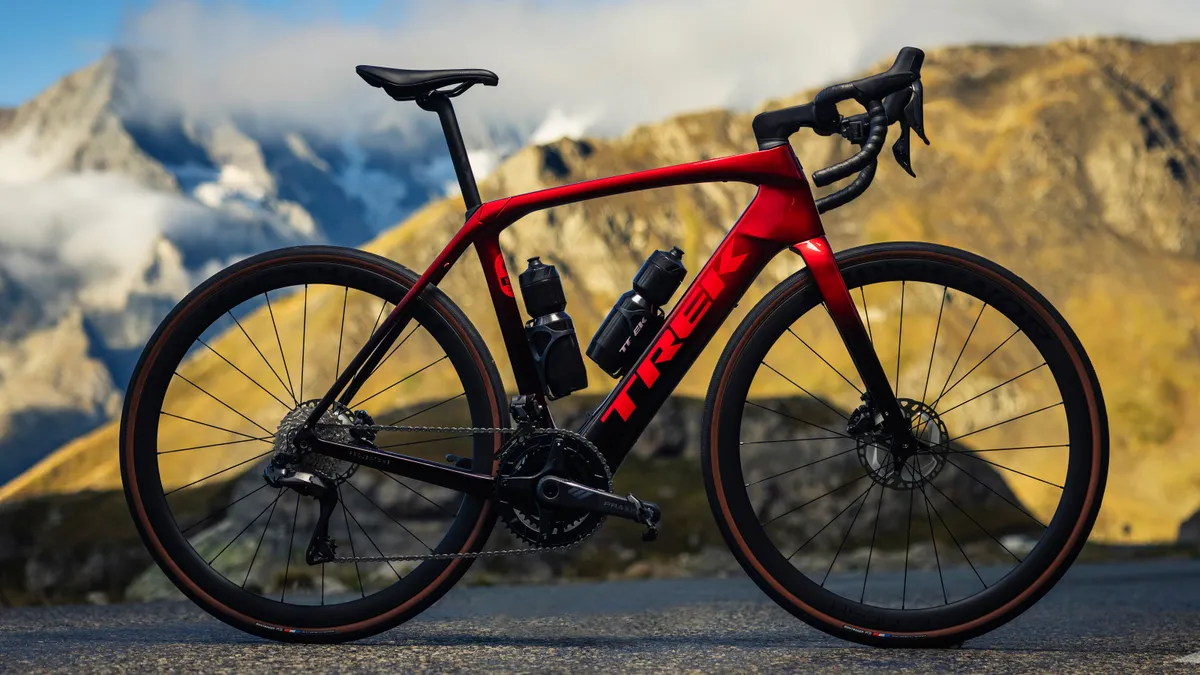
The Trek Domane+ SLR is the lightest e-road bike from the US-based brand, and one of the most refined takes on the category, full stop. Available in six different spec options but all based around a super-lightweight Trek OCLV 800 carbon frame, this is the lightest e-road bike Trek has ever produced, and it shows in how closely it mimics an unassisted road bike.
Aimed at performance roadies who want a little extra zip rather than outright power, the Domane+ SLR uses a discreet motor and battery from German specialist TQ. The result is a super smooth, quiet and natural-feeling assist that enhances your ride without dominating it. It’s the kind of system that helps you float up climbs, stay with a faster group, or simply extend your ride without feeling like you’re on a different kind of bike.
Integration is excellent throughout. You get a neatly embedded top tube display, bar-mounted controls, and a central battery that can also power lights and, on SRAM builds, shifting. Despite all this tech, it still looks, sounds and rides like a traditional road bike, which is something many e-road bikes still struggle to achieve.
With assist up to 28mph (market dependent), a range of around 60 miles (or up to 90 with a range extender), and a weight hovering around 11.8kg, it strikes an impressive balance between performance and practicality. It’s undeniably expensive, but if you want a high-end e-road bike that delivers “real road feel” with just enough help when you need it, the Domane+ SLR is one of the most convincing options out there.
Best on a budget

Claimed to weigh from 13.7kg, the Ribble Allroad E AL is one of the most affordable ways into e-road riding, and crucially, it doesn’t feel like a compromise. Visually, the frame is almost identical to its non-assisted sibling, giving it a clean, understated look that avoids the bulkier aesthetic of many budget e-bikes.
Powered by the Mahle system (now updated to the X30), the Allroad E AL delivers smooth, natural-feeling support via a rear hub motor, paired with a 250Wh internal battery. There’s no bar-mounted display, just a simple top tube button to cycle through assistance levels, which helps keep the cockpit uncluttered. For those who want more data, the companion app offers battery stats, ride info, and even heart rate-based assistance tuning.
Where this bike really stands out is its versatility. With clearance for up to 38mm tyres, endurance-focused geometry, and a tough but refined aluminium frame, it’s as comfortable on broken back roads and winter commutes as it is on long summer rides. It’s built, designed and tested in the UK, and that shows in its real-world usability.
Customisation is another strong point. You can tweak contact points and colours at purchase, and there’s a carbon-framed upgrade path in the Allroad SL R E if you want to go lighter and more powerful later.
If you’re looking for a genuinely capable, great-value e-road bike that lowers the barrier to entry without watering down the experience, the Allroad E AL is a very smart buy.
Best premium electric road bike

On the surface, the Nytro looks like any other Pinarello, complete with the signature wavy ONDA fork and sculpted aero tubing. But hidden within that sleek frame is a TQ drive unit and battery, delivering up to 250W of power and 50Nm of torque, which is plenty for steep climbs and punchy acceleration.
Built around a TorayCa T900 carbon frameset, the Nytro blends performance, responsiveness and comfort in a way you’d expect from a brand with a deep racing pedigree. Pinarello’s trademark asymmetric frame design is also present, helping balance pedalling forces for a more efficient and stable ride.
The ride feel is where this bike really earns its place. The TQ system provides smooth, well-modulated assistance that complements rather than overwhelms your effort, making it ideal for those who want to retain a high-performance road feel while extending their range and climbing ability.
Spec-wise, the E7 Ultegra model is unapologetically premium, with Shimano Ultegra Di2 shifting, hydraulic disc brakes, and deep-section carbon wheels from Pinarello’s MOST brand. It’s a fast, polished package that feels every bit a luxury product, and that’s reflected in the price tag.
For those who value brand heritage, design, and a top-tier ride experience as much as the assist itself, the Nytro delivers a compelling blend of innovation and classic road bike DNA.
Best for off road use

The Specialized Creo 2 Expert takes the idea of an e-road bike and stretches it well beyond tarmac. Launched as a complete rethink of the original Creo, it features a lighter frame, a more powerful and quieter motor, and a clear shift toward all-road and gravel capability.
At its heart is the new Turbo SL 1.2 system, delivering significantly more power (320W) and torque (50Nm) than before, while remaining impressively quiet. The assist feels really intuitive and responsive, giving you the confidence to tackle steep climbs or long off-road drags without breaking your rhythm.
What really sets the Creo 2 apart is how versatile it is. With clearance for up to 2.2-inch tyres, progressive geometry, and even a dropper post, it’s as happy on rough gravel tracks as it is spinning along smooth tarmac. The addition of Future Shock 3.0, offering 20mm of front-end travel, helps reduce fatigue and improve your control, especially over longer or rougher rides.
The MasterMind TCU and Specialized app integration add another layer of usability, letting you fine-tune assistance levels, track rides, and even update the bike over time. It’s a highly connected and adaptable platform.
If your riding spans road, gravel, and everything in between (and you want one bike to rule them all), the Creo 2 Expert makes a strong case for being the only one you need.
Best for motor power

There’s no getting around the fact that the Giant Revolt E+ 1 looks more like an e-bike than some of its sleeker rivals. But that comes with a clear upside: serious power and range for cyclists who care more about getting proper assistance than how subtle it looks.
At its core is the Shimano EP6-powered SyncDrive system, delivering up to 85Nm of torque, a heck of a lot more than most e-road bikes offer. That means effortless climbing, punchy acceleration, and the ability to carry speed even on challenging terrain or with added load.
The large, integrated EnergyPak Smart Compact 500 battery supports long-distance riding, while the SmartAssist mode automatically adjusts support based on your cadence and effort. That means you can just ride without constantly managing assist levels, which is a big plus for newer e-bike users, or those who want a more hands-off experience.
The aluminium ALUXX SL frame is robust and practical, with mounts for racks and mudguards, and paired with wide tyres and a D-Fuse seatpost for added comfort. It’s well-suited to mixed-terrain riding, commuting, or even light touring.
If your priority is maximum assistance, ease of use, and all-day usability rather than a stealthy road bike feel, the Revolt E+ 1 is one of the most capable and confidence-inspiring options available.
Best for integration

At the other end of the spectrum, the Orbea Gain M30 is one of the most seamless integrations of electric assist into a road bike, and one of the earliest examples of doing it well. Using the compact Mahle X20 rear hub system, it delivers more torque and a lower profile than earlier versions, resulting in a bike that barely gives away its electric credentials.
The Gain is about getting just enough assistance to take the edge off climbs and headwinds without overwhelming the ride. The motor response is tuned to feel natural and unobtrusive, particularly in the 75–95 rpm cadence range, where most cyclists are at their most efficient.
Integration is second to none. The internal battery powers both front and rear lights, neatly built into the bike, and the included Mahle computer allows for easy control and monitoring without relying solely on the top tube interface. The whole system feels cohesive and well thought-out.
On the road, the Gain behaves much like a traditional endurance bike, with balanced geometry and a smooth ride quality. The Shimano 105 12-speed groupset offers dependable performance, even if it feels slightly modest at this price point.
For those who want an e-road bike that enhances rather than redefines the riding experience, and one that looks and feels as close to “just a bike” as possible, the Gain M30 remains a benchmark.
Best value

Canyon’s Endurace:ONfly CF 8 hits a sweet spot between performance, integration and value for money, offering a high-end spec at a comparatively competitive price point.
Built around a carbon frame with clean integration, it uses the TQ HPR40 motor system paired with a 290Wh battery. While the 40Nm torque figure is lower than some competitors, it’s well-suited to reasonably fit road cyclists who want subtle, natural-feeling assistance rather than outright power. The benefit is a lighter overall package, weighing around 10.9kg, and a ride feel that stays close to a traditional road bike.
The spec is where this model really shines. Shimano Ultegra Di2 electronic shifting and DT Swiss carbon wheels elevate the ride quality, while thoughtful features like integrated lighting, top tube mounts, mudguard compatibility and even a built-in GPS tracker add real-world practicality.
It’s also impressively quiet, with none of the mechanical noise sometimes associated with e-bike systems, reinforcing that “just a road bike, but better” feel.
Range is solid but not class-leading, so longer rides may require a bit of planning or a range extender. But for many, the balance of weight, performance and spec will be more than worth it.
How to choose the best electric road bike
Your riding demands will dictate which e-road bike is best for you. Hopefully, this guide should have given you an idea of what's out there. Next, you should consider how you may want to use your e-bike: are you commuting to work, adventuring and discovering new terrain or simply adding a new bike to your fleet? Your requirements will dictate weight, gearing, range, price point, etc. Test ride a bike if you can and chat with manufacturers or stores about which e-bike is best for you.
Here are the main points we think you need to consider:
- What type of riding do I want to do? If you want to ride both on road and off-road, consider a bike with greater tyre clearance.
- What range do I need? Check the claimed range and consider purchasing a bike to which you can fit a range extender if you think you need more.
- How much assistance do I need? If you want a natural ride feel, a lower torque motor may be the best option, whereas if you want maximum assist, consider a motor with 60Nm torque or more.
- What do I want to pay? The more you pay, in general, the lighter the bike will be and the more premium the components.
Electric road bikes: Frequently asked questions
What do I need to know about the drive system?
With the electric bike market continually growing, more and more brands are getting on board and developing newer and better technology all the time. The best electric road bike will likely come with a powerful and reliable drive system, including one of the best e-bike motors from the likes of Bosch, Yamaha, and Shimano.
These systems place the motor either at the bottom bracket or the rear hub and vary in weight. In fact, some of the integrated systems are surprisingly light. The power they offer is an important factor, and most hover between 250W and 500W.
What's the best capacity for an electric bike battery?
How long is a piece of string? It all depends on how much you're riding and how much you care about your electric road bike's aesthetic.
When e-bikes started to gain popularity, the batteries were bulbous and almost appeared to be haphazardly bolted on wherever there was space. Now we are seeing brands working to integrate them into the frame seamlessly.
Unfortunately, the smaller the battery, the smaller the capacity, which is measured in watt-hours (Wh). While some brands are quick to make claims about how far certain Wh batteries will take their bikes, these figures can vary greatly depending on the level of boost, the terrain, the weather and even the weight of the rider. Bosch has put together a handy Range Assistant, which can provide a good idea of how much mileage you can expect to achieve, depending on your riding habits.
While some bikes have removable batteries, which allow you to keep a spare and make charging easier, others with hidden battery packs look much cleaner. Often, there's a range extender available as an option, which takes up one of your bottle cages but can add up to 50% extra range.
Will an electric road bike be considered cheating?
E-bikes are now nearly universally accepted, and the 'cheating' argument has fallen by the wayside as people have acknowledged how useful and varied e-bike uses can be. Whether that be aiding sustainable travel or helping groups of riders with varying fitness ride together, no one is likely to be looked down on for choosing some extra assistance.
Are electric road bikes unisex?
As a general rule of thumb, most e-road bikes are made to be unisex, while having multiple size options that should work for most people. The saddle, which is the key contact area that needs some tailoring to fit the users, is easily swapped out for one of the best women's road bike saddles if need be.
If you would prefer a women's specific model, be sure to check out our list of the best women's electric bikes.
What are the e-bike laws in different countries?
Most e-bikes use one of a few major e-bike systems, however, depending on where you live, the level of assistance, as well as whether you need a licence and insurance, will vary. Here's a breakdown of all the e-bike restrictions in place in the UK, US and Australia.
1. The UK
The UK retains the EU's regulations regarding e-bikes. Most of the bikes featured here fall under 'The Electrically Assisted Pedal Cycle (EPAC) Amendment Regulations' mandates; electric assistance can only provide 250 watts of continuous power (although peak output can be higher) and must cut out at 25kph. It also stipulates the rider must be pedalling for the motor to kick in and be at least 14 years old.
Electric bikes (and riders) that meet these standards have the same legal standing as regular bicycles and are allowed on roads and bike paths.
In Europe, a new class of speed-pedelecs or s-pedelecs is gaining popularity. These are capable of providing assistance up to 45kph. You still need to pedal for the motor to kick in, however, under UK and EU law, these are considered two-wheel mopeds and require insurance, a legally certified helmet and a qualifying driver's licence.
2. The US
In the US, rules for e-bikes vary from state to state; 30 states classify e-bikes as ordinary bicycles, while the remaining 20 label e-bikes as mopeds, scooters or something else altogether.
Federal law defines an electric bicycle as a two- or three-wheeled vehicle with fully operable pedals and an electric motor of fewer than 750 watts, whose maximum speed on a paved level surface, when powered solely by such a motor while ridden by an operator who weighs 170 pounds, is less than 20mph.'
It's worth noting that this statute defines the maximum assisted speed of the bike when being only powered by the motor, not when it's being pedalled. To make things more confusing, state regulations can override the federal statute.
The Bicycle Product Suppliers Association has proposed a three-class system which divides electric bikes based on their maximum assisted speed:
Class 1: the motor provides assistance only when the rider is pedalling and cuts out a 20mph
Class 2: the motor can contribute regardless of pedalling, but is governed to 20mph
Class 3: the motor provides assistance when the rider is pedalling but cuts out at 28mph and must be equipped with a speedometer.
For all three classes, the motor can only put out a maximum of 750 watts, and the class needs to be clearly labelled. This system also defines where the bikes can be ridden; classes 1 and 2 are permitted anywhere bikes are allowed, while class 3 can be ridden on roads and bike lanes but not multi-use paths, and may be subject to minimum user age and helmet requirements.
So far, 22 states have legislation creating a class system and our friends over at People for Bikes have put together a full state-by-state rundown.
3. Australia
In Australia, e-bikes are split into throttle-operated and pedal-assist. Both systems must be limited to 25kph, and the throttle-operated motors can only output 200 watts while pedal assist is legal up to 250 watts. Anything that exceeds these figures is considered a motorbike and must be licensed and insured.
How we test
Although we haven't ridden many of the electric road bikes above, we've reviewed plenty of electric bikes and know what to look for and recommend.
When we review a bike, we'll ride it for an extensive period over a range of distances and in different conditions. That includes long rides and local loops that we know well, allowing us to compare bikes. We'll compare and score bikes across a range of criteria to reach our conclusions and publish our scores so you know what we think.
If you want to know more, head to our How We Test page.
