Italian isolated in front group, loses over seven minutes to new maglia rosa Afonso Eulálio
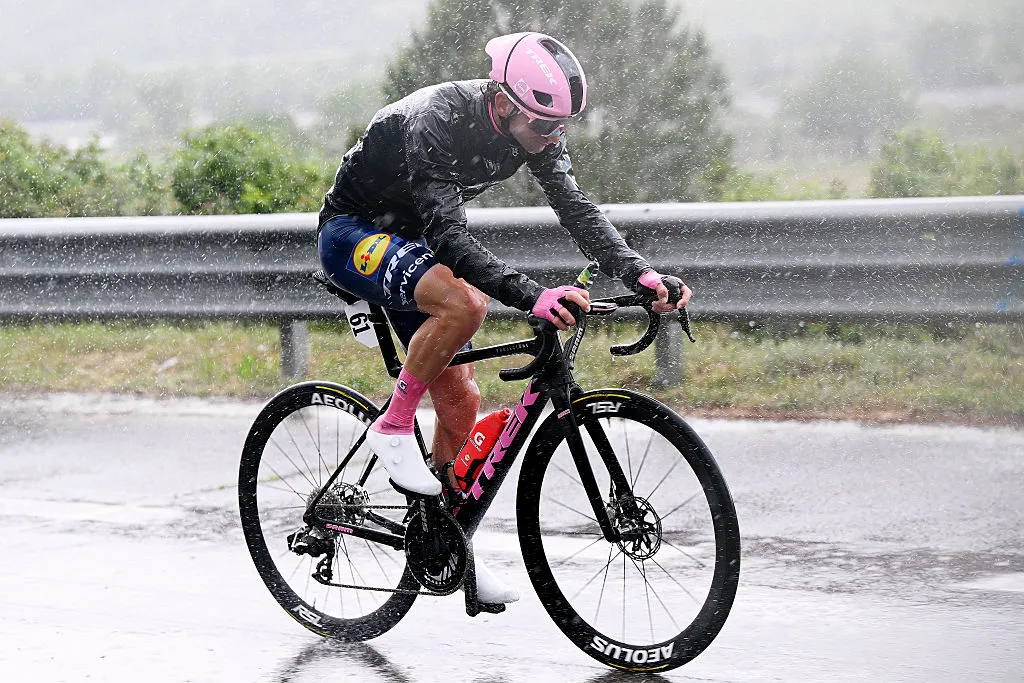
Italian Giulio Ciccone (Lidl-Trek) wore the maglia rosa on stage 5 under a rain jacket, only the pink seen on his helmet, gloves, socks and bike due to cold and heavy rain(Image credit: Getty Images)
Giulio Ciccone did manage to reach the Lidl-Trek team bus by bike after he completed stage 5 of the Giro d'Italia, then pedalled another three kilometres to the large car park outside Potenza where the teams' paddock was situated. But the way the Italian staggered towards the bus door after dismounting, his face grey with fatigue, made it clear he was down to the barest minimum of energy levels. It really had been that kind of a day.
The leader of the Giro d'Italia for a fleeting 24 hours, Ciccone and Lidl-Trek had been forced onto the defensive when Afonso Eulálio (Bahrain Victorious), just over a minute down before stage 5, had made it into the large defining break of the day. Then when Eulálio bridged across to lone-attacker Igor Arrieta (UAE Team Emirates-XRG) on the toughest, most decisive, climb of the day, the Cat.2 Monte Grande di Viggiano, the alarm bells truly began ringing for the race leader.
A 50-kilometre-long pursuit, most of it unsupported, by Ciccone over the summit of Viggiano and on through the long, rugged descent to Potenza, did not work out. Freezing rain and waterlogged roads made it tough for everybody, of course, but for a rider working alone on the front of the reduced pink jersey bunch, the demands were even more difficult.
It didn't work out. Ciccone completed the stage in 28th spot, 7:13 down, and slumped to sixth overall, 6:12 on the new Portuguese race leader. It had been a truly gutsy defence in abysmal conditions, but on this occasion, the odds of pulling the break back in were just too long.
In some ways, this was not a surprising situation. Ciccone had previously warned that his team, with a big focus on sprinter Jonathan Milan, was not structured for a full-blown GC defense. For that reason, perhaps, the strength of the mid-stage breakaway, let alone the two riders who finally went the full distance, proved a real challenge.
On top of that, one key team worker, Matteo Sobrero, having gone flat out to help teammate Derek Gee-West regain contact after the Canadian had a mechanical on Tuesday, was perhaps still too fatigued to help Ciccone put out another big fire 24 hours later.
"We brought four guys for the [sprint] train and we knew they would have problems to survive the first climb," Lidl-Trek Sports Director Grégory Rast told a small group of reporters.
Get The Leadout Newsletter
The latest race content, interviews, features, reviews and expert buying guides, direct to your inbox!
"We knew there would be fireworks, because everybody saw our team, everybody smelled their chance and that's exactly what happened.
"At some points the [breakaway] group was good, at some points it was not so good, and I think at one point we tried the maximum with Amanuel [Ghebreigzabhier, team worker] to keep it close and we were also hoping that another team was also moving on the hard climb.
"It didn't really happen. Bora jumped in [on the climb] and they wanted to try something but it was not good enough to catch the others.
"This is what we have. Matteo was not on the best day, because we would use him to pull after the climb, there were still 50 k's to go after it But then he was dropped on the climb."
As Rast explained, even though Gee-West was in the group, Lidl-Trek have major ambitions overall with the Canadian, fourth overall last year, and they could not risk sacrificing that long-term goal for a short-term mission of keeping the pink with Ciccone.
"In the end, everybody was in the same situation, there weren't many guys left to pull after the climb, we only had two. And some other teams had more, but they didn't have any interest to bring it back. This is how it is and we had this in our minds this morning that this could happen, to defend it but not at any cost."
Ciccone also found himself facing a difficult dilemma, Rast agreed, when he was so cold he had to change into warmer, dry clothing mid-stage. That change allowed the gap on the breakaways to double to two minutes, and by then, Lidl's options of catching the breakaway duo of Eulálio and Arrieta shrank considerably.
"You could continue and get frozen and dropped on the climb, or you change your clothing, you get warm, survive the climb and then you're too far away to catch the group," Rast reflected.
"Honestly, it was a really difficult stage for us to control, we knew this and the weather was unbelievable. That didn't play in our favour."
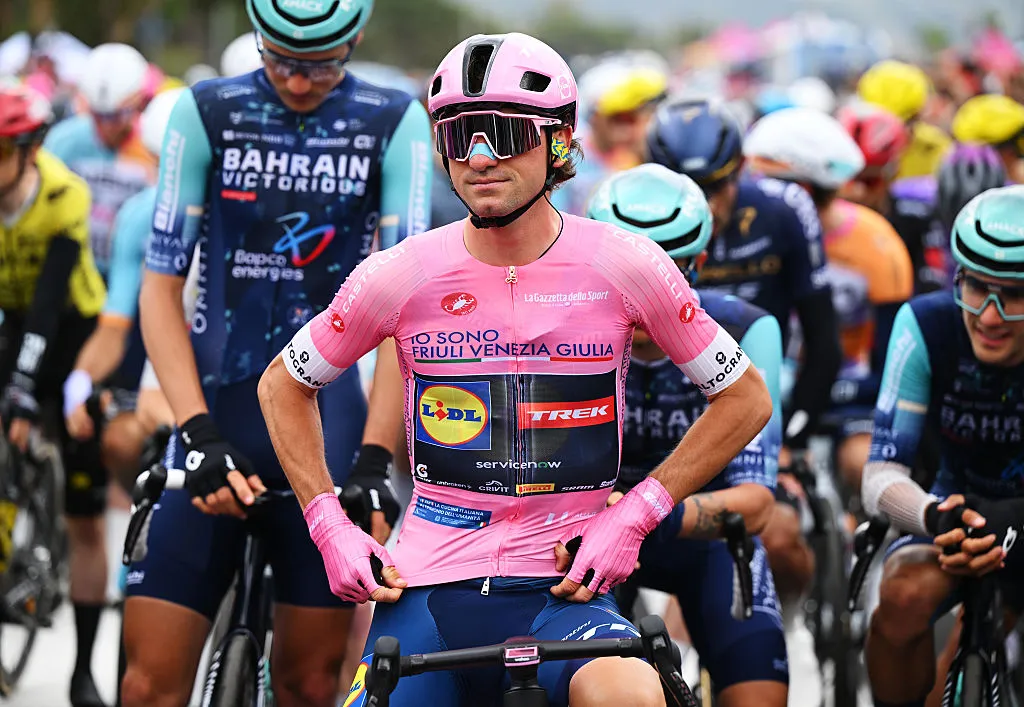
Giulio Ciccone in the pink jersey at the start in Praia a Mare (Image credit: Getty Images)
Ciccone himself refused to go down without a full-blown struggle, as his lone chase on the front of the group even when defeat was staring him in the face suggested. That, it was put to Rast, was his way of honouring the jersey.
"For him, yes, but also he was never really warm and the best you can do is ride. At one point, when others attacked Derek could have tried to counter them and then maybe anothe team would chase.
"But Derek was also grabbing a rain jacket at this moment, this guy was also gone and then everybody sat on the wheels. And that's fair enough."
Put all of these factors together, and it seemed almost inevitable that Ciccone's hopes of taking the jersey into his native Abruzzo region in two days time when the race tackles the Blockhaus on stage 7 were bound to fade in the rain, the cold and the incessant attacks en route to Potenza.
But his stubborn fight to defend the lead all the way to the finish will not be quickly forgotten either.
Who will challenge Jonas Vingegaard at this year's Giro d'Italia? Subscribe to Cyclingnews for unlimited access to our coverage of the Corsa Rosa. Enjoy unrivalled reporting from our team of journalists on the ground, including breaking news, analysis, and more, from every stage as it happens, plus access to the Cyclingnews app to follow the action on the go!Find out more.
Alasdair Fotheringham has been reporting on cycling since 1991. He has covered every Tour de France since 1992 bar one, as well as numerous other bike races of all shapes and sizes, ranging from the Olympic Games in 2008 to the now sadly defunct Subida a Urkiola hill climb in Spain. As well as working for Cyclingnews, he has also written for The Independent, The Guardian, ProCycling, The Express and Reuters.
You must confirm your public display name before commenting
Please logout and then login again, you will then be prompted to enter your display name.