The latest race content, interviews, features, reviews and expert buying guides, direct to your inbox!
You are now subscribed
Your newsletter sign-up was successful
An account already exists for this email address, please log in.
Unbound Gravel 200 has the history but 'The Traka pushed me into entirely new kinds of discomfort' – Lauren De Crescenzo compares the two titans of gravel
Emporia race focuses on one distance with 'a washing machine of talent' as The Traka splits the field
Lauren De Crescenzo will compete in her seventh Unbound Gravel in 2026, looking to finish for a fifth time and become part of the 1,000 Mile Club(Image credit: Life Time)
Unbound Gravel shaped my career. It’s the race I measure everything against. It's the race that broke me, changed me, and somehow convinces me to keep coming back for more.
In 2019 I started my first Unbound Gravel 200, but crashed in the first 30 miles, a broken collarbone ending my day. After a COVID shutdown, I returned in 2021 and won solo. This year in Emporia, I’ll attempt to join the 1,000 Mile Club, representing five completed editions of Unbound Gravel and 1,000 accumulated miles across the Flint Hills of Kansas.
So when I heard people referring to The Traka, the 360km gravel race through Girona, Spain, as the “European Unbound,” my interest piqued. Had I ever raced The Traka? No. Been to Spain? Also no.
My findings? I learned the two races may share a distance, a level of prestige, and a place on gravel’s biggest stage but beyond that they could not feel more different.
The lead into Spanish gravel
My Traka race block started the way most privateer race blocks do: light chaos. Sea Otter Classic Gravel then The Growler at Levi's GranFondo, where I raced 147 miles with 15,000 feet of climbing, before boarding a flight the following night to Spain with half the North American gravel scene.
Cecily Decker, Pete Stetina, Samara Sheppard, and a bunch of other racers and privateers were all packed onto the same flight to Barcelona looking equally wrecked.
The week quickly settled into a rhythm that felt almost cinematic for someone who grew up racing gravel in Kansas and Oklahoma. Cappuccinos in medieval plazas, routes rolling through farm roads and mountain switchbacks as well as tiny grocery stores stuffed with muesli and espresso pods. And then suddenly, Friday at 3:00 a.m. local time, I was awakened from my European dream for a 5:50 a.m. start, in the dark.
Get The Leadout Newsletter
The latest race content, interviews, features, reviews and expert buying guides, direct to your inbox!
The Traka starts where Unbound eases in
Every edition of Unbound 200 that I’ve raced has started with a strange calmness. Sure, everyone is nervous and sure, positioning matters but there’s usually an understanding that nobody wants to burn any matches before sunrise amid a sense of fear of what the next 200 miles will bring.
The Traka felt like the exact opposite. The route is front-heavy with climbing immediately. The techy descents start immediately – in the pitch black.
At the start of the 360, Klassmark, the race organisation, accidentally let hundreds of amateurs start before the pro women. This wasn’t the plan, as the elite women were supposed to start five minutes before the amateur men and five minutes after the pro men.
When the organisers tried to turn the age-groupers around, some decided to keep riding while others listened and turned around. That’s how the pro women and the amateur fields immediately intermixed. Then, even though explicitly against the race rules, plenty of amateur men were drafting the pro women. Surprisingly, this wasn’t one of the main storylines of the day and it seemed to slip off the radar even though it affected our race.
If the situation were reversed and hundreds of amateurs were sent out before the pro men’s field it would be a different conversation.
Honestly, the situation highlighted something gravel is still figuring out. If you want an elite women’s race, you need enough separation for the race to actually exist.
Unbound has gone through similar growing pains. In 2023, the infamous “mud year,” the setup was: elite men first, elite women two minutes later, and the amateur field another eight minutes more. Between the 'peanut butter' mud and the small time gaps, all the gaps vanished and we merged together.
That’s why in 2024, Life Time started the elite men 15 minutes ahead of the elite women and amateurs then started 25 minutes behind the elite women, giving us enough space to actually race each other.
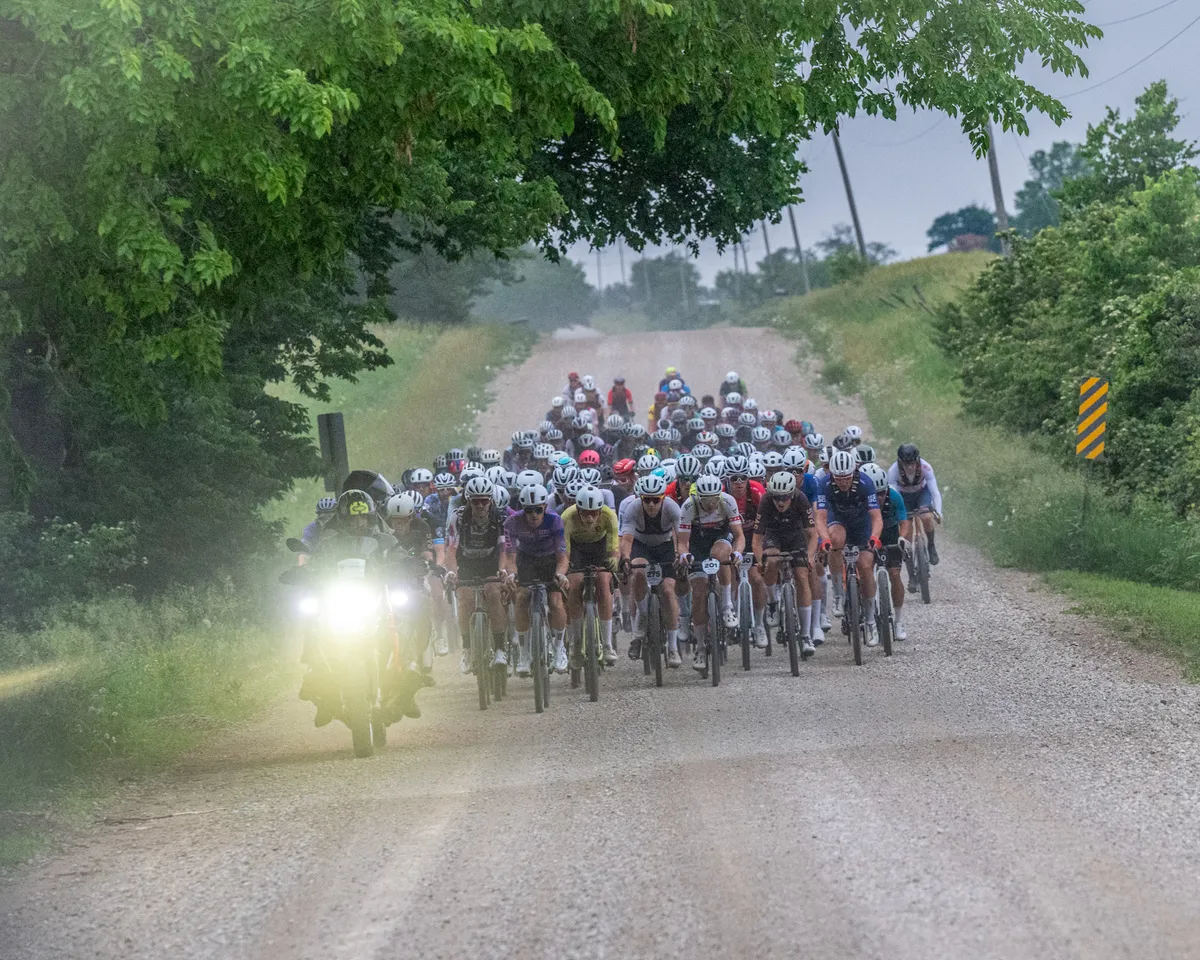
A calm field for pro start of Unbound Gravel 200 in 2024 (Image credit: Life Time)
200 vs 360 at The Traka
One of the biggest differences between The Traka and Unbound is that The Traka splits the elite field between two marquee races: the 200 km and the 360 km. At Unbound, the 200-miler is the race. Everybody shows up for that one massive throwdown in Emporia.
Technically, Unbound 100 is really the equivalent of The Traka 200 (miles vs. km), but Unbound 100 is low-key and mostly sits on the Life Time radar for U23 and junior riders who aspire to racing Unbound 200 later. The gravity of the event, the attention, and all of the biggest names in gravel focus on the star event - Unbound 200.
At Traka, the talent gets split. Some riders choose the shorter, faster 200, others choose the longer more unhinged 360, and it completely changes the dynamic of the event.
The Traka 200 is explosive and tactical. The 360 feels like an ultra-endurance race layered onto highly technical European gravel. It creates this interesting question all week long: who picked which race, and why?
At Unbound, everybody gets thrown into the same washing machine together. At The Traka, it feels like two separate championships happening on two separate days.
The roads completely change the racing
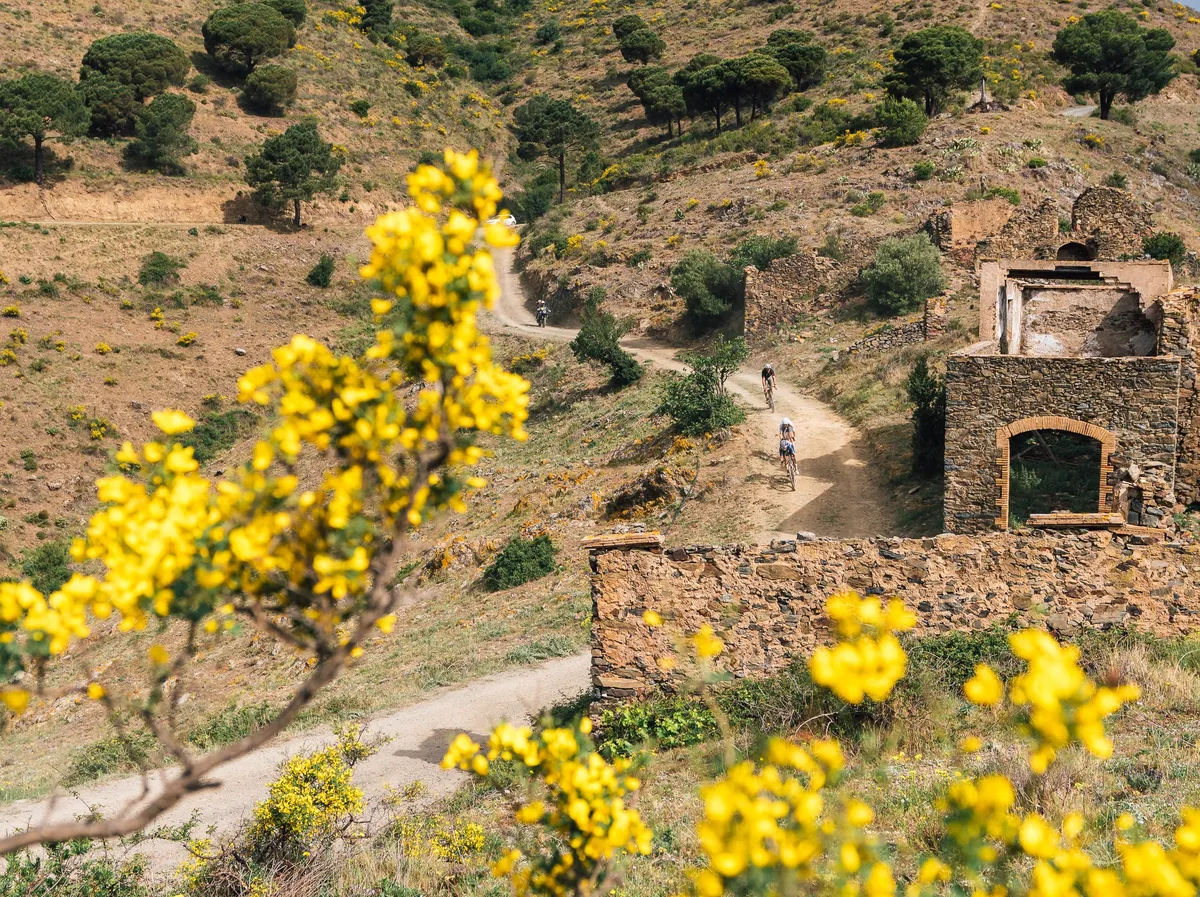
Twisting roads are normal for The Traka (Image credit: @ Gravel Earth Series l @ The Traka 360)
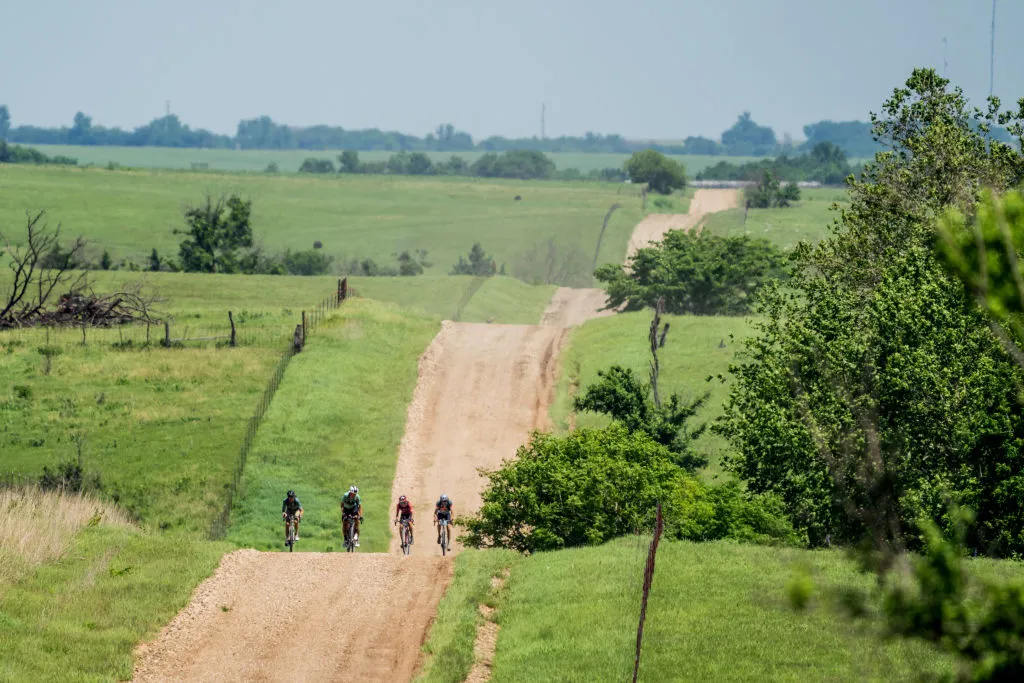
Mid-western US gravel roads are wide open. You can usually see riders from far away and there’s space to pass riders from different fields while out of the draft.
At The Traka, the roads are narrow and constantly changing. Twisty farm roads, tiny bridges, urban sectors, river crossings and steep ramps over 20% are common. Random sharp turns appear out of nowhere.
This year’s The Traka 360 winner and former Unbound champion, Rosa Klöser, said, “The key difference is that Traka is far more technical and terrain-driven, with constant climbing and descending, whereas Unbound is all about endurance, resilience, avoiding mechanicals and managing the unknown over an incredibly long day.”
There were moments where passing groups of amateur riders without accidentally entering their draft felt almost impossible. And once I finally fought my way to the front because I was trying to follow the rules, entire groups of amateur men would often stay attached to my wheel.
That’s one of the biggest cultural differences I’ve observed between European gravel and American gravel right now.
In the U.S., especially at the bigger races, there’s become more of an understanding that the elite women deserve their own race with no interference. A lot of that has been reinforced by the Life Time Grand Prix over the last few years. At The Traka, it felt less defined.
Wrong turns part of the race
Long, rolling, wide roads of Kansas (Image credit: Getty Images)
Both races have unmarked courses. At Unbound, navigation mistakes can happen, but the options are generally simple: left, right, or straight.
At Traka, the course constantly twists through tiny intersections, wooded sectors, alleyways, and random connectors that appear out of nowhere.
At Unbound, there are long stretches where I can mentally disappear into the effort and focus entirely on power, fueling, and survival.
At The Traka your brain never really shuts off. You’re constantly reacting, constantly checking the route, constantly scanning for riders, corners, turns and random alleyways.
By hour 12, I was hallucinating. Not metaphorically, literally, and somehow I kind of liked it.
So, which race is harder?
Despite all the chaos, there were parts of The Traka that genuinely impressed me. The repeated climbing creates more natural selection and rewards pure fitness in a way that feels different from American gravel.
The course marshalling was top-notch. Drivers were respectful. In Girona, cycling is deeply woven into the culture, yet it still feels aspirational in many parts of the United States. Cars stopped immediately. Nobody seemed annoyed that thousands of cyclists had completely taken over the roads for the day and that stood out to me.
Unbound Gravel 200 still feels 'heavier' to me because of its history, the Flint Hills, the weather, the unpredictability, the peanut butter mud and the psychological weight the race carries in American gravel culture. But The Traka pushed me into entirely new kinds of discomfort: descending gravel in the dark, fighting through endless groups, constantly navigating, constantly reacting, never knowing what’s around the next corner.
Same distance, completely different experiences. Maybe that’s why both races work so well.
And honestly maybe that’s the spirit of gravel – the unknown.
Subscribe to Cyclingnews for unlimited access to our gravel cycling coverage in 2026. We'll be on the ground at the biggest races of the season, bringing you breaking news, expert analysis, in-depth features, and much more. Find out more.
Lauren De Crescenzo is an accomplished gravel racer, having gained fame as the 2021 Unbound Gravel 200 champion and racking up wins at won The MidSouth (three times), The Rad Dirt Fest and podiums at Crusher in the Tushar and Big Sugar Gravel. In 2016, she suffered a nearly fatal, severe traumatic brain injury (TBI) in a professional road race. While the bike almost took her live, she says the bike saved her life as a rehabilitation tool in the following years and she found a new love– gravel and off-road racing. She now wants to be a role model of tenacity, grit, and hard work to promote the vital message of TBI awareness, positively impacting the lives of those affected by TBIs.
You must confirm your public display name before commenting
Please logout and then login again, you will then be prompted to enter your display name.