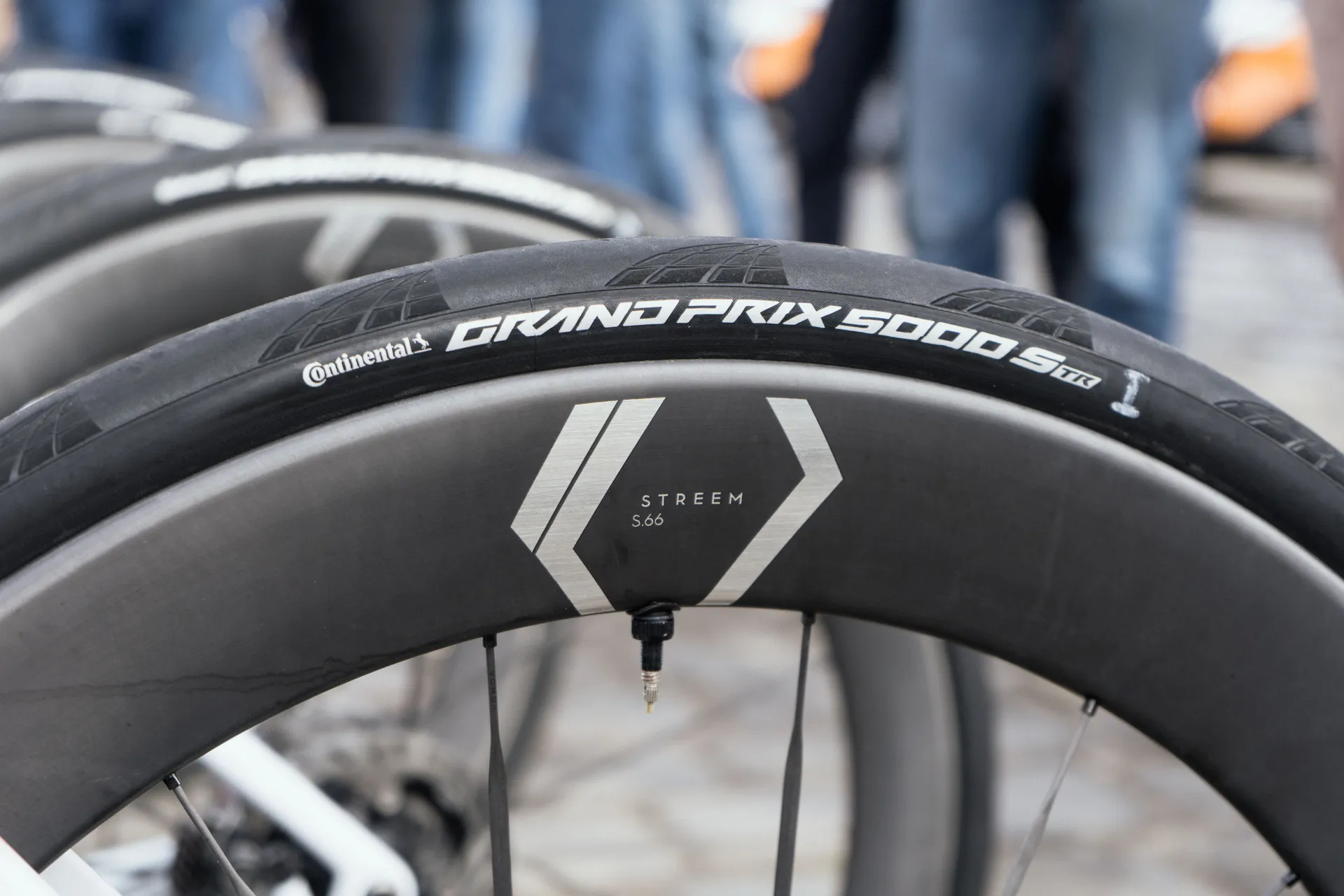
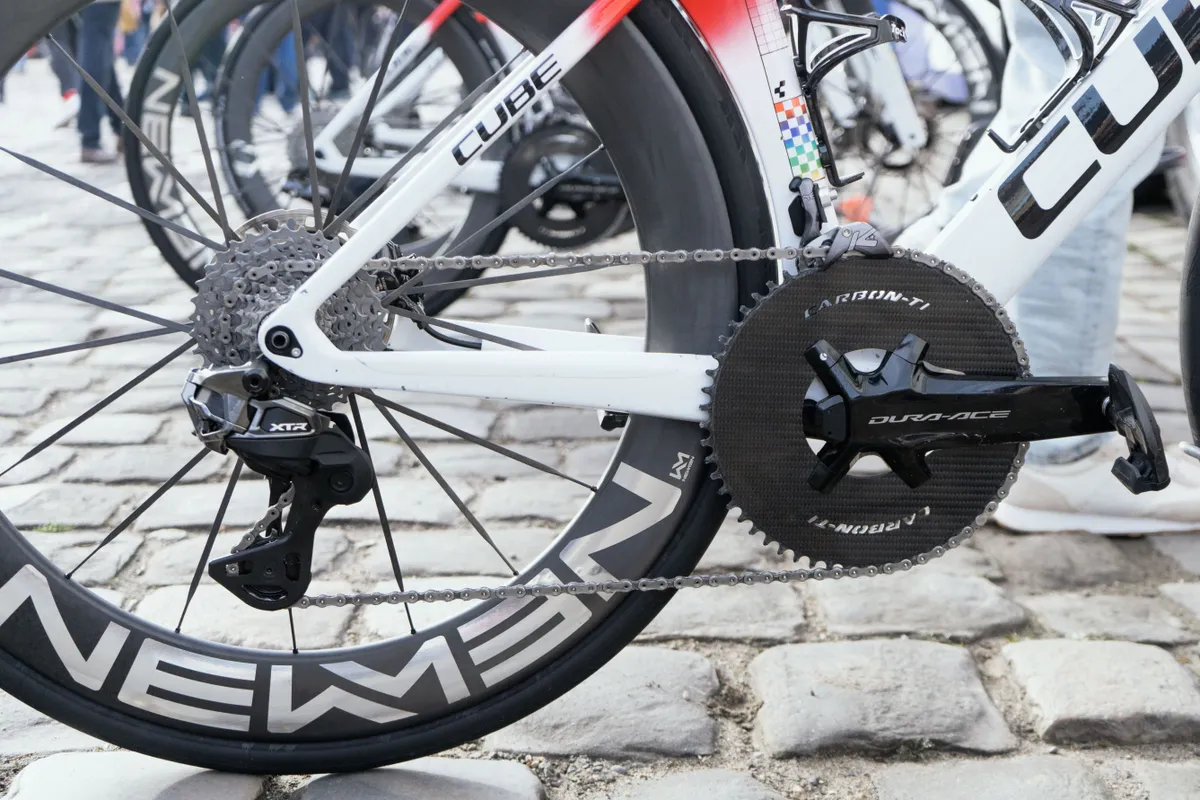
At the start of Paris-Roubaix this year, my colleague Will Jones spotted a Newmen 'Streem S.66' wheel on Team TotalEnergies' Cube bikes and included it in our Paris-Roubaix men's tech gallery.
The wheel in question was part of a wheelset which uses a 66mm deep rear wheel, and a 60mm front.
On paper, a wheel of that depth would, as of January 1st this year, fall foul of the controversial UCI rim depth rule that limits wheels to a maximum of 65mm. The team confirmed that the wheels were, as the label suggests, 66mm deep, but assured that they were still UCI-legal.
We followed it up post-Roubaix to see how the team could legally use a wheel that's over the stipulated limit, and found that the UCI rule allows a 1mm tolerance to account for the "thickness of surface coatings (paint and sponsors’ logos)."
Despite this, a Newmen spokesperson has spoken out against the rule, calling it "Totally stupid."
The brand explained to Cyclingnews that the UCI approval was more about accounting for manufacturing tolerances, which it believed had not been considered, than finding some kind of 1mm depth gain for an aero advantage in a racing situation, which would probably be negligible.
Get The Leadout Newsletter
The latest race content, interviews, features, reviews and expert buying guides, direct to your inbox!
In the Clarification guide of the UCI technical regulation, on maximum rim depth, Article 1.3.018 states:
'The maximum height of the rim does not measure more than 65 mm (measured as the perpendicular distance from the tangential line passing through any point of the outer extremity of the rim to the inner extremity of the rim)'
Slightly further down the page, the 1mm tolerance mention can be found.
'A tolerance of one millimetre is allowed for the elements to account for the thickness of surface coatings (paint and sponsors’ logos). No tolerance is allowed when inspecting technical designs.'
On top of this, the UCI also stipulates an overall wheel diameter rule, which says:
"Wheels of the bicycle may vary in diameter between 700 mm maximum and 550 mm minimum, including the tyre."
A 700c road wheel has a diameter of 622mm, leaving 78mm of wiggle room regarding tyre sizing choice. This creates a de facto limit on tyre size, too, which works out at approximately 38mm wide, albeit depending on the rim's internal width and the tyre's construction.
"Totally stupid"
Speaking exclusively to Cyclingnews, a spokesperson for Newmen explained that he believed the UCI had not taken into account manufacturing tolerances when it announced the rim depth rules.
Tolerances are present in all manufacturing, and he explained that when manufacturing around 400,000 wheelsets per year, as Newmen does, with many being OEM pre-orders, the wear of the carbon mould needs to be accounted for. Not every '65mm deep' rim coming out of a mould will be exactly 65mm deep.
He explained that Newmen had actually altered its manufacturing tooling to account for the new rule, but made the point that not all brands may have the funds to do the same.
"We had our rim tooling reworked so that our rims, after painting, are not more than 66mm. With this height, we follow the UCI rules, and we got the official confirmation."
However, he then continued to offer the company's stance on the broader implementation of the rule.
While the UCI rim depth rule is in place to slow riders down and increase safety, teams still have a range of choices when it comes to tyre sizes, which also affect aerodynamics and thus speed as part of an overall wheel system.
"Independent of this, this 65mm rule is totally stupid," he continued. "The wheel is a system of rim and tyre. The wheel should be viewed as a whole. Some teams use 28mm tyres, some 32mm tyres. The rim, together with the tyre, is important, not only the rim. Anyone who deals with aerodynamics knows this, and the whole [wheel] would also be much easier to check."
Tom joined the Cyclingnews team in late 2022 as a tech writer. Despite having a degree in English Literature he has spent his entire working life in the cycling industry in one form or another. He has over 10 years of experience as a qualified mechanic, with the last five years before joining Cyclingnews being spent running an independent workshop. This means he is just as happy tinkering away in the garage as he is out on the road bike, and he isn’t afraid to pull a bike apart or get hands-on with it when testing to really see what it’s made of.
He has ridden and raced bikes from an early age up to a national level on the road and track, and has ridden and competed in most disciplines. He has a keen eye for pro-team tech and enjoys spotting new or interesting components in the wild. During his time at Cyclingnews, Tom has already interviewed some of the sport's biggest names including Mathieu van der Poel, Tadej Pogačar and Alberto Contador. He's also covered various launches from brands such as Pinarello, Ridley, Specialized and more, tackled the Roubaix Challenge sportive aboard his own rim-brake Cannondale SuperSix Evo, tested over 20 aero helmets in the wind tunnel, and has created helpful in-depth buying advice relating to countless categories from torque wrenches to winter clothing.
You must confirm your public display name before commenting
Please logout and then login again, you will then be prompted to enter your display name.