Tubeless road tyres have been taken up with gusto in the pro peloton in the last few years, with a key benefit being lower rolling resistance, not to mention much easier set-up than the pros' former love, the tub.
Talking of set-up, the tolerance improvements in both tyres and rims make mounting and running tubeless tyres much easier than a few years ago. There's little chance of a tyre blowing off the wheel when it's inflated either.
These advantages mean the best tubeless road tyres are rapidly gaining traction as the best option for all road riders and many now rank among the best road bike tyres you can buy.
We've put that rolling resistance claim to the test ourselves too, taking a Michelin man-load of tyres to the Silverstone Sports Engineering Hub to test them on the rolling resistance rig. The full tyre testing results are available to Cyclingnews subscribers.
In addition to the lab testing, here at Cyclingnews, we've used tubeless road tyres for years, testing to see which are the most durable, the easiest to fit, the longest lasting, and more.
We've covered a range of uses among our tyre recommendations below, but if you're looking for more advice, head further down the page for our buyer's guide on how to choose the best tubeless road tyres for you.
Last updated on 23rd January 2026
Specialized S-Works Turbo TLR tyre added as 'best lightweight' option. Buy if/don't buy boxes added to each section, and sections have been numbered. The "How to Choose" section has also been changed into bullet points, making it easier for people to read.
Best tubeless road tyres available today
You can trust Cyclingnews Our experts spend countless hours testing cycling tech and will always share honest, unbiased advice to help you choose. Find out more about how we test.
Best tubeless road tyre

✅ You run hookless rims: These tubeless tyres are hookless rim compatible.
✅ You prioritise grip: Not only are these tyres fast-rolling, but they're super grippy too.
❌ You have weak thumbs: We won't lie, these are a bugger to get on and off.
Continental’s GP5000S TR is a superb road tyre that's now well-established as our benchmark ultra-high-performance choice. It was the fastest all-rounder (as opposed to time trial) tyre in our rolling resistance tests, and has a joyously lively feel that handles all situations from fresh tarmac to ancient acne backroads with effort-shrinking ease. It's grippy in all conditions, richly communicative and works with hookless rims at low pressures.
You are paying a high price for all these superlatives though and if you can get your local shop to fit them, you'll be saving yourself a fight.
Continental has expanded its tubeless-ready GP5000 tyre range too, with the GP5000 AS TR offering four-season reliability, with thicker tread and sidewalls and a reformulated rubber compound to increase wet/cold weather grip. There's also the GP5000 TT TR, which is designed for time trial use and weighs a claimed 220g, but still incorporates a Vectran breaker for puncture protection.
Read how the S TR tyres earned a top score in our Continental Grand Prix 5000 S TR road tyre review.
Best tubeless road tyre for comfort

✅ You're a fast rider: These are firm favourites in the pro peloton for a reason.
✅ You want a comfortable ride: Thanks to the 320tpi thread count, these tyres offer a supple ride.
❌ You get a lot of punctures: Sadly, these don't seal that well so best to stay away from Paris-Roubaix on these tyres.
Vittoria Corsa Pro tyres are as popular a choice among pro teams as the Contis above, but unlike the Contis they have a cotton casing, which offers a 320tpi thread count. Not surprisingly, this leads to a very supple ride.
There was a little more rolling resistance than the Contis in our tests - if you want less, try the Corsa Speed tyres. During outdoor testing though the added rolling resistance was countered by improved grip and an incredibly smooth ride feel. The suppleness can make them feel a little vague through aggressive bends but otherwise, the Corsa Pro tyres are unmatched in overall ride feel.
In our experience, they also don't handle punctures as well as the Contis. On paper, they will resist punctures well but if they do puncture we found the sealant didn't always manage to create a permanent, airtight seal. The Corsa Pros are also expensive.
You can read our conclusion after a year of riding a range of widths in our Vittoria Corsa Pro tyre review.
Best tubeless tyre for setup

✅ You want an easy setup: These are among the easiest of tubeless tyres to setup.
✅ You want lightweight tyres: They're not the lightest but they do save grams compared to some other big brands.
❌ You want speed: These aren't the fastest rolling tyres.
The current version of the popular Schwalbe Pro One tubeless road tyre comes with Schwalbe's latest Addix compound and Souplesse casing that promise decreased rolling resistance and increased comfort over the previous version.
When translated onto the road, that makes for a tyre that rolls well, offers good levels of puncture protection and impressive levels of grip, resulting in a great all-around road tyre. It's not the fastest-feeling tyre on this list and our tests found a significantly higher rolling resistance than the Continental GP5000 S TR, but it is a decent weight and was durable beyond our expectations.
What's more, the tubeless setup was a breeze, which is less common than we'd like, even today. Read our detailed review of the Schwalbe Pro One TLE tyres to see how they earned their spot in this guide.
Best tubeless road tyre for puncture protection

✅ You want an all-weather tyre: These are designed to be ridden no matter the season.
✅ You want decent puncture protection: Pirelli has packed this tyre full of anti-puncture protection.
❌ You want low rolling resistance: Durability comes at a price, and in this case, it's speed.
The Pirelli Cinturato was the first tyre to use a wrap-around, radial structure. Originally designed for Pirelli’s motorsports use, it’s the design that almost all modern tyres are based on.
So Pirelli knows a thing or two about making tyres, and it shows with the Cinturato Velo TLR. Designed specifically as a puncture-proof road tyre, it has a compound designed for high mileage, an aramid breaker strip beneath the tread and a bead-to-bead puncture protection layer.
It's available in sizes ranging from 26mm to 35mm widths, and despite being designed with a greater focus on grip, durability and puncture protection in mind, it still manages to be reasonably competitive on weight.
In our Pirelli Cinturato Velo TLR review, Andy Turner found they offered more than enough puncture protection for riding rough roads with confidence and were even durable enough for light off-road excursions as well. Andy suffered from zero punctures during testing despite the frequency of hedge cutting in his local lanes and a bit of gravel riding too.
They roll pretty well too and offer a decent amount of comfort, two performance metrics which have been a trade off with more puncture proof road tyres in the past. Its not going ot be able to match the riding performance from the likes of Continental's GP5000 AS TR, but for a workhorse road tyre thats significantly more affordable it certainly does the job for winter training miles and fast commuting.
Overall, they are well priced, given their premium performance, especially with their increased lifespan as a result of their durability.
Best budget tubeless road bike tyres

✅ You want a good value tubeless tyre: You can pick these up for almost half the price of some leading tyres.
✅ You want a supple ride feel: Our reviewer reckons these are grippy and offer a supple ride feel.
❌ You want hookless compatible tyres: These tyres will not work with hookless rims.
❌ You want wide tyres: These only go up to 28mm width.
The decent performance at a price that's around half that of the Conti GP5000 S TR tyres sets these tyres apart.
What's more, once set up, the ratio of performance to price has been excellent. They're not the fastest rolling tyres out there, but their grip, supple ride feel and durability have been impressive, and we're yet to notice a single puncture when run tubeless, even one that has self-sealed.
The only drawbacks in a tyre world that's rapidly supersizing are the 23, 25 and 28mm widths only. Plus, they're not hookless compatible and we found more rolling resistance in our tests than much of the competition.
For more details on how the Michelin Power Cup tyres performed during testing, read our full review.
Best tubeless road tyre for all seasons
✅ You want all-season protection: These are built for all-weather riding.
✅ You want to be seen: They also include a reflective sidewall strip.
❌ You want a cheap winter tyre: Sure, they're good. But they're quite expensive for a 1-2 season tyre.
❌ You want hookless compatibility across sizes: These will only work with hookless rims in the 25mm width.
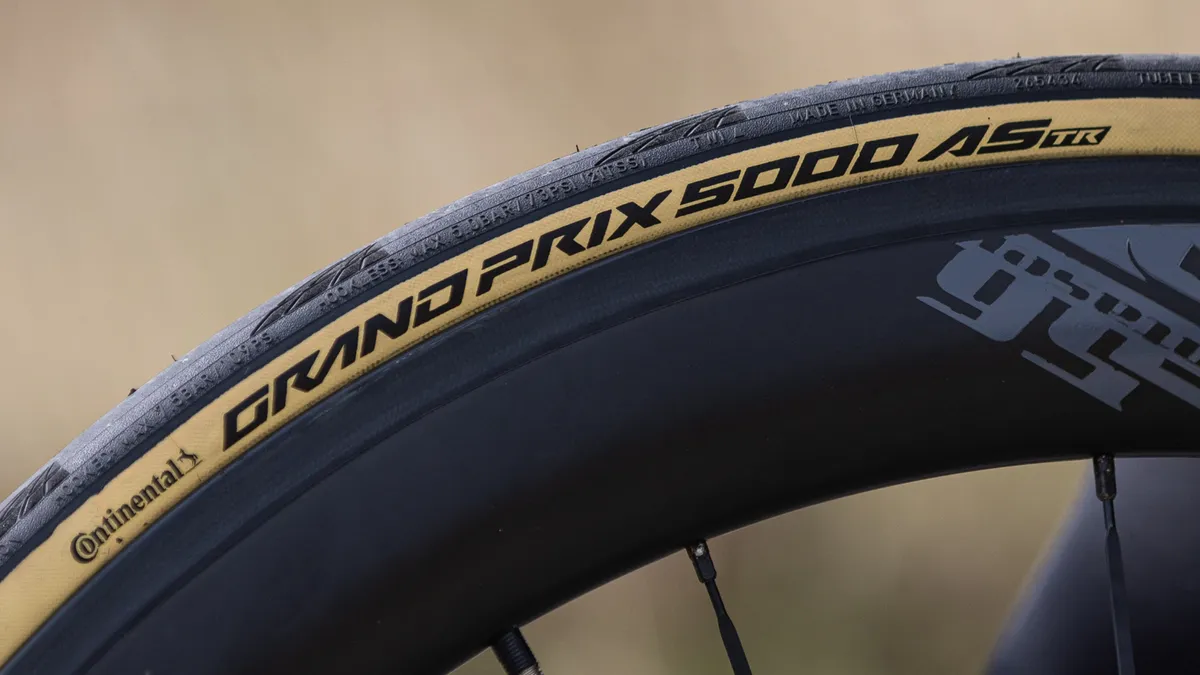
Continental has ported over much of the tech of the GP5000 S TR into the AS TR, but added an extra layer of casing fabric and used a grippier rubber compound. Go for the black sidewalls and they include a dark reflective strip to increase your visibility on dark winter nights.
There's a thicker tread too and, although we found a rolling resistance penalty to its summer brother, this was no more than some fair-weather tyres. If you aren't hung up about going as fast as possible or often ride on bad roads or in poor conditions then it's probably worth considering the GP5000 AS TR as an all-year tyre for peace of mind.
The GP5000 AS TR comes in a good range of larger sizes with options up to 35mm, although if you are running hookless rims your only approved option is the smallest 25mm width.
You can read more in our Continental GP5000 AS TR tyre review.
Best tubeless road tyre for rolling speeds

✅ You want a fast race tyre: These came out on top in our lab testing, with the least rolling resistance.
✅ You want a confidence-inspiring tyre: There is grip galore with the Corsa Pro Speed.
❌ You want a durable tyre: They're designed for racing and speed, not for winter miles.
❌ You want wide tyres: They only offer up to 28mm widths.
When we headed over to the Silverstone rolling resistance rig, these came out with the lowest rolling resistance of the 24 tyres we tested. It's proven to be fast on the WordTour stage as well, with a wide, smooth central section and the absence of puncture protection leading to a tyre that's pro time trial light and fast - as long as you don't flat.
The thin sidewalls mean these tyres should definitely be reserved for wringing every bit of speed possible at your 10-mile TT, rather than racing around your local lanes on the Sunday club ride. If you need to go as fast as possible though these are the tyres to pop on for those special occasions.
As with the Michelin Power Cup, there's a limited range of widths that stops at 28mm, but as a dedicated tyre for fast, short rides this probably doesn't matter too much.
Best lightweight tubeless road tyres

✅ You want a lightweight tubeless tyre: They're one of the lightest options out there.
✅ You want a good value performance tyre: We'd expect these to be priced much higher given the performance.
❌ You want a choice of sizes: The Turbo TLR tyre comes in limited widths.
The Specialized S-Works Turbo TLR tyre is the brands latest all-round tubeless road race tyre, and our pick of the lightweight options. Admittedly, it's not as light as the Vittoria Corsa Pro Speed, but, they are more durable.
This new Turbo TLR tyre comes with claims of improved rolling resistance and grip, and our reviewer thinks those performance appear to live up to those claims. They also reckon the dry weather grip is on par with the best, and while it's difficult to rest rolling resistance scientifically without lab testing, out on the road these appear to roll fast in basic comparative testing.
Read more in our Specialized S-Works Turbo TLR Review
How to choose tubeless road tyres
- Choosing the best tubeless tyre for your riding is very similar to picking a standard clincher road tyre. Keep reading for a few things to consider when choosing a tubeless tyre that best fits your needs.
- What type of riding do I do? Are you racing, or training? Training tyres generally offer more durability, puncture protection and grip in the wet. But, this comes at the cost of rolling resistance. Whereas the opposite is true for racing tyres.
- What conditions will I ride in? If you're riding in the Alps in the middle of summer, you'll need a different tyre to if you're riding in Bristol in the winter. Look for tyres with more puncture protection and harder compounds for winter riding, and softer compounds and a more supple casing for faster, summer riding.
- How much clearance does my bike have? Check the specs of your bike, or measure the distance between the fork, chainstays and seatstays, to find out what the maximum clearance tyre you can fit. Also worth remembering, if you're running mudguards you will need to account for that too.
- What size tyres can I fit to my wheels? Inner rim width will affect tyre width compatibility although most tubeless road bike wheels should have a suitably wide profile to give the tyre its intended shape. If in doubt, most wheel manufacturers will have information regarding compatible rim and tyre widths for their products.
- What compound do I need? The compounds used for the tyre tread affect the rolling speed and grip levels of a tyre with each brand offering its own formulas with their own characteristics. Softer compounds will give better grip and are featured on performance tyres while harder compounds are used on budget, endurance or all-season tyres as they wear slower and resist punctures better.
- How much puncture protection do I need? Puncture protection is added to the tyre's casing, which forms the structure of the tyre and impacts the ride quality. They are usually made up of multiple layers of carcass fabric and layers of puncture protection, although this added protection can come at the detriment of rolling speed, comfort and weight.
- What is TPI? Carcass fabric is measured in TPI (Threads Per Inch) or EPI (Ends Per Inch), higher thread counts (80 and above) give a tyre a more supple feel and lower counts (between 50 and 80) will be more resistant to sidewall cuts.
- What widths do tubeless tyres come in? Most tubeless tyres will come in a minimum 25mm width and depending on the brand can be up to 40mm wide. We find that 28mm to be around the sweet spot for most riding but will spec wider tyres if we want more comfort or control.
What you need to know about tubeless road tyres
When deciding which tubeless tyres to get for your road bike, first consider whether or not you actually need (and want) tubeless tyres. There are numerous benefits to going tubeless, but even the best tubeless road tyres come with a few negatives that you need to be aware of.
Are my wheels tubeless compatible?
Before buying any of the best tubeless road tyres, you'll need to check that your wheels are actually tubeless compatible. Some wheels will say this on the rim sidewall, while others will hide the info on the rim bed beneath the inner tube. If you can't find it on the wheel itself, check with the manufacturer.
If the wheels aren't tubeless compatible, they will be less likely to offer the tight fit needed to remain airtight, and even though you can sometimes get them to seal, you run the risk of them failing later down the line, potentially whilst descending at speed. It's not recommended to try to set up tubeless unless both your wheels and rims are tubeless-ready.
The good news is that most of the best road bike wheels are now tubeless-ready, so if you're looking to upgrade your wheelset this is unlikely to be a problem.
What are hookless rims?
The latest new wheel tech is hookless rims, which have actually been ported over from mountain bike wheels, where they've been a feature of top spec wheels for years. They're designed to be used with tubeless tyres.
A normal wheel rim has a lip to help retain the tyre, but a hookless rim has straight sides without the lip. This makes the wheel lighter (and also cheaper to manufacture), but it also dictates a more precise fit between the tyre and the rim. There are horror stories of tyres blowing off hookless rims and destroying expensive carbon wheels.
But tyre and wheel makers have worked together to ensure the precise tolerances needed in both their products and many tubeless tyres are now hookless rim compatible.
Nevertheless, it's wise to ensure that your wheel-tyre combination is compatible - check the websites for both - before mounting a tyre on a hookless rim. In general, tubeless tyres need to be 28mm or wider for hookless compatibility, although there are exceptions. They also need to be run at 73psi/5 bar or lower pressure.
What size tubeless tyres should I get?
This depends on a number of factors, including the internal width of your rims, the clearance offered by your bike, your riding habits, and ultimately your preferences. Of course, we're talking road tyres, so we're going to assume you're riding a bike with 700c wheels, but when it comes to width, there are plenty of factors to consider.
If you're riding all-day epics on a disc brake-equipped road bike, you'll probably have enough clearance to run wider tyres, and would likely benefit from anything between around 28c and 32c. However, if you're riding a rim brake road bike, your brake calipers will limit you to narrower widths.
If you're racing, you probably don't need the comfort of a 32c tyre and would find greater benefit in the lower weight and increased aerodynamics of going narrower. But of course, this all depends on the width and shape of your rim, as most modern rims are designed for optimal use with a specific tyre size - which the manufacturer will no doubt be happy to tell you, if it's not already published.
How much puncture protection do I need from my tubeless tyres?
Given all tubeless road tyres are designed to self-seal punctures, you might be forgiven for thinking that you no longer need to worry about the level of puncture protection, but the reality is that they can still be susceptible to damage.
Like tube-type tyres, the best tubeless road tyres come in various forms. Some are designed as a fit-and-forget solution to punctures, while others are almost paper-thin and designed to minimise rolling resistance. These thin tyres will still seal punctures, but as they are more fragile, they will be more prone to larger tears and they will typically wear out more quickly.
Exactly how much puncture protection you need will depend on your riding habits. If you're fitting tubeless tyres for your commute, then durability and high levels of protection will likely be more important than the few watts you might save.
In contrast, if you're fitting tubeless tyres to your time trial bike, then thinner, more supple tyres will help you go faster. Those are the extremes, but there are plenty of options that balance speed and protection well.
Will I still experience flat tyres with tubeless road tyres?
One of the main benefits of tubeless road tyres is increased puncture protection, but that doesn't necessarily mean fewer punctures.
However, when an object pierces the tyre, the pressurised air tries to escape through that hole. As it does, sealant is pushed through the hole. The best tubeless sealant will clog up rapidly, plugging the hole and fixing the puncture with only a small loss of pressure. Most of the time, with the kind of punctures you tend to pick up from small bits of glass, rocks or thorns, you might not even notice it happening and can just keep riding along, although you may find a spray of sealant on your frame next time you wash your bike.
Sealant alone won’t be able to fix larger cuts in the tyre (anything over about 5mm) but what makes tubeless tyres different is that you've not got extra layers of flat protection. Your first layer is the tyre itself but that's the same as a tube-type tyre. Without an inner tube, you avoid many of those roadside repair jobs.
The next layer of protection is the sealant, which is usually enough to solve the problem. If your tubeless sealant fails then your next step of puncture protection is a plug system such as those offered by Dynaplug.
Do I still need to carry a tube when using tubeless road tyres?
It can sometimes happen that you find yourself unable to fix a flat. The hole may be too big for the sealant and for one reason or another, the plug repair may not hold.
The nice thing about tubeless tyres is that you still aren't stuck. You should always carry a tube with you as a last line of defence. There's nothing that says you can't put a tube in a tubeless tyre and get yourself home, although it can be a messy business due to the sealant.
Even more convenient is the fact that with tubeless you may go for years never using your emergency tube. A TPU inner tube like those from Tubolito, Schwalbe and Vittoria might be more expensive but given the rarity of use, they start to make a lot of sense for their compact size and low weight.
How much pressure should I run in tubeless road tyres?
In the eyes of this writer, there is no bigger advantage to running tubeless road tyres than the ability to run lower pressures. With a tube in a tyre you run the risk of pinch flatting any time your wheel experiences low pressure or hits a rock.
Removing that obstacle means you can run the right pressure for your weight with your wheels and it's probably a lot less than you think it is. My favourite place to look up the right pressure is on the Enve Tyre Pressure Chart.
Running a lower pressure isn't just about comfort. Sure, you'll have a more comfortable ride when you don't overinflate your tyres but there's more to it. Running lower pressure also helps with flat resistance. If you want to visualize this, think about a balloon that's as full as possible vs a balloon that's a bit flat. Given the extra ability to stretch and conform, the flatter balloon is harder to pop.
Are tubeless tyres faster?
This question follows the lower-pressure question because it tends to be the next question in the discussion.
No road is perfectly smooth, it will always have small bumps and imperfections, and however small they may be, they deflect forward motion upwards as you and your bike roll over them. Each of those deflections causes a small loss in momentum, resisting the wheel's ability to roll. By lowering that resistance, a wheel (and therefore the bike and its rider) will be faster for a given power output.
There are a couple of ways that tubeless tyres enable this. First, the lower tyre pressures enable more suppleness overall, meaning the tyre can more easily conform to those imperfections, rather than deflecting over them.
Secondly, removing the inner tube from the equation means there's no sliding friction between the inside of the tyre and the tube inside, which makes it easier for the rubber to contort around the bump and lowers frictional loss.
If you want to dive even deeper into this then Silca will take you about as deep as anyone would want to go. They have an article that explains their tyre pressure calculator and gets very detailed. Their tyre pressure calculator is also another resource although I tend to use the Enve reference because it's less complex.
Are there downsides to the best tubeless road tyres?
The main downsides revolve around installation. There's no getting around the fact that putting a tubeless road tyre on a rim is almost always a more difficult process than mounting a tubed tyre. You may need an (expensive) reservoir pump to get the tyre to seat properly and sometimes even the best tubeless sealant doesn't ensure a leak-free seal to the rim.
Tubeless tyres aren't maintenance-free either. The sealant will dry up over time, so you need to check it regularly and keep it topped up to preserve your puncture protection.
Not only that but if you are changing a tyre it's likely to be a messy experience. The upside is that it's only getting easier as the manufacturers of wheels and tyres iron out standards that mean every tyre fits every wheel in the way you'd expect.
Which tubeless sealant should I use?
This depends, because the best tubeless sealant comes in various forms. Some are designed to seal very quickly at high pressures, but these will usually dry out more quickly in the tyre.
Others prioritise longevity, meaning they can last for six months and more before drying out inside the tyre, but they will usually be a little slower at sealing the puncture, resulting in a probable need to top the air up before continuing your ride.
How do I fit tubeless road tyres?
We've got a guide for that. Check out how to set up tubeless tyres for step-by-step instructions.
How we test
To find out what the best tubeless tyres are, we have tested all the top brands in the real world and in the lab to find out how they perform.
The first part of Cyclingnews testing involves measuring the weight of every tyre, fitting them to rims, setting them up with tubeless sealant and measuring actual widths when fitted to rims.
Once they are set up our reviewers put the tyres to the test in the real world, seeking out all types of road services and riding in all weather conditions to determine how the tyres feel and perform when riding. We also have a bank of tyre rolling resistance data from when we took 24 race-ready tyres to the Silverstone Sports Engineering Hub lab and ran a series of tests on each tyre using an efficiency rig. If you want to see the full results, check out our test where we found out which road bike tyres are the fastest.

I used to be the most terrible tubeless naysayer, staunchly sticking to inner tubes over sealant, but I have now seen the light. With the ever-widening size of modern road tyres the higher pressures that stopped sealant working so well are becoming a thing of the past, and you really do see great improvements in handling, comfort, and puncture resistance once you've made the change. Swapping to tubeless is the first thing I do with any review bike, and with enough practice it's no more difficult than changing a tube.

With 3 years of racing as a UCI Continental professional under his belt and working as an aerodynamics consultant at Venturi Dynamics it isn't a surprise that Andy favours performance over all else. When testing a tubeless tyre he is looking for fast rolling speeds and precise handling characteristics.