The best MTB trail tyres provide confidence-inspiring grip and durability without having so much traction and weight that pedalling uphill becomes a real chore. Trail tyres sit between bombproof gravity tyres, and XC tyres that prioritise speed.
When choosing the best MTB trail tyres, it's important to first establish a priority. If you want to save weight, there are lighter-weight options with thinner casings and lower-profile knobs, but if you want grip, a softer compound and more aggressively shaped lugs are usually preferable. With most things, there are trade-offs, as a lightweight trail tyre won’t offer a lot of protection when slamming through rock gardens.
The type of rider you are also matters. If you’ve got a slim build or are highly skilled, you can ride lighter-weight tyres with a thinner casing. If you’re a bigger rider, or you ride an e-MTB, we’d recommend a heavier tyre with a thicker sidewall. Increased weight, be it from rider or bike, will heighten the risk of pinch flats, or tyre burps if you're running tubeless (which we'd definitely recommend).
Whatever kind of mountain bike trail rider you are, our team of expert testers have put an extensive number of tyres through their paces and come up with our pick of the best MTB trail tyres you can buy.
For further help on choosing the right tyres for you, jump to the bottom of the article for our advice section.
Best MTB trail tyres
You can trust Cyclingnews Our experts spend countless hours testing cycling tech and will always share honest, unbiased advice to help you choose. Find out more about how we test.
Best MTB trail tyre overall

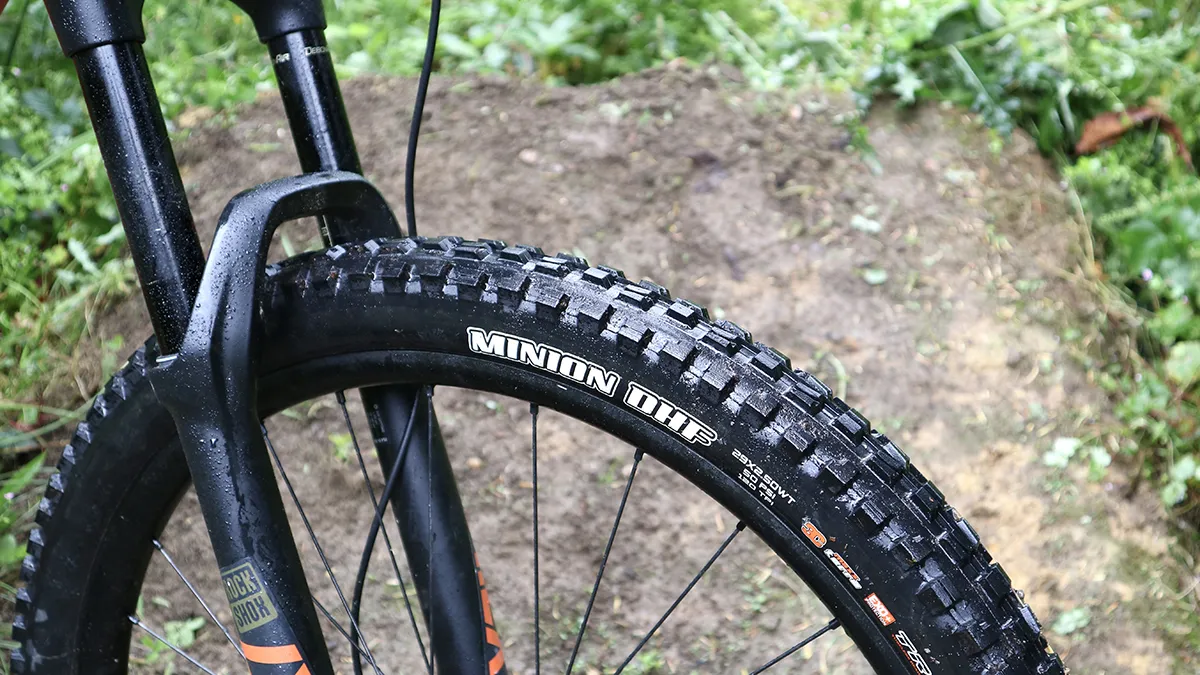
The Maxxis Minion DHF was a game-changer when it first appeared, and it has continued to dominate the trail and hardcore front tyre market ever since. With its massive side knobs, it has great directional control and cornering grip, but still rolls faster than you’d expect. It’s really a front-only tyre (designed to be paired with the DHF II), but some riders like to run one at both ends. There are several casing and rubber compound options, but the sweet spot for trail riding is the 3C MaxxTerra with the Exo+ casing.
Exo+ is light reinforcement with an extra layer of reinforced material that runs bead to bead. It has a mesh-type structure that, according to Maxxis, improves tread puncture protection by 27 percent, sidewall durability by 51 percent, and pinch-flat resistance by 28 percent.
The 3C compound uses a hard base layer, which creates a solid foundation and stability to the tyre, there’s a medium center section for quick rolling and enhanced wear and soft low-rebound rubber edge lugs for the ultimate cornering grip. This custom compound does ramp up the cost, but in our tests, we found the Minion DHF was predictable and tenacious and, with its open tread and impressive wet weather performance, we could easily keep it on our bike all year round.
Our reviewer Guy Kesteven enthused: "If I had to pick a single (cost-no-object) tyre for every situation, it would be this one… It tips in really smoothly and predictably. Once you’re into the lean, you can also load it up aggressively on pretty much every surface from slippery gravel to winter slop and wet woods."
For more info, see our full Maxxis Minion DHF review.
Best aggro MTB trail tyre

If you want something with a bit more bite and traction than the Minion DHF, the also excellent Assegai is a brilliant choice. The flip side of that extra front wheel confidence is that it's a little slower, though.
It was developed by downhill racer Greg Minnaar, so naturally, it’s available with a reinforced DoubleDown casing, but the lighter Exo+ version is a better option for trail riding. The 2.6in tyre gets an extra layer of lightweight reinforced nylon called Silkshield. It adds weight, but the nylon has a sort of lattice work construction that adds casing stability (you can run lower pressure without the tyre folding), thorn-type puncture protection and pinch-flat resistance, which is really handy if you’re riding in the desert or rocky terrain.
Like most of the Maxxis flagship tyres, the Assegai comes with either MaxxTerra (medium) or MaxxGrip (soft) triple rubber compounds. What you’re looking at here is a hard, stable rubber base, a quick-rolling centre section, and then a soft rubber on the edge for grip. MaxxGrip tyres don’t keep their sharp edge for long, but a good call is to run a MaxxGrip up front with the harder-wearing MaxxTerra on the rear.
For trail use, we found the Assegai is one of the best all-rounders. It can handle hardpack and loose conditions as well as wet rocks and roots. Its open tread spacing means it even works in deep mud. You can easily ride this tyre throughout the year.
Our reviewer Paul Burwell reported: "Grip levels are superb with the softer MaxxGrip tyre – it feels so surefooted and never does anything unexpected. It’s really consistent at all lean angles, even chopping and changing lines through tight singletrack. It’s a real confidence tyre that lets you push the envelope without having to pay the consequences."
Find out more in our Maxxis Assegai 3C MaxxGrip EXO+ review.
Best lightweight MTB trail tyre

Depending on your riding, the Kenda Hellkat Pro is available in three different casing structures – ATC, AEC, and AGC. The middle letter stands for trail, enduro, and gravity respectively and from a structural point of view, the gravity casing has an aramid strip under the tread with an Apex chafer to resist pinch flats. The light enduro tyre eliminates this chafer, and the trail tyre gets thinner plies, a more resilient 120tpi casing, and an all-in weight of 902g, making it one of the lightest trail tyres in this category.
The Hellkat Pro uses Kenda’s ‘dual tread’ construction, which means the centre tread uses a firmer rubber and the edge lugs are softer rubber. We measured the hardness at around 55a, which is only medium/soft, but the company claims the rubber also has low-rebound properties, so on the trails there’s plenty of grip. The HellKat Pro doesn’t do anything weird – we found it’s stable, confidence-inspiring and predictable.
The tread has a flat profile and relatively open motocross-style tread with some deep lugs, which creates excellent bite and mud-shedding but also has a good turn of speed on the flats. Overall, a great tyre for all conditions, even those nasty ones in the middle of winter.
Our reviewer Paul Burwell summed up: "It has good grip and braking traction, rolls surprisingly quickly and the moto-x style tread works in most conditions. A summer tyre you could easily run over the winter."
For more, head over to our full Kenda Hellkat Pro ATC review.
Best front MTB trail tyre for grip

When WTB first launched the Verdict, it offered a mud version with deeper side knobs, but the standard tyre worked so well in the gloop (and elsewhere) that the mud tyre was gradually phased out.
The High Grip (triple compound) WTB Verdict is an absolute monster. It hooks up where others falter, and in all conditions too. This light version gets the company’s SG2 puncture protection, a double-ply 60Tpi casing that does add weight but still ensures the tyre has a supple and responsive ride feel. The Verdict can be fitted to either wheel but excels as a front-only tyre offering incredible hold on hardpack, loam or slippery mud.
Like most WTB tyres, the Verdict is tubeless-ready, but we found it can be tricky to seat on certain rim brands. It's only offered in a single 2.5in width, so you may struggle with clearance on some frames and suspension forks, especially if you run a mudguard.
At 1,150g for the 29x2.5in sizes, it’s not a lightweight trail tyre, but the trade-off is an awesome amount of grip, excellent pinch-flat resistance, and an impressive wear rate. It’s criminal how underrated this tyre is. In fact, back to back this with the tougher WTB Judge on the rear and you’re going to be unstoppable.
Our tester Paul Burwell noted: "The Verdict TCS Light High Grip never feels nervous, no matter what surface you’re riding on and, with its impressive wet weather performance, it’s a tyre you can easily run year-round."
Check out our full WTB Verdict TCS Light High Grip review.
Best front MTB trail tyre for control

The Butcher T9 Grid Trail uses Specialized’s latest blend of Gripton rubber. It’s comparable in terms of durometer to the softest compounds from other tyre manufacturers, but Specialized claims it has a lower rebound, so has better damping ability. On the trail, it's noticeable that it doesn't get pinged around so much, so you don’t have to work as hard keeping the bike under control, especially riding across rock or dry roots.
To resist flats in those situations, the 60tpi triple-ply Grid Trail casing has an extra floating protective layer that runs the full width of the tyre tread. This doesn’t really add that much weight – the Butcher is one of the lightest trail tyres tested – but it does add some stability, allowing you to run slightly lower pressures without the tyre tucking or folding under load. The lug layout is similar to the Maxxis DHR II, but they’re slightly deeper profile, so offer a little bit more bite in loam and the wet. The Butcher T9 works really well riding at slower speeds where you have to pick your way down, but it also has a good turn of speed for those long dirt road sections.
In our tests, we found the damping effect was obvious straight away. There was none of the very pressure-sensitive jarrings on really rough or sudden impacts and it didn’t crumple or fold suddenly if we dropped pressures low.
Our tester Guy Kesteven also found that: "Ripping them round the concrete hard bucket berms and rutted flat corners of the recent tundra weather on our test trails didn’t reveal any vices, just vast amounts of snarling grip."
Best front MTB trail tyre for winter

If you're after a tyre that will give you grip in the worst of wet mud, then look no further than the Specialized Hillbilly. The tyre uses the same excellent Gripton T9 60TPI compound as the Specialized Butcher.
The centre/shoulder tread pattern is very different though, following the classic ‘square studs with plenty of space around them’ format of most good soft condition tyres. The Hillbilly runs alternating pairs of knobs close together for a slight paddle effect, and the knob tops are siped (slotted) to help them to reshape and spread under load.
Weight is average for a modern 2.4in ‘trail tyre’ at 1,074g, but at 59mm across, they’re actually closer to 2.3 than 2.4in wide. There’s also a Gravity Grid version, but that takes weight beyond 1,300g, which is a hefty pedalling punishment for bombproof survival.
We found the grip and control levels are well up for extreme riding. Our tester Guy Kesteven said, "While they don’t ‘lean outwards’ to grab carving/off-camber traction automatically, the side knobs are well-supported enough to deliver the traction as soon as you tip the bars into the turn. The tread cleans super quickly even in clay conditions and when they do start to slide, it’s a very predictable, normally saveable push, rather than a sudden snap-out and dump-you situation."
Prices for the Hillbilly and the rest of Specialized's tyre range are extremely competitive, which makes them an even better choice.
For more info, check out our full Specialized Hillbilly tyre review.
Best rear MTB trail tyre overall

The Maxxis Minion DHR II was initially launched as a rear-only tyre, but it turns out to be a balanced all-rounder with an impressive performance on most surfaces – weathered hardpack, deep loam, and even sticky mud. There are front tyres with more bite in this guide, but on the rear, we've found the DHR II is peerless. In our tests, it did everything with assured confidence and felt stable even on loose or slippery off-camber. Rolling speed is a notch below some (choose the Dissector if you need that extra MPH), but braking traction is up there with the very best, especially if you up the size to a 2.5 or 2.6in.
It also comes with three casing options (Exo, Exo+, DD) allowing you to tune the weight and protection levels of both wheels to the terrain. For example, if you’re at the bike park or sessioning downhill trails on a long-travel trail bike, fit an Exo+ or DD on the rear, Exo on the front – it’s what bike manufacturers do. It can be a little draggy in the bigger sizes and with the DD casing, but it’s a solid tyre that won’t let you down.
Our reviewer Paul Burwell, reported: "The wide, open, block tread is utterly reliable whatever the conditions. Literally from loose, kitty litter trail centre surfaces in summer to dirty Welsh woods in winter, you can go super heavy on the brakes and slam lean angles knowing that a DHR II will let you get away with more than almost any other tyre."
See our full Maxxis Minion DHR II review for more.
Best rear MTB trail tyre for speed

There are more aggressive trail tyres in this buyer's guide, and while it can be run up front, the Maxxis Dissector we've found it works best on the rear if you want to add a bit of urgency to your ride. It doesn’t have the deepest lugs, so braking traction can be lacking in wet and slippery conditions as the shallow spaces clog up, but the flatter profile and smaller 2.4in size mean on hardpack or dirt roads it accelerates quickly and carries that speed for ages. The oversized side knobs and 3C MaxxTerra compound also allowed the tyre to hold a tight line on loose off-camber trails and if it did break away when we'd been too heavy on the anchors, it did so in a predictable manner.
If you ride hard and end up slamming into roots or catching stumps, you will want a bit more protection on the rear end and the Dissector does come with the Exo+ reinforced casing. This adds some stability to the tyre but also boosts puncture protection, both snakebite and thorn type. It would be nice to see a DD or gravity option, but with the focus on speed, this is the perfect foil to the Assegai or Minion DHF up front.
Our reviewer Guy Kesteven summed up: "Dissector boosts rolling speed and response, but still feels damped and anchored with great ‘grip to slip’ bandwidth for control surfers."
For deeper analysis, see our full Maxxis Dissector tyre review.
Best rear MTB trail tyre for grip

If you like to take risks or find yourself on a few downhill trails, the WTB Judge with the tough dual-ply casing and high-grip Tritec rubber has got your back. As the name suggests, the Tritec is a triple compound rubber, which consists of a hard base, medium rubber in the centre, and soft edge knobs. The tyre is also heavily reinforced, but that’s not at the expense of too much weight – the Judge is similar to the WTB Verdict.
It's no slouch either – in our tests, when the trail opened up, it picked up speed and carried that speed really well for a tyre this chunky. Lean into a turn or cross rut some off-camber and the tyre is predictable, surefooted, and confidence-inspiring. There are some burly centre bars and good depth to the side knobs, so we found braking traction was very good, and when it did give way, it was predictable, so we didn't end up face down in the dirt.
We have struggled to fit some WTB tyres tubeless; they take a bit of work to get the beads to seat, but they hold air better than most. The Judge only comes in a 2.4in width, but it’s a great tyre for crossover trail/enduro/e-MTB use.
Our reviewer Jim Bland concluded: "The competitive price, premium grip properties and high levels of protection make it a strong contender if you’re a gravity rider on the hunt for a year-round rear tyre that grips like stink and won’t flinch when you give it hell."
Check out the full WTB Judge review for more.
How to choose the best MTB trail tyres
The best MTB trail tyre has to be the best of both worlds, borrowing features from the best XC tyres to make them quick-rolling but encompassing the aggressive knobs, grip, and thicker sidewall protection of an enduro or DH tyre.
Trail riders still need to cover the ground efficiently, so the tyre needs to accelerate quickly, carry speed through turns, and not be too fatiguing on long rides. On the other side of the coin, a trail tyre needs to have good grip and traction because modern trail riders are venturing into more technical terrain and riding at greater speed. There’s more risk involved, so you need a tyre that is more robust, has a beefier tread pattern, and a thicker casing. And, because trail riders load the tyre more aggressively in corners, the compound generally must be softer too.
For more on tyre tech, see our guide on everything you need to know to choose the best MTB tyres for your riding.
FAQs
So how wide are trail tyres?
There are no hard and fast rules when it comes to an ideal size but nothing smaller than 2.35in, even on a lightweight short-travel, trail bike. The maximum size you can run on a trail bike is limited by the amount of frame clearance you have although anything over 2.5in is probably overkill. Obviously, always check for clearance and any flex in the rear wheel – if the tyre rubs on the stays under load, it can wear through the paint or worse.
Are trail tyres soft compound?
Every manufacturer has its own rubber formulations, and they are a closely-guarded secret. We ask manufacturers about the rubber compound all the time but few disclose any information. What we do know is the softness or durometer of the rubber; that’s something we’re able to measure. What makes it slightly confusing for the consumer is not all tyre manufacturers state the durometer; they often call the rubber a name like ‘super tacky’ or ‘gumX’.
Durometer is only one part of the story, but to give you a rough guide, a soft compound tyre is around 45-55 on the Shore A Hardness scale, a medium tyre is around 55-65 and anything above that is a hard compound.
On a trail bike, you generally want to run a medium compound on the rear and a medium/soft on the front. That way, you’ll have good cornering grip combined with quick-rolling and acceleration. The firmer rear tread will also wear better, saving you money.
What tread should you choose?
Since you are riding aggressively, it makes sense to have a more aggressive tread, meaning deeper side lugs, bigger blocks, and more open spacing for mud shedding.
Like the compound the same rules apply, some of the best MTB trail tyres are symmetrical and they’ll work okay on either wheel, but most are front and rear-specific. A good front tyre design is one with square knobs in a uniform pattern that are slightly angled on the leading edge for cornering. On the rear, you’re looking for bars running perpendicular to the trail for straight-line grip when braking and accelerating.
Do I need a thicker casing?
A thicker casing will add weight and increase rolling resistance, but it’s a must on a trail tyre. The reinforcement is often extra plies (layers of nylon) or an additional chafer, which is a strip of reinforcement between the body of the tyre and the rim that helps reduce the risk of pinch flats. It will usually say if the sidewall is reinforced, but you can also tell because it adds weight, around 50-150g.
Again, you can run dedicated casings front and rear on a trail bike – lightweight (or regular) on the front, reinforced on the back. Why? You lift the front wheel over obstacles, but the back often comes along and smashes into them.
Does tyre pressure matter?
Mountain bike tyre pressure is critical and it’s something you should check before every ride with a proper pressure gauge, especially in hot or cold temperatures. Even a couple of psi can make a significant difference to performance.
Some riders believe a harder tyre is quicker rolling and that might be the case on, say tarmac, but an overinflated tire will be hard to control because it won’t deform to the trail surface, and you’ll decrease grip and braking traction. Then again, if you go too low, the sidewall can partially collapse or roll under hard cornering efforts and that can also lead to a loss of control. If you hit a jump with a soft tire, it can cause the front end to squirm off the lip and bottom out on the landing.
Tyre pressure is relative to volume, so the bigger the tyre, the less pressure you need. With a 2.6in tyre, you can run as little as 18psi, but for an average weight rider on a 2.4-2.5in tyre, we’d recommend running around 20-25psi. If you’re unsure about what tyre pressure to run, try experimenting by changing the pressure a few psi at a time and keeping a record.
At the risk of repeating ourselves, tyre pressure can vary between the front and rear wheels – the rear is often subjected to harder impacts, so if you want tyre deformation and grip to be the same, run 2-3psi more.
Can I run different width tyres?
This has been something mountain bikers have been experimenting with for years, so the answer is yes. If your bike is a mullet (29in front and 27.5in rear) you can run a fatter rear tyre to close the gap between the diameters, but if you want to improve the front-end grip of your bike you can run a bigger tire there too. Bear in mind a fatter tyre will have a slight knock-on effect on the geometry; it can slacken the head angle and lift the bottom bracket height.
In most circumstances, a wider tyre will offer more grip because of the increased contact patch, but in loose or muddy conditions, grip is created as the tyre digs into the soft surface. A fatter tyre can often float over the surface, so in certain conditions thinner can sometimes be better as it cuts through the soft top layer to find grip.
Should I run my tyres tubeless?
Most definitely! Why? Going tubeless greatly increases pinch-flat resistance and offers a significant improvement in tyre feel. Most modern bikes are fitted with tubeless compatible rims, and most tires are tubeless-ready, so going tubeless involves buying a couple of valves, some tubeless tyre sealant, and maybe some tubeless tape.
You do have to monitor the sealant levels and seating some tyre and rim combos can be a pain, but you’re unlikely to get a thorn-type puncture ever again. If a deflation disaster does happen though, you can always chuck in an inner tube.
How we test the best MTB trail tyres
All the tyres in our review list have been thoroughly put to the test on a wide range of trails, and in all weather conditions, from dusty bone-dry to wet winter mud.
We test them out over several months so we can get a proper feel for how they respond in varying conditions and review their durability. Among the qualities we assess are grip, stability, mud clogging, damping, rolling speed, weight, ease of setup, and durability.

