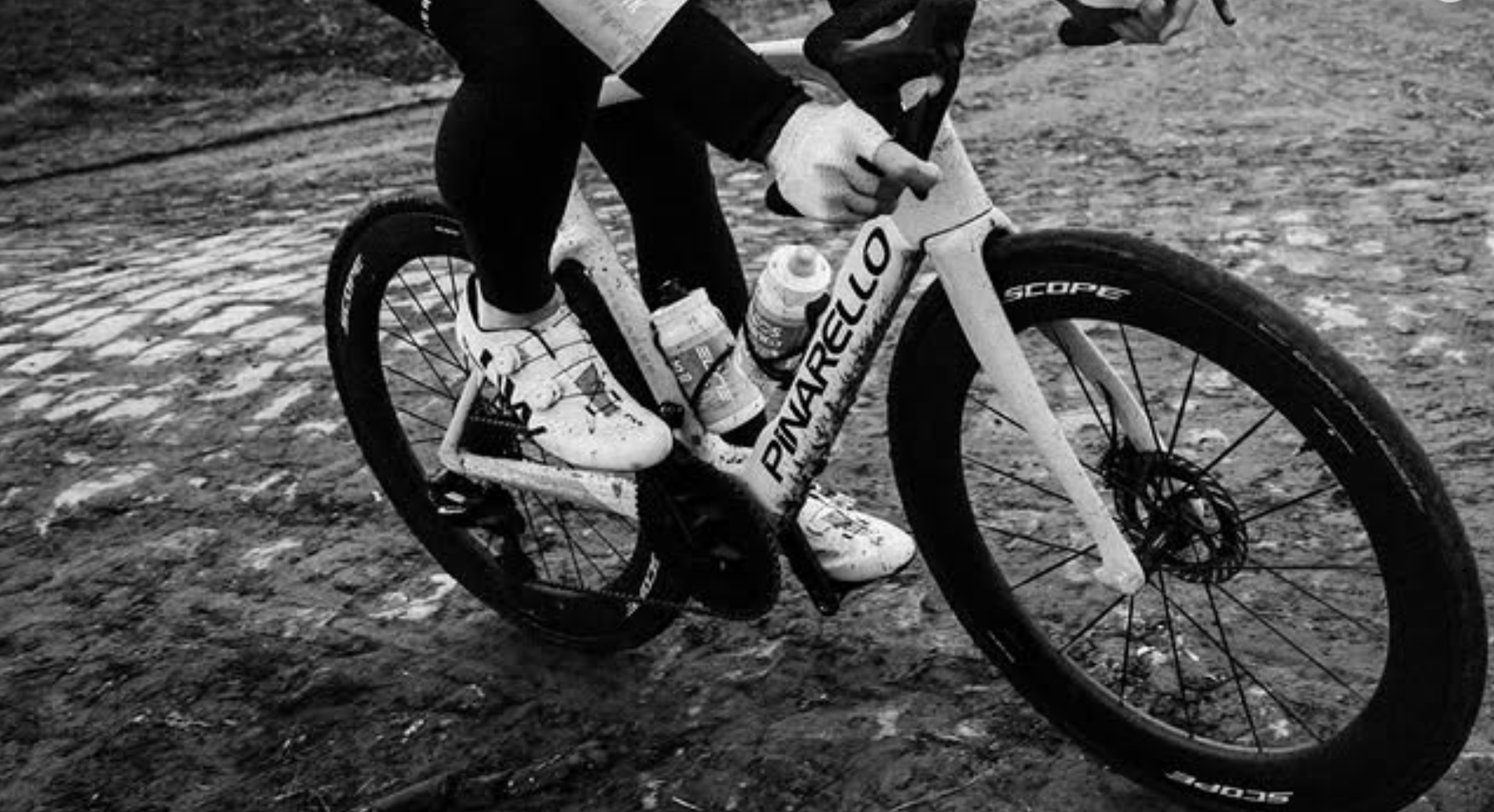
If ever you've ridden on cobbles, you probably know a few basic truths.
Firstly, it's quite unpleasant, bone-rattlingly so. They're often slippery, and with a ridge at the centre that relentlessly urges you into the ditch at either side. Your momentum is sapped with every stone, and picking a good line is akin to finding a quiet corner at Glastonbury Festival.
Article continues below 
The tests
We used the Pedalling Efficiency Rig at Silverstone Sports Engineering hub, which allows users to test the difference between setups in a controlled, close-to-real-world recreation, or the same setup across multiple different surfaces.
Cyclingnews' tech writer Tom Wieckowski was our test rider, and he covered over 70km of riding on our day of testing, with over half of that coming on cobbles at close to his threshold. Naturally, we ensured he was fed and watered, and weighed him after each run to ensure he was hydrated accordingly to keep his weight constant throughout.
Specifically, the tests we ran were:
Three tests: Road 'natural', cobbles 'natural', and cobbles 'loaded'
- Road natural: Simply riding on the road surface in the position that felt most natural for Tom.
- Cobbles natural: Riding on the cobbled surface in the position that felt most natural for Tom.
- Cobbles loaded: We asked Tom to ride with his hands on the tops, pushing a big gear, and loading the saddle.
Three tyre pressures: 25psi, 30psi and 35psi
Two speeds: 30km/h and 35km/h
What did we measure?
Using data from the Pedalling Efficiency Rig, Body Rocket power pedals, and the accompanying Body Rocket Saddle Sensor, we were able to quantify exactly how Tom sat on and pedalled the bike on each surface.
Specifically, we measured:
- The input power required to hold an equivalent speed
- His exact position (via the centre of maximum pressure) on the saddle, both left/right and fore/aft, including how well balanced he is, and how far this position moves from centre during a 60-second capture.
- His weight distribution across the bike, breaking down how much is placed on the left pedal, the right pedal, the saddle and the handlebars respectively.
- His pedalling power phases for both pedals, showing torque effectiveness, smoothness, peak phase and absolute power
- His pedal offset, showing how centrally onto the pedals the power is placed
- His max heart rate during each capture

What did we find?
The biggest changes we noticed were Tom's position on the saddle and his weight distribution, but not necessarily in the way we expected.
When riding on tarmac at the slower speed, Tom's position was fairly central on the saddle in relation to the sensor, measuring an average of 7.4mm in front of the sensor's centre line across the three different tyre pressures, as shown below.

But when we moved him to a higher speed, and thus a higher power output, he shuffled forwards by 15.7mm, to an average of 23.1mm, as you can see here:

Next up, things got really interesting when we moved him onto cobbles. The immediately noticeable difference is how his position on the saddle shifts from a constant hotspot to a blur from all the impacts.
Despite this, we can still tease out some averages. He was still in a more forward position, essentially reflecting the effort Tom was having to put into the bike.
At 30km/h, shown below, his average position was more forward than earlier, at 14.6mm, but not as far forward as the 35km/h test.

And then at the higher speed of 35km/h, he was 23.8mm in front of the centre, 16.5mm further forward than the slower, smoother test at the beginning.

One of the more unexpected shifts we saw was in Tom's weight distribution when changing from road to cobbles.
The expected shift is that as you transition onto rougher surfaces, you'll unweight your saddle and handlebars and use your legs to absorb the rough surfaces, but in this case, Tom's weight distribution actually moved more onto his hands.
On the six road tests (two speeds, three tyre pressures each), he only put an average of 11.5% of his weight through his hands, but when we moved him onto cobbles, that grew to an average of 18.8%, and then when he switched up his position to the 'loaded' test, it grew further to 20.2%.
Curiously, despite intentionally trying to alter his technique, the 'loaded' test actually made very little difference to his weight distribution.
His weight on the saddle grew by just 0.2%, while he put 1.4% more weight through his hands, and correspondingly less through the pedals.
There are two potential reasons for this.
The first is that since Tom moves forward on the saddle when the effort level increases, it's natural for his weight distribution to shift to the front of the bike onto the bars, even when moving from the hoods to the tops. This theory is somewhat debunked by the fact that he put more weight on the bars during the slower-speed road tests than for the higher-speed road tests, but with such a small sample of data, it's still possibly a factor.

The second is that the Pedalling Efficiency Rig only subjects the rear wheel to the cobbles, while the first is fixed into a sprung load cell. In the real world, where cobbles hit both front and rear wheels, we might have seen Tom subconsciously adapt to overcome these extra impacts up front, too.
As Tom himself puts it: "The rig is pretty different to riding Roubaix cobbles."
With all that said, despite not making much difference to his weight distribution, it consistently raised his max heart rate by approximately five beats per minute when compared to the 'natural' cobble tests, meaning Tom was working a good deal harder to maintain the same power input (at the pedals), essentially fighting the bike more in the bigger gear and different muscle usage.
This tells us that, although Tom's only ridden on cobbles a handful of times and is by no means a Pro Classics Specialist, his intuition and subconscious feeling are a good gauge of what gets him over the cobbles with the least amount of effort.
What does all this mean?
While we didn't come away with groundbreaking conclusions, nor even things we expected to see, we can still take away some interesting tidbits.
In Tom's case, we can see that his weight distribution on the bike shifts more forward when riding hard, and when on cobbles. The exact front-wheel to rear-wheel balance wasn't something we measured, but we can infer that as more weight is placed on his handlebars, more weight is on the front wheel too.
Thinking in extremes, this might suggest that Tom would benefit from fitting a wider tyre at the front than at the rear, to try and offset the increased load on his hands when the going gets rough.
More simply, it might affect his optimal tyre pressure. Most online tyre pressure calculators assume a weight distribution of 55% rear and 45% front. If we know that this shifts slightly when he rides hard, and he'll be hitting cobbles at 40km/h, he might want to avoid the lower limit of the calculators' recommendations, since his weight distribution is likely closer to 50/50.
It might also mean he can remove a few PSI at the rear for extra comfort.
In addition, it might be that Tom warrants a second layer of bar tape when riding on cobbles, since he knows his weight shifts onto his hands more.
And separate from cobbles at all, we know that Tom slides forward on the saddle when the effort level increases. If Tom were a pro athlete, he might have spent time in the wind tunnel, where generally the resistance is set at 100-200 watts, so you don't fatigue during a full day of testing. But when the going gets spicy, he slides forward on the saddle, and that could mean his CdA changes, meaning his optimal setup could also change.
Knowing this, he could test in the wind tunnel at 300 watts instead, and he might find that a different helmet or skinsuit tests better as his back becomes more rounded.

Other conclusions
This isn't necessarily a conclusion from our day of testing, but in unpacking the data, the folks at Body Rocket explained that when they performed a similar protocol with a different rider, his adjustment to riding on cobbles was different to Tom's, with the more expected change toward loading the pedals more and unloading the saddle and bars.
At face value, this suggests the technique of riding on cobbles is unique to each rider, and that the optimal setup for one rider might differ completely from the next.
But it could also be equipment-dependent. Tom was aboard a Canyon Grizl with 45mm tyres fitted, whereas we're told the other rider was on a road bike with 28mm tyres.
Given that we know wide tyres can save as many as 80 watts on cobbled surfaces compared to their narrower counterparts, it's possible that we were simply watering down the brutality of the cobbles a little too much, and Tom didn't need to adjust as much.
Regardless, with half an eye on Paris-Roubaix this weekend, it's impressive to see how much data can be captured with just four sensors.
Given WorldTour team engineers - the likes of Dan Bigham (Red Bull-Bora-Hansgrohe) and Jamie Lowden (Visma-Lease a Bike) - have each spent countless hours standing at the side of the Carrefour de l'Arbre in winters past, with dozens of bikes peppered with accelerometers, you can be sure they have even more data at their fingertips.
I expect they already understand how each of their respective riders responds to riding on the cobbles, and how to choose the perfect setup each time. And I expect they're feeding that information back to Specialized, Cervélo et al to engineer the next bit of new bike tech for you and me to get excited about.

You must confirm your public display name before commenting
Please logout and then login again, you will then be prompted to enter your display name.