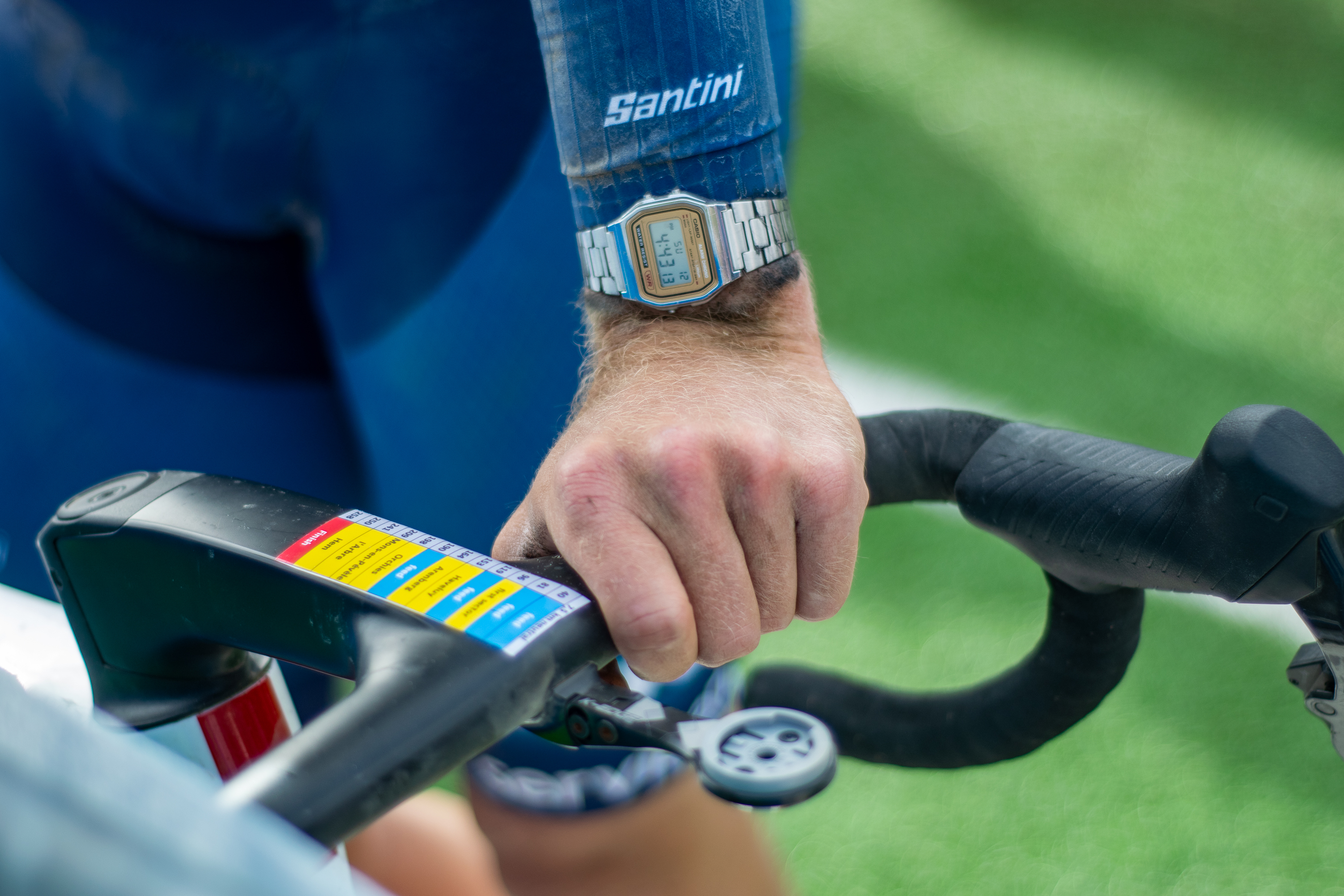
The two most striking lines from Tadej Pogačar's long-awaited pre-season press conference on Saturday came right at the beginning of his answers and right at the end.
Asked whether he'd prefer to win Paris-Roubaix a first time or the Tour de France a record-equalling fifth time, if forced to choose, the UAE Team Emirates-XRG leader said he'd pick victory in the Hell of the North.
Then half an hour later, when responding to a question on whether he realised that achievements like taking podiums in all five Monuments in 2025 meant he was making history, Pogačar also answered: "Yeah, I think after all these years and all these victories, I start to realise that, yeah, we're making something great. I enjoy that process and I hope I don't stop writing this book."
With each year of runaway success, though, the question of how Pogačar adds another chapter to an already hefty tome of historical achievements becomes simultaneously more straightforward and more complicated. As he agreed, if he wins Paris-Roubaix and Milan-San Remo at some point in his career, there won't be much more for him left when it comes to major success, barring perhaps the Vuelta a España and some week-long stage races.
Yet the very fact that Pogačar is running out of fresh fields to conquer begs the question of how to avoid falling into what could become a more tedious cycle of simple repetition. As UAE team manager Joxean Fernández Matxin told Domestique on Saturday, much of what the calendar is designed to ensure is that Pogačar's season-long motivation remains high.
Furthermore, not absolutely everything went Pogačar's way in 2025, either, for all an awful lot did. The UAE leader's slightly lacklustre third week of the Tour, for example, was hampered by a knee injury that could have cost him the race. Subsequent plans to possibly race the Vuelta a España last autumn - which would have made 2025's level of achievements even more stratospheric - were quietly dropped in early August. If Paris-Roubaix was lost in part due to a crash and Sanremo's route design puts him at something of an automatic disadvantage, Pogačar's trademark long-distance breakaway in Amstel Gold last April failed to pay off and he was beaten by Matthias Skjelmose (Lidl-Trek). Just because Pogačar's success rate is so phenomenal, in other words, it doesn't mean that he can take anything for granted.
All of which makes choosing his goals much more relevant than you might think, and it's never one purely of his own deciding, either. "If Roubaix and the Tour were at the same time, it'd come down to a team decision about what I do and the team would probably choose the Tour," Pogačar explained. "But at the moment I don't see why doing one should compromise the other."
Combining all of these factors - motivation, multiple targets, the risks that form part of any racing, and the all-but-inescapable goal of the Tour de France - partly explains Pogačar's reduction of the calendar to the biggest Classics of them all in the spring. Rather than repeat his 2025 season-opener at the UAE Tour, he'll go back to the 2024 strategy of kicking off with Strade Bianche - rapidly considered having Monument status despite lacking the actual label - and then continuing with a 'greatest hits' of only the biggest Spring one-day races of them all, from San Remo and Flanders through to Roubaix and his usual closer of Liège-Bastogne-Liège.

Targeting all five Monuments was already Pogačar's goal in 2025, of course, but it's worth highlighting how groundbreaking this project remains. The only Grand Tour winner to even think about trying and do the same since Bernard Hinault in the 1980s was Vincenzo Nibali in 2022, but he dropped the idea quite quickly as well. After ruling out Roubaix in his December press conference last year, Pogačar himself only opted to take part closer to the time, but now a season without the Hell of the North has become unthinkable, and last year he became the first defending Tour de France champion to race Roubaix since Greg LeMond in 1991.
It's yet another sign of how exceptional Pogačar is that his unconventional race program has become taken for granted. That ability to spin things round on a coin and opt for a change of program is also one of Pogačar's in-house specialities, in fact. Rather than set everything in stone, as he puts it, "In my experience, with my mind, I can decide in a second some things and collapse [re-structure] all the calendar." But if it surely maintains his interest in race programs, keeping us all guessing, albeit a little, is no bad thing for the fans, either.
After the Classics, arguably the most unconventional element of his 2026 program is his approach to the one race that has featured on his calendar every year since 2020: the Tour de France. Heading to France is something seemingly unavoidable for Pogačar, although it's worth remembering a certain Eddy Merckx once opted to skip to the Tour back in 1973, prior to coming back and winning it for a fifth time in 1974.
However, if the Tour is on the program for a sixth straight season for Pogačar, the Tour de Romandie and Tour de Suisse, two of the biggest week-long stage races, are both utterly new terrain for him. Both represent prestigious goals in their own right and there was even a time when Suisse was considered the fourth Grand Tour, although its new, radically reduced format, means winning or losing now pivots on far fewer elements than the biggest stage races.
But if the two Swiss WorldTour events are worthy 'boxes to tick' for what they are, racing Romandie and Suisse also make Pogačar's approach path to his biggest challenge of the year an unprecedented one, and one which no-one can quite predict the outcome of, either.
If Romandie and Suisse are interesting enough - and another sign of how Pogačar, within limits, is determined to keep on tearing up the script rather than stick to the tried-and-tested - it's also striking that after July, for now there is nothing on the calendar. It'd be a major surprise if the World Championships didn't feature post-Tour, but with a reduced number of race days up to the end of July - 36 rather than 45 as in 2025 - there's still plenty of room for manouevre.
As for a fifth Tour, for all he might prefer a first Roubaix, winning in July remains a massive goal for Pogačar, and one where again he'll be making history in his own, remarkable, way. Should he take another Tour in 2026, in fact, he'll have joined the legendary circle of five-time champions at 27. That's the same age that Miguel Indurain, the last rider to achieve that, won his first Tour back in 1991.
Rather than a crowning pinnacle of a career, then, for Pogačar at his comparatively young age, standing in yellow on the final day of cycling's biggest bike race for a fifth time this July would feel like a jumping-off point into lands unknown.
That's hardly likely to be daunting for him, though: as Pogačar's pointed out in the past, setting off to find new challenges is something he's always keen to do, and even if the fresh fields to conquer are shrinking in number, it's heartening to see that he has no intention of stopping trying to find them.
You must confirm your public display name before commenting
Please logout and then login again, you will then be prompted to enter your display name.