
Gravaa, the manufacturer of the KAPS (Kinetic Air Pressure System), was declared bankrupt this week by a Dutch court, in news first reported by Road.cc and other media outlets.
Gravaa's system enabled the user to adjust tyre pressures whilst riding, and we first reported on a Jumbo-Visma trial of the technology back in early 2023. The system, however, had been in development for several years before this.
Article continues belowThe system has helped riders claim huge wins. Pauline Ferrand-Prévot used it to claim a winning debut at The Hell of the North last year. Marianne Vos also took victory at the World Gravel Championships in 2024 using the system. Both races are perfect examples of where changing tyre pressure for certain sections offers a clear advantage.
Cyclingnews contacted Gravaa for comment. It seems some parties are showing interest in restoring the company. and the brand supplied the following statement:
"Gravaa has started serial production in the Netherlands since last year, and things were going quite well. Of course, the partnership and use of Gravaa by Team Visma-Lease a Bike helped us, and there was concrete interest from other road teams and gravel racers.
"Gravaa was available for the consumer market as well, via our own web shop and retailers. But it was difficult to get enough orders to be able to scale turnover and make any margin. We all see the financial struggles the bicycle industry is still facing after COVID-19, and this made it hard to get significant orders.
"Even though we have the option to produce Gravaa high- volume/ low cost, it turned out that converting this capability into sustained OE orders proved challenging in the current market environment.
"Some industry parties are showing their interest in taking over the assets and restarting the company. We are ready for it and hope this will lead to a stable solution and the success of Gravaa we aim for. Our app and back-end will stay operational for now, and we have products on stock, which means teams and individual racers still can ride and use Gravaa in the upcoming races."

For races like Paris-Roubaix and the Gravel World Championships, the ability to tune tyre pressure to suit both smooth asphalt and rough cobblestones does present an advantage and a potentially huge wattage saving. In this regard, the advantages of the system for pro teams are easy to see.
Larger sizes of tyres may also create huge wattage savings on rough surfaces without the need to drop pressure, something we found in our CN Labs tyre testing.
In business terms, it seems Gravaa did not receive the order volume to create a profitable business. Perhaps most amateur cyclists are simply happy to select a tyre pressure that strikes a balance for the terrain they are riding.
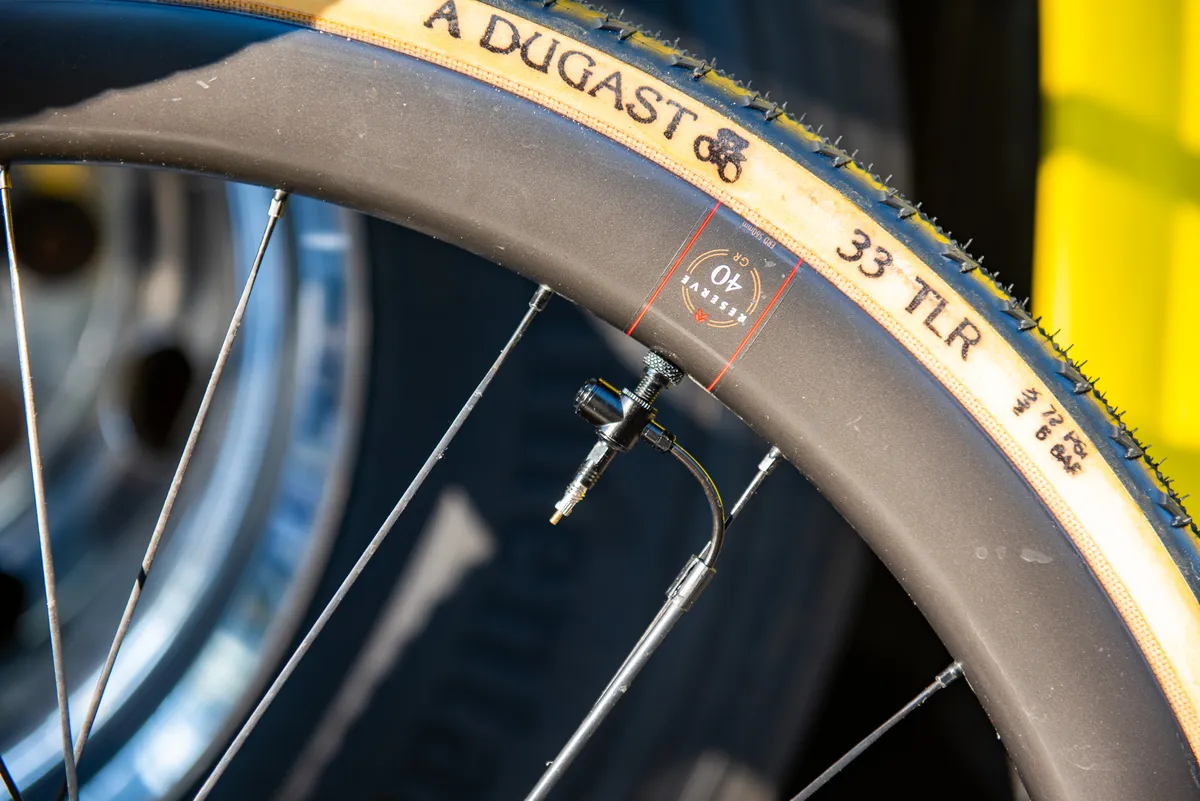
Gravaa partnered with DT Swiss and Reserve wheels, as its hubs needed to be built into a complete wheelset. The starting point for a wheelset and Gravaa hardware was around €3,000 and rising to €4,400 depending on model, representing a fairly sizeable investment.
The system also wasn't without its pitfalls; tubeless compatibility was still in development, limiting users to inner tubes or tubulars (pictured above), and the hub size also required a proprietary five-bolt disc rotor, which was included at sale and manufactured by Galfer.
Without OEM partners fitting the system on bikes from the get-go, a goal of Belgian brand Classified right now, as it looks to build its business, it seems that converting interest into sales ultimately proved difficult for Gravaa.
Perhaps one day bikes will be equipped with tyre pressure inflation systems from the off. Gravaa worked hard to produce a genuinely innovative product that claimed victory in the sport's biggest races; perhaps its idea was simply too far ahead of its time.

You must confirm your public display name before commenting
Please logout and then login again, you will then be prompted to enter your display name.
