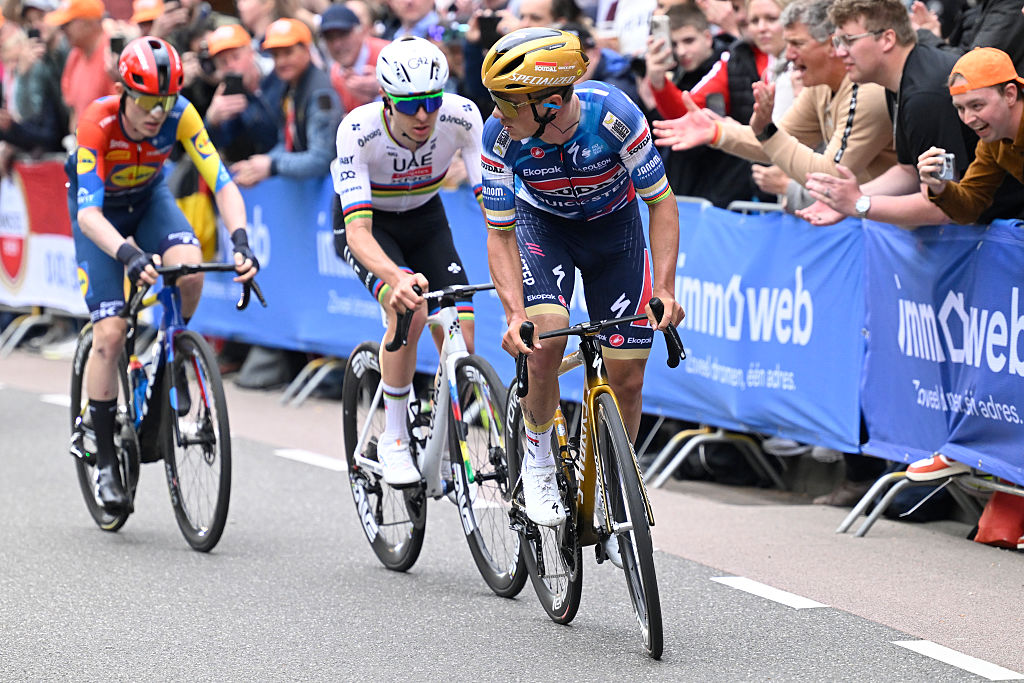
"There are only two kinds of pro cyclists: ones that have had a big accident and ones that are going to have a big accident." Aerobag co-founder Quinton Van Loggerenberg says, recounting a prominent pro cyclist's opinion on crashing in the pro ranks, and it paints a sobering picture.
Aerobag is a Belgian startup company that has developed a lightweight airbag system designed to dramatically reduce serious injuries for cyclists. It's the very thing I speculated on in the Cyclingnews end-of-year Christmas wish list.
In the event of a crash, the system rapidly inflates tough TPU tubes to protect critical areas like the neck and back. Aerobag, it’s fair to say, has the potential to dramatically reduce crash injuries for cyclists, and at least two WorldTour teams are testing it out right now.
Article continues belowSome riders will go a lifetime without serious injury; others will be well-versed in broken bones and road rash; and for professional racers, it’s more a case of when, not if, they crash. Being tough and shrugging off road rash and grazes are one thing, but each year, dozens of professional cyclists are badly injured in training or during races. January isn't yet over, and Jay Vine and Jhonatan Narváez have already fractured bones and ended up in the hospital. That’s to say nothing of incidents involving amateur riders and everyday cyclists worldwide.
Helmets protect our heads, but cyclists – in particular riders of drop bar bikes – ride largely unprotected. Compare the safety technology in cycling kit to other sports, and the level of protection on offer is laughable. Indeed, the thought is often pushed to the back of a cyclist's mind, far better to not let it in at all than to ponder the consequences of crashing on a mountain descent, or in a bunch sprint wearing only thin Lycra for protection.

Helmets in professional racing were made mandatory in 2005, and helmet safety tech is ever-improving. Crash-resistant Dyneema fabrics also exist but haven't been widely adopted. Aside from cycling gloves and sunglasses, what safety protection is there for riders descending mountain passes at 100kph+?
Aerobag was founded by industry veterans with a background in developing race kit at Bioracer. After years of helping riders go faster, they turned their attention to improving safety for cyclists. Their product, which blew up online after being exhibited at the Velofollies trade show in Belgium recently, has the potential to make one of the largest steps forward that there has ever been when it comes to minimising the risk of serious injury for cyclists and improving the protection on offer from cycling kit.

Safety over speed
In 2019, 22-year-old rising Belgian star Bjorg Lambrecht died after crashing during stage 3 of the Tour de Pologne. Lambrecht’s shocking death led Aerobag's other co-founder, Bert Celis, to leave his position at the company, and after developing the idea, he asked Sam Ratajczak, the man behind the Bioracer wind tunnel, to develop a wearable safety solution.
Co-founded with Quinton Van Loggerenberg, Aerobag also has backing from big names in the industry, and secured initial startup investment from Fundracer Capital, an investment fund founded by Gerard Vroomen, co-founder of Cervelo, Andy Ording, President/CEO of Zipp for 17 years, and Rene Wiertz, former owner and CEO of 3T.
Van Loggerenberg helped riders go faster for a long time, but the search for pure speed, it seems, led ultimately to safety. A key topic of debate regarding how to make pro racing safer and a focus of the UCI SafeR project.
“It was a fairly innocuous kind of accident, the sort of thing that could happen, and does happen, literally, in every race. Van Loggerenberg said of Lambrecht's crash.
"You're sending athletes down the road at 60, 70, 90k an hour in Lycra. And that was it. That was the catalyst,” he explains.
“My mission, my absolute mission, is that you, as a rider, wake up at home. You don't wake up in the back of an ambulance.”
Aerobag was born. The heart of the USB-C rechargeable system is housed in a small 3D-printed box, and in total weighs a little under 700g currently. The airbag itself uses tough TPU tubes that are incorporated into the rear Y-section and straps of bib shorts. This is the initial execution, but the brand stresses there is a much wider scope when it comes to pairing the system with kit and apparel.
The TPU tubes or 'airbags' are almost instantly inflated in the event of an accident by a Japanese-made 28g refillable CO2 cartridge, which comes from the lifejacket world. It features multiple sensors, including on the X, Y, Z axis position and rotation, as well as one for the Earth's magnetic field, to give the system a magnetic zero process data as the wearer cycles.
In use, the system monitors the rate of change of the sensors' readouts, and essentially, if the algorithm running the system thinks a crash is taking place, it will deploy the airbag. The trick, it seems, is developing the system to the point where it only deploys when needed and not for a false alarm.
The TPU tubes fill very quickly, and to the extent that they should provide a large amount of protection to critical areas in the event of a hard impact, a bonus is that they should also help to reduce abrasions and potentially be located in different areas on the body. Van Loggerenberg explains that the speed at which the system deploys is critical in keeping a rider safe.
"Laying the bike down won't set the air bag off. Bunny hopping won't set the airbag off. Losing your footing won't set the air bag off; the algorithm controls the firing process.
"The bag inflates in about a hundredth of a second. We must achieve the right diameter, the right internal pressure in the tubes to provide sufficient impact protection. It's based on existing motorbike systems. It's much smaller in terms of packaging and much finer in terms of sensors. The actual energies involved in the bike crash are lower, but they happen just about as fast."
The airbag deflates in a couple of minutes, and the system also packs itself away post-deployment – one of Aerobag's patents relates to this particular feature. So the rider doesn't need to repack an airbag as team cars and a race convoy shoot past. The CO2 cartridge is one-time use, though, and can be switched out in under 30 seconds, the brand says.
But what makes the Aerobag know when to deploy? An algorithm has been created to control and test the system, and the way that algorithm has been created is incredible.
The Belga news agency keeps a large archive of cycling crash footage. In-depth analysis of this footage has been used to create the Aerobag algorithm, which determines when the airbag deploys.
"There is an agency that has access to a video and film database of almost every single crash that has been broadcast, Van Loggerenberg explains.
"We can feed that into an AI engine, which then reverse engineers the accident for us, because you can often identify shoulders, hips, and elbows [in the crash]. You can put that into a 3D model, and you can work out what the person was actually doing during the accident.
"Using the timeline, you can then work out how fast the rotation was. You know where the person was in frame one, you know how many seconds passed, and you know where they were in frame 50.
"The computer can work backwards and work out what the body did. The engine can then work out what the rotations and geometries were during the accident.
"We have a 3D robot on which we have a dummy wearing our system, and we can then tell the dummy to play the accident back. So you can take a TV accident, or a form of an accident, work out the geometry with a reasonable level of accuracy, and we can then replay it in real time, using our robot with a 3D dummy and our Aerobag."
The goal now is to finesse the system so that it only deploys when needed and not in what the brand calls a 'false positive', i.e. the airbag deploying when it isn't meant to, which would be an inconvenience in a race or event. Either way, this represents a huge step forward.
But how much protection does a rider stand to gain in an accident? Real-world crash testing is a difficult thing to do, and is something that is hopefully not necessary thanks to the AI analysis and lab testing.
"I can say it's substantial," says Van Loggerenberg. "If I put a number on it, someone's going to criticise me."

Bringing the system to market
The Aerobag system currently has a price tag of around €750-850, though it isn't available to buy just yet. The brand is already working with Nalini and Nimbl, suppliers to Picnic PostNL and Visma-Lease a Bike, as well as MOA, a big manufacturer of kit for a range of brands.
The business model of Aerobag involves working with brand partners to incorporate the Aerobag system into all kinds of cycling kit and apparel. Kit will need to accommodate the airbag and become 'Aerobag certified', which is free, but the sky could be the limit.
"The intention is that it can be in bib shorts today, and it can be in a backpack tomorrow, and it can be in your commuter jacket when you're out to work from Monday to Friday," Van Loggerenberg says.
"We have apparel partners who are developing articles of clothing into which this will fit, and we are 100 per cent certain that they're going to come up with cleverer solutions than we have. So far, we've picked the obvious one, which is a pair of bibshorts."
Pro teams are already testing the technology in race kit, but it appears Aerobag-equipped products will be on shelves in the not-too-distant future.
"There are apparel partners who are committed to having their own articles, not pro-sponsored clothing, their own jackets, their own bib shorts, on shelves in 2027."
The brand says the price will come down in time, but for now, it seems that airbag-equipped cycling kit is something that is about to become a reality.
And the price, it may well be a relatively expensive option to begin with, and the cycling world can be quick to pour scorn on the latest expensive tech development, but the prospect of a genuine, real-world reduction in serious cycling injuries softens things somewhat is a big one. What price can be placed on any rider's safety and health?

WorldTour teams on board
At least two WorldTour teams are testing Aerobag tech right now: Picnic PostNL and Visma-Lease a Bike, with the system displayed in Picnic kit at Vellofollies. Several other teams also picked up the phone to Aerobag after the product display at Velofollies.
Picnic PostNL have been an early adopter, and the team has used crash-resistant Dyneema fabrics in its race kit for years. Piet Rooijakkers, long-time R&D expert at Picnic PostNL and ex pro rider, is in charge of testing the system and explains that the team has been communicating with Aerobag for a couple of years already.
Plenty of cyclists, pro and amateur, want to feel fast and light on the bike; you would think this would be the case for professional riders in particular, who might flinch at the prospect of an extra 700g, although Aerobag did mention that the system, when worn on the back, actually offered a small aero benefit in testing. Nevertheless, Rooijakkers indicats that the team's riders are not against using the system.
"Riders these days are pretty aware of the risks that they take. And they are not negative to it. They also want this. They are mindful of the downsides," he says.
Testing is going on within the team; it's clear riders won't start lining up for races wearing the Aerobag next week, but things are moving behind the scenes. Teams will want to ensure it's lightweight, breathable and comfortable enough for riders, that aerodynamics aren't affected, that it doesn't deploy at the wrong time, and importantly, that riders are happy and comfortable using the system.
Will we see riders wearing the system in a WorldTour race in 2026? Rooijakkers explained it may not happen this year, partly due to the level of approval that new tech needs to go through.
"I think when you can train with it, you can also race with it. But then we need to be sure that it's tested in the right ways. I think, to UCI race it this year will be tight. We need to go over some safety checks, and need a UCI agreement. That will at least be after the Tour de France."

When will we see Aerobag in a race?
Adam Hansen is the current president of the CPA (Cyclistes Professionnels Associés), the body which protects the interests of professional riders, and a board member for the UCI SafeR structure. He's also a racer who broke 17 bones as a professional rider during his long career.
Hansen was positive on the subject of whether the CPA would be happy with riders wearing the system and the mechanics of using it in races, where a lot is going on already.
"If the riders are willing to race with it, then we're happy, that's what it's got to come down to. We don't want it to be a compulsory thing at the moment, because we have to see how to implement it," he tells Cyclingnews.
"If it doesn't interfere with the riders' clothing and the way they feel and things like that, and the riders are happy, I think it's great that a team is testing it, and in SafeR, we have been discussing it, and we're happy to hear this is a step forward."
There can be resistance to change in cycling; certain things have been done a particular way for a long time. Perhaps at face value, the prospect of wearing some kind of airbag would make hardened European pros scoff, but Hansen believes it would be hard for riders not to see the potential benefits.
"I do believe there might be some resistance from some riders. But then I do believe that in five or 10 years, riders will say, 'how did they race without an airbag system, you know, 10 years ago?'"
Professionals probably just want faster, more aero and lighter when it comes to kit; comfort also plays a big part when you spend as many hours as they do on the bike. Possibly a reason why super-strong, but warmer and less flexible Dyneema fabric hasn't been universally embraced. Hansen, a renowned weight-weenie as a pro, says he would have welcomed the tech during his career.
"For me, if it's comfortable and it doesn't restrict you from racing, and it's not too hot, I would have welcomed it. I had a lot of bad injuries. I broke my sternum twice, my collarbone two or three times, and dislocated my shoulder. I broke 17 bones when I was racing.
"So I think something like this could have reduced quite a lot of accidents. I think the most important thing about the airbag system is that it will reduce the severe accidents, that's the important thing."
Hansen also mentioned SafeR's efforts in trying to implement an accelerometer sensor for racers to help make clear concussion decisions. The Aerobag electronics will allow more crash data to be analysed than ever before, as Van Loggerenberg explained.
"The electronics pack records the couple of seconds before the accident, the accident itself, and a couple of seconds afterwards. We can get to that data. So for the first time, we're actually going to be able to extract data on what actually happened in a crash."
It's probably a way off, but the ability to make a clear-cut decision regarding a crash impact and how that informs the concussion protocol decision-making process can only help keep riders safer long term.
10 years from now
The cycling world is littered with clever, innovative inventions that just didn't quite make it. But Aerobag has a palpable feeling of momentum; teams and brands are picking up the phone because they, like Aerobag, want to help keep cyclists safe, and this is a way to do it.
In the professional world, Aerobag will need to be tested by teams and riders until they feel happy to train and race with it and gain UCI certification as a safety device, amongst other things. But it may well be used in a race in the near future.
Van Loggerenberg's desire to keep cyclists safe is palpable; the brand seems genuinely intent on improving safety for everyone who rides a bike, not just racers.
"I think this is going to save careers, it's going to save severe injuries and often for accidents that are entirely not the athlete's fault. It's the dog running in front of you. It is the granny pulling out. It is the bus stopping. It's the stupid, stupid accidents that are not the fault of the athlete and that can have such unintended consequences," he says on the accidents that are sometimes the most heartbreaking of all.
Only time will tell if airbag safety technology is embraced. It isn't quite ready yet, and it may not come immediately, but it must represent an opportunity to move things forward when it comes to injury protection for cyclists, and Aerobag is intent on trying to achieve this goal. Perhaps in 10 years, cyclists will indeed look back and wonder how they ever rode without airbags.

You must confirm your public display name before commenting
Please logout and then login again, you will then be prompted to enter your display name.