'I would trade all the prize money for safety' – Top gravel pros voice concerns about mayhem with media vehicles, intersections and feed zones
Bigger isn't always better as The Traka, Unbound Gravel and Leadville among races with close calls due to course chaos

An assumption about gravel racing is that because it happens largely 'off' paved roads, the elite riders are clear from motor vehicles, traffic furniture, sidewalks, gutters and throngs of crowds close to the action at every corner. But is off-road racing really a safer environment?
The short answer is no, as off-road racing has its own set of dangers and risks, with a laundry list of natural and man-made obstacles that can cause chaos: elites mixing with amateur fields, media vehicles on the same minimum maintenance roads (MMR), courses open to public traffic and more. With more live streaming of gravel races, including events at the Gravel Earth Series and Life Time Grand Prix, global audiences can now see for themselves what the riders have talked about for years.
"Safety should be number one. I would trade all the prize money for safety," was an emphatic response from Keegan Swenson to The Cooldown co-host Alexey Vermeulen in March after a camera crew on an all-terrain vehicle almost crashed with Sofia Gomez Villafañe and Paige Onweller, the elite women's leaders at The Mid South.
"These issues happen so often. In the end, it's small instances out on course, and you sometimes forget how close of a call it is because you're in the midst of racing and you go straight back to racing. It's good it got caught on camera, to see actually how sketchy it was.
"At almost every single race, there's an incident. Big Sugar last year was one. You talk to promoters or race organisers after and it's always 'Oh, sorry, it won't happen again'. But it just keeps happening. It just seems like a recurring theme. It's time for them to step back and focus on the safety of the riders more than the shot," Swenson said to Vermeulen.
Both riders are part of the Life Time Grand Prix, Swenson currently second overall and Vermeulen third, and noted that even the races in the series were not immune challenges. At Sea Otter Classic the course is closed, but has had issues with dust kicked up by media vehicles and hand-off in feed zones. Unbound Gravel 200 and Leadville Trail 100 MTB have areas where the course passes over active roads, and the feed zones were shared with age-group riders.
"The sport, to begin with, isn't very safe. You know, I come from the road. We still see crashes with cars, even though it's closed courses. We still see riders making stupid decisions," Vermeulen said.
The latest race content, interviews, features, reviews and expert buying guides, direct to your inbox!
"The UCI has done some things, like trackers on bikes now, riders can't get lost. We [gravel racers] deal with even more, because we're racing off road, there's all sorts of weird surface things. I feel like in the end, you need to control the controllables."
Media vehicle mayhem, 'dusting' riders and 'the slip'

Onweller and Villafañe were not injured at The Mid South near-collision with a media all-terrain vehicle, but it disrupted their race. A nine-rider sprint was won by Villafane, with Onweller finishing fourth. Onweller said she has spent a lot of time talking with Mid South organisers since and they had been receptive to her input for safety, specifically with media vehicles.
"They've been super open to feedback and wanting to talk through like plans and how things are improved. I'll continue to talk with them as they work towards next year's event," she told Cyclingnews.
Vermeulen confirmed that while The Mid South got called out for the incident because it was seen globally on a live stream and social posts, it still happens all the time.
"When you have a conversation about how crazy an event was, very rarely is it in a photo, on video or two [people] actually talking about it afterwards, because you go on to the person who won the race. And if there was the catastrophe or someone got hit, then there isn't a reason to really talk about it. People want to glance over it because we don't want to point the flashlight at the dark corners of the sport."
The Mid South is not an isolated incident related to chaos kicked up by UTVs, motorbikes and jeeps. A 'side-by-side slip' can be created by these vehicles, specifically when conditions are dry, that provides less air resistance like drafting from the front. These common situations, according to Swenson, occur when a media vehicle misjudges the speed of the racers.
"They'll be stopped at the bottom of the hill, and we roll up onto them so fast. [Then] accelerating, trying to get out of there, they're dusting us. It creates a situation where it puts off this mean slip[stream]. You happen to get in the slip of this thing, you can just be gone."
He recounted how Cameron Jones and Simon Pellaud used this slipstream effect at Unbound Gravel 200 in 2025 to break away from the lead group. It wasn't a safety issue, but could be interpreted as a fairness issue.
"It's not necessarily the fault of the riders, because if it's there you're going to use it. We're looking for every advantage. Sometimes you just happen to attack and the side-by-side is there, and there's nowhere else to go.
"And I think the issue with the side-by-side, not many think about it, is those big exposed wheels [of the UTV]. They can just suck you in, like catch your foot on them. Whereas a motorcycle, it's more like a bike. At least you're not going to get sucked under the wheel and run over by a 5,000-pound machine."
But motorbikes are not clear of trouble, as a moto crashed at Lauf Gravel Worlds last year and caused separation in the pro field. Another moto crashed at Unbound two years ago. The Cooldown hosts agreed that skillful motorcycle operators were part of the solution.
"What's hard, is that it's changed really quickly. I think in the span of three or four years that you and I have been involved, gravel has gone from 'spirit of gravel' – hang out, have fun, stop in feed zones – to professional racing. We're going that first part of the race 27, 28 miles an hour average into the first feed zone. You can't plan on the fly when you're going that fast," Vermeulen added.
Did feed zones work at Unbound?

The early feedback was positive on expanding feed zones for pros only at Unbound Gravel 200 this year, a change made by Life Time, the organisers of the Grand Prix series and owners of the collection of six races, because of input from the elite riders.
"Unbound was always tough because it's such a long race, so feed zones historically, got you to think about carrying like four litres of water," Onweller told Cyclingnews after she finished top five for a second time at Unbound 200.
"I went to a wind tunnel with Sika specifically testing how to carry four litres of water, and then the next thing you know, Life Time announces they're doing a third feed zone. So I think a lot of us elite racers were really excited, and the elite feeds were separate so that improved safety."
Onweller said the first pro-only feed zone was really short, and the speeds carried into the area would be too high for the space allowed, but the mud at mile 15 split the men's and women's pelotons apart so there was no mass entry of riders. She thought the second two feed zones were super long and having space between team set-ups was good. However the difficult logistics for crews to move between feed zones was stressful and split resources.
"We had a crew that was at the start line that then went to feed two, and then the feed zone one people went to feed zone three, so they alternated each other, so that they could catch both male and female riders," she confirmed.
"At the end of the day, adding a third feed zone actually split resources. Yeah, I think that was a really big struggle. We tried to get as many bodies as possible, but it's still a stress to your resources, so for that reason I didn't really like the added third feed zone. Unless you have endless resources in this industry, which is pretty rare, I think it stressed a lot of people."
Andrew L'Esperance, who completed his fourth Unbound Gravel 200 this year and back as an invited rider in the Grand Prix, agreed that the third feed zone did work for the most part but did create stress.
"I think it worked quite well. It avoided all the challenges that were in previous versions of Unbound, just because the feed zones were longer and they had way less people in them, so there was just a lot more space to operate," he told Cyclingnews.
"There were some challenges with transportation between feed zone one and two. I just think with the way the course layout was, it wasn't really impossible to have the same person feed [at both]. It is just the reality of the area we're racing in, that the way that we got from feed zone one to feed zone two was all on back gravel roads, and there was no real main roads to get there quickly.
"This is just an example of them [Life Time] trying to improve, They hit it like 90% great, and that last 10% is just something they can do to make it perfect."
Close calls and closed courses

Gravel races typically cover so much real estate, are closed courses possible? In Europe, the courses often pass through densely populated areas. Vermeulen and Onweller noted that USA Cycling had a closed course for US Gravel Nationals that worked, Onweller third in Nebraska two years ago and Vermeulen finishing fourth at US Nationals in Minnesota last year. Swenson said the 2025 circuit course for SBT GRVL was 'semi-closed' and seemed safe.
L'Esperance noted that one of the best-organised gravel races he has done was a regional event near his home outside Montreal, Gravelooza. It was held the weekend after Unbound, with 1,800 participants, and he noted that all intersections were marshaled by construction workers.
"At the front of the race, it felt safe the whole time," he said, noting that the workers are used to regulating traffic.
Leadville and Big Sugar were races many riders called out as unsafe – Leadville for the two-way traffic up and down the Columbine climb, and Big Sugar in Arkansas for multiple intersections where the course crossed paved roads, many of them busy. L'Esperance also noted that The Traka 360, where he finished ninth this year, had issues that may have gone unnoticed.
"I ran into the situation at The Traka where there was just most of the busy roads were marshaled by volunteers, I would say with varying effectiveness. So they didn't have the same confidence or authority that you'd expect in that situation.
"There was a fast gravel road corner and our group came very close to getting hit by a car. It was just one of those scenarios where I think the group had been pretty used to having marshals at key intersections most of the day. This happened to be one where there wasn't a marshal, and it wasn't a hard corner, it was like a softer corner, so maybe there was less alertness by the group on it, but these things obviously can happen."
Vermeulen pointed out that while it is great to have volunteers along a course, they need to be helpful, pay attention at all times and understand what is the proper hand signal to use. Are they signaling that an intersection is clear to cross or are riders to stop, or is a car to stop?
Onweller noted that Life Time did a better job this year with protected intersections, and securing the pro finish lines with fencing for an extended distance and providing police at many of the later intersections, for amateurs and pros.
Leadville the next barometre

In the 'early days' of gravel racing, just five years ago, Life Time, the organisers of the Grand Prix series and owners of the collection of six races, set a precedent by outlawing comfort bars from the elite divisions of the off-road races. It was a rather seismic rule, but the dust settled quickly.
Next came separate starts for elite men and women, larger spacing from age-division rider starts and a no-drafting rule for riders in outside categories. Rules vary from race to race around the globe on all of those, with The Traka allowing age-group men to start before the elite women this year and chaos ensued.
Life Time created two athlete advisor roles for this year, the fifth season of the series, to provide feedback from the elite competitors to improve "race experience, competition structure and key decisions that shape the series". Melisa Rollins and L'Esperance were selected by their peers for 2026, and both shared with Cyclingnews how the 'shaping' of the series has a key focus on safety.
"Life Time is open to feedback, and they're trying to improve all the time, and this is just an example of them trying to improve," L'Esperance said, the process still being developed.
"It's really cool to see that our opinions really do matter and they are actively making changes. When they say they are gonna bring it back to the team and come back to us, they always do," said Rollins, who has been out most of 2026 due to several injuries.
"I'm just getting one billion texts from one billion different avenues, about this and that, so we're kind of a good middle I think, Lespy and I."
A past winner of Leadville Trail 100 MTB, Rollins said that race had its own issues related to feed zones, media vehicles and two-way traffic with age-group riders that bring safety to the forefront.
"It seems as the media demand is sort of elevated at these races. Everybody wants media, but the more media, all the media vehicles, that's when we're having more safety problems. We aren't keeping up with the safety protocol," she said.
"Having the pro-only feed zones will help with availability for media. Hopefully it'll be safer in that regard because obviously last year there was a media crew incident coming down Columbine and we don't want a repeat of that.
"I'm not sure if there's really a solution other than closing the roads and we get a really, really safe race. That's not possible, not with races that are taking us [pros] six hours and an amateur race going on that take people 12 hours."
Cyclingnews provides you with comprehensive coverage of the 2026 gravel season. Subscribe today for unlimited access to all the breaking news, race reports, in-depth tech coverage, and analysis from all the biggest gravel races. Find out more.
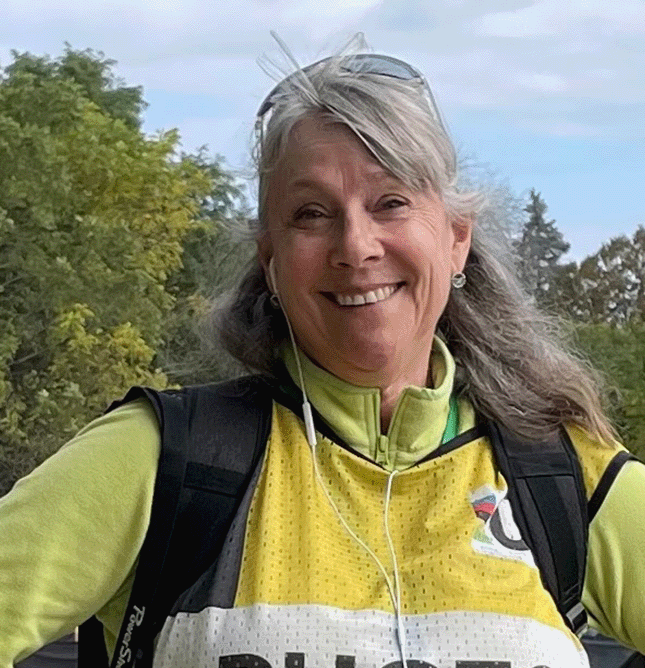
Jackie has been involved in professional sports for more than 30 years in news reporting, sports marketing and public relations. She founded Peloton Sports in 1998, a sports marketing and public relations agency, which managed projects for Tour de Georgia, Larry H. Miller Tour of Utah and USA Cycling. She also founded Bike Alpharetta Inc, a Georgia non-profit to promote safe cycling. She is proud to have worked in professional baseball for six years - from selling advertising to pulling the tarp for several minor league teams. On the bike, she has climbed l'Alpe d'Huez three times (not fast), and spends time on gravel around horse farms in north Georgia.
You must confirm your public display name before commenting
Please logout and then login again, you will then be prompted to enter your display name.
