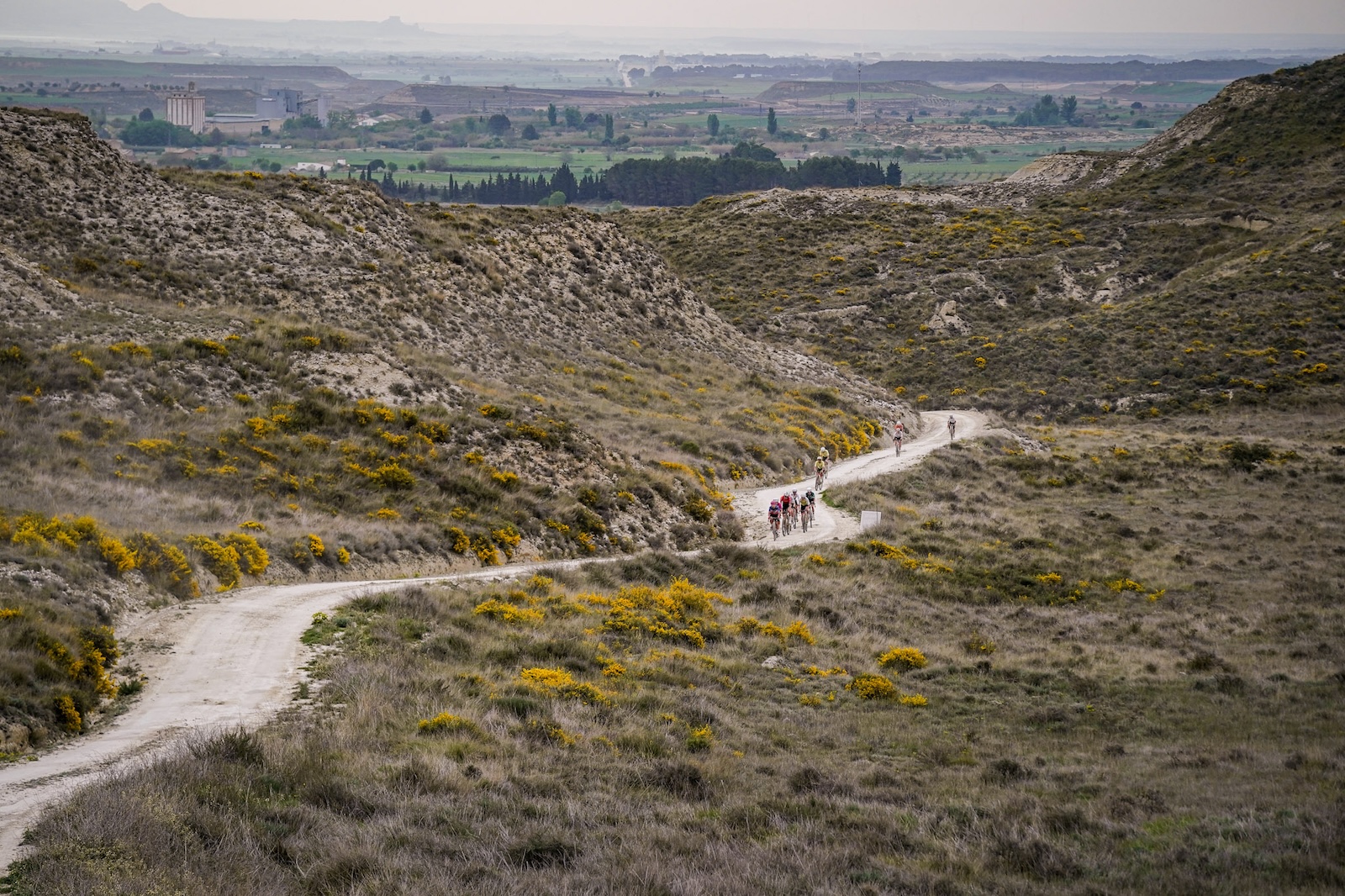
Whether you like it or not, gravel riding now has a professional side to it. That's reality, and not the argument of this article. There's no single definition of 'gravel pro', and the fact that it is given so many column inches shows how young the discipline is.
Brands are seeing huge demand for gravel bikes, and they're spending hundreds of thousands of dollars to market them. As always in sport, a big chunk of that budget ends up behind athletes.
Is the era of the privateer moving on?
A privateer is simply an independent professional athlete. They build their own group of sponsors and deliver both racing results and content. In gravel, this model effectively started with Ted King in the mid-late 2010s. He wasn't called a 'privateer', but a brand ambassador who happened to be racing bikes fast. The model grew and evolved with time.
Ted King walked, which allowed a whole host of others to run: Pete Stetina, Ian Boswell, Laurens ten Dam. They used their WorldTour engines and industry connections to race at the pointy end while getting paid.
The privateer model became gravel's default. It brought freedom to a generation of athletes who could exist outside of the sport's tradition. You choose your own calendar, sponsors, and travel the world with friends. There's no team telling you what to do or where to go. It almost made life cheaper for the brands, with athletes splitting income across a network of partners.

The analogy of running a start-up business is one that's often used. The job of being a pro in gravel isn't just racing bikes fast; it's the whole picture. Accommodation, flights, spreadsheets, sponsors, contracts, and deliverables.
You still have to be as strong an athlete as possible, but you have to figure out everything else, too. Unless you're on the podium at the biggest races every week, it's no longer good enough to just be an athlete.
If the first generation of what we now deem 'gravel pros' were ex-WorldTour riders, the second generation were WorldTour or XCO adjacent. Two of the leading names in the modern men's field are Alexey Vermeulen and Keegan Swenson. Both had careers in their respective first disciplines, road and mountain bike, before switching to gravel.
At the top level, the narrative was always that gravel, especially in the US, meant freedom and big pay cheques. But that wasn't entirely true then, and it's becoming even less true now as the sport enters a new era.
Enter the team era
Speaking to The Guardian in 2024, gravel racer Payson McElveen, who is also a two-time US Marathon MTB champion, said: "Gravel races forbid team tactics, which opens the door for more creativity and storytelling."
Less than 18-months later, that ship has sailed. As more money pours into gravel from brands looking for return on investment, the sport is slowly moving beyond the romantic idea of privateer racing.
The most notable shift this off-season is the signing of Keegan Swenson and Mads Wurtz-Schmidt to the men's side of Specialized Off-Road Racing. They joined Matt Beers, who can count World Marathon MTB Champion, European Gravel Champion and three-time Cape Epic winner in his career achievements. Time will tell, but this team seems to have already drawn a line in the sand for a new era of gravel racing. They're not alone either; PAS Racing have increased their racing investment, and Q36.5 launched a women's pro gravel team this year.
There has been pushback, often wrapped up in the meme-ified 'spirit of gravel', and sometimes, almost ironically, by the same generation of riders that first professionalised gravel.
In late 2019, Stetina left the WorldTour and declared: "I'm still going to be a pro rider… I'll just be doing different kinds of races." That moment turned out to be pivotal. It marked gravel's shift to a legitimate professional race scene. The riders who arrived next simply accelerated that shift.
Nothing is shocking about this, though. It's just sport behaving like sport. Brands paid big for gravel winners, the audience grew, and the incentives got bigger. As soon as there was big money on the line, riders naturally started to realise that teamwork makes a difference.
In gravel, as in any sport, the choice is simple: evolve or die. In truth, the earliest generation of pro gravel racers became victims of their own success. They raised the discipline's profile, and the discipline changed around them.
Teams aren't the issue. The real threat is pretending gravel should stay stuck in some beers-the-night-before era, an era that, let's be honest, mostly benefitted the ex-WorldTour riders who dropped in with huge engines, and ready-made sponsor relationships.
There is a certain irony to all of this. The growth of teams could, in fact, democratise pro-gravel. Teams create natural pathways for riders who didn't come from the WorldTour pipeline, and with proper support, riders rise on talent and work ethic, not just pedigree and connections.
This is where the debate gets interesting because while teams make sense competitively, they're harder to justify economically.
One of the biggest arguments against teams is simple maths. Every additional rider costs money, not just in salary, but also in travel, equipment, and logistics. The return on investment for a rider who won't win every week is hard to justify. A three-rider roster guarantees maximum exposure with minimum outlay, but expanding to five or six requires a sponsor to believe those additional athletes will generate proportional value. And right now, gravel doesn't reward depth.
A team can gain huge visibility with one race-winning rider; they won't gain much more with a strong 15th-place finisher. Until gravel has meaningful coverage, rankings, or a true league structure, the commercial incentive is to stay small. The ceiling grows, the floor stays low.

How much money are people making?
Pro gravel has, at least in part, been painted as a gold rush. And sure, a handful at the very top do get paid well. But the idea that gravel is full of big salaries and endless autonomy was always a myth. The vast majority were nowhere near those six-figure numbers.
The privateer model is often praised because riders can choose their own sponsors, but that's not the reality for most. Choice only exists when you have leverage. For many privateers, partnerships are dictated by who can actually pay, not who they'd ideally like to represent. Business is business, after all.
There is real money at the very top, but that's exactly the point: the money is concentrated, not widespread. Gravel is a professional sport being played on completely different playing fields. It has winners and survivors, but almost nothing in between. A healthy ecosystem needs a middle class where riders who aren't winning everything can still make a living.
Right now, that doesn't exist. There are maybe 15 to 20 riders earning six-figure salaries, and the drop beneath them is steep. Some riders finishing inside the top-10 of the Life Time Grand Prix (LTGP), the world's most prestigious off-road series, are barely breaking even, let alone earning a salary. A discipline where most of the 'league' can't cover their costs isn't a professional one.
Andrew 'Lespy' L'Esperance is a Canadian professional rider who finished seventh overall in the 2025 Life Time Grand Prix, along with a long list of high-level results. His experience captures the reality behind gravel's supposed 'gold rush'.
"As a Canadian, we're not international, but we're not American. We rely on US sponsorships, as the Canadian market is smaller; it's a weird place to be. I gather a pot of money from sponsors that allows me to run a calendar, and in certain cases, expenses like accommodation are provided at events. It's not clear cut in gravel as to why you're paid what. There's not an exact value to being in the Grand Prix; it's more 'What can each brand afford to spend?' All of our contracts have confidentiality clauses, which doesn't always help," the 34-year-old revealed.
"I'll be very honest, last year I didn't do that well at all financially; it was definitely a bridge year. I need to perform well to keep doing this. We're essentially small businesses, and there are a lot of ways to create efficiencies in small businesses.
"For 2026, a lot of my sponsorship discussions happened before the Grand Prix selection. Maybe my sponsors assumed I'd get in, but it wasn't discussed. I don't have an additional bonus if I get into the Grand Prix, but I do have them attached to performing within the Grand Prix."
Raise the floor, not the ceiling
To their credit, Life Time accelerated gravel's professionalisation. The Grand Prix created a marketplace for riders to prove value and gave structure to a discipline that had none. And they've made it clear that they want the LTGP to become a true league. Their 2026 prize pot of $590,000, split evenly across genders, is their biggest step yet.
The huge prize pot unsurprisingly grabbed headlines but fundamentally missed the point. For the LTGP to become a true league, it needs to have strength and depth. At the very least, each rider in said league needs to be making a livable salary.
You have a handful of riders making six figures who are racing against, and often being beaten by, some who aren't making a cent. It's nonsensical. To become a legitimate league, it would be better to raise the bottom of the LTGP than to reward the winner. It sounds paradoxical, and it's far from sexy.
Gravel doesn't need bigger rewards for the already successful; it needs a middle class. If Life Time wants the sport to professionalise, as they seemingly do, their priority has to shift. Not more money for the winner, but better conditions for everyone else. A league can only be as strong as the minimum standard it guarantees.

So, how do you become a gravel pro in 2026?
In many ways, it's positive news. Becoming a gravel pro is becoming more similar to any other discipline. If you are consistently performing at a top level, brands and teams will pay attention to you. And, if you're good, but your results aren't exceptional, you need to bring another form of value to the table.
The privateer model will still exist and thrive, but it won't be the dominant pathway anymore. It will reward the few who can juggle racing, media, and business.
For everyone else, the rise of teams shouldn't be seen as a threat, but a chance to level the playing field. That being said, teams still need to be wary. Gravel isn't the WorldTour, and trying to copy that system would be a mistake. The WorldTour model barely works for the WorldTour. The teams need to find that sweet spot between performance and relatability to their original audience.
Nonetheless, they bring the structure and finances that allow riders to rise and exist based on talent, not just reputation.
You must confirm your public display name before commenting
Please logout and then login again, you will then be prompted to enter your display name.