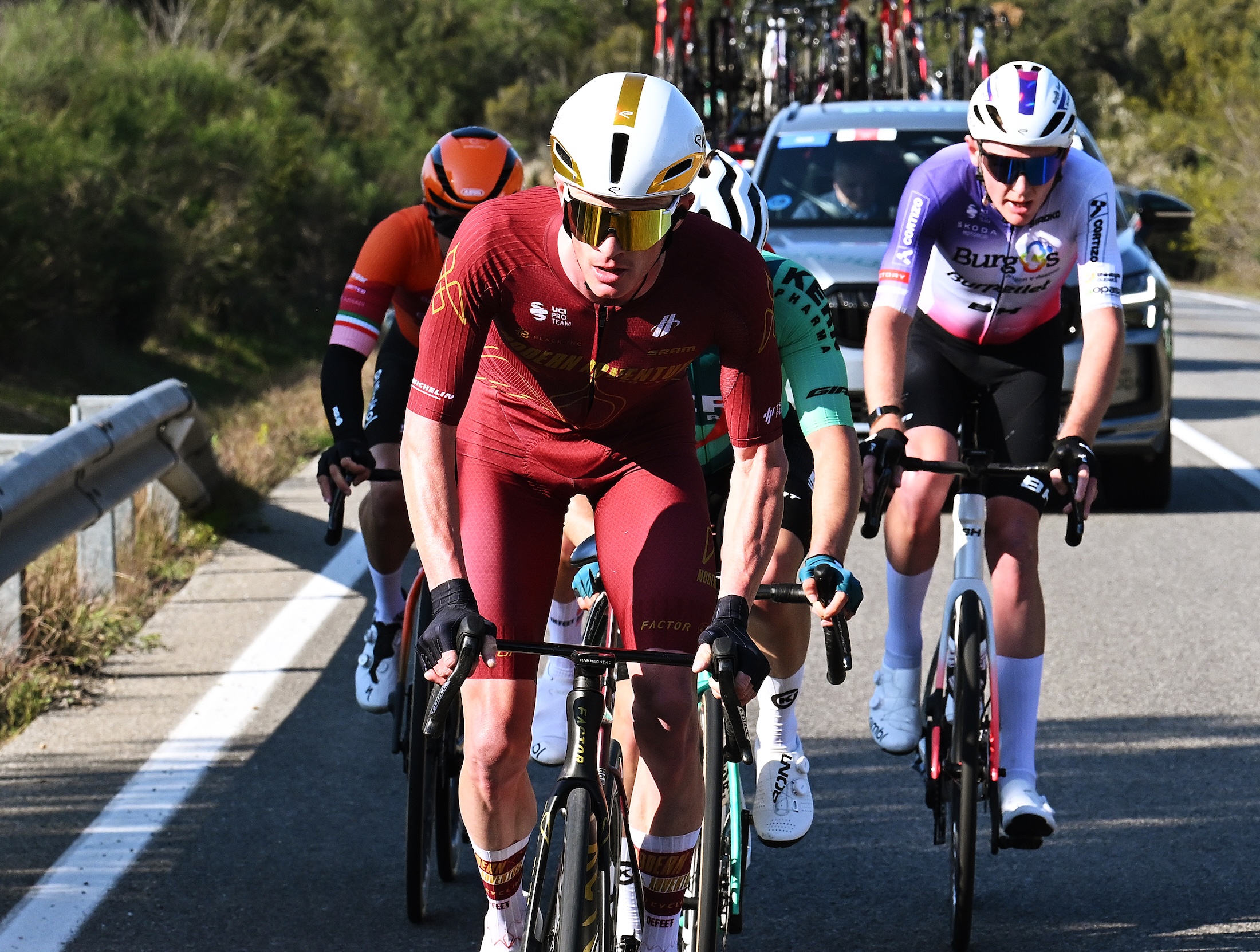
The Cannondale SuperSix has gone through many iterations over the years, and this latest generation is certainly an evolution over the previous model rather than coming out with anything revolutionary.
However, as the race bike of EF Education-EasyPost, it has proven to be a mightily effective bike, taking wins in cobbled Classics, mountainous Grand Tour stages, epic breakaways (primarily via Ben Healy), and sprints. It's also claimed a world title last season, going some way to back up the credentials as a highly versatile, do-it-all race bike.
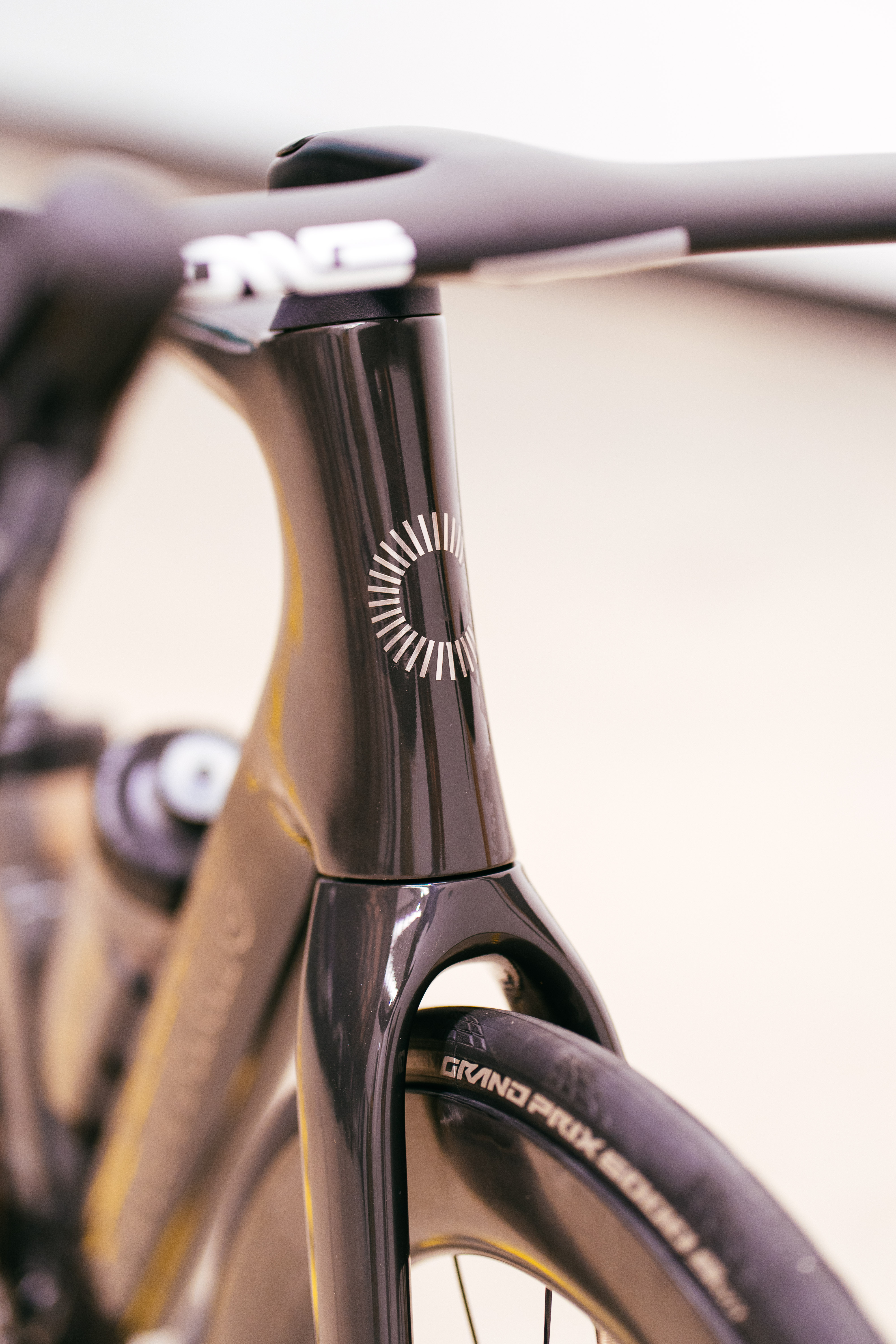
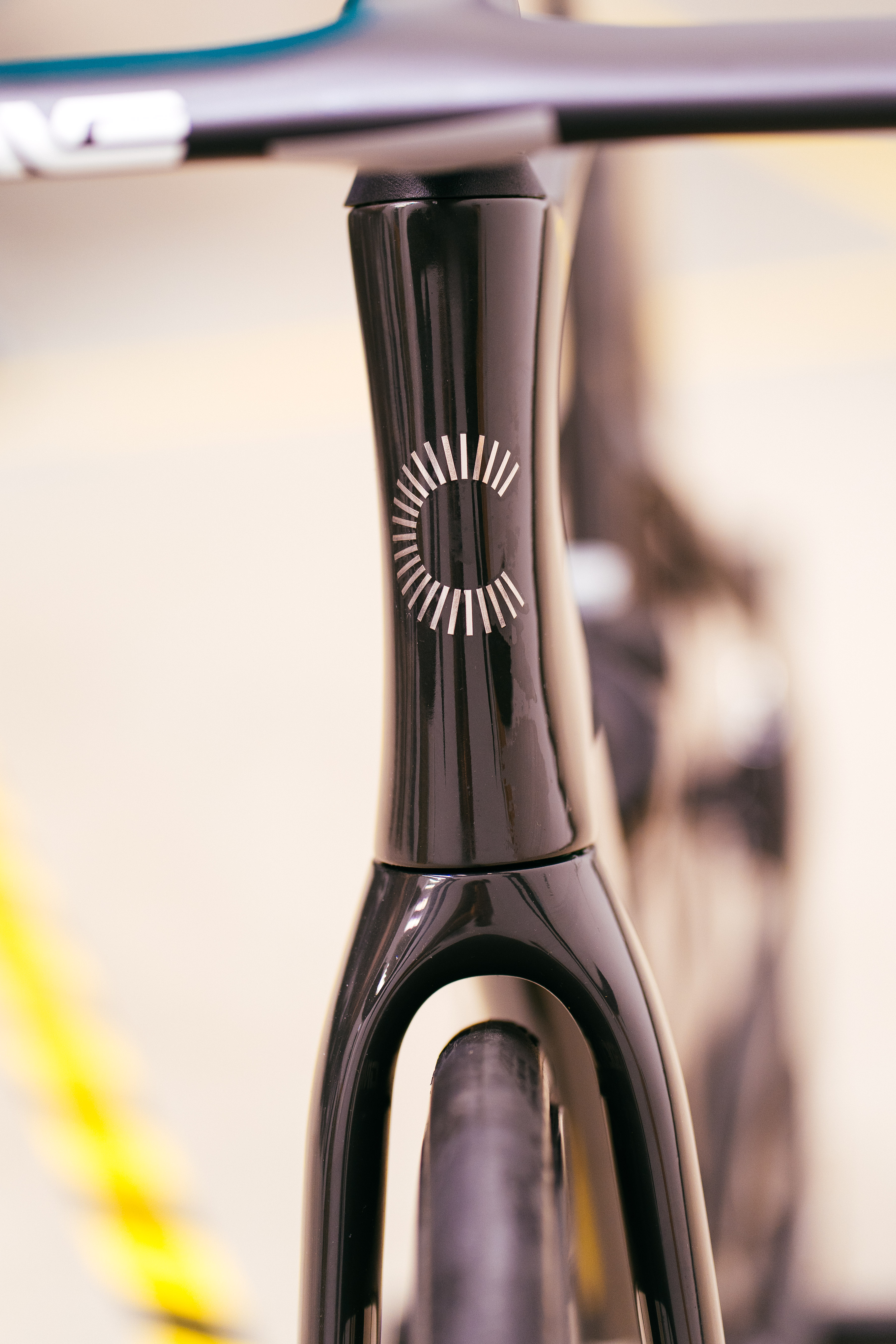
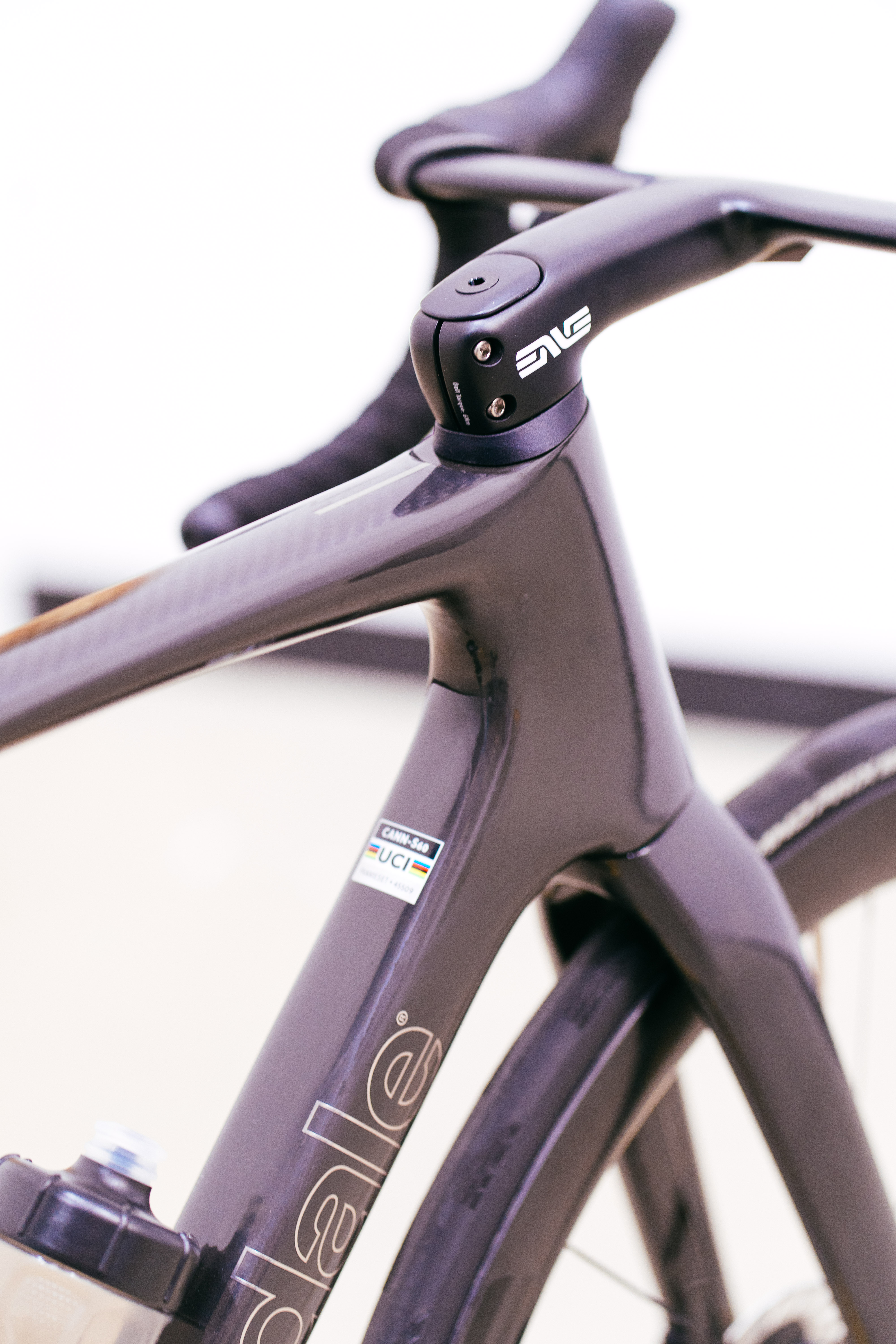
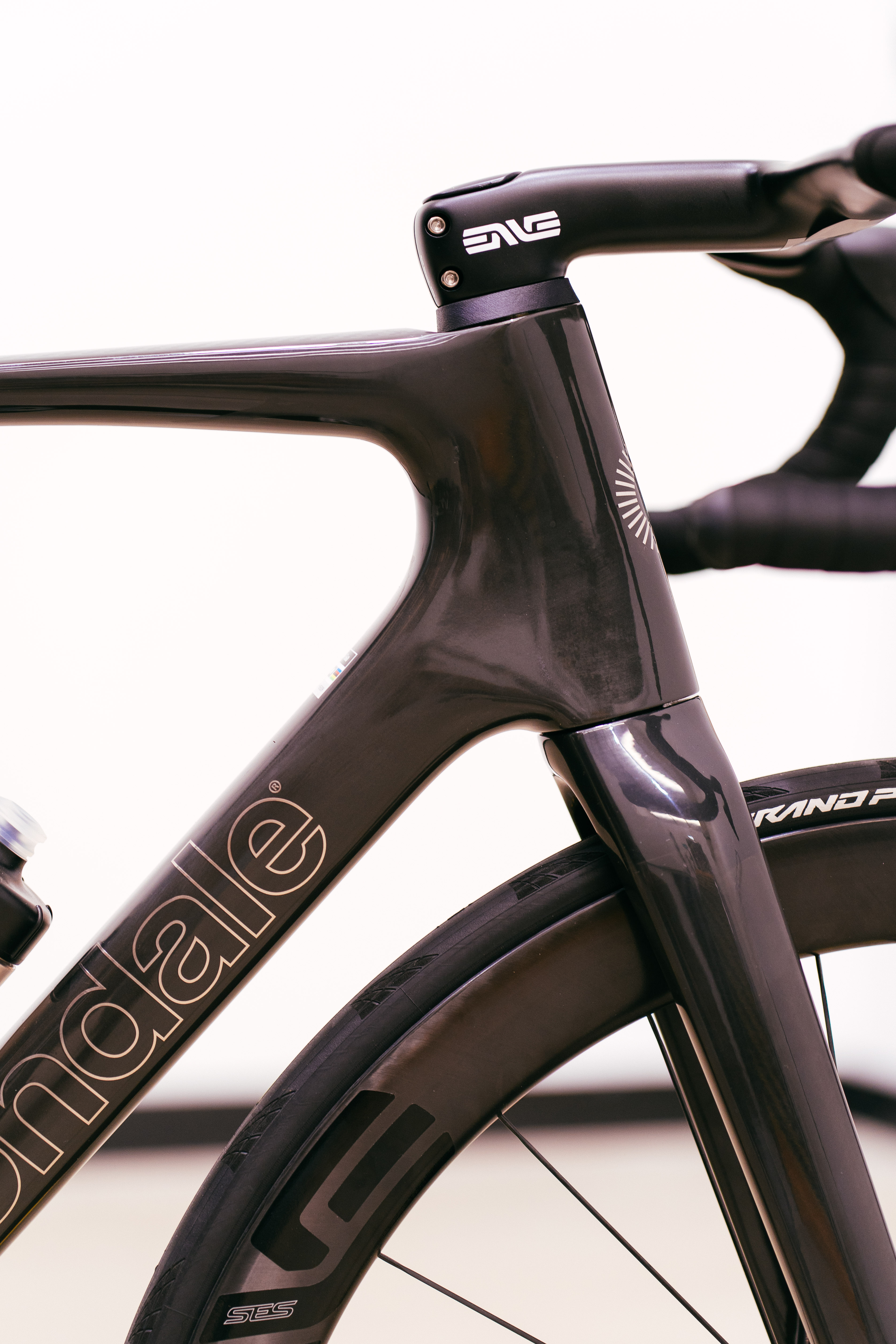
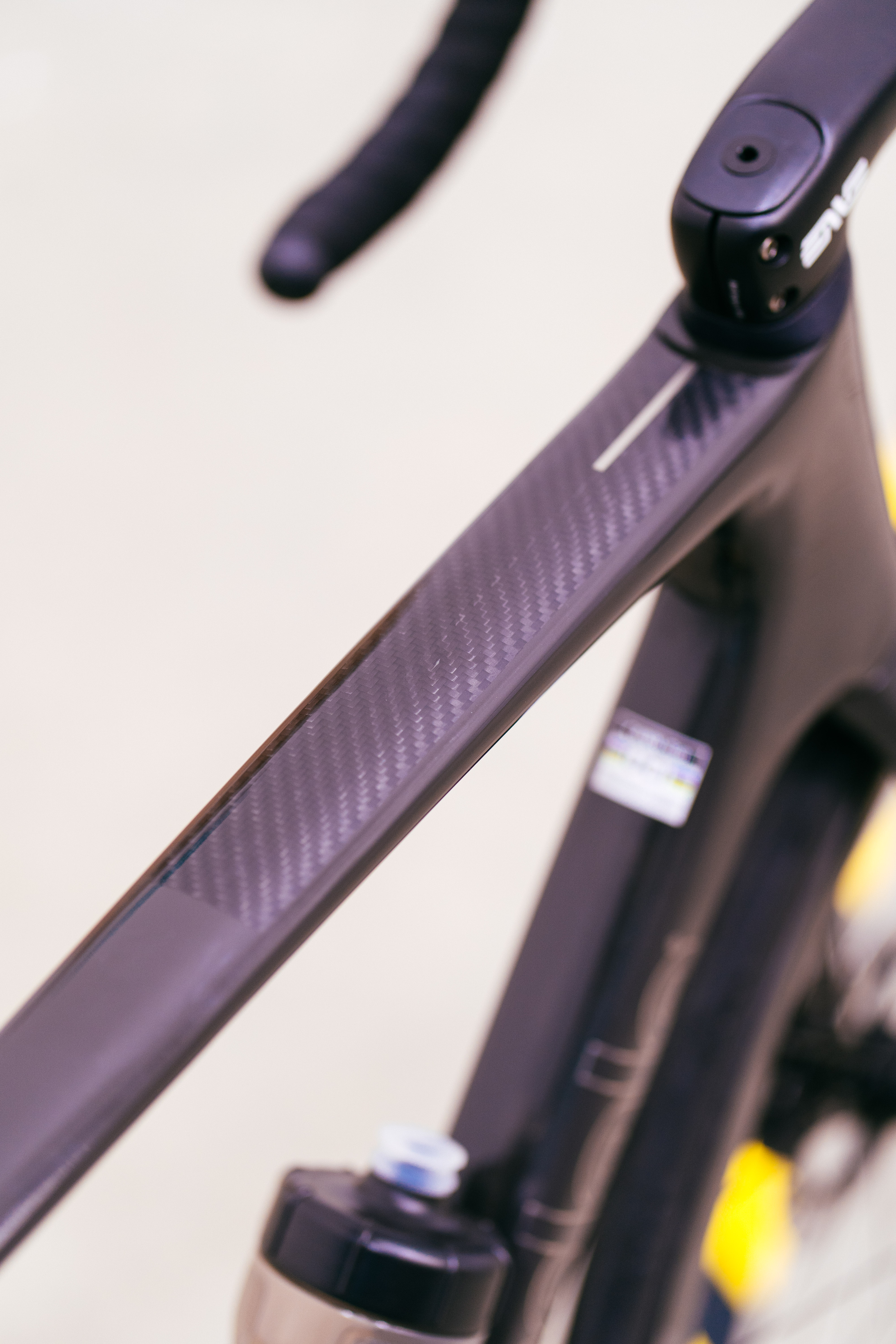
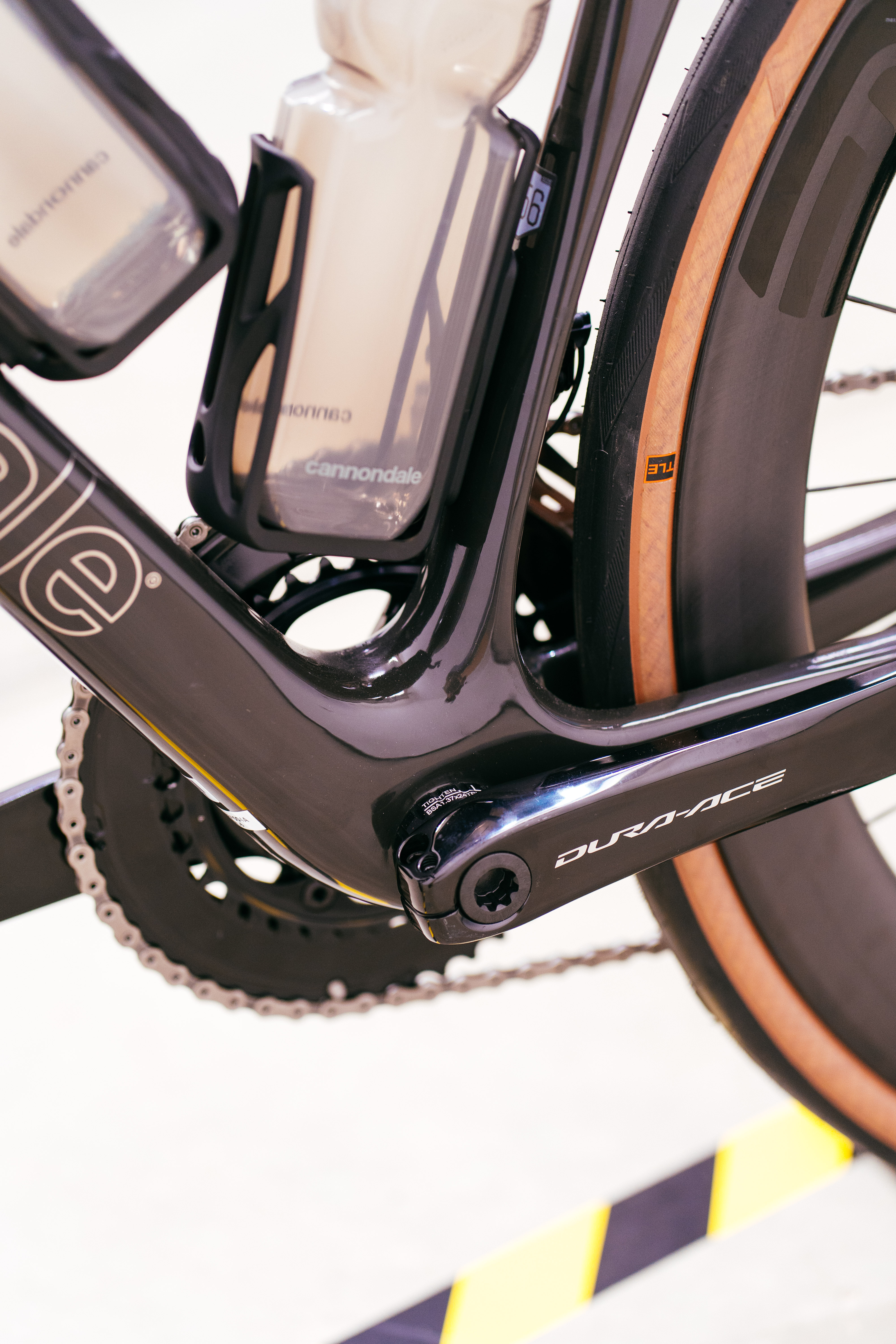
As with the previous generation SuperSix, the semi-integrated bottle cages remain. These house a squared-off bottle which sits nicely in line with the shape of the frame. The cages can also be used with standard bottles to improve versatility.
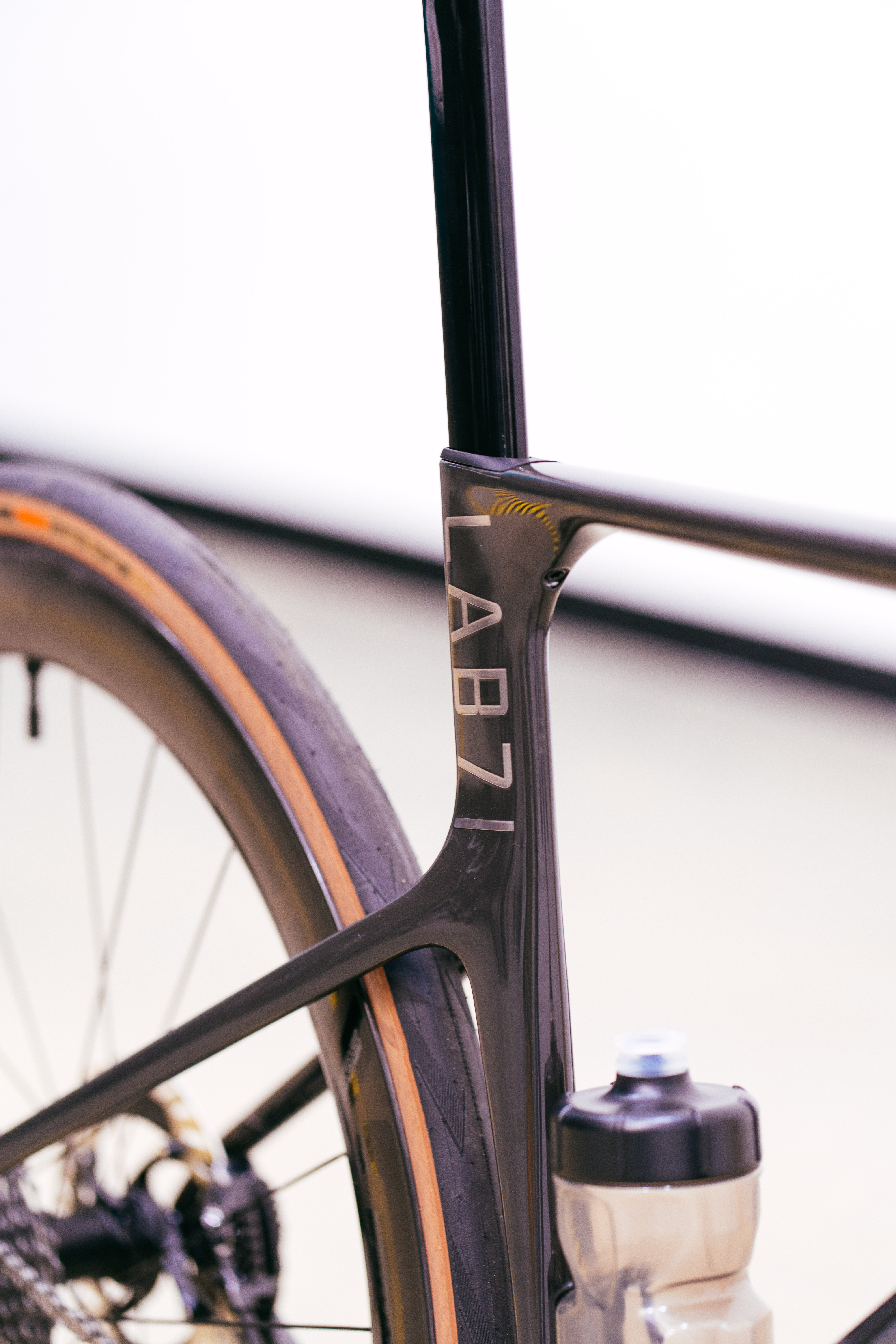
The main differences in terms of aerodynamics come from the seatpost and some deeper tube profiles at the front of the bike. These are both thinner and deeper, aimed to perform better at higher race speeds as bike races get faster and faster. The seatpost is razor thin, looking at it from the front.
This is also part of the updated geometry, with an in-line seatpost rather than the standard setback that used to be supplied. This allows for a more 'over the BB' riding position, which, when paired with the trend of shorter cranks and lower front ends, can help allow for a more aerodynamic position. For our testing, we kept positions as standardised as we could throughout, for fairness.
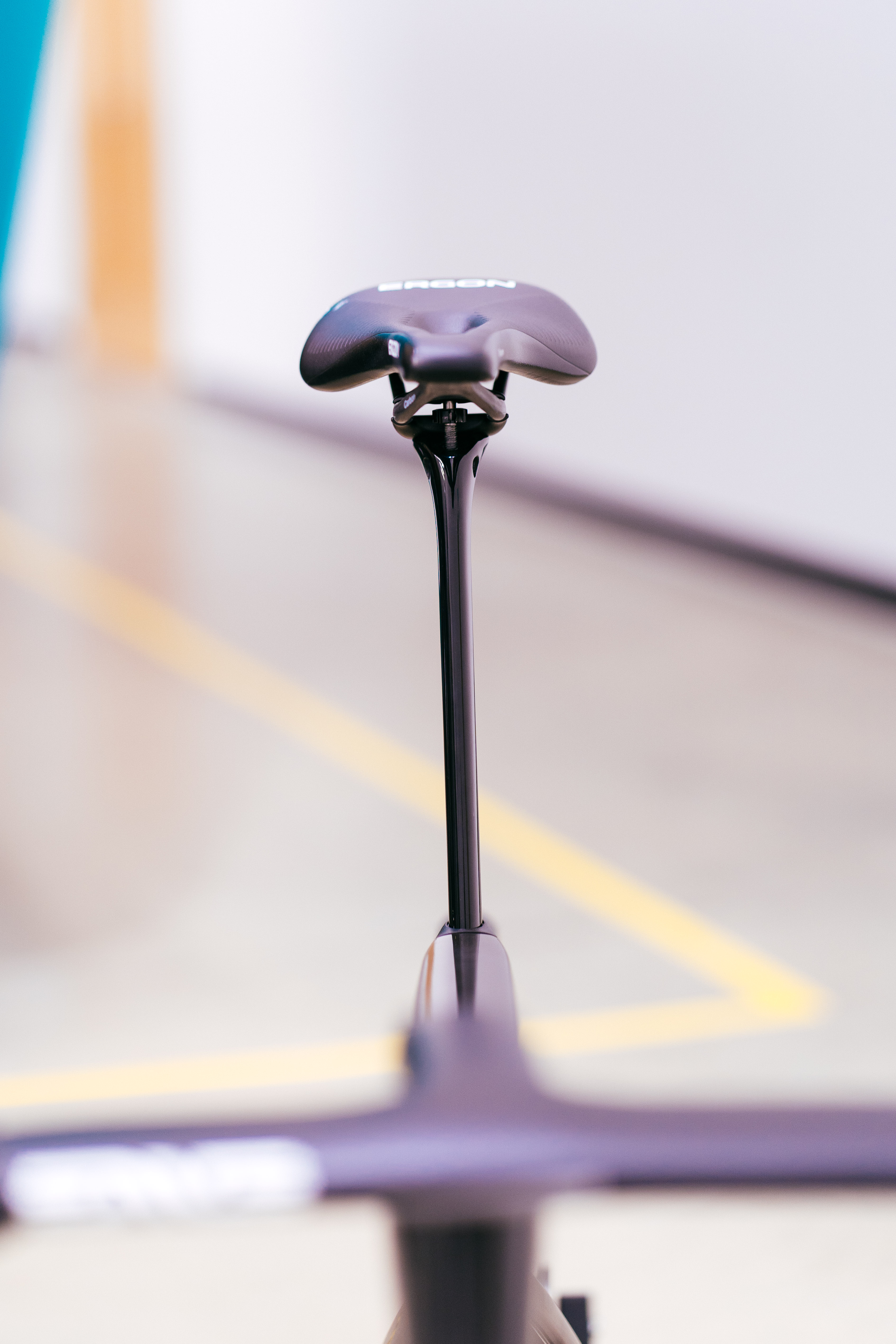
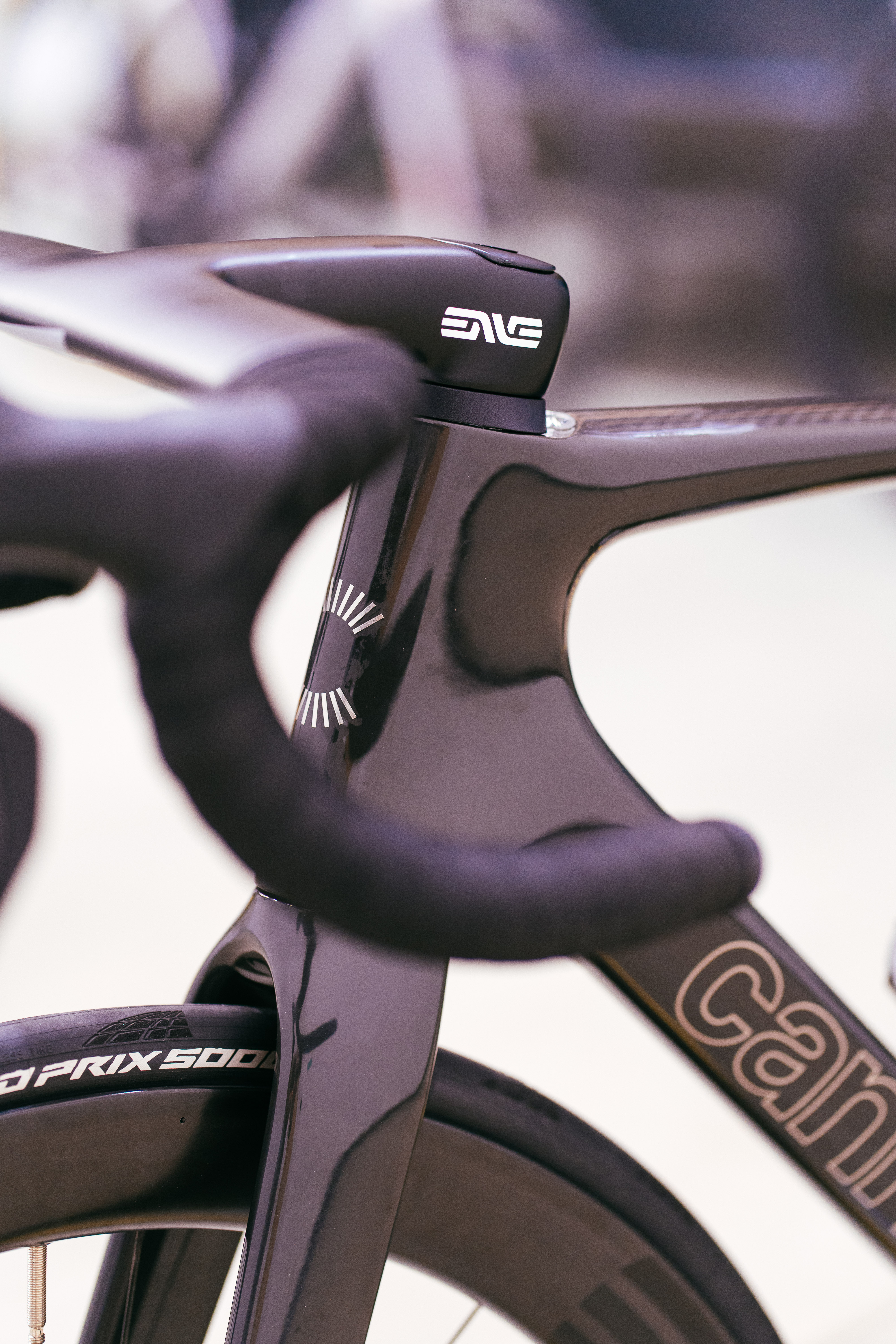
This new bike also features an updated handlebar, as seen recently at races. It forgoes the old rubber bung that used to sit at the rear of the stem, and now looks far more conventional. However, this test bike was supplied with the ENVE SES one-piece bar and stem as used by Team UAE Emirates-XRG.
So far, we don't have any details from Cannondale about the watt savings of this bike versus the previous generation. But given the updated tube profiles, we can expect at least some positive change to the overall drag of this model versus the old one, so let's find out just how much.
The test protocols
For this test, to ensure maximum accuracy and the ability to compare across tests, we followed the same protocol as used in our previous two wind tunnel aero bike tests. Those include the 2024 test, which covered bikes like the S-Works Tarmac SL8, Trek Madone and Canyon Aeroad, and the 2025 test that featured dedicated aero bikes, such as the Cervélo S5, Colnago Y1Rs and Factor ONE.
That means we also took the Cannondale SuperSix Lab71 to the wind tunnel at the Silverstone Sports Engineering Hub, and tested it against our baseline bike, a 2015 Trek Emonda ALR, complete with rim brakes, external cables and round handlebars.
By keeping that baseline bike unchanged between each of our testing days, we're able to quantify the 'delta' – or difference – irrespective of the atmospheric conditions that can affect the results.
And this in turn allows us to compare the delta of the S-Works Tarmac SL8, the Factor ONE, and the Cannondale SuperSix Lab71, despite testing them all on separate days.
To be a tease, we also tested a handful of other bikes on the same day, including the Cinelli Aeroscoop, the Seka Spear, the Enve Melee, X-Lab AD9, and a Felt we can't yet tell you about.
To add to the confidence and completeness of our results, we test each bike in three different ways.
- Bike-only: This offers repeatability and accuracy. You know the results here are as a result of the bike, as there's nothing else in the wind tunnel, but you lose some of the realism, given bikes can't actually pedal themselves.
- With-rider: This adds the realism missing above, but with reduced accuracy, because the ability for a real human to hold an exacting position repeatedly is hard work. We take steps to mitigate, but the variance is still approximately 2-3 watts higher than a bike-only test.
- Bike-only, standardised wheels: This allows an extra test to quantify whether the bike's stock wheels are where the aero benefits actually lie, how well a frame works with another pair of wheels, and quantify the difference between framesets alone, rather than the complete package as sold by each brand.

Each setup was tested at seven different 'yaw angles' – the angle of the wind, to you and me – which spanned from -15° through to +15° in five-degree increments.
We tested at 40km/h, which is the sort of average speed you'll see in an amateur road race, road bike time trials, and longer breakaway days in the pro peloton. For bike-only tests, we ensured the wheels were spinning at the same speed, and for rider-on bike tests, we chose the closest optimal gear and ensured pedalling stayed at 90rpm.
For bike-only tests, we measured for 10 seconds per yaw, while the rider-on tests were captured for longer – 30 seconds – to ensure the results weren't skewed by any accidental movements by the rider.
The wind tunnel, as ever, was tared - like a zero offset on your kitchen scales - before each test.
As per the previous tests, each bike was a 56cm or equivalent frame size, and adjusted to fit as closely as possible to the baseline Trek Emonda ALR, which in turn is fitted to the rider, our Associate Editor, Josh.
With different handlebar widths, different flares of the same width, and then the various geometries of each bike, the position does differ slightly across bikes. The differences here are small enough that we're not concerned that they affect results unfairly.
Each bike was fitted with a 25mm Continental GP5000 S TR front tyre, to ensure the result wasn't unfairly skewed by differences in tyre size. For the test with the Enve wheels, we ran a pair of 28mm GP5000 S TR.
Everything else you can think of was standardised too, including what Josh wore, bottles and cages, the computer mounts, and saddles.
With saddles, we were kindly sent a box full of Ergon SR Women Team saddles, which have exactly the same upper – both in shape and material – for both round and carbon railed versions, meaning we could standardise across all levels of bike today and in future.

A few caveats
We ran multiple repeats of the Trek Emonda ALR to quantify what our repeatability was on the day, which in turn gave us a confidence margin that is applied to the results below.
That margin is as follows:
Error | Bike | Rider |
|---|---|---|
CdA (in M²) | 0.0007 | 0.0034 |
Watts (at 40km/h) | 0.58 | 2.80 |
Our error margin differed slightly on each testing day, which is why the data for some bikes have bigger variances than others when graphed out below.
This and all of our other tests are independent, impartial, and entirely unbiased, and we hire the wind tunnel at the normal commercial rate.
A fair, honest and unbiased protocol is essential to the success of these tests. Even if we could maintain impartiality, you wouldn't trust the result if it were sponsored by Cannondale, so even though we've had multiple requests from various brands (not including Cannondale, for what it's worth), we've rejected them.
Importantly, the data below is merely the result of our day of testing, not the final word on whether the Cannondale SuperSix is a good, bad, fast or slow bike.
We hire a highly respected facility and test as accurately as we can using our set protocol, but we understand that you may see different results under different testing conditions or using different protocols, such as faster test speeds, using mannequins, or testing at different yaw angles.
We also understand that this is just one piece of a much bigger puzzle. Countless other metrics make up a bike's performance, such as stiffness, weight and compliance, and unless you're a pro cyclist, you should also consider how easy it is to live with, service, and how easy the brand is to do business with, in the case of an issue down the road.
The results
Starting with the raw CdA data for each yaw point. This doesn't necessarily give us much to go on in terms of comparing to the industry's competitors, but it's really interesting to see how a bike handles the wind. Some really struggle when the wind angle grows (to become more of a crosswind), and others actually get faster in crosswinds.
We can see, looking at the CdA graph here, just how the Cannondale performs in relation to our 'slow' bike with the Trek Emonda ALR, and our 'fast' bike, the Factor ONE. Whereas the Emonda is affected consistently by the wind, getting draggier the higher the YAW, the Cannondale behaves a bit more like the Factor, although not with the same proper sail effect.
Instead, the Cannondale is fastest at 0˚ YAW, but is better at 15˚ than 10˚. Crosswinds don't have the same detrimental effect on drag as on a round-tubed bike, likely due to the bladed frame profiles assisting in giving a little bit of a sail effect to reduce the negative effect on drag that a more side-on profile creates.
Things get a bit more interesting when a rider is fitted to the bike. The SuperSix at 0˚ YAW performance is, relatively speaking, slower when compared to the Factor, but when the wind angle increases, the Cannondale gets closer to the Factor, and even surpasses it at more extreme yaw angles.
There is some possibility of the Factor suffering a bit of a stalling effect at these extreme wind angles around 15˚ due to the gaps in the frame design around the seat stays and forks. But at the speeds that the bike has been designed around, those yaw angles are unlikely to be experienced, as the faster you go, the closer your effective yaw angle gets to zero degrees.
The Cannondale, though, is still very much an all-rounder sort of bike, similar to the Specialized Tarmac SL8 or the Seka Spear. It is not the out-and-out aero model such as the Factor ONE, Van Rysel RCR-F, or Ridley Noah 3.0. This means it lacks some of those more radical design choices that tend to influence aerodynamic performance, especially at lower yaw angles. Deep frame tubing and integrated frame bottles will have quite an impact on drag.
Also, although the ENVE SES road bars have a flared design, which gives narrower hoods, we carried out the rider-on testing in the drops, which were consistent with the widths used across the other bikes on the whole.
When we look at the bike only testing as a whole with the other bikes we've tested, this latest Cannondale SuperSix does jump up the table into the top half, whereas the previous iteration sat in the second half of the table.
All in all, it offers a saving of 34.79w over the Emonda ALR, 1.46w faster than the previous generation frame, and 5.49w off the leader of the pack, the Factor ONE.
A margin for error still keeps it pretty much in the same position within these charts where a cluster of aero bikes find themselves. But what happens when we place a rider on the bike?
Performance with a rider on the bike drops the Cannondale down the charts slightly, sitting very much dead in the centre. Meanwhile, the previous version plummeted to fifth from the bottom, so in terms of evolution, it's quite a positive step.
It saves 20.75w over the Emonda ALR, but 6.5w down on the Cervélo S5 (2025). Taking the margin for error into account, at best, the Cannondale could be performing similarly to the Seka Spear and Wilier Filante SLR, but it could also drop down as far as the previous SuperSix model.
A rider on the bike does, unfortunately, make it harder to keep things fully consistent, but taking the frame-only results into account as well, the Cannondale SuperSix V5 performs similarly to the previous iteration, so things appear to be consistent.
Interestingly, the bike was supplied with ENVE 4.5 wheels, the same that we use as our control set. What differed, however, were the 25mm tyres fitted to the Cannondale versus the 28mm on our control set. So how did that affect things?
This protocol was only added in 2025, so we don't have data for our 2024 cohort of bikes, including the previous generation SuperSix.
Fitting the 28mm tyre-clad ENVE 4.5 to the Cannondale SuperSix led to an interesting discovery. Wider tyres are more aero, in this case. In total, the addition of wider tyres accounted for a saving of 1.17w against the 25mm clad version.
This is in line with the ENVE 4.5 featuring a wide internal and external width that better suits wider tyres being used, so as to smooth the flow of air from tyre to rim profile. It also works nicely with the updated wider clearance for tyres in this new SuperSix model.
Of course, different wheels perform differently with different frames, but we can attest to the fact that here, the wider tyres make for an aerodynamic improvement.

Conclusions
Of course, this article just looks at the aerodynamic performance of the bikes in the wind tunnel. Many of the updates to the Cannondale SuperSix have focused more on compliance, geometry, weight savings, and clearances. It's very much an evolution rather than a revolution, but that can often be a very good thing.
Cervélo, for example, has evolved the S5 over the years to great effect to make a bike that is both incredibly fast and lightweight, yet impressively compliant. We will have a full review of the new SuperSix to come, where we will dive into these details further.
In terms of aerodynamic performance, this latest iteration is certainly an improvement over the previous generation. A modest one, but an improvement nonetheless. It doesn't take the more radical design approaches that Colnago or Factor have undergone with their latest aero offerings, instead it maintains a rather classic look to be a lightweight bike that has plenty of aero features.

Probably the biggest change to the bike is the razor-thin seatpost, which is somewhat of a semi-setback. This allows for a more forward position so that a rider can more easily get into a more aggressive aero position. We standardised this, of course, but if an aero position is more easily achieved while being comfortable, that is an important performance gain. And although more inline, the seatpost looks to have more compliance built in, a problem that stiff inline posts can suffer from, such as older generation Cervélo S5 models.
Aside from that, it's more a case of don't fix what isn't broken. The semi-aero bottles remain, and much of the frame profiling is very similar, with only minor adjustments to tube depths. From the outside, everything that worked well on the SuperSix remains, while small tweaks have been made to improve areas that required it.
I personally do hope that Cannondale comes back with a radical aero SystemSix rebirth in the future, but as a balance of a lightweight all-rounder with solid aero credentials, the SuperSix does a good job. It does, however, still fall behind the likes of the Specialized Tarmac SL8 and the Seka Spear; both equally lightweight all-rounders that somewhat overperform in the aero category.
You must confirm your public display name before commenting
Please logout and then login again, you will then be prompted to enter your display name.