Date |
August 10, 2024 |
Distance |
221.1km |
Start/Finish location |
Donostia/San Sebastián |
Edition |
45th |
Previous edition |
|
Previous winner |
Giulio Ciccone (Lidl-Trek) |
Start time |
11:05 |
Estimated finish |
16:45 |

Donostia San Sebastián Klasikoa 2026
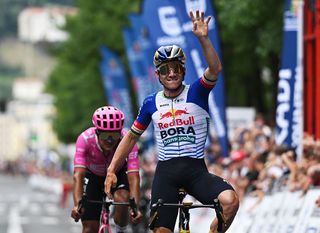
Remco Evenepoel (Red Bull-Bora-Hansgrohe) has claimed a record fourth victory at Donostia San Sebastian Klasikoa, outsprinting late-race breakaway companion Richard Carapaz (EF Education-EasyPost) at the finish line in San Sebastián. The Olympic champion recovered from an untimely mechanical to claim the record for the most wins.
Donostia San Sebastián Klasikoa 2026 information
The 45th edition of the Donostia San Sebastián Klasiko, previously known as the Clásica San Sebastián in Spanish, takes place on Saturday August 1, 2026, marking a crossroads and reboot in the racing season as some riders end a summer campaign after racing the Tour de France and others intensify their racing with the one-day WorldTour race.
Remco Evenepoel has won three times in 2019, 2022, 2023, and holds the record for most wins alongside Marino Lejarreta. Other big-name winners include Philippe Gilbert, Paolo Bettini, Davide Rebellin and Alaphilippe.
As per tradition, the winner of the Donostia San Sebastián Klasiko will be awarded a special Basque txapela beret.
In 2024 Marc Hirschi outsprinted Julian Alaphilippe to win the Donostia San Sebastián Klasikoa, the duo escaping on the final climb of Pilotegi, a new climb added to the 2024 Basque race.
In 2025, around 15% of the 2025 San Sebastián field also rode the Tour de France with Quinn Simmons (Lidl-Trek), 2024 winner Marc Hirschi (Tudor Pro Cycling), Romain Grégoire (Groupama-FDJ) and Lenny Martinez (Bahrain Victorious) all in action.
However Giulio Ciccone (Lidl-Trek) returned triumphantly to racing after his injuries at the Giro d'Italia to win with style.
He survived the attacks on the final climbs, paced his ride and so emerged as the strongest rider on the day, then going solo on the final climb of Murgil-Tontorra.
Jan Christen (UAE Team Emirates-XRG) finished second and Maxim Van Gils (Red Bull-Bora-Hansgrohe) was third in the one-day WorldTour race.
Clasica San Sebastian start list
Donostia San Sebastián Klasikoa 2026 route

The San Sebastián Classic takes riders on a 221.1 kilometre journey around Donostia/San Sebastián between three different loops. The first is a large circuit to the west that covers half the race before returning to the city centre after 141.5km.
In the initial lap there are four significant climbs - the Kalbario (category 3 - 2.2km at 8%), Azkarate (category 3 - 4.2km at 7.3%), Urraki (category 2 - 8.6km at 6.2%) and Alkiza (category 3 - 4.4km at 6.2%).
The second 62.1km lap takes riders to the east to tackle two tough ascents, the Jaizkibel (category 2 - 7.9km at 5.6%) and Erlaitz (category 1 - 3.8km at 10.6%), where the elite selections are normally made.
The race concludes with a 17.6km short lap, taking on the category 2 Murgil (2.1km at 10.1%) with 8.2km to go.
With the final selection made, whoever is left - usually a very small number - have a flat run-in to the finish line after a fast descent.
Donostia San Sebastián Klasikoa history
The one-day Spanish WorldTour race was first held in 1981 and still starts and finishes overlooking San Sebastián sandy beaches. The route includes a series of classic steep Basque climbs, that are traditionally packed with screaming fans.
The climbs of Jaizkibel and Erlaitz usually shape the race – which this year packs in seven classified climbs and 4,150m of cumulative elevation gain – before final attacks are launched on the steep ascent of Murgil-Tontorra (2km at 9.6%) with less than 10km to go.
If a small group stays together, they will sprint for victory on the Boulevard Donostia, near where the Tour de France stage finished in 2023 when Victor Lafay attacked late to hold off Wout Van Aert.
The early climbs always spark a selection with the Jaizkibel (7.9 km at 5.5%) now coming after 150km.
It is followed by the steep Erlaitz (3.8 km at 10.6%) that ends with 40km to race.
A long descent leads the riders for the final climb, the Murgil Tontorra (2.1 km at 9.6%). The final kilometre is at 14% and the finish less than 10km away. This is the place were solo attacks will be made and the cheering Basque fans at their thickest.
-
Donostia San Sebastian Klasikoa1 August 2026 | San Sebastian | WorldTour